
Oil Spill Consequences and Cleanup Technologies
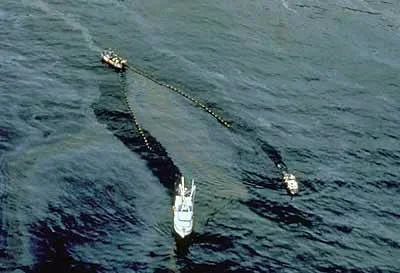 Figure 1. Oil being skimmed from the sea surface in Prince William Sound, AK.Copyright NOAA http://response.restoration.noaa.gov/photos/exxon/10.html
Students explore an important role of environmental engineers—cleaning the environment. They learn details about the Exxon Valdez oil spill, which was one of the most publicized and studied human-caused environmental tragedies in history. Then, in the associated activity, students experiment with many "engineered" strategies to clean up their own manufactured oil spill and learn the difficulties in dealing with oil released into our waters.
When oil spills occur, environmental engineers help clean them up. They determine which type of cleanup method is best for different situations by examining the weather patterns of the area, the type of oil spilled, and what living creatures and natural environments are being affected by the spill. Their efforts, plus those of many rescue workers, help restore habitat after such a disaster occurs.
After this lesson, students should be able to:
- Explain an oil spill in terms of density of a liquid.
- Relate oil spills to an environment's ability to provide food, water, space and essential nutrients for its inhabitants.
- Describe one oil spill event in history and use numbers to understand the magnitude of the spill.
- Describe some technologies used by environmental engineers to cleanup oil spills.
- 7.1.2.c Solve real-world and mathematical problems involving the four operations with rational numbers.
Grade 7
Do you agree with this alignment? - 6.1.1.c Use ratio and rate reasoning to solve real-world and mathematical problems.
Grade 6
Do you agree with this alignment?
- Identify problems, and propose solutions related to water quality, circulation, and distribution – both locally and worldwide
Grade 6
Do you agree with this alignment? - Identify the various causes and effects of water pollution in local and world water distributions
Grade 6
Do you agree with this alignment?
- CCSS.Math.Content.6.NS.B.2 Fluently divide multi-digit numbers using the standard algorithm.
Grade 6
Do you agree with this alignment? - CCSS.Math.Content.6.RP.A.3d Use ratio reasoning to convert measurement units; manipulate and transform units appropriately when multiplying or dividing quantities.
Grade 6
Do you agree with this alignment?
- STEL-7S Create solutions to problems by identifying and applying human factors in design.
Grades 6-8
Do you agree with this alignment?
- CCC.8.6-8.12 All human activity draws on natural resources and has both short and long-term consequences, positive as well as negative, for the health of people and the natural environment.
Grades 6-8
Do you agree with this alignment?
An understanding of the concept of density.
Exxon Valdez: What happened?
At 9:12 PM on March 23, 1989, the Exxon Valdez departed from Prince William Sound, Alaska, with several people in charge of the ship. The pilot, captain and the helmsmen all were responsible to steer the 986-foot ship—carrying 53,094,510 gallons of oil—through the Valdez Narrows. Navigating through the Valdez Narrows is exceptionally challenging because of the Bligh Reef, which makes the narrows just 500-feet wide.
That night, the Exxon Valdez came across icebergs, so the captain ordered the helmsmen to turn the ship out of the shipping lanes and around the icebergs. Later that evening the wheelhouse was turned over to the third mate and a different helmsman. They were given specific instructions to turn the ship back into the shipping lanes at a certain point to avoid the reef. However, due to reasons unknown, the helmsmen did not steer the vessel back to the channel, and at 12:04 AM on March 24, the Exxon Valdez ran aground on Bligh Reef, spilling 10.8 million gallons of oil into Prince William Sound.
It was unclear who was at fault, but was likely some type of human error. Later investigations charged the captain with negligent discharge of oil. He was ordered to pay a $50,000 fine and give 1000 hours of community service. The Exxon Shipping Company continued operations under a new name, Sea River Shipping Company. The Exxon Valdez was repaired and renamed the Sea River Mediterranean, and prohibited from entering Prince William Sound. In 2012, the ship was sold for scrap metal in India.
Effects of the Spill
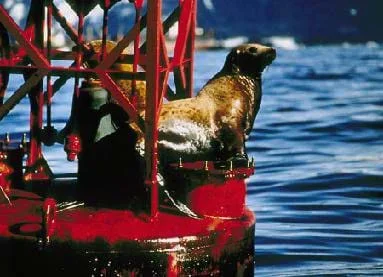 Figure 3. An oil-covered sea lion in Prince William Sound, AK.Copyright Geoffrey Orth, Exxon Valdez Oil Spill Trustee Council (EVOSTC) http://wilderness.org/blog/my-one-man-boycott-exxon.
It is estimated that 10.8 million gallons of oil leaked from the Exxon Valdez—enough oil to fill 125 Olympic-sized swimming pools. The spill is the largest ever in the U.S. Oil covered about 1,300 miles of shoreline, with 200 miles heavily covered and 1,100 lightly covered. The impact of an oil spill of this magnitude is tremendous. Exxon paid $2.1 billion to clean up the spill, but the effects are still being felt today. The ecological impacts are impossible to know because the effects last a long time. It is estimated, however, that the oil spill killed 250,000 seabirds, 2,800 sea otters, 300 harbor seals, 250 bald eagles 22 killer whales and billions of salmon and herring eggs. Ten years later, only two of the 23 species injured by the spill have recovered.
Cleanup
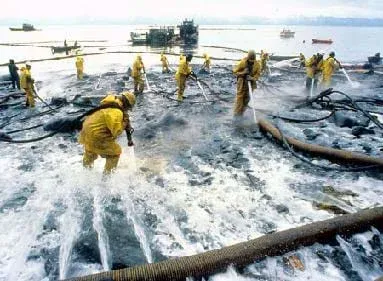 Figure 4. Cleanup workers spray oiled rocks with high pressure water after the Exxon Valdez oil spill.Copyright Al Grillo, Exxon Valdez Oil Spill Trustee Council http://www.evostc.state.ak.us/facts/photos09.html
During cleanup of the Exxon Valdez oil spill, environmental engineers developed methods that could prove helpful in similar large disasters. They tried traditional mechanical methods: backhoes to sift through sand covered with oil-soaked soil and high pressure hot and cold water treatments to wash the oil off the shore to be scooped up by skimmers or adsorbed by adsorbent material. Additionally, they used the uncommon method of bioremediation: adding fertilizer to the beaches to promote the growth of bacteria that can degrade the oil. During the Exxon Valdez oil spill clean up, environmental engineers learned a lot and optimized many processes. The use of bioremediation, for example, was not commonly used before this oil spill, and now is used for many different applications. Conversely, the use of hot water treatment was very common before this oil spill. However, during the Valdez cleanup, they found that hot water did more damage then good, because it harms the small water organisms. Now have students conduct the design based associated activities Small-Scale Modeling of Oil Spill Cleanup Methods and Modeling Oil on the Ocean: Testing & Improving Oil Booms to simulate the impact of oil spills and brainstorm ways to improve the clean up process in the future.
(Be ready to show a simple class demonstration with four liquids and a graduated cyllinder, as described below.)
The Exxon Valdez oil spill was one of the largest oil spills in history. It took place in Alaska in March 1989 when an oil tanker ran aground, spilling 10.8 million gallons of crude oil into Prince William Sound. While this was a huge spill, it was only a small fraction of what the U.S. uses in oil in any one day. The U.S. uses about 700 million gallons of oil every day. That is a lot of oil—enough to completely fill nine school gymnasiums!
How do we use oil? (Answer: To operate cars and other methods of transportation; to run our electrical power plants; for lubrication, for things such as bicycles and doors; to make paint and varnishes; to make all sorts of plastics; and to run machinery, among other things.) Often, oil spills are caused by human mistakes. Sometimes, they happen during natural weather disasters, such as when a hurricane destroys oil mining equipment or oil tankers; other times, they occur when large industry machinery breaks down. Unfortunately, spills are sometimes caused by deliberate acts, such as citizens dumping oil illegally or even during times of conflict (war) as a means of sabotage.
Several oil characteristics make oil spills very dangerous and difficult to clean up. One important quality of oil is that it is less dense then water, which means it floats in water. (DEMO: To motivate students to observe and estimate densities of several different liquids, have four students volunteer to stand join you at the front of the classroom and pour equal quantities of the following liquids into one graduated cylinder: water with food coloring, corn syrup, light vegetable oil and rubbing alcohol. Have students rate the liquids from most dense to least dense. Answer: In the cylinder from bottom/most dense to top/least dense: corn syrup, dyed water, vegetable oil, rubbing alcohol; remember that oil floats on water.)
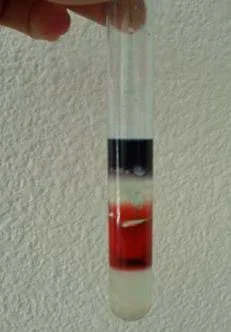 Figure 2. Layers of Karo® corn syrup, red-dyed water, vegetable oil and rubbing alcohol (dyed).Copyright 2004 Malinda Schaefer Zarske, Integrated Teaching and Learning Program, College of Engineering and Applied Science, University of Colorado Boulder
When an oil spill occurs, environmental engineers work to help clean it up. Have you ever noticed a rainbow puddle on the street or parking lot after a rain? That rainbow sheen that you see on top of the water is oil from vehicles that has leaked onto the ground. Environmental engineers are responsible for assessing what type of cleanup method is best for different situations. They examine the weather patterns of the area, the type of oil that was spilled, and what living creatures are, or will be, affected by the spill. They consider the nearby community and the population of plants or animals in the area. Some of the methods engineers use are dispersants (chemicals used to break down the oil); booms and skimmers (used to contain the oil and avoid spreading); absorbents and vacuum cleaners; burning the oil; and biodegradation (the use of microorganisms that digest oil). Today, we are going to act as if we are environmental engineers and learn how these different techniques can be used to clean up oil spills.
Today we looked at the cleanup of oil spills—in particular, the 1989 Exxon Valdez oil spill. We remembered that oil is less dense than water and therefore floats on the water, harming the organisms that need that water source to live. Environmental engineers are often employed to help clean up oil spills and improve a polluted environment so that it is once again able to provide food, water, space and essential nutrients for its population of plants and animals. As citizens, we can help prevent some oil-related problems by using less oil in our daily lives, whenever possible.
(After conducting the associated activity, discuss with students the effectiveness of cleaning up oil spills.) How effective are our efforts to clean up oil spills? After trying to contain, clean, dissolve or remove the oil spill with the various utensils and "chemicals," did you ever achieve a pristine environment? (Answer: Probably not.) Is it better to use more than one technology to clean up oil spills? (Answer: Usually, yes.) What are some ideas you have for helping to clean up oil spills? (Answers will vary.)
(If time permits, have students compare methods they used to clean up their model oil spills with the methods currently used to clean up real-world oil spills.) Help me describe and then compare the following methods: dispersants (chemicals used to break down the oil) to soap; booms and skimmers (used to contain the oil and avoid spreading) to pieces of thread and cotton balls; absorbents and vacuum cleaners to paper towels and pipettes; and burning the oil to using matches.
- biodegradation
- The use of microorganisms that digest oil as a means of cleaning up oil spills.
- bioremediation
- Adding fertilizer to oil-covered beaches to promote the growth of bacteria that can degrade the oil.
- dense
- Being crowded closely together; being compact.
- density
- The mass per unit volume of a substance.
- dispersant
- A chemical used to break down oil.
- solubility
- The ability or tendency of one substance to dissolve into another at a given temperature and pressure; generally expressed in terms of the amount of solute that dissolves in a given amount of solvent to produce a saturated solution.
Pre-Lesson Assessment
Brainstorming: As a class, have students engage in open discussion. Remind them that in brainstorming, no idea or suggestion is "silly." All ideas should be respectfully heard. Take an uncritical position, encourage wild ideas and discourage criticism of ideas. Write their ideas on the board.
- What do environmental engineers do? Name one thing. (Have each student write an answer on a piece of paper. Then go around the room and ask each student to give an answer. List all the ideas on the board, creating categories of similar ideas, as makes sense. Example answers: Clean up oil spills, track down the sources of air and water pollution, protect the environment, treat drinking water, design landfills, and treat waste water.)
Discussion Question: Lead an informal discussion by asking students the following question. Record their answers and ideas on the classroom board.
- In March 1989, nearly 11 million gallons of crude oil spilled from a ship into Prince William Sound in Alaska. What are the possible effects of a massive oil spill like this?
Post-Introduction Assessment
Question/Answer: Ask students the following questions to determine their understanding of the Exxon Valdez oil spill.
- Where did the oil spill occur? (Answer: Prince William Sound, Alaska.)
- What were the main environmental effects of the oil spill? (Answer: It killed more than 250,000 seabirds, 2,800 sea otters, 300 harbor seals, 250 bald eagles, up to 22 killer whales, and billions of salmon and herring eggs.)
Math Problem: Ask students to calculate how many classrooms the spilled oil from the Exxon Valdez oil spill would fill if each classroom is 20 x 20 x 10 feet. (Answer: We know that 10.8 million gallons of oil spilled in the Exxon Valdez oil spill. 7.4805 gallons = 1 cubic foot. 10.8 million gallons = ~1,443,753 cubic feet or ~361 classrooms that are each 20 x 20 x 10-feet (4,000 cubic feet volume).
Lesson Summary Assessment
Persuasion Papers/Oral Defense: Engineers are often required to explain their point of view to companies, communities and conference attendees. Have students defend the position of an environmental engineer with regard to pollution in a one-page persuasive piece. Require them to explain the jobs environmental engineers perform, the sources of pollution and why pollution is harmful to the environment. If time, have them explain their position orally.
Community Debate: Have students write/perform a short play or debate about the lesson topic. Make the setting a town meeting about a relevant issue. The people present are an environmental engineer, oil company owner, oil tanker captain, local politician and various citizens. The scenario is a large oil tanker spill in the nearby marina or lake.
This lesson provides an opportunity to introduce or review a variety of concepts including solubility, density and biological effects of pollution. Some additional discussion questions include: Why did the oil and water not mix? How can we keep the oil from washing onto beaches? What was produced when oil burned? How could the air be polluted? What would happen if the oil had been denser than water? What are some dangers of a large oil spill, such as the Exxon Valdez spill?
Ask students if they know how an oil spill in a neighboring body of water will impact the economy of a country. Have students research a few of the more recent oil spills in the world and their resulting economic impacts.
Assign students to estimate the relative and exact densities of each liquid used in the demonstration during the Introduction/Motivation section.
Exxon Valdez Oil Spill Trustee Council. http://www.evostc.state.ak.us/
Office of Response and Restoration, National Ocean Service, National Oceanic and Atmospheric Administration (NOAA). http://response.restoration.noaa.gov/
- Environmental Engineering
- Oil Spill Consequences and Cleanup Technologies
- How Clean is that Water?
- An Underground River
- Who's Down the Well?
- Landfills: Building Them Better
- You Are What You Drink!
- The Air We Breathe
Contributors
Sharon D. Perez-Suarez; Melissa Straten; Malinda Schaefer Zarske; Janet Yowell
Supporting Program
Integrated Teaching and Learning Program, College of Engineering, University of Colorado Boulder
Acknowledgements
The contents of this digital library curriculum were developed under grants from the Fund for the Improvement of Postsecondary Education (FIPSE), U.S. Department of Education and National Science Foundation (GK-12 grant no. 0338326). However, these contents do not necessarily represent the policies of the Department of Education or National Science Foundation, and you should not assume endorsement by the federal government.
Copyright
2005 by Regents of the University of Colorado