
Stream Consciousness
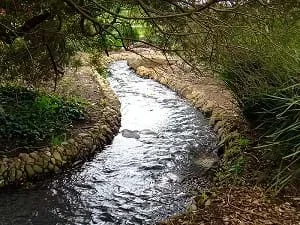 Students become stream consciousnessCopyright Wikimedia Commons http://commons.wikimedia.org/wiki/File:Urban_stream_in_park.jpg
During this activity, students learn how environmental engineers monitor water quality in resource use and design. They employ environmental indicators to assess the water quality of a nearby stream. Students make general observations of water quality as well as count the number of macroinvertabrates. They then use the information they collected to create a scale to rate how good or bad the water quality of the stream. Finally, the class will compare their numbers and discuss and defend their results.
Environmental engineers monitor water quality in resource use and design. They use environmental indicators to assess the water quality of streams, rivers, ponds, lakes and oceans. Building dams or factories near water affects the water quality. Environmental engineers determine the magnitude of these impacts and steps to take to mitigate them.
After this activity, students should be able to:
- Identify and measure important water quality parameters that engineers use, such as temperature and pH.
- Identify aquatic insects that can be indicators of poor water quality.
- Create a rating tool to measure the water quality of the stream.
- Understand why engineers are concerned about water quality and its affects on water resources.
- 6.3.1.d.ii.2 Describe the nature of the attribute under investigation, including how it was measured and its units of measurement.
Grade 6
Do you agree with this alignment?
- Interpret and analyze data about changes in environmental conditions – such as climate change – and populations that support a claim describing why a specific population might be increasing or decreasing
Grade 6
Do you agree with this alignment?
- CCSS.Math.Content.7.EE.B.4 Use variables to represent quantities in a real-world or mathematical problem, and construct simple equations and inequalities to solve problems by reasoning about the quantities.
Grade 7
Do you agree with this alignment?
- STEL-3D Explain how various relationships can exist between technology and engineering and other content areas.
Grades 3-5
Do you agree with this alignment?
- MS-ESS3-3 Apply scientific principles to design a method for monitoring and minimizing a human impact on the environment.
Grades 6-8
This resource focuses on the following Three Dimensional Learning aspects of NGSS:
Science & Engineering Practices- Apply scientific principles to design an object, tool, process or system.Do you agree with this alignment?
Disciplinary Core Ideas- Human activities have significantly altered the biosphere, sometimes damaging or destroying natural habitats and causing the extinction of other species. But changes to Earth's environments can have different impacts (negative and positive) for different living things.Do you agree with this alignment?
Crosscutting Concepts- The uses of technologies and any limitations on their use are driven by individual or societal needs, desires, and values; by the findings of scientific research; and by differences in such factors as climate, natural resources, and economic conditions. Thus technology use varies from region to region and over time.Do you agree with this alignment?
- Relationships can be classified as causal or correlational, and correlation does not necessarily imply causation.Do you agree with this alignment?
Do you agree with this alignment? - Apply scientific principles to design an object, tool, process or system.
- MS-ETS1-1 Define the criteria and constraints of a design problem with sufficient precision to ensure a successful solution, taking into account relevant scientific principles and potential impacts on people and the natural environment that may limit possible solutions.
Grades 6-8
This resource focuses on the following Three Dimensional Learning aspects of NGSS:
Science & Engineering Practices- Define a design problem that can be solved through the development of an object, tool, process or system and includes multiple criteria and constraints, including scientific knowledge that may limit possible solutions.Do you agree with this alignment?
Disciplinary Core Ideas- The more precisely a design task's criteria and constraints can be defined, the more likely it is that the designed solution will be successful. Specification of constraints includes consideration of scientific principles and other relevant knowledge that is likely to limit possible solutions.Do you agree with this alignment?
Crosscutting Concepts- The uses of technologies and any limitations on their use are driven by individual or societal needs, desires, and values; by the findings of scientific research; and by differences in such factors as climate, natural resources, and economic conditions.Do you agree with this alignment?
- All human activity draws on natural resources and has both short and long-term consequences, positive as well as negative, for the health of people and the natural environment.Do you agree with this alignment?
Do you agree with this alignment? - Define a design problem that can be solved through the development of an object, tool, process or system and includes multiple criteria and constraints, including scientific knowledge that may limit possible solutions.
Each group should have:
- 1 copy of each of the three Macroinvertebrate Identification Sheets (or you may print one or two copies for groups to share)
- 1 copy of the Stream Consciousness Worksheet (PDF)
- 1-liter bottle (of water sample)
- Trays or petri dishes or bowls in which student may observe samples
- 1-2 magnifying glasses or dissecting microscope (if already available)
- Thermometer
- Optional: pH paper or meter (neutral water: pH = 7)
Why might environmental engineers be concerned with the health of a stream? Would the stream be a possible source of drinking water for the community? Might the stream flow into a community water source? Engineers are interested in the water quality and health of a stream for conservation, restoration and resource use (fishing, recreation and drinking water).
How might an engineer be able to tell if a stream is healthy or not? How can they determine the water quality of a stream or pond? (Possible answers: looking, smelling, testing the chemistry) What are some visible indicators of stream health? (Possible answers: clear water, healthy plant growth surrounding/in the water, macroinvertebrates, presence of fish) What would good water quality look like? (Possible answers: clear or even, crystal clear) What are some indicators of bad water quality? (Possible answers: visible pollution or murkiness).
A macroinvertebrate is an organism without a backbone that can be seen with the human eye (e.g., flies, worms, larvae). Macroinvertebrates are creatures that can be sensitive to pollution. They are good indicators of water quality because they live in or near water most of their lives. They are also fairly easy to collect and observe. Engineers often use macroinvertebrates as indicators of water quality and health.
Before the Activity
For this activity, access to a stream, creek or pond is required. There are two options of obtaining samples for this activity: as a class, walk to a stream to collect a sample or have just one adult get the stream sample in advance. (Note: A 1-liter sample of stream, creek, or pond water for each student group should be acquired). The water samples are best if a rock, covered in dirt and debris, or a slimy stick from the stream bottom is included in each.
This activity is written with the assumption that students will walk to a stream, but it can easily be used for already-prepared samples.
Print out (and consider laminating) the three Macroinvertebrate Identification Sheets – Groups 1 (PDF), 2 (PDF) and 3 (PDF) (see Attachments) for students to share to identify their water life.
With the Students
- Ask the students the following question: "How can we determine if a stream is healthy or not?" Tell them that this is the question they are going to answer today. There are many possible answers, and we are going to explore some methods used by engineers to help us come up with a solution.
- Divide students into groups of 4. Each group should take a water sample (about a half liter) from the stream in a jar or tub. Try to include at least one rock —covered with dirt and debris — in each sample.
- Ask students to use the thermometer to determine the temperature of the water sample and record on their Stream Consciousness Worksheet.
- Then, they should use the pH tester or pH paper to determine the pH of the water and record on their Stream Consciousness Worksheet.
- Have students record on the activity sheet any other observations or physical characteristics of the water (odor, color, what things are floating or sinking in your sample).
- Next, ask students to pour a small amount of their water sample onto a petri dish or tray for observation. Using the macroinvertebrate identification chart and a dissecting microscope or magnifying glass, they should identify as many macroinvertebrates in the sample as possible. Have them list on the Stream Consciousness Worksheet which invertebrates and how many of each are found.
- Student should then take another small amount of their sample and continue counting and identifying macroinvertebrates until they have examined the entire sample. Note: students do not need to count more than 150 invertebrates.
- Have students count how many of each different kind of macroinvertebrate are found in their sample and write down whether they think their sample indicates good, medium or bad water quality and why.
- Have the students create their own "rating scale" to determine the biotic index of the water. Example: for "good" invertebrates, assign a value of 10 point to each. For "bad" invertebrates, assign a value of 2 point to each. They should total the points for "good" and "bad" invertebrates and divide by the total number of invertebrates (average bug value). Have them compare this to your (teacher's) rating scale to determine if the stream is good or bad water quality.
- Compare your analysis with the class. Did each group come to the same conclusion? Why or why not?
- Have each group report to the class the number of macroinvertebrates and how they rated the stream. Record the numbers on the board. As a class, calculate an average number of macroinvertebrates found and discuss any discrepancies in rating the stream. Did all the students find that it was very healthy? Or did some students rate the stream poorly while others found it was clean?
- Ask the students to define why they rated their sample as they did.
- Review with the students why engineers would care about water quality. Discuss how changes in water quality affect drinking water, or how water quality is used as an indicator of harmful industrial discharges or fertilizer use. Discuss how engineers may be involved in stream maintenance or restoration.
Pre Activity Assessment
Brainstorming: Ask students what they think are indicators of water quality. As a class, have the students engage in open discussion. Remind students that in brainstorming, no idea or suggestion is "silly." All ideas should be respectfully heard. Take an uncritical position, encourage wild ideas and discourage criticism of ideas. Have them raise their hands to respond. Write their ideas on the board. (Answers may include some of the following: smell, color, murkiness, number of macroinvertiberates, pH, and presence of trash.)
Hypothesize: Have students hypothesize whether or not they think the stream or sample they are going to investigate is healthy. Why or why not?
Activity Embedded Assessment
Worksheet: Have the students record their measurements and observations and follow along with the activity on the Stream Consciousness Worksheet. After students have finished their worksheet, have them compare answers with their peers.
Rate It!: Have the students create their own rating scale to determine the biotic index of the water. They should assign numbers to good and bad water quality macroinvertebrates and develop a way to quantify the health of the stream sample.
Post Activity Assessment
Take a Stand!: Have students write a persuasive essay (teacher should set length depending on time available to spend on writing). In the essay, students should pretend they are environmental engineers that were asked by the community to evaluate a stream. Their essays should clearly explain how they rated the stream and why.
- Alternatively, each group of students can create a PowerPoint® presentation and make a presentation to the class. In this case, the class would role play a group of experts from the community, including business leaders, citizens and other engineers.
Do not allow students to drink their samples.
Give students a time limit for this activity or the counting portion of it; otherwise, the students will get caught up in examining the macroinvertebrates.
- If available, test for the conductivity and/or salinity of the water with the appropriate test kits.
- Research this stream/waterway for use. Is this stream a drinking water, industrial, recreational or irrigation resource for anyone? What other streams might it feed into? What other streams might affect it? How might engineers find this out?
- Monitor this stream (repeat the activity) in a different season (fall vs. winter vs. spring). Does the water quality change? Why or why not?
- Ask students to predict what might affect the pH of a stream and why would environmental engineers be involved in those situations. (Example: Industry pouring chemicals into a local water resource. Engineers may need to find the source of pH pollution and develop a way to treat the affected water.)
For 6th grade, have the students make a poster or a flyer of their results from the viewpoint of a local engineering firm. Have them defend the rating they gave their stream.
For 7th grade, do the activity as is.
For 8th grade, let the students develop their own "rating" system with little guidance. Consider giving them constraints, such as "numeric values must be assigned." Also:
- Complete the same activity as for 7th grade, but have the students create a simple algebraic equation for the determination of their stream rating. Example: If "good bugs" = a and "bad bugs" = b, then (a)(10) + (b)(2)/ (a + b)= stream rating value.
- Have the students research where the stream goes (from which their water samples came). Does it affect any local drinking water treatment plants? Fisheries? Local recreation? Have the students develop a long-term monitoring plan for this stream to either improve or maintain the stream health. How would a local engineer be involved in this process?
Activity adapted from Green by Design teacher professional development workshop, Integrated Teaching and Learning Program, University of Colorado at Boulder.
Virginia Department of Forestry. www.dof.virginia.gov
Contributors
Malinda Schaefer Zarske; Janet Yowell; Melissa Straten
Supporting Program
Integrated Teaching and Learning Program, College of Engineering, University of Colorado Boulder
Acknowledgements
The contents of this digital library curriculum were developed under a grant from the Fund for the Improvement of Postsecondary Education (FIPSE), U.S. Department of Education and National Science Foundation GK-12 grant no. 0338326. However, these contents do not necessarily represent the policies of the Department of Education or National Science Foundation, and you should not assume endorsement by the federal government.
Copyright
2005 by Regents of the University of Colorado