
How Does a Roller Coaster Work: Tracking Potential and Kinetic Energy
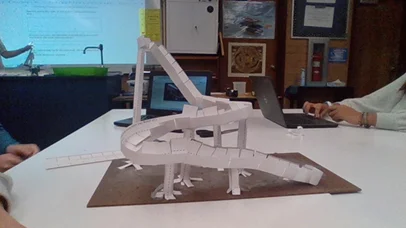
Building on their understanding of potential and kinetic energy from previous investigations, students explore how gravity, height, and track design affect energy transformations within a mechanical system. Following the engineering design process, student teams design, build, test, and improve a functional paper roller coaster that must safely navigate a rolling marble from a peak release point to a secure ground-level catch basin. Their designs must meet specific criteria and constraints, including incorporating a hill, loop, and turn while keeping the marble safely on the track. As students test and refine their designs, they investigate how changes in track height and geometry affect the marble’s motion. Students then develop system models to illustrate how the roller coaster's components interact, identify where energy transformations occur, and explain how changes in height affect the marble's speed.
Mechanical engineers design roller coasters by applying principles of energy and motion while balancing performance, structural, and safety requirements. Engineers make decisions about track features such as starting height, hills, loops, and turns to control a coaster’s motion and ensure it can safely navigate the entire track. Throughout the design process, engineers build and test models, analyze performance and failures, and modify track features to improve their designs.
After this activity, students should be able to:
- Apply the engineering design process to design, build, test, and improve a paper roller coaster that meets specified criteria and constraints, including a hill, loop, turn, and secure catch mechanism.
- Construct a system model that identifies the roller coaster's components, illustrates the marble's motion, and shows where potential energy transforms into kinetic energy and vice versa.
- Explain how gravity, starting height, and track geometry affect the marble's motion, identifying where potential and kinetic energy are greatest and how they change throughout the system.
- CCSS.Math.Practice.MP4 Model with mathematics.
Grades K-12
Do you agree with this alignment?
- STEL-7Q Apply the technology and engineering design process.
Grades 6-8
Do you agree with this alignment? - STEL-7R Refine design solutions to address criteria and constraints.
Grades 6-8
Do you agree with this alignment?
- MS-ETS1-1 Define the criteria and constraints of a design problem with sufficient precision to ensure a successful solution, taking into account relevant scientific principles and potential impacts on people and the natural environment that may limit possible solutions.
Grades 6-8
This resource focuses on the following Three Dimensional Learning aspects of NGSS:
Science & Engineering Practices- Define a design problem that can be solved through the development of an object, tool, process or system and includes multiple criteria and constraints, including scientific knowledge that may limit possible solutions.Do you agree with this alignment?
Disciplinary Core Ideas- The more precisely a design task's criteria and constraints can be defined, the more likely it is that the designed solution will be successful. Specification of constraints includes consideration of scientific principles and other relevant knowledge that is likely to limit possible solutions.Do you agree with this alignment?
Crosscutting Concepts- The uses of technologies and any limitations on their use are driven by individual or societal needs, desires, and values; by the findings of scientific research; and by differences in such factors as climate, natural resources, and economic conditions.Do you agree with this alignment?
- All human activity draws on natural resources and has both short and long-term consequences, positive as well as negative, for the health of people and the natural environment.Do you agree with this alignment?
Do you agree with this alignment? - Define a design problem that can be solved through the development of an object, tool, process or system and includes multiple criteria and constraints, including scientific knowledge that may limit possible solutions.
- MS-ETS1-2 Evaluate competing design solutions using a systematic process to determine how well they meet the criteria and constraints of the problem.
Grades 6-8
This resource focuses on the following Three Dimensional Learning aspects of NGSS:
Science & Engineering Practices- Evaluate competing design solutions based on jointly developed and agreed-upon design criteria.Do you agree with this alignment?
Disciplinary Core Ideas- There are systematic processes for evaluating solutions with respect to how well they meet the criteria and constraints of a problem.Do you agree with this alignment?
Do you agree with this alignment? - Evaluate competing design solutions based on jointly developed and agreed-upon design criteria.
- MS-ETS1-4 Develop a model to generate data for iterative testing and modification of a proposed object, tool, or process such that an optimal design can be achieved.
Grades 6-8
This resource focuses on the following Three Dimensional Learning aspects of NGSS:
Science & Engineering Practices- Develop a model to generate data to test ideas about designed systems, including those representing inputs and outputs.Do you agree with this alignment?
Disciplinary Core Ideas- Models of all kinds are important for testing solutions.Do you agree with this alignment?
- The iterative process of testing the most promising solutions and modifying what is proposed on the basis of the test results leads to greater refinement and ultimately to an optimal solution.Do you agree with this alignment?
Do you agree with this alignment? - Develop a model to generate data to test ideas about designed systems, including those representing inputs and outputs.
- MS-PS2-2 Plan an investigation to provide evidence that the change in an object's motion depends on the sum of the forces on the object and the mass of the object.
Grades 6-8
This resource focuses on the following Three Dimensional Learning aspects of NGSS:
Science & Engineering Practices- Plan an investigation individually and collaboratively, and in the design: identify independent and dependent variables and controls, what tools are needed to do the gathering, how measurements will be recorded, and how many data are needed to support a claim.Do you agree with this alignment?
- Science knowledge is based upon logical and conceptual connections between evidence and explanations.Do you agree with this alignment?
Disciplinary Core Ideas- The motion of an object is determined by the sum of the forces acting on it; if the total force on the object is not zero, its motion will change. The greater the mass of the object, the greater the force needed to achieve the same change in motion. For any given object, a larger force causes a larger change in motion.Do you agree with this alignment?
- All positions of objects and the directions of forces and motions must be described in an arbitrarily chosen reference frame and arbitrarily chosen units of size. In order to share information with other people, these choices must also be shared.Do you agree with this alignment?
Crosscutting Concepts- Explanations of stability and change in natural or designed systems can be constructed by examining the changes over time and forces at different scales.Do you agree with this alignment?
Do you agree with this alignment? - Plan an investigation individually and collaboratively, and in the design: identify independent and dependent variables and controls, what tools are needed to do the gathering, how measurements will be recorded, and how many data are needed to support a claim.
- 8.2.1.a Use computational thinking to analyze data about the relationship between the mass and speed of objects and the relative amount of kinetic energy of the objects.
Grade 8
Do you agree with this alignment? - 8.2.2.a Ask questions about how the amount of potential energy varies as distance within the system changes.
Grade 8
Do you agree with this alignment? - 8.2.3 Engage in argument to identify the strongest evidence that supports the claim that the kinetic energy of an object changes as energy is transferred to or from the object. Examples could include observing temperature changes as a result of friction, applying force to an object, or releasing potential energy from an object.
Grade 8
Do you agree with this alignment?
Each group needs:
- 1 rigid cardboard backing board or poster paper base (to serve as the stable build foundation)
- 1 set of cardstock paper roller coaster template pages from https://www.sciencebuddies.org/cdn/science-activities/paper-roller-coaster-template-kit-2022-07-11.pdf (including straight tracks, hills, loops, and sharp turns)
- 1 standard glass marble (to act as the passenger)
- 1 roll of masking tape or painters' tape
- 1 pair of scissors
- 1 metric ruler
- How Does a Roller Coaster Work? Worksheet (PDF)(1 per student)
- (optional) extra cardstock or scrap paper for reinforcing track supports during testing and redesign
For the entire class to share:
- 1 laptop/computer with projector or digital screen to display the anchoring video clips:
- Cannibal Ride at Lagoon Video (Anchor Phenomenon, 2:37 minutes)
- Paper Roller Coasters Tutorial Video (Construction Guide, 2:10 minutes)
Students should:
- Understand that potential energy depends on an object's mass and height and that kinetic energy depends on its mass and speed.
- Recognize that potential energy transforms into kinetic energy as an object moves downward and that kinetic energy can transform back into potential energy as an object moves upward.
- Have experience investigating how mass and height affect energy and motion through the Can Crusher Challenge and Car on a Ramp Challenge.
Note: Students are not expected to calculate potential energy or kinetic energy using mathematical formulas. This activity builds on their qualitative understanding of energy and motion developed in the previous two activities.
(Have the front-row ride video Cannibal Ride at Lagoon Video (2:37 minutes) ready to play before beginning.)
Have any of you ever been on a roller coaster? Think about that feeling in your stomach as you pull away from the loading platform and begin climbing toward the first big drop. What makes a roller coaster move through all those hills, loops, and turns? Let's watch this quick clip together of a roller coaster called Cannibal at Lagoon amusement park in Utah. (Play the video clip for the class).
As you watch, record three observations about how the roller coaster moves and how the track is designed. Pay attention to when the coaster seems to speed up or slow down, where it travels uphill or downhill, and what you notice about the shape and height of the track. Then, write down two questions you have about how the roller coaster works.
Now, let's discuss what you observed. What patterns did you notice in the roller coaster's motion? What questions do you have about how it moves through the track? (Invite students to share several of their questions. Students might ask questions such as, “How does the coaster have enough speed to make it through a loop?” or “Why does the first hill need to be so high?”)
Think back to the Can Crusher Challenge and Car on a Ramp Challenge. In both activities, you investigated how mass and height affect the energy available to move objects and perform work. How might those same principles help explain the motion of a roller coaster? (Allow students to share their ideas and connect their previous investigations to the roller coaster.)
Unlike a falling bottle or a cart rolling down a single ramp, a roller coaster travels through a series of hills, drops, loops, and turns. As a roller coaster travels downhill, potential energy transforms into kinetic energy, and the coaster generally speeds up. As it travels uphill, some kinetic energy transforms back into potential energy, and the coaster generally slows down. But how do engineers determine whether a roller coaster has enough energy to make it through an entire track? How does the height of the first hill affect its motion? As you design and test your own roller coaster today, pay attention to how changes in height and track design affect the motion of your marble.
Today, you are going to work as mechanical engineers to investigate these relationships. Your engineering challenge is to design, build, test, and improve a working model roller coaster using poster board, cardstock track templates, and masking tape. Instead of carrying people, your roller coaster will carry a glass marble.
Like engineers designing a real roller coaster, your team must work within specific criteria and constraints. Your roller coaster must include at least one hill, one loop, and one turn. The marble must remain safely on the track as it travels from the starting point to the end, where a catch mechanism must stop it from rolling or flying off the track. You will also have a limited set of materials and a limited amount of time to complete your design.
You will have 20 minutes to build, test, and improve your roller coaster. As you test, think about where your marble has more potential energy, where it has more kinetic energy, and how the height and shape of your track affect its motion. At the end of the design challenge, teams will demonstrate their roller coasters and evaluate how successfully each design meets the criteria and constraints. Be prepared to explain how your understanding of energy and motion helped guide your engineering decisions. Let’s get started!
Background
Building on the Can Crusher Challenge and Car on a Ramp Challenge, this activity extends students' understanding of potential and kinetic energy to a more complex mechanical system. In previous investigations, students explored how mass and height affect the energy available to perform work and how potential energy transforms into kinetic energy as objects fall or roll downhill. In this activity, students apply these concepts to a roller coaster system in which energy repeatedly transforms between potential energy and kinetic energy as a marble travels through hills, drops, loops, and turns.
Potential Energy and Kinetic Energy
When a lift mechanism or a person raises a marble to an elevated starting point, work is done on the marble-Earth system, increasing its gravitational potential energy (GPE). Gravitational potential energy depends on an object's mass, its height, and the strength of gravity. As gravity pulls the marble down the track, potential energy transforms into kinetic energy (KE), the energy of motion. As the marble loses height, its speed generally increases; as it travels uphill and gains height, its speed generally decreases as kinetic energy transforms back into potential energy.
Unlike the single downward motions investigated in the previous activities, a roller coaster provides opportunities to observe repeated energy transformations. At higher points along the track, the marble generally has more potential energy, while at lower points, it generally has more kinetic energy. The marble's starting height determines the initial potential energy available to move through the system, while the track's geometry influences how that energy is transformed as the marble travels through hills, loops, and turns.
Conservation of Energy and Friction
In an ideal system without friction or air resistance, the total mechanical energy of the marble-Earth system remains constant as energy transforms between potential energy and kinetic energy. Real roller coasters and classroom models experience friction and air resistance, so some mechanical energy is transformed into thermal energy and transferred to the surroundings through sound and other interactions. Although the mechanical energy available for motion decreases, total energy is conserved when all forms of energy and relevant energy transfers are considered.
These energy transformations help explain why a marble may slow down, stall, or fail to complete a loop or hill. A marble released from a greater starting height generally has more initial potential energy available to navigate the track. However, the marble's ability to complete the course also depends on the track's geometry, structural stability, and friction. Note: Students will investigate the effects of friction and the conservation of energy more thoroughly in the next activity using the PhET Energy Skate Park simulation.
Engineering Design and System Modeling
Mechanical engineers apply principles of energy and motion when designing roller coasters. They consider how starting height, track geometry, gravity, and friction affect a coaster's speed and ability to safely navigate hills, loops, and turns. Engineers use physical and computational models to predict system behavior, test designs against established criteria and constraints, identify performance problems, and make improvements.
In this activity, students apply these same engineering practices by designing, building, testing, and improving paper roller coasters. As they test their designs, students observe where the marble speeds up, slows down, or stops and use their understanding of energy transformations to explain these observations and guide modifications. For example, if a marble cannot complete a loop, students may investigate whether increasing the starting height or modifying the loop's geometry improves its performance.
Students then construct system models that identify the roller coaster's physical components, illustrate the marble's motion, and represent where potential energy and kinetic energy are greatest and how they transform throughout the system. By connecting their models to observations from physical testing, students develop evidence-based explanations of how gravity, height, and track design affect energy and motion. These models provide a foundation for the subsequent computational investigation and the culminating Roller Coaster Final Model activity.
Before the Activity
- Prepare Materials:
- Make one set of copies of the Paper Roller Coaster Template Kit on cardstock for each group.
- Gather and organize a building kit for each group containing the track templates, a rigid cardboard backing board or poster board base, masking tape, scissors, a metric ruler, and a glass marble.
- Prepare extra cardstock or scrap paper for reinforcing track supports during construction and redesign.
- Make copies of the How Does a Roller Coaster Work? Worksheet (PDF) (1 per student.)
- Prepare Multimedia:
- Set up a laptop/computer with internet access and a projector or digital display.
- Open and queue the two videos:
- Cannibal at Lagoon (2:37 minutes; introductory phenomenon)
- Paper Roller Coasters (2:10 minutes; construction guide)
- Plan for Subsequent Activities: Determine how students will document and preserve their roller coaster designs for use in the subsequent PhET Roller Coaster Simulation and Roller Coaster Final Model activities. Have students photograph their completed prototypes and retain their design sketches and system models for future reference. If possible, store the physical prototypes for students to revisit during the culminating activity.
During the Activity
Part 1: Ask & Research (10 minutes)
- Divide students into groups of three or four.
- Distribute one How Does a Roller Coaster Work? Worksheet (PDF) to each student.
- Introduce the challenge: To use the engineering design process to design, test and model a paper roller coaster system and to explain how a roller coaster works.
- Play the front-row ride video of Cannibal at Lagoon (2:37 minutes) for the class to see.
- Instruct students to record three observations about the roller coaster's motion and track design, along with two questions about how it works, in their worksheets.
- Facilitate a brief class discussion in which students share their observations and questions about how the roller coaster moves, speeds up, and slows down.
- Ask students to recall the Can Crusher Challenge and Car on a Ramp Challenge. Have them discuss how their previous investigations of mass, height, speed, and energy might help explain the roller coaster's motion.
- Explain that students will work in small engineering groups to construct a physical model roller coaster and evaluate its performance against established design criteria and constraints.
- Play the Paper Roller Coasters (2:10 minutes) tutorial video to demonstrate basic cutting, folding, and structural alignment techniques.
- Review the engineering requirements and design constraints:
- Materials: Use the provided cardstock templates, backing board, tape, and other approved construction materials.
- Track features: The track must include at least one hill, one loop, and one turn.
- Safety: Keep the marble on the track throughout its journey.
- Catch mechanism: Include a mechanism that securely catches the marble at the end of the track.
- Time: Teams have 20 minutes to build, test, and improve their roller coasters.
Part 2: Imagine & Plan (5 minutes)
- Give students one minute to individually brainstorm ideas for their roller coaster designs and record them in their How Does a Roller Coaster Work? Worksheet (PDF). Encourage students to consider how starting height and track geometry might affect the marble's motion.
- Have students briefly share their initial ideas with their teams and discuss how their designs could meet the established criteria and constraints.
- Give teams three minutes to sketch their proposed roller coaster designs in their worksheets. Have them:
- Identify and label the necessary components, including the starting hill, loop, turn, and catch mechanism.
- Use directional arrows to indicate the marble's anticipated path through the track.
- Predict where the marble will have the greatest potential energy and kinetic energy.
- Consider how the starting height and track geometry may affect the marble's ability to successfully navigate the hills, loops, and turns.
- Have teams briefly review their designs against the established criteria and constraints and make any necessary adjustments before beginning construction.
Part 3: Create, Test & Improve (20 minutes)
- Distribute construction materials to each team.
- Start a 20-minute countdown timer for building, testing, and improving the roller coasters.
- Give teams approximately 15 minutes to construct their roller coaster prototypes and begin testing individual track sections as they build. Remind students to follow their design plans and ensure their tracks include a hill, loop, turn, and secure catch mechanism. Encourage teams to make adjustments based on their observations throughout construction rather than waiting until the entire track is complete.
- Once teams have constructed their prototypes, have them test their designs by releasing a marble from the starting point and observing whether it successfully navigates the track features and reaches the catch mechanism.
- As teams test their roller coasters, have students observe where the marble speeds up, slows down, or stops. Encourage them to use their understanding of potential and kinetic energy to explain these observations and identify possible improvements.
- If the marble stalls or derails, have teams identify possible causes and refine their designs by adjusting the starting height, track geometry, structural supports, or alignment. Encourage students to explain how their modifications may affect the marble's motion and energy transformations before retesting.
- Circulate among teams and ask guiding questions, such as:
- Where does the marble have the greatest potential energy? Where is its kinetic energy greatest?
- How does the height of the starting hill affect the marble's ability to complete the loop?
- What happens to the marble's speed as it travels downhill or uphill? How can you explain these changes using potential and kinetic energy?
- How might changing the height or shape of the track improve the roller coaster's performance?
- At the end of the 20-minute construction and testing period, instruct teams to stop working and prepare to demonstrate their roller coasters.
- Have each team photograph its completed prototype from an angle that clearly shows the track's hills, loops, turns, and starting height for reference during the subsequent PhET Roller Coaster Simulation and Roller Coaster Final Model activities.
A student-constructed paper roller coaster prototype created by folding track templates and taping them securely to a supporting poster board base.Copyright Photograph taken by Rachel Kenning, Cache County School District. Used with permission.Part 4: Peer Review Gallery Walk (5 minutes)
- Have student teams rotate to neighboring stations to observe live demonstrations of other teams’ roller coasters. Encourage students to observe how successfully each design meets the established criteria and constraints.
- Instruct students to reflect individually in their How Does a Roller Coaster Work? Worksheet (PDF) by answering the following questions:
- Which team's roller coaster most successfully guided the marble through its hills, loops, and turns? What specific track features contributed to its success?
- How did the starting height and track geometry influence the marble's motion and the transformation of potential energy into kinetic energy and vice versa?
- What design features or improvements could you apply to your own roller coaster based on your observations?
Part 5: System Modeling & Explanation (10 minutes)
- Direct students to work independently to construct a system model of their paper roller coaster that illustrates its physical components, the marble's motion, and how potential and kinetic energy transform as the marble moves through the system. Have students:
- Identify and label the major physical components, including the track, base, starting hill, loops, turns, catch mechanism, and marble.
- Use directional arrows to illustrate the marble's path through the track, identifying where it speeds up, slows down, or stops.
- Label locations where potential energy and kinetic energy are greatest and identify where potential energy transforms into kinetic energy and vice versa.
- Illustrate how gravity and changes in height affect the marble's motion and energy transformations throughout the system.
- Identify at least one location where the marble slowed down, stopped, or failed to complete a track feature during testing, and explain how the observation relates to energy and motion.
- Review students' system models to verify that they:
- Include and accurately label the major physical components of the roller coaster system.
- Use directional arrows to represent the marble's motion and identify locations where its speed changes.
- Correctly identify where potential and kinetic energy are greatest and represent how energy transforms between these forms as the marble moves through the track.
- Instruct students to write a concise paragraph beneath their models explaining how potential and kinetic energy transform as the marble moves through the roller coaster. Have students describe how gravity, starting height, and track geometry affect the marble's motion and support their explanations with specific observations from testing.
- Conclude the activity by having students share and compare their completed models and explanations with a peer. Encourage students to discuss similarities and differences in their representations of energy transformations and identify any revisions that could improve their models.
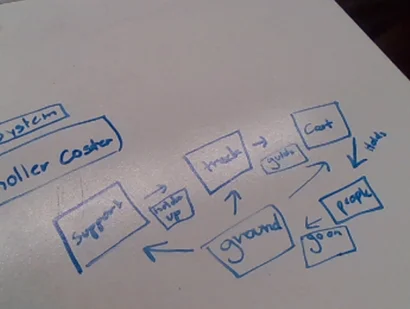 A student's initial system model sketch from the worksheet, identifying the core components and structural interactions required to make a roller coaster function.Copyright Photograph taken by Rachel Kenning, Cache County School District. Used with permission.
- system
- A group of related parts or pieces that interact and work together as a whole.
- components
- The individual physical parts or objects that make up a complete system.
- interactions
- The way physical parts or forces affect one another within a system.
- work
- The transfer of energy that occurs when a force causes an object to move or change.
- potential energy
- The stored energy an object has because of its position or condition.
- kinetic energy
- The energy an object possesses because of its motion.
Pre-Activity Assessment
Phenomenon Observations: While watching the introductory video of the Cannibal at Lagoon coaster, look at student worksheets to verify they can identify changes in motion over time. Students show readiness if they observe that the coaster moves slowly at peak heights and speeds up as it moves downward toward the ground.
Activity Embedded (Formative) Assessment
System Model Checklist: Review each student's drawn diagram in their How Does a Roller Coaster Work? Worksheet (PDF) using three criteria:
- Components: The drawing includes the key physical parts (the track layout, the marble, and the starting hill).
- Directional Interaction: The student used directional arrows along the track to chart the physical path of the marble.
- Qualitative Prediction: The student clearly labeled the single highest point as "slowest" (maximum stored energy) and the lowest drop points as "fastest" (maximum motion energy).
Post-Activity (Summative) Assessment
Cause-and-Effect Reflection: Evaluate the individual written paragraphs at the bottom of the student worksheets using this grading guide:
- Proficient: The student accurately explains that the initial height of the starting hill causes the marble to move, and that changing the track geometry (hills and loops) directly causes the marble's speed to change over time.
- Developing: The student describes the track or the marble's motion but does not connect how a change in height or position causes a specific change in speed.
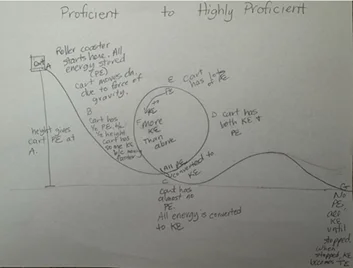 An example of a proficient teacher model from the post-activity assessment, charting the system components, directional path, and predictions for potential energy and kinetic energy transformations as a reference for the unit end goal.Copyright Photograph taken by Rachel Kenning, Cache County School District. Used with permission.
- Sharp objects: Instruct students to use caution when handling scissors while cutting the track templates.
- Projectile prevention: Ensure all teams design a secure catch mechanism at the end of their track. Marbles should be safely caught and contained rather than flying off the edge of the desk or baseboard into the room.
- Marble stalling: If a marble stalls out in a loop or fails to clear a hill, check the height of the very first drop. Remind students that the initial starting hill must be the highest point in the entire system to provide enough energy to clear subsequent track geometries.
- Track structural sag: Cardstock tracks can sag under the weight of a rolling marble, causing it to lose speed or derail. Encourage students to roll small pillars or fold supporting struts out of scrap paper and tape them underneath the track joints for added stability.
- Friction and alignment: If the marble routinely flies off the track during a sharp turn, check the banking of the cardstock. Students may need to tilt or raise the outside wall of the track along the curve to cleanly guide the marble through the change in direction.
Connect this introductory challenge to digital simulations. Have students recreate their physical track layouts using the PhET Energy Skate Park Simulation to dynamically observe how the bar graphs for potential energy and kinetic energy shift in real time as an object slides through matching hills and loops.
- For Lower Grades (6th–7th): Focus strictly on the direction of motion. Instead of labeling potential and kinetic energy locations, have students focus on predicting where the marble slows down or speeds up by counting the number of seconds it takes to complete different sections of the track.
- For Older/Advanced Students (8th Grade Extension): Challenge students to mathematically calculate the average speed of the marble across the system. Provide them with the total length of their track in centimeters (using their metric ruler) and have them use a digital stopwatch to time the full run from start to finish. They can then calculate speed using the formula s=d/t.
"Kinetic Energy." Wiktionary, Wikimedia Foundation, 12 June 2026, https://en.wiktionary.org.
NGSS Lead States. Next Generation Science Standards: For States, By States. National Academies Press, 2013. Next Generation Science Standards, https://www.nextgenscience.org.
"Potential Energy." Wiktionary, Wikimedia Foundation, 15 June 2026, https://en.wiktionary.org.
Science Buddies. (2022, July 11). Paper Roller Coaster Template Kit [PDF]. https://www.sciencebuddies.org/cdn/science-activities/paper-roller-coaster-template-kit-2022-07-11.pdf.
"Work." Merriam-Webster’s School Dictionary, Merriam-Webster, 2026, https://www.merriam-webster.com.
Contributors
Rachel Kenning, Spring Creek Middle School, Cache District, Utah (Advice from: Karen Merritt, Hillary Swanson, Idris Solola)
Supporting Program
Engineering Research Center for Advancing Sustainability through Powered Infrastructure for Roadway Electrification (ASPIRE) in the College of Engineering, Utah State University
Acknowledgements
This material was developed based upon work supported by the National Science Foundation under grant no. EEC 1941524—Engineering Research Center for Advancing Sustainability through Powered Infrastructure for Roadway Electrification (ASPIRE) in the College of Engineering, Utah State University. Any opinions, findings, and conclusions or recommendations expressed in this material are those of the authors and do not necessarily reflect the views of the National Science Foundation.
Copyright
2026 by Regents of the University of Colorado; original © 2025 Utah State University