
From Can Crushers to Roller Coasters: Engineering with Energy
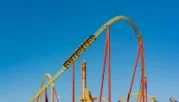 A roller coaster in an amusement park on a clear day.Copyright Olga Nayda on Unsplash
Through a series of five hands-on engineering activities, students investigate potential and kinetic energy, energy transformations, and the conservation of energy. Students explore how mass, height, speed, gravity, and friction affect energy and motion while applying the engineering design process, conducting investigations, analyzing data, and developing system models.
The unit begins with the Can Crusher Challenge, in which students investigate how mass and drop height affect the energy available to crush an aluminum can. Next, in the Car on a Ramp Challenge, students deepen their understanding by systematically varying mass and ramp height, collecting quantitative data, and optimizing their designs to accomplish a task using minimal energy. Then, in the How Does a Roller Coaster Work activity, students design, build, test, and improve paper roller coasters to explore how gravitational potential energy transforms into kinetic energy and vice versa as objects move through a system. Building on their roller coaster investigations, students use the PhET Energy Skate Park Simulation activity to visualize energy transformations, investigate the effects of friction, and explore the conservation of energy. In the culminating Roller Coaster Final Model activity, students synthesize evidence from previous investigations to construct a final roller coaster system model and develop a scientific explanation of how energy is transferred, transformed, and conserved.
Engineers apply principles of energy, motion, and energy conservation to design systems that operate efficiently, reliably, and safely. Mechanical engineers use these principles to design roller coasters, machinery, and other systems that control energy transformations, while automotive engineers analyze how mass and speed affect energy transfer during collisions to improve vehicle safety. Engineers also consider energy losses due to friction when optimizing system performance. By developing models, conducting controlled tests, analyzing data, and refining designs, engineers use scientific evidence to predict system behavior, evaluate trade-offs, and develop effective solutions within real-world constraints.
List the suggested order of the associated lessons and activities along with their durations and brief descriptions in this Unit.
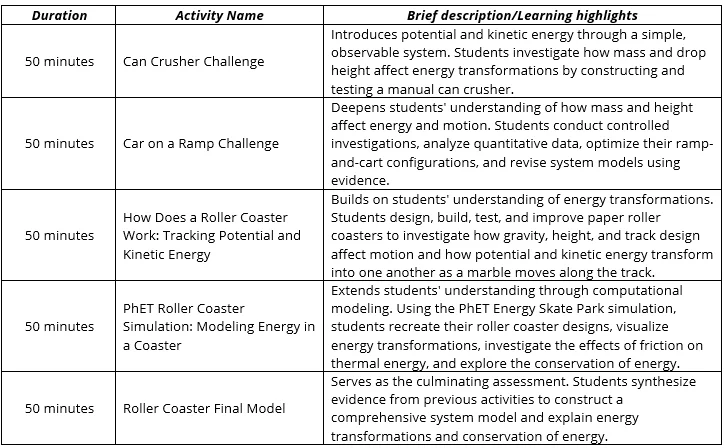
- From Can Crushers to Roller Coasters: Engineering with Energy
Contributors
Rachel Kenning, Spring Creek Middle School, Cache District, Utah (Advice from: Karen Merritt, Hillary Swanson, Idris Solola)
Supporting Program
Engineering Research Center for Advancing Sustainability through Powered Infrastructure for Roadway Electrification (ASPIRE) in the College of Engineering, Utah State University
Acknowledgements
This material was developed based upon work supported by the National Science Foundation under grant no. EEC 1941524—Engineering Research Center for Advancing Sustainability through Powered Infrastructure for Roadway Electrification (ASPIRE) in the College of Engineering, Utah State University. Any opinions, findings, and conclusions or recommendations expressed in this material are those of the authors and do not necessarily reflect the views of the National Science Foundation.
Copyright
2026 by Regents of the University of Colorado; original © 2025 Utah State University