
Roller Coaster Final Model
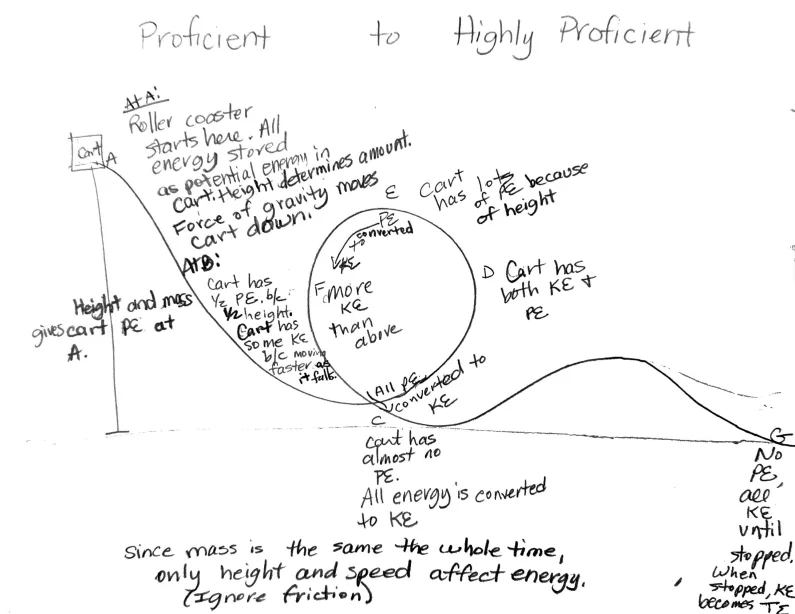 The teacher's own exemplar model, built as the target for students to aim for, showing energy reasoning at Proficient through Highly Proficient depth.Copyright Rachel Kenning
In this culminating activity, students synthesize evidence from the four previous engineering activities (Can Crusher Challenge, Car on a Ramp Challenge, How Does a Roller Coaster Work: Tracking Potential and Kinetic Energy, PhET Roller Coaster Simulation: Modeling Energy in a Coaster) to construct a comprehensive system model of the paper roller coaster they designed and tested earlier in the unit. Working individually, students revisit their original roller coaster designs and initial system models, incorporating evidence from physical testing and the PhET Energy Skate Park simulation. Students identify and label the system's components, illustrate the marble's motion, and explain how potential and kinetic energy transform as the marble travels through hills, loops, and turns. They also represent how friction transforms mechanical energy into thermal energy and explain why total energy remains conserved even as the marble slows down or stops. Using evidence from their investigations, students develop written scientific explanations connecting mass, height, speed, gravity, and energy transformations to the roller coaster's behavior. By comparing their initial and final models, students demonstrate how scientific understanding develops through investigation, computational modeling, and evidence-based reasoning.
Mechanical engineers use system models to predict and explain how energy is transferred, transformed, and conserved in roller coasters and other mechanical systems. Engineers analyze how starting height, track geometry, gravity, and friction affect a coaster's motion, performance, and safety. By combining physical testing with computational simulations, engineers evaluate energy transformations, identify potential problems, and refine their designs. These evidence-based models help engineers ensure that roller coasters have sufficient energy to navigate hills, loops, and turns safely while accounting for energy transformed into thermal energy through friction.
After this activity, students should be able to:
- Construct a system model of their roller coaster that labels every physical component and uses directional arrows to trace the cart's motion and energy changes over time.
- Explain where the gravitational potential energy comes from.
- Provide evidence of how kinetic energy changes over time.
- Develop an evidence-based scientific explanation that connects their final system model to experimental observations and demonstrates how their understanding has changed since their initial model.
- CCSS.Math.Practice.MP4 Model with mathematics.
Grades K-12
Do you agree with this alignment?
- STEL-7Q Apply the technology and engineering design process.
Grades 6-8
Do you agree with this alignment? - STEL-7R Refine design solutions to address criteria and constraints.
Grades 6-8
Do you agree with this alignment?
- MS-ETS1-1 Define the criteria and constraints of a design problem with sufficient precision to ensure a successful solution, taking into account relevant scientific principles and potential impacts on people and the natural environment that may limit possible solutions.
Grades 6-8
This resource focuses on the following Three Dimensional Learning aspects of NGSS:
Science & Engineering Practices- Define a design problem that can be solved through the development of an object, tool, process or system and includes multiple criteria and constraints, including scientific knowledge that may limit possible solutions.Do you agree with this alignment?
Disciplinary Core Ideas- The more precisely a design task's criteria and constraints can be defined, the more likely it is that the designed solution will be successful. Specification of constraints includes consideration of scientific principles and other relevant knowledge that is likely to limit possible solutions.Do you agree with this alignment?
Crosscutting Concepts- The uses of technologies and any limitations on their use are driven by individual or societal needs, desires, and values; by the findings of scientific research; and by differences in such factors as climate, natural resources, and economic conditions.Do you agree with this alignment?
- All human activity draws on natural resources and has both short and long-term consequences, positive as well as negative, for the health of people and the natural environment.Do you agree with this alignment?
Do you agree with this alignment? - Define a design problem that can be solved through the development of an object, tool, process or system and includes multiple criteria and constraints, including scientific knowledge that may limit possible solutions.
- MS-ETS1-2 Evaluate competing design solutions using a systematic process to determine how well they meet the criteria and constraints of the problem.
Grades 6-8
This resource focuses on the following Three Dimensional Learning aspects of NGSS:
Science & Engineering Practices- Evaluate competing design solutions based on jointly developed and agreed-upon design criteria.Do you agree with this alignment?
Disciplinary Core Ideas- There are systematic processes for evaluating solutions with respect to how well they meet the criteria and constraints of a problem.Do you agree with this alignment?
Do you agree with this alignment? - Evaluate competing design solutions based on jointly developed and agreed-upon design criteria.
- MS-ETS1-4 Develop a model to generate data for iterative testing and modification of a proposed object, tool, or process such that an optimal design can be achieved.
Grades 6-8
This resource focuses on the following Three Dimensional Learning aspects of NGSS:
Science & Engineering Practices- Develop a model to generate data to test ideas about designed systems, including those representing inputs and outputs.Do you agree with this alignment?
Disciplinary Core Ideas- Models of all kinds are important for testing solutions.Do you agree with this alignment?
- The iterative process of testing the most promising solutions and modifying what is proposed on the basis of the test results leads to greater refinement and ultimately to an optimal solution.Do you agree with this alignment?
Do you agree with this alignment? - Develop a model to generate data to test ideas about designed systems, including those representing inputs and outputs.
- MS-PS3-5 Construct, use, and present arguments to support the claim that when the kinetic energy of an object changes, energy is transferred to or from the object.
Grades 6-8
This resource focuses on the following Three Dimensional Learning aspects of NGSS:
Science & Engineering Practices- Construct, use, and present oral and written arguments supported by empirical evidence and scientific reasoning to support or refute an explanation or a model for a phenomenon.Do you agree with this alignment?
- Science knowledge is based upon logical and conceptual connections between evidence and explanations.Do you agree with this alignment?
Disciplinary Core Ideas- When the motion energy of an object changes, there is inevitably some other change in energy at the same time.Do you agree with this alignment?
Crosscutting Concepts- Energy may take different forms (e.g. energy in fields, thermal energy, energy of motion).Do you agree with this alignment?
Do you agree with this alignment? - Construct, use, and present oral and written arguments supported by empirical evidence and scientific reasoning to support or refute an explanation or a model for a phenomenon.
- 8.2.1.a Use computational thinking to analyze data about the relationship between the mass and speed of objects and the relative amount of kinetic energy of the objects.
Grade 8
Do you agree with this alignment? - 8.2.2.a Ask questions about how the amount of potential energy varies as distance within the system changes.
Grade 8
Do you agree with this alignment? - 8.2.3 Engage in argument to identify the strongest evidence that supports the claim that the kinetic energy of an object changes as energy is transferred to or from the object. Examples could include observing temperature changes as a result of friction, applying force to an object, or releasing potential energy from an object.
Grade 8
Do you agree with this alignment?
Each student needs:
- Roller Coaster Final Model Handout (PDF)
- Photographs, sketches, physical prototypes, and/or initial system models of the paper roller coaster designed and constructed in the How Does a Roller Coaster Work: Tracking Potential and Kinetic Energy activity.
- Completed PhET Roller Coaster Simulation Worksheet (PDF), including data, observations, and screenshots from the PhET Roller Coaster Simulation: Modeling Energy in a Coaster activity
- 1 sheet of poster paper or large drawing paper for constructing the final system model (white board space can also be used)
- markers or colored pencils (at least two colors) for labeling components and illustrating motion and energy transformations
For the entire class to share:
- 1 laptop or computer with a projector or digital display to show the Roller Coaster Proficiency Model (PDF) image (see Image 1)
- (optional) access to the PhET Energy Skate Park simulation for reviewing energy graphs and simulation results
Students should:
- Have completed the Can Crusher Challenge, Car on a Ramp Challenge, How Does a Roller Coaster Work: Tracking Potential and Kinetic Energy, and PhET Roller Coaster Simulation: Modeling Energy in a Coaster activities.
- Understand how mass, height, speed, and gravity affect potential and kinetic energy and how these forms of energy transform as objects move through a system.
- Recognize that friction transforms mechanical energy into thermal energy and that total energy is conserved even when an object slows down or stops.
- Have experience constructing and revising system models that identify physical components, illustrate motion, and represent energy transformations and transfers (Can Crusher Challenge and Car on a Ramp Challenge).
- Be familiar with conducting controlled investigations, analyzing experimental data and graphical evidence, and using observations to explain cause-and-effect relationships.
- Have access to their original roller coaster designs, initial system models, and evidence collected during the PhET Roller Coaster Simulation: Modeling Energy in a Coaster.
Note: Students are not expected to calculate potential or kinetic energy using mathematical formulas. This culminating activity emphasizes synthesizing evidence from previous activities to develop comprehensive system models and scientific explanations of energy transformations and conservation.
(Before class, display the Roller Coaster Proficiency Model (PDF) (see Image 1) on the board. Have students retrieve their original paper roller coaster designs, initial system models, and evidence collected during the PhET Energy Skate Park simulation.)
The teacher's own exemplar model, built as the target for students to aim for, showing energy reasoning at Proficient through Highly Proficient depth.Copyright Rachel KenningThink back to everything you've investigated throughout this unit. You began by crushing aluminum cans to explore how mass and height affect energy. Next, you experimented with carts rolling down ramps to investigate how energy affects motion and the ability to perform work. Then, you designed, built, and tested your own paper roller coasters, developing system models to explain how potential and kinetic energy change as a marble travels through hills, loops, and turns. Finally, you used the PhET Energy Skate Park simulation to investigate friction, thermal energy, and the conservation of energy.
Throughout these activities, you've been exploring an important question: How is energy transferred, transformed, and conserved as objects move through a system?
Think back to your original roller coaster model. You identified where your marble had potential and kinetic energy and explained how its motion changed along the track. But there were still questions your model couldn't fully answer. What happened to the marble's energy when it slowed down or stopped? Did that energy disappear, or did it transform into another form?
Now, look at the graphs and data you collected during the PhET simulation. What did you observe about potential, kinetic, thermal, and total energy as the rider moved through the track? What happened when you introduced friction? (Allow students to share their observations. Listen for responses indicating that potential and kinetic energy transform into one another, friction transforms some mechanical energy into thermal energy, and total energy remains conserved.)
Exactly. Energy doesn't disappear when an object slows down or stops. Instead, energy is transferred or transformed into other forms. Even when friction reduces the mechanical energy available for motion, the total energy of the system remains conserved.
Today, you're going to bring together everything you've learned to construct your Final Roller Coaster System Model. Working individually, you'll revisit your original roller coaster design and initial system model, using evidence from your physical investigations and the PhET simulation to develop a more complete explanation of how energy behaves within your roller coaster.
Your final model should identify the major components of your roller coaster, illustrate the marble's motion, and show where potential and kinetic energy are greatest and how they transform as the marble moves through the track. You'll also represent how friction transforms mechanical energy into thermal energy and explain why total energy remains conserved, even when the marble slows down or stops.
Then comes the challenge: You'll write a scientific explanation that uses evidence from your investigations to explain the cause-and-effect relationships among mass, height, speed, gravity, friction, and energy. Your goal isn't simply to label energy types or use scientific vocabulary. It's to explain what happens to energy throughout your roller coaster system and support your explanation with evidence.
Finally, you'll compare your initial and final models to see how your understanding has developed throughout the unit. Just as engineers use experimental evidence and computational models to refine their designs and explanations, you'll use what you've learned to create a more accurate representation of your roller coaster system.
Let's get started!
Background
Energy Transformations and Conservation of Energy
This culminating activity brings together the concepts and engineering practices students developed through the Can Crusher Challenge, Car on a Ramp Challenge, How Does a Roller Coaster Work: Tracking Potential and Kinetic Energy, and PhET Roller Coaster Simulation: Modeling Energy in a Coaster activities. Throughout this unit, students investigated how mass, height, speed, gravity, and friction affect energy and motion, explored energy transformations within physical systems, and used experimental evidence and computational models to explain their observations. In this activity, students synthesize that evidence to construct comprehensive roller coaster system models and develop scientific explanations of how energy is transferred, transformed, and conserved.
Potential Energy and Kinetic Energy
When a marble is raised to an elevated starting position on a roller coaster, work is done on the marble-Earth system, increasing its gravitational potential energy. Gravitational potential energy is a type of potential energy associated with an object's position in a gravitational field. The amount of potential energy (PE) depends on the marble's mass (m), gravitational acceleration (g), and height above a reference point (h): PE = mgh.
As the marble rolls downhill, potential energy transforms into kinetic energy (KE), the energy of motion. Kinetic energy depends on the marble's mass and speed (v): KE = ½mv².
These equations are provided for your reference. Students are not expected to calculate energy values in this activity. Instead, they use qualitative comparisons and evidence from previous activities to explain how energy changes throughout their roller coaster systems.
At the marble's highest starting position, the system generally has its greatest potential energy. As the marble descends, potential energy decreases while kinetic energy increases, causing the marble to speed up. As the marble travels uphill, kinetic energy transforms back into potential energy, and the marble generally slows down. These transformations repeat as the marble travels through hills, loops, and turns. Because friction and other energy transfers affect the marble's speed, the location of greatest kinetic energy is not necessarily the lowest point of the entire track.
Friction, Thermal Energy, and Conservation of Energy
In an ideal system without friction or other energy losses, mechanical energy remains constant as potential and kinetic energy transform into one another. In real roller coaster systems, friction between the marble and track, along with air resistance and other interactions, causes some mechanical energy to transform into thermal energy. Energy may also be transferred through sound and vibrations.
As a result, the marble may reach progressively lower heights, slow down, or eventually stop. However, the energy does not disappear. When all relevant forms of energy and transfers are considered, total energy remains conserved.
This principle is known as the law of conservation of energy: Energy cannot be created or destroyed, but it can be transferred between objects or transformed from one form into another. In a closed system, the total amount of energy remains constant.
Students investigated these relationships in the previous activity using the PhET Energy Skate Park simulation. The simulation's energy graphs provided visual evidence that potential and kinetic energy change as an object moves, thermal energy increases when friction is present, and total energy remains constant. Students now apply this evidence to explain energy transformations and conservation within their original paper roller coaster systems.
System Modeling and Evidence-Based Scientific Explanations
Engineers use system models to represent the components, interactions, and behavior of complex systems. These models help engineers visualize relationships, predict performance, identify problems, and evaluate potential design improvements. Engineers also revise their models as new experimental or computational evidence becomes available.
In this activity, students revisit the initial system models they constructed during the paper roller coaster investigation. Using observations from physical testing and evidence from the PhET simulation, students refine their models to represent the roller coaster's major components, the marble's motion, and the transformations and transfers of energy throughout the system.
Students identify locations where potential and kinetic energy are greatest, illustrate how these forms of energy change as the marble travels through the track, and represent how friction contributes to thermal energy. Their models should also communicate that total energy remains conserved, even when the marble's mechanical energy decreases.
Students then develop written scientific explanations connecting mass, height, speed, gravity, friction, and energy to the behavior of their roller coaster systems. These explanations should use specific observations and simulation evidence to support claims about energy transformations and conservation rather than simply describing the marble's motion or listing scientific vocabulary.
Comparing Initial and Final System Models
Scientific models are revised as new evidence becomes available. By comparing their initial and final roller coaster models, students demonstrate how their understanding of energy has developed throughout the unit.
Their initial models primarily represented physical components, motion, and transformations between potential and kinetic energy. Their final models incorporate additional evidence about friction, thermal energy, and conservation of energy, providing a more complete explanation of the system's behavior.
This comparison allows you to assess students' ability to apply scientific concepts, interpret evidence, construct and revise models, and communicate explanations. It also reinforces an essential engineering practice: using evidence to improve models and deepen understanding of how systems function.
Before the Activity
- Make copies of the Roller Coaster Final Model Handout (PDF) (1 per student).
- Have students retrieve photographs, sketches, physical prototypes, and/or initial system models of the paper roller coasters they designed and constructed in the How Does a Roller Coaster Work: Tracking Potential and Kinetic Energy activity.
- Have students retrieve their completed PhET Roller Coaster Simulation Worksheet (PDF), including data, observations, and screenshots from the PhET Roller Coaster Simulation: Modeling Energy in a Coaster activity.
- Gather and organize poster paper or large drawing paper, markers, and colored pencils for students to construct their individual final system models.
- Prepare and display the Roller Coaster Proficiency Model (PDF) using a projector or digital display to provide students with an example of a completed system model.
- Ensure students have access to their initial roller coaster system models so they can compare their initial and final models and reflect on how their understanding of energy has developed throughout the unit.
During the Activity
Phase 1: Review Your Evidence (5 minutes)
- Introduce the activity objective: To build a formal model of your roller coaster and use it to explain, in writing, how the cart's energy changes over time.
- Have students retrieve their original roller coaster designs, initial system models, and evidence collected during the PhET Roller Coaster Simulation: Modeling Energy in a Coaster activity.
- Ask students to review their initial system models and reflect on how their understanding of energy has developed. Guide students with questions such as:
- Where did you originally predict the marble would have the greatest potential and kinetic energy?
- What did the PhET Energy Skate Park simulation reveal about how potential and kinetic energy transform as an object moves through a system?
- What did you learn about friction, thermal energy, and the conservation of energy that was not represented in your initial model?
- Briefly display the Roller Coaster Proficiency Model (PDF) image and review the expectations for the final model.
- Explain that students will use evidence from their physical investigations and computational simulations to represent the roller coaster's components, motion, energy transformations and transfers, and conservation of energy.
- Remind students that their final models and written explanations should demonstrate how their understanding has developed since their initial roller coaster models and should be supported by specific evidence from their investigations.
Phase 2: Build Your Formal Model (20 minutes, individual)
- Have students use their original roller coaster designs, initial system models, and evidence from the PhET Energy Skate Park simulation to construct comprehensive final system models on their Roller Coaster Final Model Handout (PDF) or separate sheets of poster paper. (Optional: Provide students who need additional support with the scaffolded roller coaster model shown in the following image.)
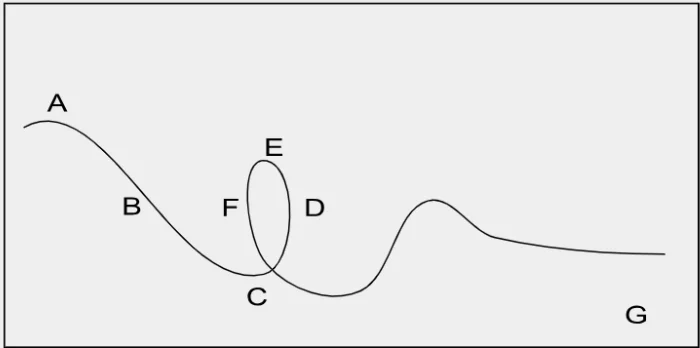 An optional scaffolded model that teachers can offer to students who need a starting structure for labeling their own track.Copyright Rachel Kenning
- Instruct students to include the following elements in their final system models:
- System components: Identify and label the major physical components of the roller coaster, including the starting hill, track, loop, turn, catch mechanism, and marble.
- Motion: Use directional arrows to illustrate the marble's path through the track, identifying locations where it speeds up, slows down, or stops.
- Potential and kinetic energy: Label at least three points along the track (e.g., A, B, and C). At each point, identify the relative amounts of potential and kinetic energy and indicate where each form of energy is greatest.
- Energy transformations: Use arrows, labels, or annotations to show where potential energy transforms into kinetic energy and vice versa as the marble moves through hills, drops, and loops.
- Friction and thermal energy: Identify where friction acts on the marble and indicate how some mechanical energy transforms into thermal energy as the marble moves along the track.
- Conservation of energy: Include annotations explaining that total energy remains conserved even as potential and kinetic energy change and some mechanical energy transforms into thermal energy.
- Encourage students to use different colors, arrows, and labels to distinguish physical components, motion, and energy transformations and transfers.
- As students construct their models, circulate and ask guiding questions such as:
- How does the marble's height affect its potential energy at different points along the track?
- Where does the marble appear to move fastest? How does this relate to its kinetic energy?
- What happens to potential and kinetic energy as the marble travels downhill or uphill?
- How does friction affect the mechanical energy available for the marble's motion?
- What evidence from the PhET simulation supports your explanation that total energy remains conserved?
- Have students compare their developing final models with their initial roller coaster models and identify how their representations of energy transformations and transfers have changed based on evidence from their investigations.
The teacher's own exemplar model, built as the target for students to aim for, showing energy reasoning at Proficient through Highly Proficient depth.Copyright Rachel KenningPhase 3: Analyze & Explain (20 minutes, independent)
- Instruct students to use their completed final system models and evidence from previous activities to write a scientific explanation describing how energy is transferred, transformed, and conserved as the marble moves through their roller coaster systems.
- Have students write a paragraph beneath their models that addresses the following:
- Potential and kinetic energy: Explain how the marble's mass, height, and speed affect its potential and kinetic energy at different points along the track.
- Energy transformations: Describe how potential energy transforms into kinetic energy as the marble travels downhill and how kinetic energy transforms back into potential energy as it travels uphill.
- Friction and thermal energy: Explain how friction transforms some mechanical energy into thermal energy as the marble moves along the track and how this affects its motion.
- Conservation of energy: Explain why the total energy of the system remains conserved even when the marble slows down or stops.
- Supporting evidence: Use specific observations from physical testing and evidence from the PhET Energy Skate Park simulation to support explanations of energy transformations and conservation.
- Encourage students to use appropriate scientific vocabulary, including potential energy, kinetic energy, thermal energy, friction, conservation of energy, mass, height, speed, and gravity. Emphasize that students should use these terms accurately to explain cause-and-effect relationships rather than simply listing them.
- Have students reference at least three labeled points on their final system models (e.g., A, B, and C) to explain how the marble's motion and energy change as it travels through the track.
- As students write, circulate and provide guidance using questions such as:
- What happens to the marble's potential and kinetic energy between the labeled points on your model?
- How does your evidence from the physical roller coaster and PhET simulation support your explanation?
- Where does energy go when the marble slows down or stops?
- How can you explain that total energy remains conserved even though some mechanical energy transforms into thermal energy?
- Remind students to ensure that their written explanations are consistent with their final system models and supported by evidence from their investigations.
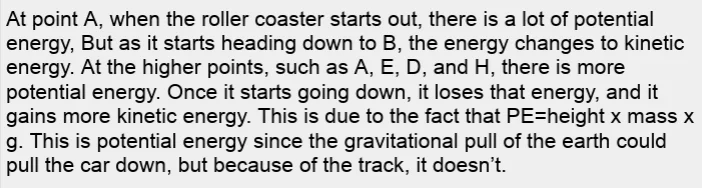 A student's completed Final Model paragraph, attempting to use the required vocabulary with the other requirements in the rubric.Copyright Rachel Kenning
Phase 4: Share, Compare, and Reflect (5 minutes)
- Have students exchange their final system models and written explanations with a peer. Instruct them to review each other's work for scientific accuracy and completeness, checking that:
- The model identifies the major physical components and illustrates the marble's motion through the roller coaster.
- The model and written explanation accurately represent transformations among potential, kinetic, and thermal energy.
- The explanation describes how friction affects the marble's motion and why total energy remains conserved.
- The explanation uses specific evidence from physical investigations and the PhET Energy Skate Park simulation to support scientific claims.
- Have students compare their final system models with their initial models from the How Does a Roller Coaster Work: Tracking Potential and Kinetic Energy activity. Ask them to identify at least one way their understanding of energy transformations or conservation has changed or become more complete.
- Allow students to make any final corrections or additions to their models and written explanations based on their peer feedback and reflections.
- Conclude the activity by inviting one or two students to share how evidence from their investigations helped them develop a more complete understanding of energy transformations and conservation within their roller coaster systems.
- kinetic energy
- The energy an object possesses because of its motion.
- potential energy
- The stored energy an object has because of its position or condition.
- mass
- The quantity of matter contained in an object, which determines its resistance to a change in motion.
- speed
- A measure of how fast an object is moving.
- height
- The vertical distance of an object above a reference point, such as the ground.
- work
- The transfer of energy that happens when an outside force moves an object across a physical distance.
- gravity
- The force of attraction that pulls objects toward the center of the Earth.
- force
- A push or pull acting on an object as a result of its interaction with another object.
This culminating activity uses pre-activity, formative, and summative assessments to evaluate students' ability to synthesize evidence from previous activities, construct comprehensive system models, and develop scientific explanations of how energy is transferred, transformed, and conserved within a roller coaster system.
Pre-Activity Assessment
Prior-Knowledge Review: Before students begin, ask them to explain potential and kinetic energy in their own words and describe how these forms of energy change as a marble travels through a roller coaster. Ask students what happens to energy when friction causes the marble to slow down or stop. Listen for evidence that students understand that some mechanical energy transforms into thermal energy and that total energy remains conserved. If students struggle, briefly review their initial roller coaster models and evidence collected during the PhET Roller Coaster Simulation: Modeling Energy in a Coaster activity.
Activity Embedded (Formative) Assessment
Final System Model Checklist: Circulate during Phase 2 (Build Your Final System Model) and review each student's developing model for the following criteria:
- System components and motion: The model identifies and labels the major physical components of the roller coaster and uses directional arrows to illustrate the marble's motion.
- Potential and kinetic energy: The model identifies relative amounts of potential and kinetic energy at three or more locations along the track and represents how these forms of energy transform as the marble moves.
- Friction and thermal energy: The model identifies where friction acts and illustrates how some mechanical energy transforms into thermal energy.
- Conservation of energy: The model indicates that total energy remains conserved even as energy transforms between different forms.
- Supporting evidence: The model incorporates evidence from students' physical roller coaster investigations and the PhET Energy Skate Park simulation.
Provide feedback as students work, prompting them to revise inaccurate representations or explanations before developing their written scientific explanations.
Initial-to-Final Model Comparison: During Phase 4 (Share, Compare, and Reflect), review students' comparisons of their initial and final system models. Look for evidence that students have incorporated new information about energy transformations, friction, thermal energy, and conservation of energy based on their investigations.
Post-Activity (Summative) Assessment
Final System Model and Scientific Explanation: Evaluate each student's final system model and written scientific explanation using the following three performance levels:
- Highly Proficient: The student constructs a comprehensive, scientifically accurate system model that identifies the roller coaster's major components, illustrates the marble's motion, and represents relative amounts of potential and kinetic energy at multiple points along the track. The model and written explanation accurately describe transformations among potential, kinetic, and thermal energy, explain how friction affects mechanical energy, and demonstrate why total energy remains conserved. The student integrates specific evidence from physical investigations and PhET simulation data to support cause-and-effect explanations and clearly demonstrates how their understanding has developed since constructing the initial model.
- Proficient: The student constructs an accurate system model that identifies the major physical components, illustrates the marble's motion, and represents potential and kinetic energy transformations at multiple points along the track. The written explanation correctly describes how mass, height, speed, and gravity affect energy, explains how friction transforms some mechanical energy into thermal energy, and recognizes that total energy remains conserved. The student uses relevant evidence from physical investigations and the PhET simulation to support their explanation.
- Developing: The student constructs a partially complete system model that identifies some physical components and aspects of the marble's motion but contains missing or inaccurate representations of energy transformations. The written explanation describes some changes in potential or kinetic energy but does not adequately explain friction, thermal energy, or conservation of energy. The student provides limited evidence from previous activities or has difficulty connecting observations and simulation data to scientific explanations.
Refer to the Roller Coaster Final Model Handout Answer Key (PDF) for an example of a completed model and scientific explanation. Ensure that the example reflects the updated expectations for energy transformations, friction, thermal energy, and conservation of energy.
Note: Comparing students' initial and final roller coaster system models provides valuable evidence of how their understanding has developed throughout the unit. See Image 3 for an example of an initial-to-final model comparison.
Refer to the Roller Coaster Final Model Handout Answer Key (PDF) for a fully worked Highly Proficient example.
Note: It is very important to compare the initial and final model to get a true sense of a student's growth over time. See Image 3 below.
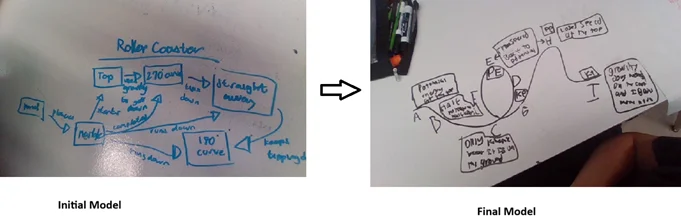 A comparison of an initial and final model as a wholistic way to assess growth over time.Copyright Rachel Kenning
This activity reuses only paper coasters, poster paper, and markers already used earlier in the unit; no new safety hazards are introduced.
Students confuse potential and kinetic energy at a point: Have them point to that spot on their coaster and ask, “Is the cart speeding up or slowing down right here?” Speeding up means potential energy is converting to kinetic energy; slowing down means kinetic energy is converting to potential energy.
Paragraph uses the eight vocabulary terms as a list rather than explaining cause and effect: Prompt students to add the word “because” immediately after each vocabulary term they use.
Team's model is missing a labeled maximum-kinetic-energy point: Remind students that the fastest point on any coaster is the lowest point of a given drop, not necessarily the lowest point of the entire track if the track has more than one hill.
A student's original roller coaster was lost, damaged, or their team is incomplete: Provide that student with a printed copy of the attached Roller Coaster Proficiency Model (PDF) to label and use instead, so the individual paragraph task is not disrupted.
Have students exchange models with a team that built a different coaster design and identify one specific track feature, such as a taller hill or a tighter loop, that would change where the maximum-kinetic-energy point occurs.
For Lower Grades (6th-7th): Reduce the required number of labeled points on the track from at least three to exactly two (one maximum-potential-energy point and one maximum-kinetic-energy point) and allow students to write their explanatory paragraph in pairs rather than independently.
For Older/Advanced Students (8th Grade Extension): Challenge students to sketch a rough energy-versus-time graph beneath their model, plotting relative potential energy, kinetic energy, and thermal energy as curves, and to explain in their paragraph why the thermal-energy curve never decreases even as potential and kinetic energy trade off.
“Conservation of Energy.” Wiktionary, Wikimedia Foundation, 2026, https://en.wiktionary.org.
“Kinetic Energy.” Wiktionary, Wikimedia Foundation, 12 June 2026, https://en.wiktionary.org.
NGSS Lead States. Next Generation Science Standards: For States, By States. National Academies Press, 2013. https://www.nextgenscience.org.
National Governors Association Center for Best Practices & Council of Chief State School Officers. Common Core State Standards for Mathematics. 2010. http://www.corestandards.org/Math.
“Potential Energy.” Wiktionary, Wikimedia Foundation, 15 June 2026, https://en.wiktionary.org.
“Thermal Energy.” Wiktionary, Wikimedia Foundation, 2026, https://en.wiktionary.org/.
Utah State Board of Education. Utah Science with Engineering Education (SEEd) Standards. 2024, https://www.schools.utah.gov/curr/science.
“Work.” Merriam-Webster's School Dictionary, Merriam-Webster, 2026, https://www.merriam-webster.com.
Contributors
Rachel Kenning, Spring Creek Middle School, Cache District, Utah (Advice from: Karen Merritt, Hillary Swanson, Idris Solola)
Supporting Program
Engineering Research Center for Advancing Sustainability through Powered Infrastructure for Roadway Electrification (ASPIRE) in the College of Engineering, Utah State University
Acknowledgements
This material was developed based upon work supported by the National Science Foundation under grant no. EEC 1941524 -- Engineering Research Center for Advancing Sustainability through Powered Infrastructure for Roadway Electrification (ASPIRE) in the College of Engineering, Utah State University. Any opinions, findings, and conclusions or recommendations expressed in this material are those of the authors and do not necessarily reflect the views of the National Science Foundation.
Copyright
2026 by Regents of the University of Colorado; original © 2025 Utah State University