
Car on a Ramp Challenge
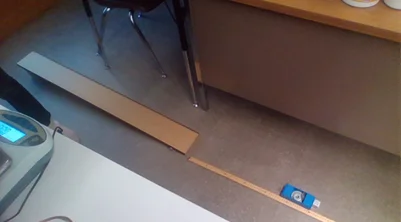 Possible student setup for the engineering design sequence.Copyright Rachel Kenning
Students investigate how mass and height affect energy and motion through a two-phase, hands-on engineering challenge. During the first phase, student teams explore a simple ramp system by rolling ping-pong and golf balls down a vinyl plank into a target cup. They make observations, ask questions, and develop an initial system model to identify factors that may affect the outcome. Teams then transition to a more controlled ramp-and-cart system and investigate how changing ramp height and cart mass affects the displacement of a wooden block. Teams plan and conduct a series of tests, analyze their data, and iteratively improve their designs to identify the lowest combination of ramp height and cart mass that moves the block more than 50 cm. Students conclude by revising their system models to show how potential and kinetic energy change within the system and use evidence from their investigations to explain cause-and-effect relationships among mass, height, motion, and energy.
Engineers design systems by considering how an object’s mass, speed, and height affect its energy and motion. Automotive engineers, for example, design vehicles and safety systems to manage the energy involved in collisions, accounting for how changes in vehicle mass and speed affect the energy that must be absorbed. Mechanical and civil engineers also design systems such as roller coasters, ramps, and other gravity-driven structures by considering how changes in height affect stored potential energy and subsequent motion. Understanding these relationships helps engineers predict system behavior, establish design criteria and constraints, test solutions, and optimize designs for performance and safety.
After this activity, students should be able to:
- Apply the engineering design process to test at least six ramp-and-cart configurations, using experimental data to identify the lowest-energy configuration among those tested that successfully moves a target block more than 50 cm.
- Explain how mass and height affect potential energy and kinetic energy within a ramp-and-cart system, using evidence from their investigations to support their explanations.
- Revise an initial system model using experimental evidence to illustrate how energy is stored, transformed, and transferred within the system and explain cause-and-effect relationships among mass, height, speed, potential energy, and kinetic energy.
- CCSS.Math.Practice.MP4 Model with mathematics.
Grades K-12
Do you agree with this alignment?
- STEL-7Q Apply the technology and engineering design process.
Grades 6-8
Do you agree with this alignment? - STEL-7R Refine design solutions to address criteria and constraints.
Grades 6-8
Do you agree with this alignment?
- MS-ETS1-1 Define the criteria and constraints of a design problem with sufficient precision to ensure a successful solution, taking into account relevant scientific principles and potential impacts on people and the natural environment that may limit possible solutions.
Grades 6-8
This resource focuses on the following Three Dimensional Learning aspects of NGSS:
Science & Engineering Practices- Define a design problem that can be solved through the development of an object, tool, process or system and includes multiple criteria and constraints, including scientific knowledge that may limit possible solutions.Do you agree with this alignment?
Disciplinary Core Ideas- The more precisely a design task's criteria and constraints can be defined, the more likely it is that the designed solution will be successful. Specification of constraints includes consideration of scientific principles and other relevant knowledge that is likely to limit possible solutions.Do you agree with this alignment?
Crosscutting Concepts- The uses of technologies and any limitations on their use are driven by individual or societal needs, desires, and values; by the findings of scientific research; and by differences in such factors as climate, natural resources, and economic conditions.Do you agree with this alignment?
- All human activity draws on natural resources and has both short and long-term consequences, positive as well as negative, for the health of people and the natural environment.Do you agree with this alignment?
Do you agree with this alignment? - Define a design problem that can be solved through the development of an object, tool, process or system and includes multiple criteria and constraints, including scientific knowledge that may limit possible solutions.
- MS-ETS1-2 Evaluate competing design solutions using a systematic process to determine how well they meet the criteria and constraints of the problem.
Grades 6-8
This resource focuses on the following Three Dimensional Learning aspects of NGSS:
Science & Engineering Practices- Evaluate competing design solutions based on jointly developed and agreed-upon design criteria.Do you agree with this alignment?
Disciplinary Core Ideas- There are systematic processes for evaluating solutions with respect to how well they meet the criteria and constraints of a problem.Do you agree with this alignment?
Do you agree with this alignment? - Evaluate competing design solutions based on jointly developed and agreed-upon design criteria.
- MS-ETS1-4 Develop a model to generate data for iterative testing and modification of a proposed object, tool, or process such that an optimal design can be achieved.
Grades 6-8
This resource focuses on the following Three Dimensional Learning aspects of NGSS:
Science & Engineering Practices- Develop a model to generate data to test ideas about designed systems, including those representing inputs and outputs.Do you agree with this alignment?
Disciplinary Core Ideas- Models of all kinds are important for testing solutions.Do you agree with this alignment?
- The iterative process of testing the most promising solutions and modifying what is proposed on the basis of the test results leads to greater refinement and ultimately to an optimal solution.Do you agree with this alignment?
Do you agree with this alignment? - Develop a model to generate data to test ideas about designed systems, including those representing inputs and outputs.
- MS-PS3-2 Develop a model to describe that when the arrangement of objects interacting at a distance changes, different amounts of potential energy are stored in the system.
Grades 6-8
This resource focuses on the following Three Dimensional Learning aspects of NGSS:
Science & Engineering Practices- Develop a model to describe unobservable mechanisms.Do you agree with this alignment?
Disciplinary Core Ideas- A system of objects may also contain stored (potential) energy, depending on their relative positions.Do you agree with this alignment?
- When two objects interact, each one exerts a force on the other that can cause energy to be transferred to or from the object.Do you agree with this alignment?
Crosscutting Concepts- Models can be used to represent systems and their interactions—such as inputs, processes and outputs—and energy and matter flows within systems.Do you agree with this alignment?
Do you agree with this alignment? - Develop a model to describe unobservable mechanisms.
- 8.2.1.a Use computational thinking to analyze data about the relationship between the mass and speed of objects and the relative amount of kinetic energy of the objects.
Grade 8
Do you agree with this alignment? - 8.2.2.a Ask questions about how the amount of potential energy varies as distance within the system changes.
Grade 8
Do you agree with this alignment? - 8.2.3 Engage in argument to identify the strongest evidence that supports the claim that the kinetic energy of an object changes as energy is transferred to or from the object. Examples could include observing temperature changes as a result of friction, applying force to an object, or releasing potential energy from an object.
Grade 8
Do you agree with this alignment?
Each group needs:
- Car on a Ramp Challenge Worksheet (PDF) (one per student)
Phase 1 – Phenomenon Exploration
- 1 ping-pong ball (approximately 2.7 g)
- 1 golf ball (approximately 46 g)
- 1 disposable paper or plastic cup
- 1 vinyl plank, approximately 15 cm × 91 cm (6 in × 36 in); For example, Achim Home Décor Nexus Vinyl Floor Plank, 10-pack (ASIN B07RR6GD6S)
- 3–5 classroom textbooks to elevate the ramp
- 1 meter stick
Phase 2 – Engineering Challenge
- 1 United Scientific dynamics cart (DNCART2, sold in sets of 2 on Amazon (ASIN B0BRQSWR1M
- 4–6 zinc-plated fender washers, ¼ in × 1¼ in — Hillman 100-pack on Amazon (ASIN B000BD8LRK)
- 2–3 Jenga wooden blocks as the target — Hasbro Jenga; blocks shared across groups
- 1 vinyl plank (from Phase 1)
- 3–5 classroom textbooks (from Phase 1)
- 1 meter stick
Students should have prior experience with the following concepts and practices from the Can Crusher Challenge:
- Basic understanding of energy as the ability to do work and familiarity with potential and kinetic energy.
- Identifying mass and height as variables that affect the amount of potential energy in a system.
- Using simple system models to represent components, interactions, and energy transformations.
- Applying the engineering design process to test different configurations, collect data, and refining a solution based on experimental evidence.
(Before students arrive, set up one ramp station per group. Rest one vinyl plank on a stack of three textbooks. Place one ping-pong ball, one golf ball, and one disposable cup at each station. Post no instructions; let the materials do the talking.)
Before we do anything today, I want you to look at what is on your table. You have a ramp, two balls, and a cup. I’m not going to explain what to do. You have five minutes. Go.
(Allow students to freely explore the materials and investigate what happens when they change different parts of the system. Circulate without directing. Expect students to start rolling the balls, knocking the cup over, adjusting the ramp height, and comparing outcomes between the two balls. Do not answer questions about what they should be discovering. Redirect with: “What do you notice? Write it down.”)
(Distribute one Car on a Ramp Challenge Worksheet (PDF) to each student.)
On your worksheet, record at least two specific observations about what you noticed and at least one question you have about why it happened. Be specific. Don’t just say, “The golf ball hit the cup harder.” Describe what you actually observed. Did the cup move farther, tip over, or stay in place? (Give students two minutes to record their observations and questions.)
Okay, what did you notice? What do you wonder? (Facilitate a brief share-out. Listen for observations that connect to mass and ramp height. Students might say, “The golf ball knocked the cup over, but the ping-pong ball didn't,” or “The cup moved farther when we raised the ramp.” Write these on the board without correcting or confirming them. If a student offers an explanation rather than an observation, redirect gently: “That's an interesting explanation. How could we turn it into a question we can investigate?”)
Think back to the Can Crusher Challenge. You investigated how changing the mass of a falling bottle and its drop height affected the energy available to crush a can. How might those same variables affect the motion of objects rolling down a ramp? (Allow students to share their ideas. Encourage them to connect their previous observations to what they just observed with the balls and ramp.)
Now let's develop a model to help explain what is happening in this system. On your worksheet, draw a simple diagram of the ramp, balls, and cup. Label the parts. Use arrows to show the direction of motion and where energy may be transferred or transformed. Where does the energy come from? Where does it go? What could you change about this system to affect the outcome? You have three minutes. (Give students three minutes to draw their diagrams.)
(Collect or photograph the initial models. Students will revise them at the end of the activity. Then collect the balls and cups from each station and replace them with Phase 2 materials: one dynamics cart, a small pile of washers, and a Jenga block.)
We are upgrading our system. Instead of two balls, you now have a cart. Instead of switching between two objects with different masses, you can add or remove washers to systematically change the mass of your cart. And instead of a cup, you have a wooden block.
Your engineering challenge is this: Design and test a ramp-and-cart system that moves the wooden block more than 50 cm while using as little energy as possible. You will plan and conduct six initial tests, changing ramp height and cart mass to investigate how each variable affects the outcome. Then, you'll use your data to refine your configuration and identify the lowest-energy setup among those you tested that successfully moves the block more than 50 cm. Think carefully about which variables you change and how you can use your results to improve your design. Let's get started!
Background
Building on the Can Crusher Challenge, this activity deepens students' understanding of potential energy and kinetic energy by investigating how mass and height affect motion and energy transfer within a ramp-and-cart system. In the previous activity, students explored how changing the mass and drop height of a falling water bottle affected the energy available to crush an aluminum can. In this activity, students apply those same principles to objects moving down an inclined plane, using controlled investigations and quantitative data to examine cause-and-effect relationships among mass, height, speed, and energy.
Potential Energy and Kinetic Energy
When a cart is positioned at the top of an elevated ramp, the cart-Earth system stores gravitational potential energy (GPE) because of the cart's height above a reference point. The amount of gravitational potential energy depends on the cart's mass (m), the acceleration due to gravity (g = 9.8 m/s²), and its vertical height (h): GPE = mgh.
As the cart rolls down the ramp, potential energy transforms into kinetic energy (KE), the energy of motion. Kinetic energy depends on the cart's mass (m) and speed (v): KE = ½mv².
Increasing the cart's mass or starting height increases its initial potential energy. Increasing the starting height generally allows the cart to reach a greater speed at the bottom of the ramp, while increasing its mass increases the amount of kinetic energy it possesses at a given speed. When the moving cart collides with the wooden block, some of its kinetic energy is transferred to the block, causing the block to move. Other energy transfers occur through friction, sound, and deformation during the collision.
In an ideal system without friction or other energy losses, the total mechanical energy remains constant as potential energy transforms into kinetic energy: Total Mechanical Energy = PE + KE.
In real systems, some mechanical energy is transformed into thermal energy through friction and other interactions. Although the amount of mechanical energy decreases, total energy is conserved when all forms of energy are considered.
At the middle school level, students investigate these relationships primarily through qualitative observations and quantitative measurements of block displacement rather than formal energy calculations.
Engineering Design and Optimization
Engineers use controlled investigations to understand how changing design variables affects system performance. In this activity, students investigate two variables: ramp height and cart mass. By changing one variable at a time while keeping other conditions consistent, students can identify how each variable affects the energy available to move the wooden block.
The engineering challenge is to identify a ramp-and-cart configuration that moves the wooden block more than 50 cm while using the least amount of initial potential energy among the configurations tested. Students conduct six planned trials, record the ramp height and cart mass for each configuration, and measure the resulting displacement of the block. They then analyze their data and refine their configurations to improve performance.
When comparing configurations with the same cart mass, a lower starting height represents less initial potential energy. Similarly, when starting height remains constant, a lower cart mass represents less initial potential energy. When both variables change, students can compare the product of total cart mass and vertical starting height (m × h) as a relative measure of potential energy because gravitational acceleration remains constant.
Students use evidence from their investigations to identify the lowest-energy successful configuration among those tested rather than assuming that the configuration with the lowest mass or lowest height necessarily uses the least energy. This process reflects how engineers evaluate trade-offs, use experimental evidence to make decisions, and optimize systems to meet performance criteria while minimizing energy requirements.
System Modeling and Scientific Explanation
Students begin by developing an initial model of a simple ramp system using rolling balls and a target cup. After completing the engineering challenge, they revise their models to represent the ramp-and-cart system, identifying its components, the direction of motion, and where energy is stored, transformed, and transferred.
By comparing their initial and revised models, students demonstrate how experimental evidence strengthens scientific explanations. This modeling process prepares them for subsequent activities in which they investigate more complex energy transformations in roller coaster systems and explore the conservation of energy through computational simulations.
Before the Activity
- Set up one ramp station per group. Rest one vinyl plank on a stack of three textbooks (approximately 15 cm height). Place one ping-pong ball, one golf ball, and one disposable cup at each station.
- Prepare a Phase 2 swap kit for each group (kept out of sight until the transition): one dynamics cart, 4–6 washers, and 2–3 Jenga blocks.
- Print one copy of the Car on a Ramp Challenge Worksheet (PDF) per student.
- Clear desk space so carts can roll freely and the Jenga block target can be placed at least 60 cm (~24 in) from the end of the ramp.
- If the activity is conducted on carpet, place a flat hardback book or a second vinyl plank flat on the floor at the base of the ramp to provide a consistent, low-friction runway for the cart after it leaves the plank.
During the Activity
Part 1: Phenomenon Exploration (10 minutes)
- Without any introduction or posted instructions, direct student groups to their pre-prepared stations (see Before the Activity) and tell them they have five minutes to freely explore the materials provided.
- Circulate and observe without directing. Listen for emerging student questions about mass (ball type) and height (book stack).
- Prompt hesitant groups with: “What happens if you change something?”
- At the five-minute mark, distribute one Car on a Ramp Challenge Worksheet (PDF) to each student.
- Instruct students to record at least two specific observations and one question on their worksheets.
- Facilitate a two-minute whole-class share-out, recording student observations on the board, loosely grouping them around mass and height (but without formally labeling them as variables yet.)
- Ask students to recall the Can Crusher Challenge and discuss how changing the mass and drop height of a falling bottle affected the energy available to crush a can. Have students predict how changing mass and ramp height might affect the motion of objects rolling down a ramp.
- Instruct students to draw an initial system model of their ramp, balls and cup in their worksheets. This drawing should include:
- Labelling of the physical components.
- Use of arrows, labels, or annotations to show the direction of motion and where energy may be transferred or transformed as the ball moves down the ramp and interacts with the cup.
- Identification of at least one variable they could change.
- Collect or photograph each group’s initial model.
- Collect all balls and cups.
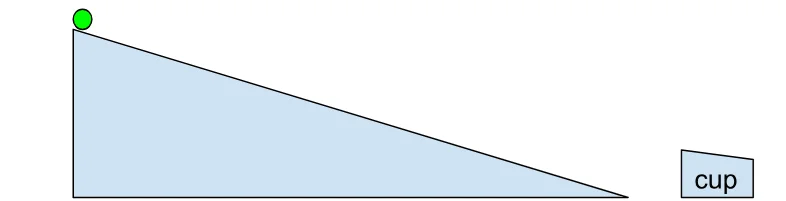 Phenomenon: Balls of different masses are rolled down a ramp.Copyright Rachel Kenning
Part 2: Engineering Challenge (25 minutes)
- Distribute Phase 2 materials to each group: one dynamics cart, 4–6 washers, and 2–3 Jenga blocks.
- Explain that students will now apply what they observed with the balls and cups and learned during the Can Crusher Challenge to a more controlled ramp-and-cart system.
- Present the engineering challenge: Design a ramp-and-cart system that moves the wooden block more than 50 cm using the least amount of energy possible.
- Ask and Research (5 minutes):
- Have students complete the Ask section of their worksheet.
- Optional: Call on a few students to share their initial questions.
- Instruct teams to identify the two variables they can change (Answers: ramp height/number of books and cart mass/number of washers) and record them in their worksheets.
- Imagine and Plan (5 minutes):
- Have teams review their Phase 1 observations and brainstorm how changing ramp height and cart mass might affect how far the block moves.
- Instruct teams to choose six test configurations, deciding how they will systematically vary height and mass.
- Encourage teams to change only one variable at a time to isolate its effect.
- Have teams identify the variables that must remain constant during testing, including the cart's release position relative to the top of the ramp, the target block's starting position, and the testing surface.
- Instruct teams to record their planned configurations in their worksheets.
- Create and Test (10 minutes):
- Have teams assemble their ramp, load the cart with their chosen number of washers, and run each of their six planned tests. For each test, students record the ramp's vertical starting height in centimeters, the cart mass (or number of washers), and the displacement of the wooden block in centimeters.
- Have teams position the wooden block at the same starting location for every trial. Instruct students to measure the block's displacement from its original position to its final position after impact. Clarify that the 50 cm design requirement refers to how far the block moves, not how far the cart travels.
- Remind students to release the cart without pushing it and to keep the ramp configuration, release position, and testing surface consistent unless those variables are intentionally being changed.
Possible student setup for the engineering design sequence.Copyright Rachel Kenning- While student teams test, circulate and prompt teams whose carts are not moving the block: “Compare the height of your starting point to the distance you need the block to travel. What would give your cart more energy at the bottom?” Prompt teams whose block moves substantially farther than 50 cm: “You’ve exceeded the goal, so now find the lowest-energy setup that still clears the mark.”)
- Improve (5 minutes):
- Instruct teams to iterate based on their data to find the exact threshold (i.e., the lowest height and least mass) that still moves the block more than 50 cm.
- Have teams record this as their optimal setup.
- At the 25-minute mark, call time.
- Ask each group to identify their optimal setup and prepare a one-sentence explanation of why it worked.
Part 3: Class Discussion (5 minutes)
- Have two or three groups demonstrate their optimal setup live for the class.
- Facilitate a class discussion: “Which group used the least amount of energy to move the block past 50 cm? How do you know? What was different about their setup?”
- Record the class consensus on the board: which variables mattered most and in which direction. Discuss how engineers use experimental evidence to evaluate trade-offs and optimize system performance.
Part 4: Model Revision and Scientific Explanation (10 minutes)
- Return students’ initial Phase 1 models, or have them reference the photograph taken at the end of Phase 1.
- Direct students to create a revised system model of the cart-and-ramp setup that:
- Labels all physical components (ramp, cart, washers, target block, book stack).
- Uses directional arrows to show the cart's motion and identifies where energy is stored, transformed, and transferred within the system.
- Labels the point of maximum potential energy (top of ramp) and maximum kinetic energy (bottom of ramp, just before impact with the block).
- Identifies which variables were changed and how changing them affected the energy in the system.
- Incorporates the scientific terms mass, height, speed, kinetic energy, and potential energy.
- Instruct students to write a concise paragraph beneath their revised model explaining how changes in mass and ramp height affected the cart's energy and the displacement of the wooden block. Have students support their explanations with evidence from their experimental data.
- Have students compare their revised model to their initial Phase 1 model and reflect: “What is the same? What did you add or change? What does your revised model explain that your first one could not?”
- energy
- The ability to do work.
- kinetic energy
- The energy an object possesses because of its motion.
- height
- The distance of an object above a reference point, such as the ground.
- mass
- The quantity of matter contained in an object.
- potential energy
- The stored energy an object has because of its position or condition.
- speed
- A measure of how fast an object is moving.
- system
- A group of related parts that interact and work together as a whole.
- work
- The transfer of energy that occurs when a force causes an object to move or change.
Pre-Activity Assessment
Phase 1 Exploration Model: While students freely explore with the balls and ramp, circulate and observe whether students spontaneously begin controlling variables (e.g., same height, different balls; same ball, different heights). Look for evidence that students recognize how changes in mass and ramp height may affect the motion of the balls and the displacement of the cup. Groups that have not yet noticed either relationship may need a targeted prompt before Phase 2: “Try the same ball from two different heights. What changes?”
Review students' initial system models to assess their ability to identify the major physical components, represent motion and possible energy transfers or transformations, and identify variables that could affect the system. Use these models as a baseline for evaluating how students apply and extend their understanding from the Can Crusher Challenge.
Activity Embedded (Formative) Assessment
Six-Test Data Table: During the engineering challenge, review each group’s data table and observe its testing process. Look for evidence that teams make deliberate decisions about which variables to change rather than testing configurations randomly. Check that students change one variable at a time during at least some trials, accurately record the ramp height, number of washers, and resulting displacement of the block for each test, and use their results to inform subsequent tests.
Design Iteration: As teams test and improve their designs, ask students to explain how their data are informing their decisions. Look for teams using evidence from previous trials to identify the lowest combination of ramp height and cart mass that successfully moves the block more than 50 cm, rather than simply selecting the configuration that moves the block the farthest.
Initial System Model: Review students’ initial system models as a baseline for their understanding of the system. Look for whether students identify the major physical components, represent the movement or transfer of energy, and identify variables that could affect the system. Students are not expected to use formal potential and kinetic energy terminology accurately at this stage.
Post-Activity (Summative) Assessment
Revised System Model and Written Explanation: Evaluate each student's revised model and written paragraph against the example proficient model (See Image 3). Assess using the following three performance levels:
- Highly Proficient: The model labels all components, uses directional arrows to show energy transfer, and explicitly identifies potential energy at the top of the ramp and kinetic energy at the bottom. The written explanation connects mass and height to energy using scientific vocabulary, identifies the minimum setup that met the design constraint, and explains why that setup was optimal using evidence from their data.
- Proficient: The model correctly shows the direction of energy transfer and labels PE and KE. The written explanation accurately connects at least one variable (mass or height) to the outcome and references their data as evidence.
- Developing: The student can describe what happened during testing but does not use PE or KE vocabulary in their model or cannot connect a specific change in a variable to a specific change in the block's displacement. These students would benefit from revisiting the class consensus data before the next activity.
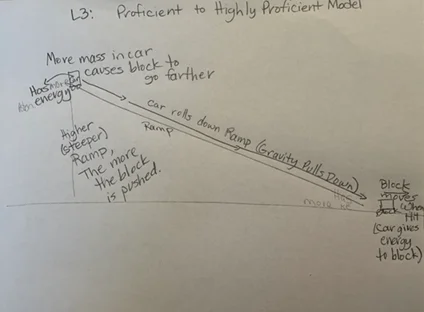 Example proficiency model.Copyright Rachel Kenning
- Projectile prevention: Golf balls can roll off desks at speed during Phase 1. Instruct students to keep a hand ready to stop the ball at the table edge and to direct the ramp toward open floor space rather than toward other students or fragile equipment.
- Cart runoff: During Phase 2, the dynamics cart can travel well beyond the Jenga block target if released from a steep ramp angle. Orient each ramp toward an open wall or clear floor area rather than toward adjacent student groups.
- Cart not reaching the block: If the cart consistently stops before reaching the Jenga block, check that the vinyl plank rests flush with the floor at the base of the ramp. Even a small lip between the plank and the floor can abruptly stop the cart. Place a flat hardback book or second vinyl plank at the base of the ramp to create a smooth transition.
- Jenga block tipping instead of sliding: If the Jenga block tips over rather than sliding forward, stack two or three blocks to create a taller, more stable target.
- Washers falling off the cart: If washers slide out of the dynamics cart’s top-mounted mass well during a run, stack them flat in the center of the well. If needed, use a small piece of masking tape to secure them.
- Carpeted surfaces: Carpet can significantly slow the cart after it leaves the ramp. Place a flat hardback book or second vinyl plank on the floor at the base of the ramp to create a consistent, low-friction surface through the target zone.
Have students recreate their optimal ramp design in the PhET Energy Skate Park simulation (https://phet.colorado.edu) in Playground mode and use the real-time energy bar graphs to observe how potential energy and kinetic energy shift as the skater moves through matching heights and slopes.
For Lower Grades (6th–7th):
Focus strictly on qualitative comparisons during the engineering challenge. Rather than measuring the exact displacement of the Jenga block in centimeters, have students categorize each test as “moved a little,” “moved a lot,” or “did not move.” Use these categories to identify the best and worst setups before connecting to the concepts of mass and height.
For Older/Advanced Students (8th Grade Extension):
Challenge students to calculate the potential energy of their optimal setup using the formula PE = mgh, where m is the measured mass of their cart plus washers in kilograms, g = 9.8 m/s², and h is the measured height of the top of the ramp in meters. Have them compare their calculated PE values across their six test configurations and determine whether the ranking matches what they observed in the displacement data.
“Energy.” Wiktionary, Wikimedia Foundation, June 2026, https://en.wiktionary.org.
“Height.” Wiktionary, Wikimedia Foundation, June 2026, https://en.wiktionary.org.
“Kinetic Energy.” Wiktionary, Wikimedia Foundation, June 2026, https://en.wiktionary.org.
“Mass.” Wiktionary, Wikimedia Foundation, June 2026, https://en.wiktionary.org.
NGSS Lead States. Next Generation Science Standards: For States, By States. National Academies Press, 2013. https://www.nextgenscience.org.
“Potential Energy.” Wiktionary, Wikimedia Foundation, June 2026, https://en.wiktionary.org.
Utah State Board of Education. Utah Science with Engineering Education (SEEd) Standards. 2024, https://www.schools.utah.gov/curr/science.
“Work.” Wiktionary, Wikimedia Foundation, June 2026, https://en.wiktionary.org.
Contributors
Rachel Kenning, Spring Creek Middle School, Cache District, Utah (Advice from: Karen Merritt, Hillary Swanson, Idris Solola)
Supporting Program
Engineering Research Center for Advancing Sustainability through Powered Infrastructure for Roadway Electrification (ASPIRE) in the College of Engineering, Utah State University
Acknowledgements
This material was developed based upon work supported by the National Science Foundation under grant no. EEC 1941524—Engineering Research Center for Advancing Sustainability through Powered Infrastructure for Roadway Electrification (ASPIRE) in the College of Engineering, Utah State University. Any opinions, findings, and conclusions or recommendations expressed in this material are those of the authors and do not necessarily reflect the views of the National Science Foundation.
Copyright
2026 by Regents of the University of Colorado; original © 2025 Utah State University