
Computer Simulation of the Sonoran Desert Community
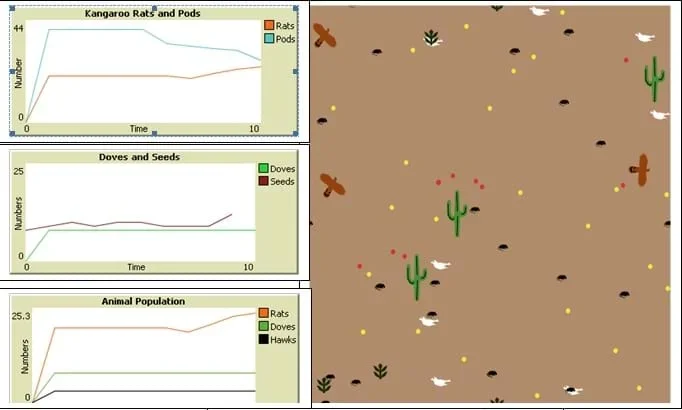 Computer simulation of the Sonoran Desert community.Copyright 2006 Wendy Holmgren, Vanderbilt University
Use of the computer program's simulation of a Sonoran Desert community ultimately strengthens students' comprehension of what is required for a natural ecosystem to sustain itself (remain in balance). This computer simulation program has great flexibility. Students can manipulate the population numbers of five Sonoran Desert species. A species natural history attachment provides vital information for students to familiarize themselves with each species' behaviors, niche and food resource needs. The program includes two producers, Saguaro cactus and Ironwood Tree. It also includes three consumers, but their interactions both toward the producers and each other differ. The community's ability to remain in balance and sustain all five species so that none die out rests on students' assessment skills enabling them to correctly identify these dependencies. Students learn by trial and error as they continue to fine tune the ecosystem for which they maintain stewardship.
This activity provides direct application in utilizing a computer simulation to allow the biologist (student) an opportunity to assess and measure the responses of a community to measurable changes within individual populations. At its simplest level of use, it permits the student a means by which to understand the interconnectedness of all species to one another. As this Legacy Cycle module continues to explore natural systems, it adds dimension to the student's ability to fully appreciate that a disturbance does not have a single outcome. As one computer program variable is altered, the student assesses the impact to the entire community. Similar programs can be a valuable tool to assist in understanding perturbations within the natural world while evaluating proposed human disturbances. This technology extends students the opportunity to manipulate and measure the effect of these changes.
After this activity, students should be able to:
- Understand how computer simulations enable biologists to study biological models.
- Understand that a species' population is dynamic and not static.
- Develop a deeper understanding for how a community's health is dependent upon the species and type of species that live there. Each species has a vital role in the overall functioning of the ecosystem.
- Explain why producers must outnumber consumers, and consumers must outnumber predators.
- Explain why pollination is a vital role carried out by pollinators.
- Explain why competition is an important parameter within communities.
- Assess and measure the responses of a community to measurable changes within individual populations, providing the students a way to understand the interconnectedness of all species to one another.
- See the connection between ecological relationships of organisms to the fundamentals of engineering design.
- Use computers and calculators to access, retrieve, organize, process, maintain, interpret, and evaluate data and information in order to communicate.
Grades 9-12
Do you agree with this alignment? - STEL-2V Analyze the stability of a technological system and how it is influenced by all the components in the system, especially those in the feedback loop.
Grades 9-12
Do you agree with this alignment? - STEL-8N Use various approaches to communicate processes and procedures for using, maintaining, and assessing technological products and systems.
Grades 9-12
Do you agree with this alignment?
- 5-LS2-1 Develop a model to describe the movement of matter among plants, animals, decomposers, and the environment.
Grade 5
Do you agree with this alignment?
- 5.3.3 Students will describe relationships within an ecosystem.
Grades 3-5
Do you agree with this alignment?
- HS-LS2-1 Use mathematical and/or computational representations to support explanations of factors that affect carrying capacity of ecosystems at different scales.
Grades 9-12
This resource focuses on the following Three Dimensional Learning aspects of NGSS:
Science & Engineering Practices- Use mathematical and/or computational representations of phenomena or design solutions to support explanations.Do you agree with this alignment?
Disciplinary Core Ideas- Ecosystems have carrying capacities, which are limits to the numbers of organisms and populations they can support. These limits result from such factors as the availability of living and nonliving resources and from such challenges such as predation, competition, and disease. Organisms would have the capacity to produce populations of great size were it not for the fact that environments and resources are finite. This fundamental tension affects the abundance (number of individuals) of species in any given ecosystem.Do you agree with this alignment?
Crosscutting Concepts- The significance of a phenomenon is dependent on the scale, proportion, and quantity at which it occurs.Do you agree with this alignment?
Do you agree with this alignment? - Use mathematical and/or computational representations of phenomena or design solutions to support explanations.
- Science concepts. The student recognizes multiple forms of energy and knows the impact of energy transfer and energy conservation in everyday life. The student is expected to:
Grades 9-10
Do you agree with this alignment?
- Each student needs a copy of the species list handout.
- Access to computers which have the NetLogo software downloaded.
- Sonoran Desert simulation downloaded into the student computers.
In the activity, we will first familiarize ourselves with 5 desert species with regard to their behaviors and feeding preferences. These same 5 species are featured in a computer simulation program that allows you to change their population numbers and watch the impact this has on the community. You will receive a simulation assignment sheet that includes directions for you to carefully follow. You will record your data after reading data graphs that plot the changes in population densities for these desert species. You will be allowed to modify the settings of the simulation and measure the differences in species densities. It is highly probably that you will witness species decline and eventual death within this community. It is your responsibility to maximize the health of this community and maintain all five species in balance. What does each species provide to the other species within this food web? What does each species require in order to continue to live and reproduce new generations? Is it easy to keep this system in balance? This activity begins the Test Your Mettle component of the Legacy Cycle. Are you able to analyze the species' dependencies with the knowledge you have gained since the beginning of this module? Analyze the species information critically and proceed. The simulation's outcome(s) will determine how capably you steward your community.
Legacy Cycle Information
This activity begins the Test Your Mettle segment of the Legacy Cycle. Students will now apply their understanding of the ecological principles studied to the computer simulation model. If they have a sound comprehension of food webs, predator-prey interactions, the importance of pollination, and the interaction of species competition both from lecture and from the handout for this activity, they will grasp the intricacies of each change that they initiate to the simulation.
Background
This simulation's program is written using NetLogo, a "programmable modeling environment for simulating natural and social phenomena." NetLogo runs on Windows Vista, XP, 2000, NT, ME, and 98. Specific information regarding system requirements can be obtained at http://ccl.northwestern.edu/netlogo/docs/.
NetLogo must be downloaded prior to using this simulation. Go to the following link to access the downloadable application: http://ccl.northwestern.edu/netlogo/download.shtml.
NetLogo provides an Educator's Group capable of responding to your questions regarding this software. It can be accessed at the above link. Once NetLogo is downloaded, the Sonoran Desert simulation program may then be opened by clicking on "File -> Open..." and entering:
in the space for the file name. Be patient, as it may take a minute or two to load. You may receive a warning message similar to "This model was created in NetLogo 4.0.2. You may need to make changes for it to work in NetLogo 5.0.3". Don't worry! Choose the "continue" option and the Sonoran Desert simulation program will open in NetLogo.
The Species Information Handout provides critical information for the students to read and become familiar with prior to beginning the simulation. They should receive this information and the Pre-Simulation Questions Handout either to read the day before in class or as a homework assignment. When they sit down in front of the computer, students should already understand that the saguaro cacti are dependent upon the white-winged dove for pollination in order to set fruit. They should realize that the ironwood tree produces seed pods that are only valuable to the squirrels, but that both the squirrels and doves compete for the fruit and seeds of the saguaro. Hawks are predators to both the squirrels and the doves. If necessary, review or prompt the students with questions until they demonstrate a strong aptitude for these relationships.
It is recommended that the teacher first familiarize himself or herself with the abilities of this computer model. The simulation's program is written to respond to spatial interactions between species and food resources as viewed on the computer screen. If white-winged doves fall to critical levels or their population crashes, the saguaro cacti will not be pollinated and fruit will not be produced. If squirrel populations climb too greatly, competition will intensify between the squirrels and the doves. Hawk populations are dependent upon large populations of their two prey species.
The simulation's plot lines allow the student to graphically view these relationships. Sliders are implemented which give the simulation an invaluable component for student learning. Students may view single interactions and continue to analyze the effect of either changing that species' population density or instead adding additional species into the simulation's community of organisms.
Before the Activity
Photocopy the attached handouts providing each student with a copy.
- Sonoran Desert Community – Species Information Handout.
- Sonoran Desert Species Pre-Simulation Questions Handout.
- Manipulate and Create a Balanced Sonoran Desert Ecosystem Handout.
With the Students
- Describe the activity by presenting the introduction for the activity as discussed above.
- When students are seated at the computers, go over the simulation's screen and all of its options with them.
- Explain how to use the slider bars to alter the species beginning population densities.
- Explain how to set the speed control bar at the top and how to stop the simulation at its end.
Activity Embedded Assessment: Review and grade this assignment to determine whether students correctly weigh and gauge the impact of the five species on one another and the overall health of this community.
For lower grades, provide more time for group discussions or go through modeling as a class demonstration while the teacher solicits student responses and ideas.
https://www.teachengineering.org/collection/van_/activities/van_biomimicry_activity4/activity4_desert_computer_simulation_program.nlogo
- Sustainable Design and Biomimicry in a Desert Ecosystem
Contributors
Wendy J. Holmgren; Megan Johnston; Amber Spolarich
Supporting Program
VU Bioengineering RET Program, School of Engineering, Vanderbilt University
Acknowledgements
The contents of this digital library curriculum were developed under National Science Foundation RET grant nos. 0338092 and 0742871. However, these contents do not necessarily represent the policies of the NSF, and you should not assume endorsement by the federal government.
Copyright
2006 by Regents of the University of Colorado; original © 2006 Vanderbilt University