
Biomimicry and Sustainable Design: Nature as Engineering Marvel
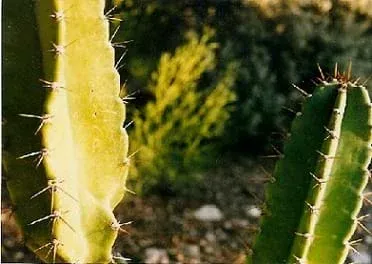 Desert adaptations of cactus.Copyright 2006 Wendy J. Holmgren, Vanderbilt University
Students are introduced to the concepts of biomimicry and sustainable design. Students can use the associated activities to see how engineers gain inspiration from studying nature and its unique properties. Countless examples illustrate the wisdom of nature in how organisms are adapted for survival, such as in body style, physiological processes, water conservation, thermal radiation and mutualistic relationships, to assure species perpetuation. Students learn from articles and videos, building a framework of evidence substantiating the indisputable fact that organisms operate "smarter" and thus provide humans with inspiration in how to improve products, systems and cities. As students focus on applying the ecological principles of the previous lessons to the future design of our human-centered world, they also learn that often our practices are incapable of replicating the precision in which nature completes certain functions, as evidenced by our dependence on bees as pollinators of the human food supply. The message of biomimicry is one of respect: study to improve human practices and ultimately protect natural systems. This heightened appreciation helps students to grasp the value of industry and urban mimetic designs to assure protection of global resources, minimize human impact and conserve nonrenewable resources. All of these issues aid students in creating a viable guest resort in the Sonoran Desert.
Many of nature's adaptations result in the conservation of energy and reduction of waste, which are variables of immeasurable interest to engineers and manufacturers. Aeronautical engineers have long studied the flight capabilities of hovering hummingbird and spiraling steep dives of peregrine falcons. For the 2009 Olympics, Speedo designed Fastskin® body suits to mimic shark scale design that prevents eddies and vortexes from forming and creating drag. Engineers of all types directly benefit from the study of biomimicry and the application of sustainable design. While biomimicry enables humans to imitate, we are incapable of replacing and replicating the studied species, as evidenced by colony collapse disorder and the unexplainable loss of bees as pollinators, which is causing farmers of orchard, berry and vegetable crops tremendous economic hardship.
After this lesson, students should be able to:
- Define biomimicry and provide examples from the natural world that have been copied for human gain.
- Explain how biomimicry supports sustainable design and why humans cannot simply replace natural systems with human designs.
- Explain how aeronautical design has benefited from biomimicry.
- Explain "Nature's Nine Laws" as stated by Janine Benyus. Defend why these laws should or should not be widely implemented.
- Demonstrate a grasp of how the function of natural systems is dependent upon its endemic species and their unique adaptations.
- Provide a solution for approaching and improving the ways in which we design products, systems and cities by incorporating biomimicry in their individual designs.
- CCSS.Math.Content.HSF-IF.B.4 For a function that models a relationship between two quantities, interpret key features of graphs and tables in terms of the quantities, and sketch graphs showing key features given a verbal description of the relationship.
Grades 9-12
Do you agree with this alignment? - CCSS.Math.Content.HSF-IF.C.7e Graph exponential and logarithmic functions, showing intercepts and end behavior, and trigonometric functions, showing period, midline, and amplitude.
Grades 9-12
Do you agree with this alignment? - CCSS.Math.Content.HSF-LE.A.2 Construct linear and exponential functions, including arithmetic and geometric sequences, given a graph, a description of a relationship, or two input-output pairs (include reading these from a table).
Grades 9-12
Do you agree with this alignment?
- Not all problems are technological, and not every problem can be solved using technology.
Grades 9-12
Do you agree with this alignment? - STEL-6F Relate how technological development has been evolutionary, often the result of a series of refinements to basic inventions or technological knowledge.
Grades 9-12
Do you agree with this alignment?
- 5-LS2-1 Develop a model to describe the movement of matter among plants, animals, decomposers, and the environment.
Grade 5
Do you agree with this alignment?
- 5.3.3 Students will describe relationships within an ecosystem.
Grades 3-5
Do you agree with this alignment?
- Science concepts. The student recognizes multiple forms of energy and knows the impact of energy transfer and energy conservation in everyday life. The student is expected to:
Grades 9-10
Do you agree with this alignment?
Legacy Cycle Information
As with Activity 4a, this lesson continues the Test Your Mettle phase in which students are asked to demonstrate their grasp of how the function of natural systems is dependent upon its endemic species and their unique adaptations. These adaptations, when studied, often provide insight into ways in which engineering problems can be resolved or improved upon. The information covered in this lesson and its accompanying activities exposes students to learning opportunities available in the biomes and ecosystems that they have just studied. They are provided with valuable examples of innovative ways to consider approaching their Challenge Question from the direction of sustainable design. This lesson concludes with the first aspect of Go Public and involves a test over the entire subject matter covered in this module.
Lecture Information
The concepts of this lesson are provided in the many linked articles. This information provides definitions and explanations as well as supplemental visuals. Nature is resilient and creative in its approaches to successful existence. Janine Benyus, author of "Biomimicry: Innovation Inspired by Nature," provides a list of Nature's 12 Laws that are natural properties that must be considered for any biomimetic design. Her rich arguments supported by examples found in nature are viewable at https://www.youtube.com/watch?v=n77BfxnVlyc.
This is a critical component of this lesson. Benyus articulately defines the concept of biomimicry and outlines the arguments for its implementation in sustainable design. She strongly advocates for researchers, engineers and manufacturers to focus on nature as a primary model, measure and mentor for all future design considerations. After listening to Benyus, the following articles provide valuable references to biomimicry application and a variety of visual reinforcements.
- "How Biomimicry Works" by Robert Lamb: https://science.howstuffworks.com/life/evolution/biomimicry.htm. This article explores how biology and engineering are bridged by biomimicry, which helps improve current and future technology by looking at the innovation of the natural world. The article provides examples of biomimicry that are currently found in industry and describes "Nature's Nine Laws":
- Nature runs on sunlight.
- Nature uses only the energy it needs.
- Energy fits form to function.
- Energy recycles everything.
- Nature rewards cooperation.
- Nature banks on diversity.
- Nature demands local expertise.
- Nature curbs excess from within.
- Nature taps the power of limits.
- "Biomimetics: Design by Nature" National Geographic Magazine: http://ngm.nationalgeographic.com/print/2008/04/biomimetics/tom-mueller-text. This article describes the unique adaptations that organisms have in response to their environment. Because of these adaptations, scientists are now studying them in order to replicate their designs to solve problems in engineering, materials science and medicine. Examples include butterfly iridescence, lizard hydrophobic skin, termite's ability to regulate temperature in mounds, and spider silk strength.
- "Biomimetics, technology that mimics nature," by Rhett Butler: https://news.mongabay.com/2005/07/biomimetics-technology-that-mimcs-nature/. This article clarifies the definition of biomimetics, provides specific examples of biomimicry in action, and lists several potential exploration areas.
- "Biomimicry" https://biomimicry.org/what-is-biomimicry/. This article provides specific examples of biomimicry that may shape the future. These include self-cleaning surfaces, redesigned signs, the lotus effect, carpet coloring and sustainable agriculture systems.
- "The NEXT Industrial Revolution" The Atlantic Online: https://www.theatlantic.com/magazine/archive/1998/10/the-next-industrial-revolution/304695/. This article describes "eco-efficiency" and the impact of biomimicry as a potential solution to the problems that industry creates.
- "Self-Cleaning Materials" by Peter Forbes, pp. 88-95; August 2008. If this specific magazine is not available, visit https://www.scientificamerican.com/article/self-cleaning-materials/ for an online version of the key concepts. "Self-Cleaning Materials" describes the lotus plant ability to repel dirt and its application to self-cleaning and antibacterial materials and microfluidic devices.
Human-designed systems—cities, industries, product manufacturers, agriculture, industrial and personal fuel demands and expenditures—all share something in common. In large part, all of these systems harm the planet and its natural resources through depletion or pollution. Consider what you have just learned about natural systems that have been "designed" over countless millions of years. Nature recycles, decomposes and operates solely within the realm of organic, nontoxic chemistry. Its species provide for one another as members of communities and food webs. Energy is efficiently managed and waste is minimized through the cooperative dependency of producers, consumers, scavengers and decomposers.
How does nature accomplish that what civilization has failed miserably with—despite the support of academia, governments and human intelligence? Can we benefit from studying these systems in their areas of energy usage, community design, species adaptations? Might this study reveal innovative ways to design future products or implement urban patterns that emulate the successful reduction of pollutants witnessed within ecosystems?
During this lesson, countless examples will illustrate the wisdom of nature and the means by which organisms are adapted (to name only a few) in their body styles, physiological processes, water conservation, thermal radiation and mutualistic relationships to assure their species continuing perpetuation within their environment and through the conservative use of its unique limiting factors. In large measure, all of these adaptations result in the minimization of energy expense and the reduction of waste. These two variables are of immeasurable interest to design engineers and manufacturers. Speedo featured its Faskin® body suits at the 2009 Summer Olympics; the swim suit material was designed to mimic shark scale design that prevents eddies and vortexes from forming and creating drag. New world records were made. Aeronautical engineers have long studied the flight capabilities of the hovering hummingbird and spiraling steep dives of peregrine falcons for inspiration in aircraft design. Refer to the Bird Flight Adaptations: Inspiration for Aeronautical Engineering activity to have students learn about real-life engineering applications. Numerous articles and videos are referenced in this unit. Each strengthens the framework of evidence in substantiating the indisputable fact that organisms operate "smarter." This provides humans with pragmatic solutions for approaching and improving the ways in which we design products, systems and cities. In some cases, biomimicry is challenged to rival nature's design; students can investigate such scenarios in the activity Bees: The Invaluable Master Pollinators where engineers struggle to find sustainable and viable solutions.
The Test Your Mettle phase of the Legacy Cycle continues. Analyze the benefits of each biomimicry example discussed in this lesson. How has our industrialized civilization performed this process or production up until now? Why is nature's way smarter? What earlier outcome is avoided or improved upon when biomimicry is implemented? Should we reevaluate all process implements as we move into the future? This section gives you an opportunity to apply natural laws to human innovation. What considerations should be adopted as we move forward? Do humans have limitations as to how well we are capable of mimicking nature?
Post-Lesson Assessment
Questions: Ask students the following discussion questions to gauge their comprehension:
- What is the difference between biomimicry and sustainable design?
- Why is biomimicry viewed as an important model for future design and manufacturing systems?
- What adaptations should we study if we focus on the success of a rainforest compared to the desert?
- Are economic considerations a part of the strength or weakness of biomimicry study?
Test: Administer the Sonoran Ecology Test (PDF) to assess student learning. Note that some graphs need to be drawn in before copying for students. The Sonoran Ecology Test Answer Key (PDF) suggests some images that support the first section answers.
How Biomimicry Works. http://science.howstuffworks.com/evolution/biomimicry.htm/printable
Biomimetics: Design by Nature. http://ngm.nationalgeographic.com/print/2008/04/biomimetics/tom-mueller-text
Biomimetics, Technology that Mimics Nature. http://news.mongabay.com/2005/0711-rhett_butler.html
Biomimicry https://intercontinentalcry.org/biomimicry/
The NEXT Industrial Revolution. http://www.theatlantic.com/doc/print/199810/environment
- Sustainable Design and Biomimicry in a Desert Ecosystem
- Designing a Sustainable Guest Village in Saguaro National Park
- Food Chains and Food Webs - Balance within Natural Systems
- Biomes and Population Dynamics - Balance within Natural Systems
- Biomimicry and Sustainable Design: Nature as Engineering Marvel
Contributors
Wendy J. Holmgren
Supporting Program
VU Bioengineering RET Program, School of Engineering, Vanderbilt University
Acknowledgements
The contents of this digital library curriculum were developed under National Science Foundation RET grant nos. 0338092 and 0742871. However, these contents do not necessarily represent the policies of the NSF, and you should not assume endorsement by the federal government.
Copyright
2013 by Regents of the University of Colorado; original © 2006 Vanderbilt University