
Sustainable Design and Biomimicry in a Desert Ecosystem
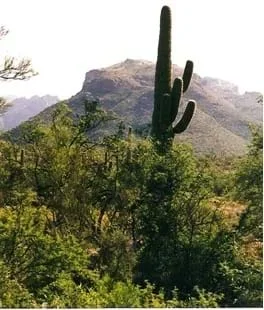 Students design for the Saguaro National ParkCopyright Wendy H. Holmgren (author); used with permission
This four-lesson "legacy cycle" unit for science and technology classes is structured with a contextually-based Grand Challenge followed by a sequence of instruction in which students first offer initial predictions (Generate Ideas) and then gather information from multiple sources (Multiple Perspectives). This is followed by Research and Revise as students integrate and extend their knowledge through a variety of learning activities. The cycle concludes with formative (Test Your Mettle) and summative (Go Public) assessments that lead students towards answering the Challenge question. See below for the progression of the legacy cycle through the unit. Research and ideas behind this way of learning may be found in How People Learn, (Bransford, Brown & Cocking, National Academy Press, 2000); see the entire text at https://www.nap.edu/read/9853/chapter/1
The "legacy cycle" is similar to the "engineering design process" in that they both involve identifying an existing societal need, combining science and math to develop solutions, and using the research conclusions to design a clear, conceived solution to the original challenge. Though the engineering design process and the legacy cycle depend on correct and accurate solutions, each focuses particularly on how the solution is devised and presented. See an overview of the engineering design process at https://www.teachengineering.org/populartopics/designprocess
The study of ecological processes that stress the strategies of energy conservation along with recycling of resources in the absence of waste and pollution are time-tested models for industry and urban design. They provide examples of sustainable design and biomimicry. The engineering fields of civil, aeronautical, manufacturing, automotive, electrical and architectural have benefited from the ingenuity observed within ecosystems.
- HS-LS2-1 Use mathematical and/or computational representations to support explanations of factors that affect carrying capacity of ecosystems at different scales.
Grades 9-12
This resource focuses on the following Three Dimensional Learning aspects of NGSS:
Science & Engineering Practices- Use mathematical and/or computational representations of phenomena or design solutions to support explanations.Do you agree with this alignment?
Disciplinary Core Ideas- Ecosystems have carrying capacities, which are limits to the numbers of organisms and populations they can support. These limits result from such factors as the availability of living and nonliving resources and from such challenges such as predation, competition, and disease. Organisms would have the capacity to produce populations of great size were it not for the fact that environments and resources are finite. This fundamental tension affects the abundance (number of individuals) of species in any given ecosystem.Do you agree with this alignment?
Crosscutting Concepts- The significance of a phenomenon is dependent on the scale, proportion, and quantity at which it occurs.Do you agree with this alignment?
Do you agree with this alignment? - Use mathematical and/or computational representations of phenomena or design solutions to support explanations.
- Day 1: Designing a Sustainable Guest Village in Saguaro National Park lesson
- Day 2: Designing a Winning Guest Village in Saguaro National Park activity (Note: 45 minutes to introduce the activity; then several weeks for teams to prepare presentations; see the Procedure section for details)
- Day 3-4: Food Chains and Food Webs - Balance within Natural Systems lesson
- Day 5: Constructing Sonoran Desert Food Chains and Food Webs activity
- Day 6-9: Biomes and Population Dynamics - Balance within Natural Systems lesson
- Day 10-11: Computer Simulation of the Sonoran Desert Community activity
- Day 12-14: Biomimicry and Sustainable Design: Nature as Engineering Marvel lesson
- Day 15-16: Bird Flight Adaptations: Inspiration for Aeronautical Engineering activity
- Day 17: Bees: The Invaluable Master Pollinators activity
- Sustainable Design and Biomimicry in a Desert Ecosystem
Contributors
Wendy H. Holmgren; Megan Johnston; Amber Spolarich
Supporting Program
VU Bioengineering RET Program, School of Engineering, Vanderbilt University
Acknowledgements
The contents of this digital library curriculum were developed under National Science Foundation RET grant nos. 0338092 and 0742871. However, these contents do not necessarily represent the policies of the NSF, and you should not assume endorsement by the federal government.
Copyright
2013 by Regents of the University of Colorado; original © 2006 Vanderbilt University