
Food Chains and Food Webs - Balance within Natural Systems
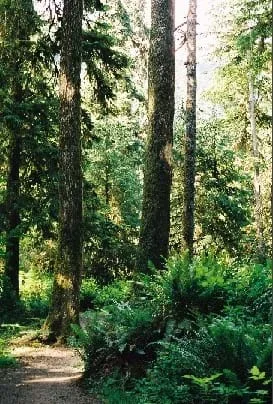 A temperate rainforest in the Olympic National Park.Copyright 2006 Wendy J. Holmgren, Vanderbilt University
With a continued focus on the Sonoran Desert, students are introduced to the concepts of food chains and food webs through a PowerPoint® presentation. They learn the difference between producers and consumers and study how these organisms function within their communities as participants in various food chains. They further understand ecosystem differences by learning how multiple food chains link together to form intricate and balanced food webs. At lesson end, students construct food webs using endemic desert species.
Engineers must first be familiar with the subject matter and environment particulars before they design anything for that environment. This lesson lays the foundations for understanding how natural systems provide for themselves. As students continue in their study of ecological relationships, connections begin to form that enable them to connect ecological relationships to the fundamentals of engineering design.
After this lesson, students should be able to:
- Explain what both a food chain and food web are and how they differ.
- Describe the types of organisms found within a community and how they link to form feeding relationships.
- Construct food chains when provided a list of organisms within a community.
- Construct a food web from separate food chains.
- Explain how they will apply this knowledge to help solve the greater challenge question posed in Lesson 1.
- STEL-2V Analyze the stability of a technological system and how it is influenced by all the components in the system, especially those in the feedback loop.
Grades 9-12
Do you agree with this alignment? - STEL-7Y Optimize a design by addressing desired qualities within criteria and constraints.
Grades 9-12
Do you agree with this alignment?
- 5-LS2-1 Develop a model to describe the movement of matter among plants, animals, decomposers, and the environment.
Grade 5
Do you agree with this alignment?
- 5.3.3 Students will describe relationships within an ecosystem.
Grades 3-5
Do you agree with this alignment?
- HS-LS2-4 Use a mathematical representation to support claims for the cycling of matter and flow of energy among organisms in an ecosystem.
Grades 9-12
This resource focuses on the following Three Dimensional Learning aspects of NGSS:
Science & Engineering Practices- Use mathematical representations of phenomena or design solutions to support claims.Do you agree with this alignment?
Disciplinary Core Ideas- Plants or algae form the lowest level of the food web. At each link upward in a food web, only a small fraction of the matter consumed at the lower level is transferred upward, to produce growth and release energy in cellular respiration at the higher level. Given this inefficiency, there are generally fewer organisms at higher levels of a food web. Some matter reacts to release energy for life functions, some matter is stored in newly made structures, and much is discarded. The chemical elements that make up the molecules of organisms pass through food webs and into and out of the atmosphere and soil, and they are combined and recombined in different ways. At each link in an ecosystem, matter and energy are conserved.Do you agree with this alignment?
Crosscutting Concepts- Energy cannot be created or destroyed—it only moves between one place and another place, between objects and/or fields, or between systems.Do you agree with this alignment?
Do you agree with this alignment? - Use mathematical representations of phenomena or design solutions to support claims.
- Science concepts. The student recognizes multiple forms of energy and knows the impact of energy transfer and energy conservation in everyday life. The student is expected to:
Grades 9-10
Do you agree with this alignment?
A basic understanding of biotic and abiotic interactions within a natural community.
Legacy Cycle Information
This is the first lesson in the Research and Revise phase in which students are introduced to food chains and food webs. The information covered in both this lesson and the next provide students with the understanding of ecological relationships necessary for them to approach the Challenge Question from the direction of sustainable design.
Lecture Information
The lesson concepts are provided in the Lesson 1 and 2 Ecology Lecture Supplement (PPT), a PowerPoint® file. This information provides definitions and explanations as well as supplemental visuals.
At presentation end, hand out the Energy through an Ecosystem Worksheet (PDF) and give students about 10 minutes to complete its seven questions.
The following is an outline of the key concepts: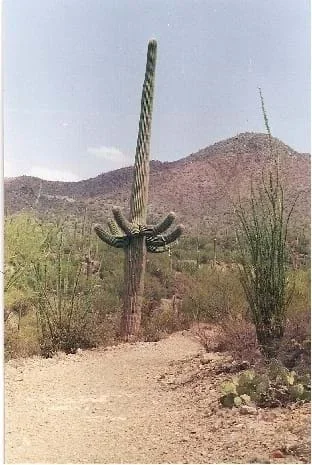 Sonoran Desert landscape within Saguaro National Park.Copyright 2006 Wendy J. Holmgren, Vanderbilt University
Ecology:
- Ecology: The study of living and nonliving parts of the environment and how they affect organisms.
- Ecology is only one aspect of biology, but all LIFE depends on a healthy environment, food resources and water.
- Human actions must protect these resources from human-caused pollution and depletion.
Non-living things can be organized into two categories: matter and energy. Living things can be organized into several categories: plants, animals, bacteria, fungi and protozoans.
Life depends on:
- water
- energy (food)
- living space
- climate
Web of Life:
- All life is interconnected.
- Interdependent, not independent.
- Destroyed links yield an unhealthy and less stable earth.
Strands of Life:
- Feeding relationships are major strands.
- Organisms are connected to each other by their needs for energy.
- Supports life's metabolism, growth, reproduction and the cycling of nutrients and chemicals.
Who Composes the Strands of Life?
- Producers - Autotrophs: plants able to use energy from the sun to make their own food.
- Consumers - Heterotrophs: animals unable to make their own food.
- Decomposers: organisms that cause decay, such as bacteria and organisms classified as fungi (like mushrooms).
- WHY is decomposition vital to the health of the environment? Answer: because it returns nutrients into the environment where they are available to taken up and re-enter the biosphere.
Organisms and Groups: Organisms in an ecosystem can be grouped by the way they acquire and contribute food.
- producers
- consumers
- herbivores (plant eaters)
- carnivores (meat eaters)
- omnivores (generalists; eat both)
- scavengers
- decomposers
All biological activity requires energy:
- Food chains and food webs are based on the flow of energy and matter from one organism to another.
- From the producer, energy and matter flow to the consumer(s).
Food Web: connection of all food chains in a community.
Balance of Life:
- Food webs and food chains keep living organisms in balance.
- These interactions keep population numbers in check.
Community: producers + consumers + decomposers that all live and interact in one area
Energy of Food Chains
- Animals receive chemical energy from the food they eat (plants and/or other animals).
- Plants are producers. Where does their energy come from? Answer: Sunlight.
Life Involves Activity and Activity Requires Energy:
- If the supply of energy stops, life stops.
- A continual cycle of matter is also needed because matter traps energy and transports it within an organism or to another organism.
- Food is matter and contains energy.
Flow of Energy is Inefficient:
- Energy escapes a food chain as heat.
- Energy must continually enter a community, beginning with photosynthesis, or the community dies.
Desert Community:
Show students photographs of Sonoran Desert species and ask them to research their feeding preferences in order to construct a desert food web. For example: badger, horned toad road runner, javelina bobcat, jack rabbit, lizards, cacti, harvester ants, toads, snakes, prickly pear, kit fox, Gambel's quail, mesquite tree... the list is endless!
All living organisms require chemical energy—what you think of as food. At this point in your lives, little thought goes into how you receive these meals. The school cafeteria provides you with lunch and your parents provide you with meals at home. You know that the local grocery store provides all the ingredients for dinner or your cravings. Have you, however, considered how organisms other than humans or pets and livestock provide for themselves? From where does their food come? Does it ever run out; and if not, why not?
During this lesson, we will study how organisms relate to one another via feeding relationships. Food chains and food webs describe the way in which organisms that live within the same community obtain their food. Food chains and food webs are based on the flow of energy and matter from one organism to another. These interactions keep population numbers in check. These relationships also explain how these communities of organisms maintain themselves over countless years and generations. By knowing this information, you will be able to see how the food chain plays a large role in the types of organisms found in a community (in particular, the community of organisms where you will be building). This begins the Research and Revise phase of the Legacy Cycle that was introduced in Lesson 1. This section gives you an opportunity to study organisms within their natural communitiesYou should begin to question and analyze whether we, as humans, provide for ourselves in similar ways. Do organisms harm their communities? Do humans? As you begin to evaluate these points, the framework of your team's design will begin to define itself. Following the lesson, students can complete the Constructing Sonoran Desert Food Chains and Food Webs activity to identify whether species are producers or consumers, and what types of consumers: herbivore, omnivore or carnivore.
Post-Lesson Assessment
- What type of organism is always the first link in a food chain? Why?
- What type of organism is always the second link in a food chain? Why?
- What travels between these links in the food chain?
- Can a species "belong" to more than one food chain?
- Do multiple links strengthen or weaken the community and its food web?
- What happens to the strength of a community's food web when species are removed?
- How does this relate back to our challenge?
Show students National Geographic's Wings over the Serengeti: Africa's Surprising Scavengers (1996). This 60-minute film explains the circle of life and death on the African plains, including the role of scavengers like vultures and decomposers like dung beetles. Available for $20 at https://www.amazon.com/National-Geographics-Wings-Over-Serengeti/dp/6304476043.
- Sustainable Design and Biomimicry in a Desert Ecosystem
- Designing a Sustainable Guest Village in Saguaro National Park
- Food Chains and Food Webs - Balance within Natural Systems
- Biomes and Population Dynamics - Balance within Natural Systems
- Biomimicry and Sustainable Design: Nature as Engineering Marvel
Contributors
Wendy J. Holmgren; Megan Johnston; Amber Spolarich
Supporting Program
VU Bioengineering RET Program, School of Engineering, Vanderbilt University
Acknowledgements
The contents of this digital library curriculum were developed under National Science Foundation RET grant nos. 0338092 and 0742871. However, these contents do not necessarily represent the policies of the NSF, and you should not assume endorsement by the federal government.
Copyright
2013 by Regents of the University of Colorado; original © 2006 Vanderbilt University