
Bird Flight Adaptations: Inspiration for Aeronautical Engineering
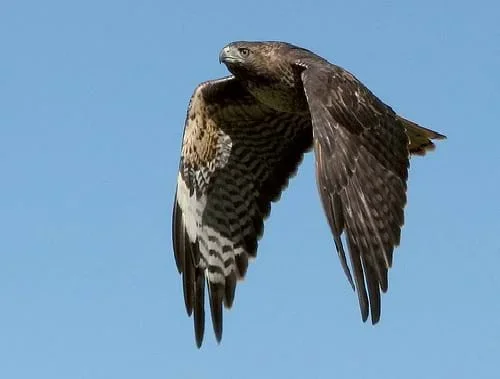 Flight pattern of a redtailed hawk.Copyright Flickr Creative Commons
Students study the patterns of bird flight and learn that four main forces affect the flight abilities of birds (lift, thrust, drag, gravity). They investigate the shape, feather structure and resulting differences in the pattern of flight. Then they look at several articles that feature newly designed planes and their bird inspirations. They watch the Nature documentary, "Raptor Force," which chronicles the flight patterns of birds, how researchers study these animals and what interests the military and aeronautical engineers about these natural adaptations. This activity serves as an extension to the biomimetics lesson. Although students will not be using this information in the design process for their desert resort, it provides interesting information pertaining to the current use of biomimetics in the field of aviation. Students may extend their design process by using this information to create a means of transportation to and from the resort, if they chose to.
The forces of lift, thrust, drag and gravity influence the flight patterns of birds and are the same parameters that must be considered in the design of aircraft. Students are exposed to the overlap in an engineering concept to the discoveries that can be made by studying birds capable of hovering, gliding or steep diving. Each flight pattern demonstrates different degrees of adaptations in the birds capable of those feats.
After this activity, students should be able to:
- Distinguish between lift, thrust, drag and gravity.
- Describe how wings of different shapes support different patterns of flight.
- Explain how the study of bird flight can be extended to the field of aeronautical engineering.
- CCSS.Math.Content.6.RP.A.1 Understand the concept of a ratio and use ratio language to describe a ratio relationship between two quantities.
Grade 6
Do you agree with this alignment?
- STEL-1O Assess how similarities and differences among scientific, mathematical, engineering, and technological knowledge and skills contributed to the design of a product or system.
Grades 9-12
Do you agree with this alignment? - STEL-4P Evaluate ways that technology can impact individuals, society, and the environment.
Grades 9-12
Do you agree with this alignment?
- 5-LS2-1 Develop a model to describe the movement of matter among plants, animals, decomposers, and the environment.
Grade 5
Do you agree with this alignment?
- 5.3.3 Students will describe relationships within an ecosystem.
Grades 3-5
Do you agree with this alignment?
- Science concepts. The student recognizes multiple forms of energy and knows the impact of energy transfer and energy conservation in everyday life. The student is expected to:
Grades 9-10
Do you agree with this alignment?
- Each student needs a copy of the bird flight handout.
- Each student needs access either to hard copies of the supporting articles or computer internet access.
- The video preview is available online and can either be viewed at computers or projected onto a screen for classroom viewing. The full length video can be purchased at the link listed below.
- It is visually helpful, although not essential, to have various bird feathers available with a dissecting microscope to allow students to see the structure of a feather.
Birds have served as prototypes for various models of aeronautical design. The hummingbird is the archetype of the helicopter. Hummingbirds are capable of hovering in mid-flight and also of backward flight. Helicopters are an early example of biomimicry. Peregrine falcons are capable of steep dives that defy the gravitational forces that push the limit of fighter pilots and that are often responsible for fighter jets falling into a stall. How is a bird capable of surviving what has proved most challenging to the designers of these planes. What can be learned by studying these living models in order to strengthen the design of future planes and protect the lives of those who command them?
In this activity, we will investigate the physical nature of flight. How do birds become and remain airborne? Why do different species of birds have different types of flight patterns? Why are some species, such as hawks, able to hunt in midair? Can you explain why the flight of an owl is silent or a vulture can soar on the thermals of updrafts? Can an understanding of these unique adaptations lend direct application to the design of airplanes? Would it surprise you to know that our own military studies bird flight? Would you like to watch a comparison of birds to strategic fighter jet design?
Although students will not be using this information in the design process of your desert resort, it provides interesting information pertaining to the current use of biomimetics in the field of aviation. As an extension to your design process, you may use this information to create a means of transportation to and from the resort if you chose to; however, it will not be counted toward your final grade.
Background
This activity introduces students to a direct application of biomimicry. It is driven by three sections. Students are first introduced to the physics behind bird flight and the various patterns of flight. They will distinguish between wing shapes, learn the structure of a feather, and understand how these features support different abilities among species. They will next be allowed to read, and it is helpful if the images can be viewed on a screen, several recent advancements made in aeronautical engineer following the examination of several different bird species. The final segment is the screening of "Raptor Force" video available for online viewing. There are breathtaking aerial footages of hawks and falcons performing amazing aerial acts that researchers are beginning to fully appreciate the supporting mechanisms. The documentary brings in footage of actual fighter jets and discusses the contributions made through the study of these creatures.
Before the Activity
- Photocopy the attached handout providing each student with a copy.
- If possible, set up microscope stations for looking at various feathers.
- Either provide hardcopies or have internet access to these articles to answer the handout questions:
https://web.stanford.edu/group/stanfordbirds/text/essays/Wing_Shapes.html
https://www.earthlife.net/birds/flight.html
- The next group of articles includes current publications discussing direct application of bird study to plane design.
Wing Morphing of The Swift Could Inspire New Aircraft Designs: https://www.sciencedaily.com/releases/2007/04/070427113243.htm
Airplane Wings That Change Shape Like a Bird's Have Scales Like A Fish: https://www.sciencedaily.com/releases/2004/04/040422000037.htm
Airborne Drones, Mimicking Gulls, Alter Wing Shape for Agility: https://www.sciencedaily.com/releases/2005/08/050824080722.htm
With the Students
- Describe the activity by presenting the introduction for the activity as discussed above.
- Explain the three segments that comprise this activity.
- Ask the leading questions provided in the introduction of the activity and allow for some brief student responses.
- As students are completing the handouts, walk around the classroom in order to ensure that students are on the right track.
- Show the "Raptor Force" segment.
Activity Embedded Assessment: Review and grade this assignment to determine students' accuracy in correctly identifying bird flight features.
For lower grades, provide more time for group discussions.
"Raptor Force" a Nature Documentary preview is available at: https://www.pbs.org/wnet/nature/episodes/raptor-force/introduction/1109/. The full length documentary is available for purchase for $19.99 on Amazon: https://www.amazon.com/Nature-Raptor-Force-Liev-Schreiber/dp/B000WCN8C8.
- Sustainable Design and Biomimicry in a Desert Ecosystem
- Designing a Sustainable Guest Village in Saguaro National Park
- Food Chains and Food Webs - Balance within Natural Systems
- Biomes and Population Dynamics - Balance within Natural Systems
- Biomimicry and Sustainable Design: Nature as Engineering Marvel
- Bird Flight Adaptations: Inspiration for Aeronautical Engineering
- Bees: The Invaluable Master Pollinators
Supporting Program
VU Bioengineering RET Program, School of Engineering, Vanderbilt University
Acknowledgements
The contents of this digital library curriculum were developed under National Science Foundation RET grant nos. 0338092 and 0742871. However, these contents do not necessarily represent the policies of the NSF, and you should not assume endorsement by the federal government.
Copyright
2013 by Regents of the University of Colorado; original © 2006 Vanderbilt University