
Force on a Current Carrying Wire
Students use a simple experimental setup consisting of a current-carrying wire and a magnet to explore the forces that enable biomedical imaging. In doing so, they run a current through a wire and then hold magnets in various positions to establish and explore the magnetic force acting on the wire. They move the magnets and change the current in the wire to explore how the force changes. They students apply what they have learned during the experiment to the challenge to create a safe working environment around MRI machines.
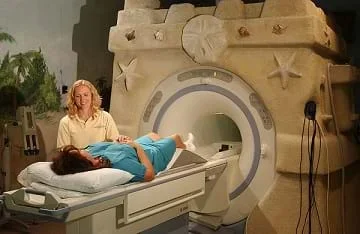 An MRI machine uses magnetic force to make images of the human body.Copyright 2009 Celebration Health, Wikipedia http://en.wikipedia.org/wiki/File:Seaside_Imaging_Center_MRI.jpg
An MRI machine uses magnetic force to make images of the human body. In the lab, we explore this magnetic force and its properties. In assessment questions 4 and 5, students are asked to apply what they have learned during the experiment to create a safe environment around MRI machines, which are the kinds of question engineers consider in the products they create.
After this activity, students should be able to:
- Predict and test the direction of the magnetic force on a current-carrying wire.
- Predict and test the effects of switching the direction of the current in the wire.
- Medical technologies include prevention and rehabilitation, vaccines and pharmaceuticals, medical and surgical procedures, genetic engineering, and the systems within which health is protected and maintained.
Grades 9-12
Do you agree with this alignment? - STEL-1O Assess how similarities and differences among scientific, mathematical, engineering, and technological knowledge and skills contributed to the design of a product or system.
Grades 9-12
Do you agree with this alignment?
- Results of scientific inquiry--new knowledge and methods--emerge from different types of investigations and public communication among scientists. In communicating and defending the results of scientific inquiry, arguments must be logical and demonstrate connections between natural phenomena, investigations, and the historical body of scientific knowledge. In addition, the methods and procedures that scientists used to obtain evidence must be clearly reported to enhance opportunities for further investigation.
Grades 9-12
Do you agree with this alignment?
- HS-PS3-5 Develop and use a model of two objects interacting through electric or magnetic fields to illustrate the forces between objects and the changes in energy of the objects due to the interaction.
Grades 9-12
This resource focuses on the following Three Dimensional Learning aspects of NGSS:
Science & Engineering Practices- Develop and use a model based on evidence to illustrate the relationships between systems or between components of a system.Do you agree with this alignment?
Disciplinary Core Ideas- When two objects interacting through a field change relative position, the energy stored in the field is changed.Do you agree with this alignment?
Crosscutting Concepts- Cause and effect relationships can be suggested and predicted for complex natural and human designed systems by examining what is known about smaller scale mechanisms within the system.Do you agree with this alignment?
Do you agree with this alignment? - Develop and use a model based on evidence to illustrate the relationships between systems or between components of a system.
Each group needs:
- compass
- permanent magnet
- lab stand
- masking tape
- 6V lantern battery
- 1 ohm 20 watt resistor
- 3 wires with alligator clips
- aluminum foil
- Force on a Current-Carrying Wire Handout (PDF), one per student
Thus far in class, we have learned that MRI machines use magnetic force to make images of the human body. In order to solve the MRI Safety Grand Challenge (as presented in the unit), we must now begin to understand the affects of such a magnetic force. In class we have learned that a magnetic field affects a current-carrying wire. This lab helps us to see and feel this force on a current-carrying wire. After this activity, you begin to consider the effects of an MRI machine on metal objects, which may impact the safety of medical personnel and patients.
Before the Activity
- Gather materials and make copies of the Force on a Current-Carrying Wire Handout (PDF).
- Set up the lab stands with a foil ribbon, 6V battery and 1 ohm resistor connected in series by alligator clips, as shown in Figure 1.
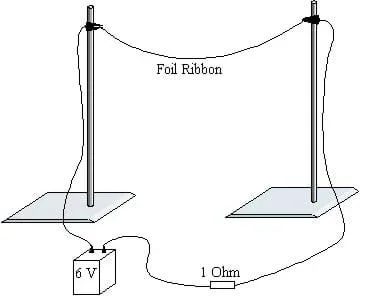 Figure 1. The activity setup.Copyright 2006 Eric Appelt, Vanderbilt University
With the Student - Initial Thoughts
Prompt students to consider and respond to the following pre-lab questions, which are provided on the handout.
- Consider a positive current moving from left to right. Sketch four diagrams showing a magnetic field oriented up, down, into the page, and out of the page with arrows indicating the force on the wire.
- Find the current flowing through a wire connected to a 6V battery and a 1 ohm resistor. Then find the magnitude of the magnetic force on 1 cm wire if the strength of the magnetic field is 1000 Gauss and the current and field are oriented in any of the positions in the diagrams just drawn.
With the Students - Procedure
Divide the class into groups of two to four students each. Hand out the materials. Then direct students to follow this procedure, which is provided on the handout.
- Use the compass to determine the direction of the magnetic field in your permanent magnet, and use masking tape to mark this direction on your magnet.
- Attach 2 alligator clips near the tops of the lab stands with masking tape as shown in the diagram (same diagram as Figure 1).
- Cut a very thin ribbon of aluminum foil from your sheet, and attach this to both clips on the tops of the lab stands.
- Complete a circuit as shown on the diagram, so that the conventional current is flowing from left to right.
- With the permanent magnet, try creating a field near the wire in each of the four orientations that you sketched, and note the behavior of the wire in each orientation.
- Switch the connections to the positive and negative terminals of the battery, and repeat the previous step.
Conclude by assigning students to answer the five questions at the end of the handout.
Post-Activity Assessment: At the conclusion of the lab, have students answer the five questions at the end of the Force on a Current Carrying Wire Handout (PDF)to apply what they have learned to the MRI Safety Grand Challenge and towards drawing engineering connections. Review their answers to gauge their comprehension of the subject matter.
- Describe the behavior of the wire in each orientation, and state whether you saw evidence of a force on the wire in the direction expected.
- Explain the change in the current when you switched the battery connections, and how this affected the behavior of the wire.
- While conventional current is thought of as positive charge moving from higher to lower potential, in reality negative charge (electrons) are moving from lower to higher potential. Explain why this should not affect your predictions or results.
- How is this related to an MRI machine?
- What have you learned during this experiment about creating a safe environment around an MRI machine?
- MRI Safety Grand Challenge for AP Physics
Contributors
Eric Appelt
Supporting Program
VU Bioengineering RET Program, School of Engineering, Vanderbilt University
Acknowledgements
The contents of this digital library curriculum were developed under National Science Foundation RET grant nos. 0338092 and 0742871. However, these contents do not necessarily represent the policies of the NSF, and you should not assume endorsement by the federal government.
Copyright
2013 by Regents of the University of Colorado; original © 2006 Vanderbilt University