
Thrown for a Current Loop: Torque and Energy in a Magnetic Field
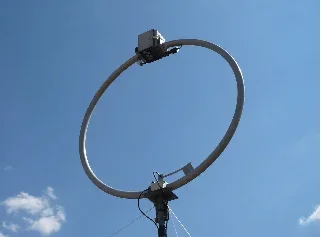 A loop carrying current.Copyright 2008 Trixt, Wikimedia Commons http://commons.wikimedia.org/wiki/File:Loop_antenna.jpg
Students begin to focus on the torque associated with a current carrying loop in a magnetic field. They solve example problems as a class and use diagrams to visualize the vector product. In addition, students learn to calculate the energy of this loop in the magnetic field. Through the associated activity, "Get Your Motor Running," students explore a physical model to gain empirical data and compare it to their calculated data. A homework assignment is also provided as a means of student assessment.
Biomedical engineers must consider not only the force resulting from a charged particle in a magnetic field but also, a current traveling through a magnetic field. During resonance and relaxation, engineers can determine the frequency of the oscillating magnetic field based on a small current in the receiver coil of the MRI machine. In the homework assessment section of this lesson, students will have to determine the magnitude and direction of the torque on a current loop due to the magnetic field.
After this lesson students should be able to:
- Describe the actions of a current loop in a magnetic field.
- Draw and fully label a diagram of current acting through a loop.
- Calculate the torque on a current loop due to a magnetic field.
- Energy can be grouped into major forms: thermal, radiant, electrical, mechanical, chemical, nuclear, and others.
Grades 9-12
Do you agree with this alignment? - STEL-1O Assess how similarities and differences among scientific, mathematical, engineering, and technological knowledge and skills contributed to the design of a product or system.
Grades 9-12
Do you agree with this alignment?
- Results of scientific inquiry--new knowledge and methods--emerge from different types of investigations and public communication among scientists. In communicating and defending the results of scientific inquiry, arguments must be logical and demonstrate connections between natural phenomena, investigations, and the historical body of scientific knowledge. In addition, the methods and procedures that scientists used to obtain evidence must be clearly reported to enhance opportunities for further investigation.
Grades 9-12
Do you agree with this alignment?
- HS-PS3-2 Develop and use models to illustrate that energy at the macroscopic scale can be accounted for as either motions of particles or energy stored in fields.
Grades 9-12
This resource focuses on the following Three Dimensional Learning aspects of NGSS:
Science & Engineering Practices- Develop and use a model based on evidence to illustrate the relationships between systems or between components of a system.Do you agree with this alignment?
Disciplinary Core Ideas- Energy is a quantitative property of a system that depends on the motion and interactions of matter and radiation within that system. That there is a single quantity called energy is due to the fact that a system's total energy is conserved, even as, within the system, energy is continually transferred from one object to another and between its various possible forms.Do you agree with this alignment?
- At the macroscopic scale, energy manifests itself in multiple ways, such as in motion, sound, light, and thermal energy.Do you agree with this alignment?
- These relationships are better understood at the microscopic scale, at which all of the different manifestations of energy can be modeled as a combination of energy associated with the motion of particles and energy associated with the configuration (relative position of the particles). In some cases the relative position energy can be thought of as stored in fields (which mediate interactions between particles). This last concept includes radiation, a phenomenon in which energy stored in fields moves across space.Do you agree with this alignment?
Crosscutting Concepts- Energy cannot be created or destroyed—it only moves between one place and another place, between objects and/or fields, or between systems.Do you agree with this alignment?
Do you agree with this alignment? - Develop and use a model based on evidence to illustrate the relationships between systems or between components of a system.
Students need to have an understanding of rotation and torque, since an important concept of this lesson is the torque created by a magnetic field. Students need to make the connection that torque on the loop leads the loop to rotate in the magnetic field. It is also crucial for the student to draw and label all example and homework problems (just as shown in the figure sets).
Legacy Cycle Information
This lesson fits into the Research and Revise phase of the legacy cycle in which students are provided with additional information enabling them to revise their initial ideas for solving the challenge. The research aspect consists of formal lecture and several example problems on how magnetic fields create torque on a current loop.
Torque on a Current Loop
Note: It may be helpful to review rotation, torque and kinetic energy at this point.
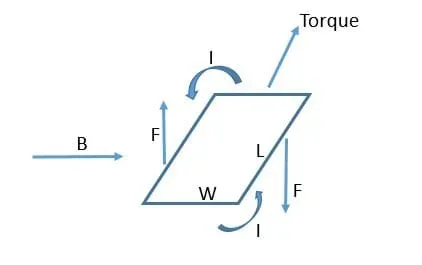 Figure A
Consider a rectangular loop of current in a magnetic field with width w and length l, and current I. Let the loop be laid out on a horizontal plane and let a magnetic field B point directly to the right. (see Figure A)
First, the field will exert no force on the two width segments of the wire as in this length the current is parallel to the magnetic field. However, there will be a force on each of the lengths of the rectangular loop as the current is perpendicular to the field on that segment. The magnitude of these forces is:
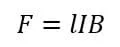
Notice that these two forces are equal and opposite in magnitude, so there is no translational movement, but there is a torque about the center of the loop. The two torques from the forces can be calculated as:
 where A is the area of the loop. The two torques are both accelerating the loop clockwise, so the total torque is:

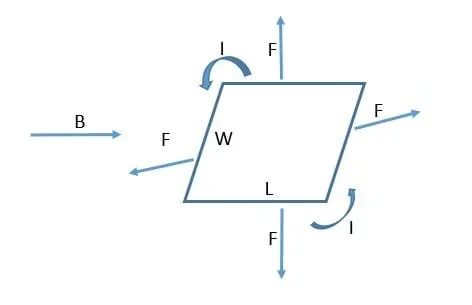 Figure BCopyright Eric Appelt, 2006
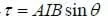
Once the loop is fully rotated, the forces appear in the configuration shown to the right. Notice that there is no longer any torque, but outward force in every direction. The forces on the width elements never contribute to the torque, but rather attempt to stretch the loop. At any angle during the rotation, the torque could be written as:
Generalizing further, imagine if the current loop actually consisted of N turns. While this would have no effect on the purely electrical properties of the circuit (assuming no resistance in the wire) the amount of current contributing to the magnetic force on the wire would be effectively multiplied by N. Thus,
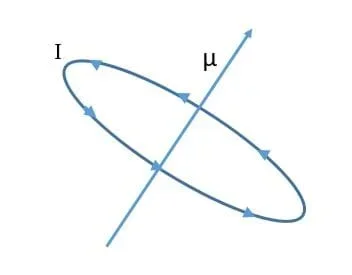 Figure CCopyright 2006 Eric Appelt, Vanderbilt University
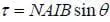
We will define the magnetic moment of the current loop as a vector normal to the plane of the loop directed according to the right hand rule with respect to the current (see diagram). The magnitude of this vector will be NAI , and the vector will be denoted μ. With this definition, we can write:

This can be shown to work if the loop is not rectangular, and is valid for any loop in a plane. Note that the torque will accelerate the loop so that the magnetic moment will become parallel to the field.
Example:
A circular wire loop of 5 turns with a radius of 10 cm weighing 54 g with a current of 1.3 A is lying flat on a table. A strong uniform magnetic field of 3 T is projected up 30 degrees from the horizontal, as shown in the diagram. Find the magnitude of the torque on the current loop.
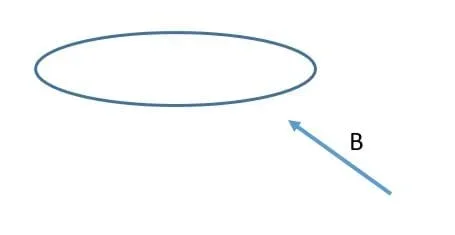 Figure DCopyright 2006 Eric Appelt, Vanderbilt University
Solution: Start by drawing the picture and labeling accordingly!

Note that the gravitational torque on this loop is
So the magnetic torque will rotate part of the loop off the table!
Energy of a Current Loop in a Magnetic Field
When a current loop is rotated through an (infinitesimally) small angle , the work done is
 (Negative as the magnetic torque works to decrease the angle)
Then the decrease in potential energy is

And so by integrating

Since it is only the change in potential energy that we are ever interested in, we can simply make a convention for when the potential energy is zero, and get rid of . In this case, if we say that the potential energy is zero at 90 degrees, then
 .
.
Then,

Note that the potential energy is lowest when μ and B are parallel and there is no torque. It is highest when μ and B are antiparallel. In the antiparallel case, a slight nudge in either direction will create a torque sending it back towards the parallel position.
Example:
A solid hoop of copper with radius 35 cm weighing 200 g is bolted to a stand so that it may rotate freely as shown in the diagram below. A current of 5.5 A is sent around the hoop, and a uniform magnetic field of 2000 Gauss is directed up. Describe the motion of the hoop. What is the maximum kinetic energy of the hoop? What is the maximum angular velocity?
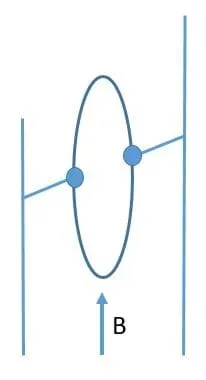 Figure ECopyright 2006 Eric Appelt, Vanderbilt University
Solution: Start by drawing the picture and labeling accordingly!
The hoop will oscillate back and forth, with a maximum kinetic energy when the hoop is oriented horizontally and will momentarily halt whenever it is vertical.
The initial potential energy is zero, and the minimum potential energy when the magnetic moment lines up with the field is

So the maximum kinetic energy is
The moment of inertia of the hoop is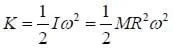 and
and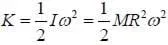
Thus
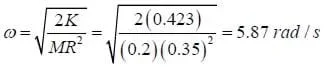
This is very close to 1 full rotation per second!
As a final note, one may notice that permanent magnets such as a compass needle have a tendency to rotate into the plane of a field, suggesting that they are comprised of a current loop. In fact, a permanent magnet can be explained as a collection of many tiny current loops, and from this model we will be able to explain the phenomena of attraction and repulsion.
We are making progress to solve the MRI challenge problem and determine the risks and dangers of an MRI. To do this, we need to learn what happens near a large electromagnet. We need to learn about the properties of magnetic fields, including the effects of a magnetic field on loops of current. As MRI machines evolved over time and were built with stronger magnets, engineers needed to account for the change in current. Refer to the associated activity Get Your Motor Running for students to investigate real applications such as electro motors used in modern products.
Homework: Assign students to complete the Current Loops in Magnetic Fieilds Homework set, which serves as an assessment tool.
- MRI Safety Grand Challenge for AP Physics
- The Grand Challenge
- May the Magnetic Force Be with You
- Thrown for a Current Loop: Torque and Energy in a Magnetic Field
- Both Fields at Once?!
- Biot-Savart Law
- Solenoids
- Ampere's Law
- Changing Fields
- Magnetic Fields Matter
- Magnetic Resonance Imaging
Contributors
Eric Appelt
Supporting Program
VU Bioengineering RET Program, School of Engineering, Vanderbilt University
Acknowledgements
The contents of this digital library curriculum were developed under National Science Foundation RET grant nos. 0338092 and 0742871. However, these contents do not necessarily represent the policies of the NSF, and you should not assume endorsement by the federal government.
Copyright
2013 by Regents of the University of Colorado; original © 2006 Vanderbilt University