
Biot-Savart Law
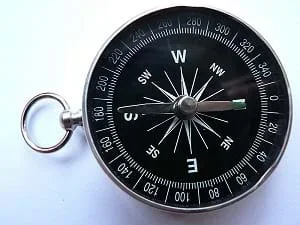 A compass can be used to detect the direction of a magnet field!Copyright 2005 Bios~commonswiki, Wikimedia Commons https://commons.wikimedia.org/wiki/File:Kompas_Sofia.JPG
Beginning with a class demo, students are prompted to consider how current generates a magnetic field, and the direction of the field that is generated. Via a lecture, students learn Biot-Savart's law (and work some sample problems) in order to calculate, most simply, the magnetic field produced in the center of a circular current carrying loop. For applications, students find it is necessary to integrate the field produced over all small segments in a current-carrying wire.
It is important that engineers know and understand how a looped wire can create a current so that imaging techniques such as MRIs can be as accurate as possible without physically harming people. During their lesson homework, students use the Biot-Savart law to find the magnitude and direction of a magnetic field due to current in a looped wire.
After the lesson, students should be able to:
- Explain that current creates a magnetic field.
- Use the Biot-Savart law to integrate and find the magnetic field of current carrying wire.
- CCSS.Math.Content.HSA-CED.A.4 Rearrange formulas to highlight a quantity of interest, using the same reasoning as in solving equations.
Grades 9-12
Do you agree with this alignment? - CCSS.Math.Content.HSG-SRT.C.8 Use trigonometric ratios and the Pythagorean Theorem to solve right triangles in applied problems.
Grades 9-12
Do you agree with this alignment?
- Energy can be grouped into major forms: thermal, radiant, electrical, mechanical, chemical, nuclear, and others.
Grades 9-12
Do you agree with this alignment? - STEL-1O Assess how similarities and differences among scientific, mathematical, engineering, and technological knowledge and skills contributed to the design of a product or system.
Grades 9-12
Do you agree with this alignment?
- Results of scientific inquiry--new knowledge and methods--emerge from different types of investigations and public communication among scientists. In communicating and defending the results of scientific inquiry, arguments must be logical and demonstrate connections between natural phenomena, investigations, and the historical body of scientific knowledge. In addition, the methods and procedures that scientists used to obtain evidence must be clearly reported to enhance opportunities for further investigation.
Grades 9-12
Do you agree with this alignment?
- HS-PS3-2 Develop and use models to illustrate that energy at the macroscopic scale can be accounted for as either motions of particles or energy stored in fields.
Grades 9-12
This resource focuses on the following Three Dimensional Learning aspects of NGSS:
Science & Engineering Practices- Develop and use a model based on evidence to illustrate the relationships between systems or between components of a system.Do you agree with this alignment?
Disciplinary Core Ideas- Energy is a quantitative property of a system that depends on the motion and interactions of matter and radiation within that system. That there is a single quantity called energy is due to the fact that a system's total energy is conserved, even as, within the system, energy is continually transferred from one object to another and between its various possible forms.Do you agree with this alignment?
- At the macroscopic scale, energy manifests itself in multiple ways, such as in motion, sound, light, and thermal energy.Do you agree with this alignment?
- These relationships are better understood at the microscopic scale, at which all of the different manifestations of energy can be modeled as a combination of energy associated with the motion of particles and energy associated with the configuration (relative position of the particles). In some cases the relative position energy can be thought of as stored in fields (which mediate interactions between particles). This last concept includes radiation, a phenomenon in which energy stored in fields moves across space.Do you agree with this alignment?
Crosscutting Concepts- Energy cannot be created or destroyed—it only moves between one place and another place, between objects and/or fields, or between systems.Do you agree with this alignment?
Do you agree with this alignment? - Develop and use a model based on evidence to illustrate the relationships between systems or between components of a system.
This lesson discusses the Biot-Savart law, which gives a way to integrate and find the magnetic field created by a loop or segment of wire. Thus, students must understand the basics of integration.
Legacy Cycle Information
This lesson fits into the research and revise phase of the legacy cycle during which students are provided with additional information enabling them to revise their initial ideas for solving the challenge. The research aspect consists of a demonstration of the magnetic field around a current-carrying wire as well as lecture on the Biot-Savart law. The lecture includes example problems for the teacher to work through with the students.
Biot-Savart Law
As was seen in the demonstration, an electric current produces a magnetic field. Consider a small segment of wire with length dl carrying a current I. We can make dl into a vector dl by giving it the direction in which the current is flowing. This small segment produces a small magnetic field dB at a point P whose magnitude and direction are given by the following equation, known as the Biot-Savart law (pronounced with silent Ts.)
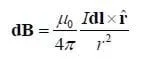 where r is a vector pointing from the segment of wire to P.
The symbol
represents a constant called the permeability of free space and in standard units is:
 T m / A.
For any real application, it will be necessary to integrate the field produced over all of these small segments in an actual current carrying wire. The simplest example is the magnetic field produced in the center of a circular current carrying loop. Another good example is a straight segment of wire.
Example:
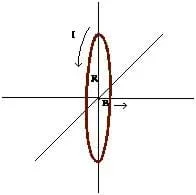
Find the magnitude and direction of the magnetic field at the center of a loop carrying a current I with radius R.
Solution:
 Copyright 2006 Eric Appelt, Vanderbilt University
Note that for any choice of dl around the ring, dl is perpendicular to r and by the right hand rule, dB will point out along the axis of the ring.
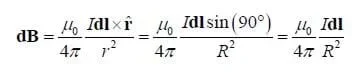

This is a relatively simple example as the integral is a constant. It is also not unreasonable to find the strength and direction of the magnetic field along the axis of the ring (see Homework in the Assessment section).
Example: Find the magnitude and direction of the magnetic field at some point P produced by a straight segment of wire along the x-axis from some point to another point
 carrying a current I.
Solution: Start with the diagram shown below. Note that we will represent the angle between a segment I dl at some point x and r by as this will prove convenient later on. By the Biot-Savart law, the infinitesimal segment I dl generates a field pointing outward with a magnitude given by:

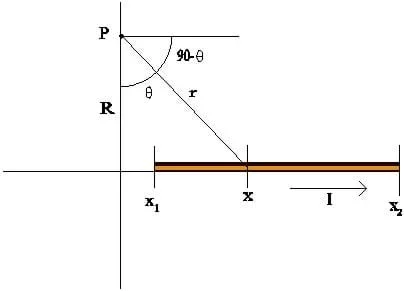 Copyright 2006 Eric Appelt, Vanderbilt University
Then we may integrate fromto to get the total field strength. However, this presents a challenge as both
 and r are functions of x. We can simplify matters by getting everything into terms ofand R using trigonometry. Note that:
 and so

Then substituting, we see that:

Now taking to be the angle toand
 to be the angle to, we can integrate from
 to
to yielding:

Finally, if the wire is extremely long, then would tend to 90 degrees and
 to -90 degrees, so for an infinitely long wire:

Engineers try to be as accurate as possible when designing MRI machines by understanding how looped wires affect magnetic fields. A significant portion of some engineers' jobs is to educate surgeons and radiologists about MRI accuracy. For example, to prevent irreversible damage to a patient with a brain tumor, it is crucial that the surgeon remove only the damaged tissue and avoid removing or coming into contact with healthy tissue.
Class Demonstration: Magnetic Field around a Current-Carrying Wire
Objective: Use this class demo to guide students to think about how current generates a magnetic field, and the direction of the field that is generated.
- 14-gauge magnet wire, 200 - 600 feet
- 30W or higher 5V DC power supply, 1-3
- 1 lab stand
- iron filings, 1 oz
- cardboard, 2 sheets, for holding the filings
- 1 roll tape
- compass, 6-10
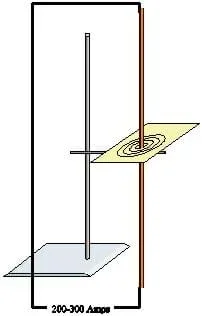 Figure 1. Class demo setup.Copyright 2006 Eric Appelt, Vanderbilt University
The basic idea for this demo was conceived by William J. Beaty who wrote:
"A number of science museum exhibits require many tens of amperes of electric current in a thick cable to generate strong magnetism. One example is a raft of compasses with a 200-amp cable running through the center of the raft. Or, three 100-amp cables with three-phase AC powering them, where the resulting field rotates and can spin a conductive object by induction.
Rather than trying to build a 2-volt, 200 ampere supply, there is an easier way. Think:
In stranded cable, the DC electric current divides equally among all the strands.
If a 200-amp cable has 200 strands, then each strand has only 1.0 ampere. So instead of using a length of thick cable, why not wind a hoop-coil of very large diameter? (For example, a hoop that is 3 ft in diameter.) Wrap the coil with black electrical tape so that it resembles a circle of heavy black cable. Send 1.0 amperes into the coil's connections, and you have a circular "cable" that has 1 ampere within each "strand," and 200 amperes within the cable as a whole. There is no difference between a segment of this "coil" and a segment of a thick electrical cable with an enormous current inside."
For this demo, making a coil with a diameter of 1.5 feet using 14 gauge wire and wrapping 20 turns makes a coil with a resistance of 1 ohm. This can be connected to the 5 volt power supply and attached to the lab stand so that a portion of the wire is directed straight up and down, as shown in Figure 1. The resulting current will be 100 amps. You will get a stronger effect if you repeat this process and tape together 2-3 cables, although even one produces an observable effect.
To begin the demonstration, have students hold magnets close to the wire in a circle with the current turned off. Make sure the compasses are all pointing in the same direction. Turn on the current and the compasses will point around the wire. Then reverse the direction of the current and the compasses will reverse directions.
Next, place a cardboard sheet horizontally around the wire as shown in Figure 1 (you will need to have punched a hole in the sheet). Sprinkle iron filings around the wire and turn on the current. You may need to shake the cardboard sheet. Then watch the filings align into concentric circles. Discuss with the class the direction and strength of the field produced, noting that the magnetic field forms closed circles around the wire.
Homework: Have students complete the Biot-Savart Law Homework (PDF) questions as a take-home assignment. Review their answers to assess their progress in understanding the concepts.
Beaty, William J. High-Ampere Magnetism Demonstration. (electricity science project; 200-amp cable) Last updated May 18, 1998. Science Hobbyist. http://amasci.com/exhibits/hiamp.html
Contributors
Eric Appelt
Supporting Program
VU Bioengineering RET Program, School of Engineering, Vanderbilt University
Acknowledgements
The contents of this digital library curriculum were developed under National Science Foundation RET grant nos. 0338092 and 0742871. However, these contents do not necessarily represent the policies of the NSF, and you should not assume endorsement by the federal government.
Copyright
2013 by Regents of the University of Colorado; original © 2006 Vanderbilt University