
Slinkies as Solenoids
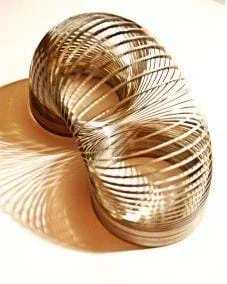 A metal slinky functions as a solenoid in this activity.Copyright 2008 Megan Brock, Free Images, Getty Images http://www.sxc.hu/photo/61986
Students use a classic children's toy, a metal slinky, to mimic and understand the magnetic field generated in MRI machines. The metal slinky mimics the magnetic field of a solenoid, which forms the basis for the magnet in MRI machines. Students run current through the slinky and use computer and calculator software to explore the magnetic field created by the slinky.
Solenoids form the basis for the magnet of MRI machines, an imaging tool designed by engineers. Exploring the properties of this solenoid helps students understand the MRI machine. In handout questions 5 and 6, students are asked to apply what they have learned during the experiment to design a safe environment around MRI machines.
After this activity, students should be able to:
- Determine the relationship between magnetic field and the number of turns per meter in a solenoid.
- Explain how the field varies inside and outside a solenoid.
- Design an experiment that measures the value of μ0, the permeability constant.
- CCSS.Math.Content.HSS-ID.B Summarize, represent, and interpret data on two categorical and quantitative variables
Grades 9-12
Do you agree with this alignment? - CCSS.Math.Content.HSS-ID.B.6 Represent data on two quantitative variables on a scatter plot, and describe how the variables are related.
Grades 9-12
Do you agree with this alignment? - CCSS.Math.Content.HSS-ID.B.6c Fit a linear function for a scatter plot that suggests a linear association.
Grades 9-12
Do you agree with this alignment? - CCSS.Math.Content.HSS-ID.C.7 Interpret the slope (rate of change) and the intercept (constant term) of a linear model in the context of the data.
Grades 9-12
Do you agree with this alignment? - CCSS.Math.Practice.MP4 Model with mathematics.
Grades K-12
Do you agree with this alignment?
- Students will develop an understanding of the relationships among technologies and the connections between technology and other fields of study.
Grades K-12
Do you agree with this alignment? - Use computers and calculators to access, retrieve, organize, process, maintain, interpret, and evaluate data and information in order to communicate.
Grades 9-12
Do you agree with this alignment? - STEL-8N Use various approaches to communicate processes and procedures for using, maintaining, and assessing technological products and systems.
Grades 9-12
Do you agree with this alignment?
- Results of scientific inquiry--new knowledge and methods--emerge from different types of investigations and public communication among scientists. In communicating and defending the results of scientific inquiry, arguments must be logical and demonstrate connections between natural phenomena, investigations, and the historical body of scientific knowledge. In addition, the methods and procedures that scientists used to obtain evidence must be clearly reported to enhance opportunities for further investigation.
Grades 9-12
Do you agree with this alignment?
- HS-PS2-5 Plan and conduct an investigation to provide evidence that an electric current can produce a magnetic field and that a changing magnetic field can produce an electric current.
Grades 9-12
This resource focuses on the following Three Dimensional Learning aspects of NGSS:
Science & Engineering Practices- Plan and conduct an investigation individually and collaboratively to produce data to serve as the basis for evidence, and in the design: decide on types, how much, and accuracy of data needed to produce reliable measurements and consider limitations on the precision of the data (e.g., number of trials, cost, risk, time), and refine the design accordingly.Do you agree with this alignment?
Disciplinary Core Ideas- Forces at a distance are explained by fields (gravitational, electric, and magnetic) permeating space that can transfer energy through space. Magnets or electric currents cause magnetic fields; electric charges or changing magnetic fields cause electric fields.Do you agree with this alignment?
- …and "electrical energy" may mean energy stored in a battery or energy transmitted by electric currents.Do you agree with this alignment?
Crosscutting Concepts- Empirical evidence is required to differentiate between cause and correlation and make claims about specific causes and effects.Do you agree with this alignment?
Do you agree with this alignment? - Plan and conduct an investigation individually and collaboratively to produce data to serve as the basis for evidence, and in the design: decide on types, how much, and accuracy of data needed to produce reliable measurements and consider limitations on the precision of the data (e.g., number of trials, cost, risk, time), and refine the design accordingly.
- CCSS.Math.Content.HSS-ID.B Summarize, represent, and interpret data on two categorical and quantitative variables
Grades 9-12
Do you agree with this alignment? - CCSS.Math.Content.HSS-ID.B.6 Represent data on two quantitative variables on a scatter plot, and describe how the variables are related.
Grades 9-12
Do you agree with this alignment? - CCSS.Math.Content.HSS-ID.B.6c Fit a linear function for a scatter plot that suggests a linear association.
Grades 9-12
Do you agree with this alignment? - CCSS.Math.Content.HSS-ID.C.7 Interpret the slope (rate of change) and the intercept (constant term) of a linear model in the context of the data.
Grades 9-12
Do you agree with this alignment? - CCSS.Math.Practice.MP4 Model with mathematics.
Grades K-12
Do you agree with this alignment?
- 3222.Math.6 Model real-world phenomena using functions and graphs.
Grades 9-12
Do you agree with this alignment? - CLE 3237.4.6 Investigate magnetic poles, magnetic fields, and function.
Grades 9-12
Do you agree with this alignment?
Each group needs:
- magnetic field sensor
- Physics with Vernier Lab Book
- metal slinky
- switch
- meter stick
- DC power supply
- ammeter
- connecting wires
- non-conducting tape, such as masking tape
- Slinky Lab Handout (PDF), one per student
The cost of durable goods needed for this lab—magnetic field sensor, Physics with Vernier Lab Book, DC power supply, ammeter and connecting wires—totals ~$250.
Note: The lab description describes the lab using Vernier magnetic field sensors and equipment, but the lab can be adapted to any sensor and calculator or computer. Vernier sensors can be ordered from www.vernier.com. Other companies include Pasco (www.pasco.com), and Texas Instruments (www.ti.com)
A solenoid is made by taking a tube and wrapping it with many turns of wire. A metal slinky is the same shape and can serve as a solenoid. When a current passes through the wire, a magnetic field is present inside the solenoid. Solenoids are used in electronic circuits or as electromagnets. (source: Vernier)
In this lab, you will explore factors that affect the magnetic field inside the solenoid and study how the field varies in different parts of the solenoid. By inserting a magnetic field sensor between the coils of the slinky, you can measure the magnetic field inside the coil. You will also measure μ0, the permeability constant. The permeability constant is a fundamental constant of physics. (source: Vernier)
An MRI machine uses a large solenoid to create its magnetic field. By exploring the properties of a small solenoid (the slinky), we can predict the properties of the MRI magnet. It is important to note where the solenoid's magnetic field is strongest, and ways of making the magnetic field of a solenoid stronger in order to understand MRI safety.
Background
To explore the properties of a small solenoid, students complete a lab modified from Vernier's "The Magnetic Field in a Slinky" online lab that is available free of charge at https://www.vernier.com/experiments/pwv/26/magnetic_field_in_a_slinky/. The first two "introduction" paragraphs at this website are included in the Introduction/Motivation section because they provide a useful background and introduction for students.
Before the Activity
- Gather materials and make copies of the Slinky Lab Handout (PDF).
- Note that the procedure on the student handout was adapted from Vernier's online lab at https://www.vernier.com/experiments/pwv/26/magnetic_field_in_a_slinky/.
With the Students
- Divide the class into small groups of two or three students each. Distribute materials and the handout.
- Direct students to follow the initial setup indicated on the handout, then design an experiment to answer the later questions in the handout. Have students refer to the handout for guidance.
- Expect students to be able to design and describe their own procedures.
- During the experiment, walk around the student groups and answer questions, as needed.
- Conclude by giving students time to individually prepare summary lab reports as directed in the handout.
Embedded Assessment: Assign students to create lab reports in which they design experimental procedures to answer a number of questions on the Slinky Lab Handout (PDF). These questions also ask students to apply what they have learned about solenoids to creating a safe MRI machine. Review their lab reports to verify their understanding of the concepts.
The Magnetic Field in a Slinky. (Grades 9-12) Physics with Vernier. Vernier Software and Technology. Accessed July 21, 2008. Original URL: https://www.vernier.com/cmat/pwv.html; new URL: https://www.vernier.com/experiments/pwv/26/magnetic_field_in_a_slinky/
Contributors
Eric Appelt
Supporting Program
VU Bioengineering RET Program, School of Engineering, Vanderbilt University
Acknowledgements
The contents of this digital library curriculum were developed under National Science Foundation RET grant nos. 0338092 and 0742871. However, these contents do not necessarily represent the policies of the NSF, and you should not assume endorsement by the federal government.
Copyright
2013 by Regents of the University of Colorado; original © 2006 Vanderbilt University