
MRI Safety Grand Challenge for AP Physics
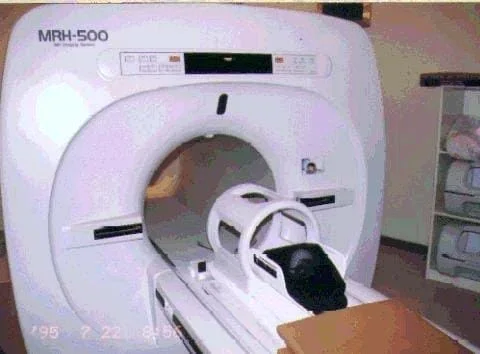 Students explore the MRI.Copyright National Institute of Health Kids Pages
The design uses a contextually based "Challenge" followed by a sequence of instruction in which students first offer initial predictions ("Generate Ideas") and then gather information from multiple sources ("Multiple Perspectives"). This is followed by "Research and Revise" as students integrate and extend their knowledge through a variety of learning activities. The cycle concludes with formative ("Test Your Mettle") and summative ("Go Public") assessments that lead the student towards answering the Challenge question. See the unit overview below for the progression of the legacy cycle through the unit. Research and ideas behind this way of learning may be found in How People Learn, (Bransford, Brown & Cocking, National Academy Press, 2000); see the entire text at https://www.nap.edu/read/9853/chapter/1.
The Legacy Cycle has similarities to the engineering design process; they both involve identifying a need existing in society, applying science and math to develop solutions and using the research conclusions to design a clear conceived solution to the challenge. Though the engineering design process and the legacy cycle depend on a correct and accurate solution, each focuses particularly on how the solution is devised and presented. An overview of the engineering design process can be found on the web at https://en.wikipedia.org/wiki/Engineering_design_process.
In Lesson 1, students are presented with the following Grand Challenge: A nearby hospital has just installed a magnetic resonance imaging facility that has the capacity to make 3D images of the brain and other body parts by exposing patients to a strong magnetic field. The hospital wishes for its entire staff to have a clear understanding of the risks involved in working near a strong magnetic field and a basic understanding of why those risks occur. Your task is to develop a presentation or pamphlet explaining the risks, the physics behind those risks, and the safety precautions to be taken by all staff members.
Students begin by Generating Ideas in a journal, answering questions such as, "What risk factors could a strong magnetic field pose to medical personnel?" Then students consider the perspective of an MRI researcher as part of the Multiple Perspectives step of the legacy cycle. Students begin the Research and Revise phase with an activity at the end of the lesson to visualize magnetic field lines.
In Lesson 2, students enter the Research and Revise step focusing on how a magnetic field affects charged particles with a deflection of an electron beam demonstration. With teacher instruction, students review vector cross products and are introduced to the Lorentz force. Finally, students participate in a magnetic force on a current carrying wire activity. This lesson concludes with a magnetic fields and forces quiz as part of the Test your Mettle stage of the cycle.
Lesson 3 returns to the Research and Revise step with instruction on torque on a current loop and energy of a current loop in a magnetic field, including example problems.
Lesson 4 proceeds in the Research and Revise phase, introducing the concepts developed from the base knowledge taught in lesson 3. These concepts include the Hall effect, velocity selector and charge to mass ratio.
In Lesson 5, students focus on what produces a magnetic field through the magnetic field around a wire demonstration. This demo is part of teaching students the Biot-Savart law in the Research and Revise phase.
In Lesson 6, students continue learning what produces a magnetic field by studying the field of a solenoid in a slinky activity and relating it to the MRI machine.
In Lesson 7, still Researching and Revising, students being with a demonstration: force between two current loops. The learn Ampere's law and then apply it to calculate the magnetic field around a loop. Then they learn about toroids (a ring form of a solenoid) and their magnetic fields.
Lesson 8 teaches students about induced EMFs with a demonstrations on eddy currents and inducing a jumping ring.
Lesson 9 explores the effects of magnetic fields in matter, including diamagnetism, paramagnetism, ferromagnetism and magnetization. Lesson 9 concludes the Research and Revise phase.
In Lesson 10, students enter the Test Your Mettle phase with a problem set on Ampere's law, Faraday's law, and the sources of magnetic field and induction. Finally, students Go Public with an informative project determining the possible hazards associated with the fields in an MRI scanner.
Magnetic resonance imaging (MRI) technology was developed by biomedical engineers as a noninvasive imaging tool. The technology makes use of concepts within electricity and magnetism whose forces can often be very dangerous but advantageous in their uses. An important task for engineers is ensuring the technology they create is safe and providing instructions to users so that it may be used safely. Engineers must analyze the equipment they design for safety risks and preventing dangers. Throughout the unit, students apply the scientific concepts they learn in electricity and magnetism to the real-world problem of analyzing the risks posed by MRI and developing a means of communicating those to hospital personnel.
- CCSS.Math.Content.HSA-CED.A.4 Rearrange formulas to highlight a quantity of interest, using the same reasoning as in solving equations.
Grades 9-12
Do you agree with this alignment?
- HS-PS3-2 Develop and use models to illustrate that energy at the macroscopic scale can be accounted for as either motions of particles or energy stored in fields.
Grades 9-12
This resource focuses on the following Three Dimensional Learning aspects of NGSS:
Science & Engineering Practices- Develop and use a model based on evidence to illustrate the relationships between systems or between components of a system.Do you agree with this alignment?
Disciplinary Core Ideas- Energy is a quantitative property of a system that depends on the motion and interactions of matter and radiation within that system. That there is a single quantity called energy is due to the fact that a system's total energy is conserved, even as, within the system, energy is continually transferred from one object to another and between its various possible forms.Do you agree with this alignment?
- At the macroscopic scale, energy manifests itself in multiple ways, such as in motion, sound, light, and thermal energy.Do you agree with this alignment?
- These relationships are better understood at the microscopic scale, at which all of the different manifestations of energy can be modeled as a combination of energy associated with the motion of particles and energy associated with the configuration (relative position of the particles). In some cases the relative position energy can be thought of as stored in fields (which mediate interactions between particles). This last concept includes radiation, a phenomenon in which energy stored in fields moves across space.Do you agree with this alignment?
Crosscutting Concepts- Energy cannot be created or destroyed—it only moves between one place and another place, between objects and/or fields, or between systems.Do you agree with this alignment?
Do you agree with this alignment? - Develop and use a model based on evidence to illustrate the relationships between systems or between components of a system.
- HS-PS3-5 Develop and use a model of two objects interacting through electric or magnetic fields to illustrate the forces between objects and the changes in energy of the objects due to the interaction.
Grades 9-12
This resource focuses on the following Three Dimensional Learning aspects of NGSS:
Science & Engineering Practices- Develop and use a model based on evidence to illustrate the relationships between systems or between components of a system.Do you agree with this alignment?
Disciplinary Core Ideas- When two objects interacting through a field change relative position, the energy stored in the field is changed.Do you agree with this alignment?
Crosscutting Concepts- Cause and effect relationships can be suggested and predicted for complex natural and human designed systems by examining what is known about smaller scale mechanisms within the system.Do you agree with this alignment?
Do you agree with this alignment? - Develop and use a model based on evidence to illustrate the relationships between systems or between components of a system.
The following schedule provides the recommended sequence to conduct the lessons and activities, which have been designed to be taught as a cohesive unit.
- Day 1-2: The Grand Challenge lesson
- Day 3: Visualizing Magnetic Field Lines activity
- Day 4-5: May the Magnetic Force Be with You lesson
- Day 6: Force on a Current Carrying Wire activity
- Day 7: Thrown for a Current Loop: Torque and Energy in a Magnetic Field lesson
- Day 8-9: Both Fields at Once?! lesson
- Day 10: Biot-Savart Law lesson
- Day 11: Solenoids lesson
- Day 12: Slinkies as Solenoids activity
- Day 13: Ampere's Law lesson
- Day 14-15: Changing Fields lesson
- Day 16: Induced EMF in a Coil of Wire activity
- Day 17: Magnetic Fields Matter lesson
- Day 18: Magnetic Resonance Imaging lesson
Contributors
Eric Appelt; Meghan Murphy
Supporting Program
VU Bioengineering RET Program, School of Engineering, Vanderbilt University
Acknowledgements
The contents of this digital library curriculum were developed under National Science Foundation RET grant nos. 0338092 and 0742871. However, these contents do not necessarily represent the policies of the NSF, and you should not assume endorsement by the federal government.
Copyright
2013 by Regents of the University of Colorado; original © 2006 Vanderbilt University