
Bubbles and Biosensors
Students work in groups to create soap bubbles on a smooth surface, recording their observations from which they formulate theories to explain what they see (color swirls on the bubble surfaces caused by refraction). Then they apply this theory to thin films in general, including porous films used in biosensors, listing factors that could change the color(s) that become visible to the naked eye, and learn how those factors can be manipulated to give information on gene detection. Finally (by experimentation or video), students see what happens when water is dropped onto the surface of a Bragg mirror.
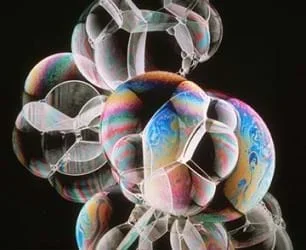 Thin films use refraction and interference to create colorful patterns.Copyright Lawrence Berkeley National Laboratory U.S. Department of Energy http://www.lbl.gov/MicroWorlds/brightbusy/greiner.check.html
The ultimate job of engineers is to take known facts about our world and its physical composition, phenomena and natural laws, and apply that knowledge to the creation of solutions that have never existed before to meet a societal need. In this activity, students think like engineers by observing a physical phenomenon (color swirls in soap bubbles) and applying the concepts that drive this phenomenon to nanoscale biosensors, which could potentially meet a need for efficient gene detection.
After this activity, students should be able to:
- List three factors one could change to alter the visible color(s) of a thin film.
- Clearly explain in at least two complete sentences how each of the three factors alters the interference pattern to produce different colors.
- Describe in at least one complete sentence how a change in one of these factors alters a biosensor.
- STEL-7Y Optimize a design by addressing desired qualities within criteria and constraints.
Grades 9-12
Do you agree with this alignment?
- HS-ETS1-1 Analyze a major global challenge to specify qualitative and quantitative criteria and constraints for solutions that account for societal needs and wants.
Grades 9-12
This resource focuses on the following Three Dimensional Learning aspects of NGSS:
Science & Engineering Practices- Analyze complex real-world problems by specifying criteria and constraints for successful solutions.Do you agree with this alignment?
Disciplinary Core Ideas- Criteria and constraints also include satisfying any requirements set by society, such as taking issues of risk mitigation into account, and they should be quantified to the extent possible and stated in such a way that one can tell if a given design meets them.Do you agree with this alignment?
- Humanity faces major global challenges today, such as the need for supplies of clean water and food or for energy sources that minimize pollution, which can be addressed through engineering. These global challenges also may have manifestations in local communities.Do you agree with this alignment?
Crosscutting Concepts- New technologies can have deep impacts on society and the environment, including some that were not anticipated. Analysis of costs and benefits is a critical aspect of decisions about technology.Do you agree with this alignment?
Do you agree with this alignment? - Analyze complex real-world problems by specifying criteria and constraints for successful solutions.
- 3231.4.2 Examine properties of light waves.
Grades 9-12
Do you agree with this alignment? - 3237.3.12 Investigate reflection, refraction, diffraction, and interference of light waves.
Grades 9-12
Do you agree with this alignment? - CLE 3231.4.2 Investigate the interaction of light waves.
Grades 9-12
Do you agree with this alignment?
Each group needs:
- 1 Styrofoam plate
- 50 ml bubble solution (store-bought or homemade)
- 3 plastic drinking straws
- (optional) 50 ml water
- (optional) 3-ml graduated plastic transfer pipet; such as 20 for $4.76 available athttps://www.amazon.com/Rienar-Disposable-Transfer-Graduated-Pipettes/dp/B00P7QZDK4/ref=sr_1_1?ie=UTF8&qid=1512079406&sr=8-1&keywords=3-ml+graduated+plastic+transfer+pipet
- (optional) 1 sample Bragg mirror, which is not available for purchase to the general public in the form needed for the activity, but may be available for free by requested donation from a university with a photonics lab. Contact physics, electrical engineering and/or chemistry departments. Availability depends on current research being performed at the university. Alternative: If Bragg mirrors are not available, have students view the 17-second Bragg Demonstration Video (MOV) instead, from which they can answer the worksheet questions.
- What Does Light See? Worksheet (PDF), one per student (students should already have this worksheet, given to them during the associated lesson)
Students must know:
- The definitions of diffraction and interference, as well as a complete understanding of these two concepts and their implications.
- The challenge question for this unit, as stated in the first lesson, Tell Me Doc—Will I Get Cancer?
In the first lesson of this unit, we were introduced to a challenge question that addresses a real need in our world. (Call on a few students to explain and elaborate upon the challenge question.)
"In 2013, actress Angelina Jolie underwent a double mastectomy, not because she had been diagnosed with breast cancer, but merely to lower her cancer risk. But what if she never inherited the gene(s) that are linked to breast cancer and endured surgery unnecessarily? Can we create a new method of assessing people's genetic risks of breast cancer that is both efficient and cost-effective?"
After brainstorming causes of cancer, we read an article about an amazing device called a Bragg grating, which could detect different pathogens simply by changing the test "chip," or sample, and we concluded that a similar device might be able to be used to detect the presence of cancer-causing genes. But how do we know for sure if it would work? How do these Bragg gratings operate anyway? What physics concept(s) are behind all of this, and would these principles also apply to a thin film used to detect genes?
The answers to all of these questions lies with an aspect of light we have not yet talked about in class. So we have an activity to help us uncover this mystery, and see if we could, in fact, use light and a porous thin film to detect specific targeted genes. In this activity, we get to do some really neat things, like blow bubbles! No, you never get too old or too cool to blow bubbles. After that, you get to see a real Bragg mirror, similar to the ones in the article, and watch it do some strange things. By the time we finish, you will be well on your way to finishing the Research and Revise portion of our Legacy Cycle for this unit; that's the step where we collect all the necessary data and experiments for solving our challenge question. So, let's begin!
Background
This activity covers the Research and Revise portion of the Legacy Cycle, and is designed to use thin-film interference to illustrate the concept of refraction, or how light bends as it enters a different material. Note that the associated lesson reviews the definition and concept of refraction itself, while this activity applies that knowledge to thin films and nanoscale biosensors.
It is helpful to break the activity into two parts. First have students perform the blowing bubbles portion of the activity in groups of three, followed by a class discussion, followed by the Bragg gratings portion of the activity. If you do not have Bragg gratings or Bragg mirrors, show students a short video instead, or doing only the bubbles portion is sufficient. Working in groups, students may discuss the worksheet questions, but write down their own answers to turn in.
Before the Activity
- Gather materials and place them at each group lab station.
- Make sure students have their copies of the What Does Light See? Worksheet (PDF) that they were given in the associated lesson (when they answered question #1); they will complete worksheet questions #2-5 during this activity. If not, make additional copies of the worksheet, one per student.
- If Bragg mirrors are not available, prepare to show students the Bragg Demonstration Video (MOV) instead.
With the Students
- Divide the class into groups of three students each. Have them assemble at group lab stations with their worksheets.
- Have them follow the worksheet question #2 instructions: One student in each group pours a small amount of bubble solution onto the Styrofoam plate and smears it around with the straw. That student uses the straw to blow a bubble on the surface of the plate. Tip: Place the straw perpendicular to the plate and blow slowly.
- A second student in each group observes the bubble from eye level as it expands, while the third student records the observations in the space provided on the worksheet (question #2). (Expect that students observe swirls of various colors and/or color separation on the bubble surfaces).
- Direct students to rotate roles until each has performed each task (blow the bubble, observe, record).
- Have students apply their observations to answer worksheet question #3, providing explanations for what they saw.
- Reconvene the class for a mid-activity discussion. Listen to responses from various groups on what they observed and their explanations for what they saw. Use the discussion to guide students to an understanding of how refraction drives thin-film interference. (Refer to the associated lesson for a full explanation.)
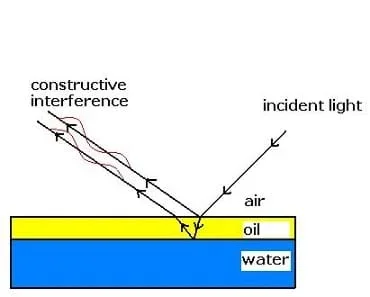 Figure 1. Thin films can cause certain wavelengths of light to interfere constructively with one another, causing us to see different colors.Copyright 2013 Caleb Swartz, Vanderbilt University
 - Provide students with a visual aid for thin film refraction by drawing Figure 1 on the board. Have students list the factors that could change the color that interferes constructively and label these factors on the drawing. (Answers: Wavelength of light used, film thickness and index of refraction of the film.)
- Direct students to return to worksheet question #3, altering and/or expanding on their explanations.
- Working in their groups again, have students follow worksheet question #4 instructions: One student in each group uses a pipet to place a single drop of water on the Bragg mirror. The other group members record their observations in the space provided on the worksheet (question #4). (Expect that students observe a distinct color change on the surface of the Bragg mirror, from blue or purple to green). (Or, show the Bragg Demonstration Video (MOV) if Bragg mirrors are not available.)
- Direct students to work in their groups to answer worksheet question #5 (from either their experimental or video observations).
- As a class, discuss the results by calling on various groups to read their responses aloud. Call on students to suggest possible connections to the challenge question. This discussion prepares students to next complete the exit ticket, the remaining three worksheet questions, as described in the Assessment section.
- diffraction
- The bending of light around an obstacle.
- interference
- The combining of two waves to form a single smaller or larger wave.
- refraction
- The bending of light caused by a change in speed as it enters a different material.
Pre-Activity Assessment
Discussion Questions: Pose the following questions on the characteristics of light to the class:
- Is light a particle or a wave? (Answer: Both, since it displays properties of both.)
- Can it carry energy? (Answer: Yes, photons carry energy, felt as heat, etc.)
- What type of wave is light? (Answer: An electromagnetic wave.)
- Can we see all types of electromagnetic waves? (Answer: No, for example, we cannot see radio waves, infrared, UV or gamma rays.)
- What causes different colors of light? (Answer: Different wavelengths cause different colors.)
Activity Embedded Assessment
Midway Discussion: During the class discussion midway between the activity halves, note/estimate the number of correct responses to worksheet question #3. If a majority of students already know that refraction causes the color change, a shorter explanation of thin film refraction can be used. If correct answers are the minority, a more detailed explanation may be necessary.
Post-Activity Assessment
Worksheet & Exit Ticket: Have students complete the entire worksheet, including the three exit ticket questions on the second page. Collect the worksheets and grade the exit tickets as a formal assessment of the activity. Use the percentage of correct responses to dictate how to proceed (re-teach or begin next lesson).
- Make sure that each team is given enough straws so that each student has his/her own, and watch that students do not share straws while conducting the bubble portion of the activity.
- The silicon edges of Bragg mirrors can be sharp. The easiest way to avoid injury, as well as sample damage is to instruct students not to touch the mirrors at all, since handling it is not necessary to complete the activity.
If students have trouble blowing bubbles on the plate surface, have them hold the straws more perpendicular to the plate, and blow slower. If this still does not work, add more fluid and make sure it is evenly smeared on the plate.
- For lower grades, provide more time for class discussion and review of the basic definition of refraction.
- For upper grades, require more detailed explanations of the factors that affect thin-film interference. For example, require explanations to be longer than two sentences, include how an increase or decrease in each of the three factors will affect the wavelength of light seen (that is, if the film gets thicker, then the wavelength of light seen will be longer). Also, require students to indicate which color of light will be seen after changing a parameter in a specific way.
Klein, Stacy S., Harris, Alene H. "A User's Guide to the Legacy Cycle." Journal of Education and Human Development. Vol. 1, No. 1, 2007. http://www.scientificjournals.org/journals2007/articles/1088.pdf
Contributors
Caleb Swartz
Supporting Program
VU Bioengineering RET Program, School of Engineering, Vanderbilt University
Acknowledgements
The contents of this digital library curriculum were developed under National Science Foundation RET grant nos. 0338092 and 0742871. However, these contents do not necessarily represent the policies of the NSF, and you should not assume endorsement by the federal government.
Copyright
2014 by Regents of the University of Colorado; original © 2012 Vanderbilt University