
Tell Me the Odds (of Cancer)
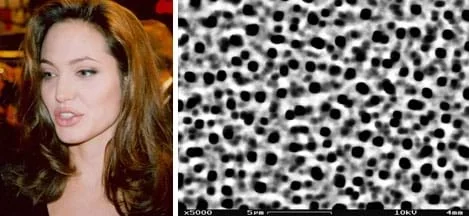 Porous silicon can be used as a sensor to detect nanoscale materials.Copyright (left) 2004 Stefan Servos, Wikimedia Commons; (right) University of Rochester; BetaBatt, Inc. via NSF http://commons.wikimedia.org/wiki/File:Angelina_Jolie.jpg http://nsf.gov/news/news_images.jsp?cntn_id=104140&org=NSF
The design of this Legacy Cycle unit is composed of a contextually based Challenge Question followed by a series of instructional activities in which students brainstorm about the challenge and make predictions (Generate Ideas), then gather more information from other sources (Multiple Perspectives).
This is followed by a Research and Revise phase during which students obtain additional data and information about the challenge topic through a variety of learning activities. The cycle finishes with formative (Test Your Mettle) and summative (Go Public) assessments that lead to answering the challenge question. See below for the progression of the Legacy Cycle through this specific unit.
Research and ideas behind this way of learning may be found in How People Learn: Brain, Mind, Experience and School, (Bransford, Brown & Cocking, National Academy Press, 2000); see the entire text at https://www.nap.edu/catalog/9853/how-people-learn-brain-mind-experience-and-school-expanded-edition. Learn about the Legacy Cycle at https://iris.peabody.vanderbilt.edu/module/hpl/cresource/q2/p07/.
The Legacy Cycle is similar to the engineering design process in that they both involve identifying existing societal needs or challenges, combining science and math to develop solutions, and using research conclusions to design optimal solutions. Though the engineering design process and the Legacy Cycle both result in viable solutions, they vary in how solutions are devised and presented. See an overview of the engineering design process at https://www.teachengineering.org/design/designprocess.
In Lesson 1, Tell Me Doc—Will I Get Cancer?, students are presented with the unit's Challenge Question: "In 2013, actress Angelina Jolie underwent a double mastectomy, not because she had been diagnosed with breast cancer, but merely to lower her cancer risk. But what if she never inherited the gene(s) that are linked to breast cancer and endured surgery unnecessarily? Can we create a new method of assessing people's genetic risks of breast cancer that is both efficient and cost-effective?"
In order to discover a new way to assess a person's risk of cancer, students begin Generating Ideas by determining what they already know about cancer research and current methods of assessing cancer risk (specifically breast cancer). Then they add to their knowledge base by garnering Multiple Perspectives from sources outside the classroom, learning about optical biosensors, which guides their research towards solving the problem.
In Lesson 2, What Does Light See?, students look into to the concept of nanoscale biosensors, considering the possibilities of porous thin film as a gene detector. They also learn about the concept of light refraction, while reviewing their understanding of the concepts of diffraction and interference. Through the Bubbles and Biosensors activity, students see first-hand how refraction can work with thin film interference to produce color patterns, similar to how nanosensors work. They apply their knowledge of refraction to the original challenge question to generate a potential solution in the form of a biosensor, enabling them to extend their understanding of cancer risk analysis through gene detection, and fulfilling the Research and Revise phase of the Legacy Cycle.
In Lesson 3, Quantifying Refraction, students learn the relevant equations for refraction (index of refraction, Snell's law) and how to use them to predict the behavior of light waves in specified scenarios. Student groups work through a few example conceptual and mathematical problems. Then, through the When Silicon Talks: Refraction Equation Practice & Bio Lab Work activity, students practice using the equations in a problem set, examine data from a porous film like those used in biosensors, and apply the equations they learned to a hypothetical scenario involving biosensors. They learn about the factors that affect this interference and how to calculate exactly what will happen when each factor is manipulated in a certain way. The feedback from the activity and problem set enable students to Test Their Mettle to gauge their understanding before the summative assessment.
Finally, in Lesson 4, See the Genes: Communicating Your Work, Findings and Ideas, and its associated activity, Show Me the Genes: Making Posters to Communicate Solutions, students focus on communicating their work and ideas, a valuable skill for scientists and engineers. In their groups, students create posters depicting the solution to the unit's challenge question— how refraction of light in a porous film (an optical biosensor) can be used as a method to detect cancer-causing genes. A provided rubric guides poster preparation and grading. Individually, students complete a summative assessment quiz. This concludes the unit and serves as the culminating Go Public phase of the Legacy Cycle.
In this unit, students are challenged to apply the optical concepts of refraction and interference to the problem of cancer risk analysis, as it relates to the field of biosensing. Engineers work continually to design solutions to health and medical problems that range from risk analysis to prevention, diagnosis and treatment. Many devices and procedures in use today, including diagnostic equipment, pacemakers, surgical techniques, hearing aids, laser eye surgery, ultrasound, amniocentesis, in-vitro fertilization and pain medicine, are the direct result of engineering design for medical fields. Even with these technological advances, many unanswered questions remain, and existing methods and devices can be improved.
- Identify criteria and constraints and determine how these will affect the design process.
Grades 9-12
Do you agree with this alignment? - Refine a design by using prototypes and modeling to ensure quality, efficiency, and productivity of the final product.
Grades 9-12
Do you agree with this alignment?
- HS-ETS1-1 Analyze a major global challenge to specify qualitative and quantitative criteria and constraints for solutions that account for societal needs and wants.
Grades 9-12
This resource focuses on the following Three Dimensional Learning aspects of NGSS:
Science & Engineering Practices- Analyze complex real-world problems by specifying criteria and constraints for successful solutions.Do you agree with this alignment?
Disciplinary Core Ideas- Criteria and constraints also include satisfying any requirements set by society, such as taking issues of risk mitigation into account, and they should be quantified to the extent possible and stated in such a way that one can tell if a given design meets them.Do you agree with this alignment?
- Humanity faces major global challenges today, such as the need for supplies of clean water and food or for energy sources that minimize pollution, which can be addressed through engineering. These global challenges also may have manifestations in local communities.Do you agree with this alignment?
Crosscutting Concepts- New technologies can have deep impacts on society and the environment, including some that were not anticipated. Analysis of costs and benefits is a critical aspect of decisions about technology.Do you agree with this alignment?
Do you agree with this alignment? - Analyze complex real-world problems by specifying criteria and constraints for successful solutions.
- HS-PS4-1 Use mathematical representations to support a claim regarding relationships among the frequency, wavelength, and speed of waves traveling in various media.
Grades 9-12
This resource focuses on the following Three Dimensional Learning aspects of NGSS:
Science & Engineering Practices- Use mathematical representations of phenomena or design solutions to describe and/or support claims and/or explanations.Do you agree with this alignment?
Disciplinary Core Ideas- The wavelength and frequency of a wave are related to one another by the speed of travel of the wave, which depends on the type of wave and the medium through which it is passing.Do you agree with this alignment?
Crosscutting Concepts- Empirical evidence is required to differentiate between cause and correlation and make claims about specific causes and effects.Do you agree with this alignment?
Do you agree with this alignment? - Use mathematical representations of phenomena or design solutions to describe and/or support claims and/or explanations.
- MS-PS4-2 Develop and use a model to describe that waves are reflected, absorbed, or transmitted through various materials.
Grades 6-8
This resource focuses on the following Three Dimensional Learning aspects of NGSS:
Science & Engineering Practices- Develop and use a model to describe phenomena.Do you agree with this alignment?
Disciplinary Core Ideas- A sound wave needs a medium through which it is transmitted.Do you agree with this alignment?
- When light shines on an object, it is reflected, absorbed, or transmitted through the object, depending on the object's material and the frequency (color) of the light.Do you agree with this alignment?
- The path that light travels can be traced as straight lines, except at surfaces between different transparent materials (e.g., air and water, air and glass) where the light path bends.Do you agree with this alignment?
- A wave model of light is useful for explaining brightness, color, and the frequency-dependent bending of light at a surface between media.Do you agree with this alignment?
- However, because light can travel through space, it cannot be a matter wave, like sound or water waves.Do you agree with this alignment?
Crosscutting Concepts- Structures can be designed to serve particular functions by taking into account properties of different materials, and how materials can be shaped and used.Do you agree with this alignment?
Do you agree with this alignment? - Develop and use a model to describe phenomena.
- 3231.4.2 Examine properties of light waves.
Grades 9-12
Do you agree with this alignment? - 3231.4.8 Solve problems related to Snell's law [Index of refraction: n = (sin θr / sin θi); Snell's law: ni sin θi = nr sin θr].
Grades 9-12
Do you agree with this alignment? - 3237.3.12 Investigate reflection, refraction, diffraction, and interference of light waves.
Grades 9-12
Do you agree with this alignment?
- Day 1: Tell Me Doc—Will I Get Cancer? lesson
- Day 2: What Does Light See? lesson and Bubbles and Biosensors activity
- Day 3: Bubbles and Biosensors activity
- Day 4: Quantifying Refraction lesson and When Silicon Talks: Refraction Equation Practice & Bio Lab Work activity
- Day 5: When Silicon Talks: Refraction Equation Practice & Bio Lab Work activity
- Day 6: See the Genes: Communicating Your Work, Findings and Ideas lesson and Show Me the Genes: Making Posters to Communicate Solutions activity
- Day 7: Show Me the Genes: Making Posters to Communicate Solutions activity
- Tell Me the Odds (of Cancer)
Contributors
Caleb Swartz
Supporting Program
VU Bioengineering RET Program, School of Engineering, Vanderbilt University
Acknowledgements
The contents of this digital library curriculum were developed under National Science Foundation RET grant nos. 0338092 and 0742871. However, these contents do not necessarily represent the policies of the NSF, and you should not assume endorsement by the federal government.
Copyright
2014 by Regents of the University of Colorado; original © 2012 Vanderbilt University