
What Does Light See?
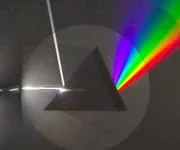 Prisms use refraction to separate the colors of light.Copyright 2009 Marcellus Wallace, Wikimedia Commons http://commons.wikimedia.org/wiki/File:Prism_by_Godzilla.png
Students are introduced to the concept of refraction. After making sure they understand the concepts of diffraction and interference, students work collaboratively to explain optical phenomena that cannot be accounted for via these two mechanisms alone. Then, through the associated activity, students see first-hand how refraction can work with interference to produce color patterns, similar to how nanosensors work. Finally, students apply their knowledge of refraction to the original challenge question to generate a possible solution in the form of a biosensor.
Every product or system that engineers develop is derived from fundamental facts about the nature of the universe, and the logically channeling of those facts to perform useful tasks. Through this lesson and its associated activity, students are guided to discover refraction, a fundamental aspect of the nature of light, and asked to think like engineers to apply that knowledge to the possibility of a biosensor that can test for specific genes.
After this lesson, students should be able to:
- Define refraction in a single sentence.
- List three factors that one could change in a refractive situation to alter the visible colors, and describe in one sentence each how each factor would alter the result.
- STEL-7Y Optimize a design by addressing desired qualities within criteria and constraints.
Grades 9-12
Do you agree with this alignment?
- HS-ETS1-1 Analyze a major global challenge to specify qualitative and quantitative criteria and constraints for solutions that account for societal needs and wants.
Grades 9-12
This resource focuses on the following Three Dimensional Learning aspects of NGSS:
Science & Engineering Practices- Analyze complex real-world problems by specifying criteria and constraints for successful solutions.Do you agree with this alignment?
Disciplinary Core Ideas- Criteria and constraints also include satisfying any requirements set by society, such as taking issues of risk mitigation into account, and they should be quantified to the extent possible and stated in such a way that one can tell if a given design meets them.Do you agree with this alignment?
- Humanity faces major global challenges today, such as the need for supplies of clean water and food or for energy sources that minimize pollution, which can be addressed through engineering. These global challenges also may have manifestations in local communities.Do you agree with this alignment?
Crosscutting Concepts- New technologies can have deep impacts on society and the environment, including some that were not anticipated. Analysis of costs and benefits is a critical aspect of decisions about technology.Do you agree with this alignment?
Do you agree with this alignment? - Analyze complex real-world problems by specifying criteria and constraints for successful solutions.
- 3231.4.2 Examine properties of light waves.
Grades 9-12
Do you agree with this alignment? - 3237.3.12 Investigate reflection, refraction, diffraction, and interference of light waves.
Grades 9-12
Do you agree with this alignment? - CLE 3231.4.2 Investigate the interaction of light waves.
Grades 9-12
Do you agree with this alignment?
Students must understand the following:
- An understanding that light is a wave.
- The definitions of diffraction and interference, as well as a complete understanding of these two concepts and their implications.
- The challenge question from the previous lesson, Tell Me Doc—Will I Get Cancer?
Legacy Cycle Information
This second lesson of the unit covers the Research and Revise portion of the Legacy Cycle. Students learn the basic concept and nature of refraction, which reinforced through the associated activity, Bubbles and Biosensors, that permits them to view its effects. From the understanding they gain as a result of the research they conduct, they revise their initial thoughts on the challenge question. More specifically, students add refraction as a method of manipulating a sensor to detect certain genes.
Lecture Information
In advance of the lesson, make copies of the What Does Light See? Worksheet (PDF), one per student.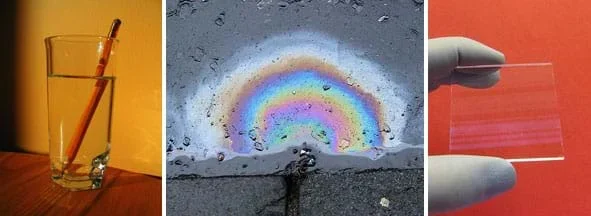 Figure 1. Examples of refraction may be found all around us.Copyright (left) 2005 Denise Carlson, ITL Program, College of Engineering, University of Colorado Boulder; (middle) 2007 John, Wikimedia Commons; (right) 2011 Zaereth, Wikimedia Commons http://commons.wikimedia.org/wiki/File:Dieselrainbow.jpg http://commons.wikimedia.org/wiki/File:Antireflection_coating_split_pic.jpg
Refraction, or the bending of light, is an engaging topic for students since it is highly visual and many examples of it can be seen in daily life. For example, refraction is what makes a drinking straw look broken when placed in a glass of water, splits light into its rainbow colors through a prism, causes rainbows and the swirl of colors observed in oil slicks, and makes fishing with a spear difficult (see Figure 1). The main idea of this lesson is to use a few of these examples to give students a true understanding of refraction, not just a book definition. For assessment purposes, expect students to be able to define refraction as "the bending of light caused by a change in speed as it enters a different material," as well as explain how refraction affects the color of light that is reflected from a thin film.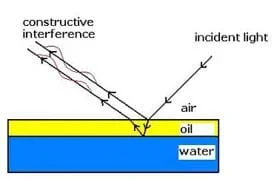 Figure 2. Thin films can cause certain wavelengths of light to interfere constructively with one another, causing us to see different colors.Copyright 2013 Caleb Swartz, Vanderbilt University
Refraction affects the color of light that is reflected from a thin film, as illustrated in Figure 2. In the case of Figure 2, the thin film is made up of oil. In a thin film, some light reflects off the surface of the film, while some goes into the film, is refracted and reflects back out. Since color is based on wavelength, the color that gets reflected is determined by which wavelengths interfere with each other constructively as they reflect and refract. Constructive and destructive interference has to do with properties of the waves leaving the thin film, specifically their phases. Constructive interference occurs when the beams of light leaving the thin film have the same phase, and destructive interference happens when those light waves have difference phases (see Figure 3). Constructive interference results in stronger, more intense visible light, while destructive interference causes the light waves to be less intense or attenuated.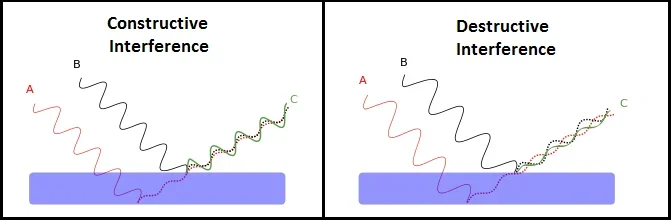 Figure 3. The difference between constructive interference and destructive interference is based on the phase of the resultant waves.Copyright 2013 Jhbdel, Wikimedia Commons http://commons.wikimedia.org/wiki/File:Thin_film_interference_phase_1.svg http://commons.wikimedia.org/wiki/File:Thin_film_interference_phase_2.svg
To eventually solve the challenge question, students need to understand the three factors that can be changed to alter the color that gets reflected: 1) The wavelength of light used. If everything else is kept the same, we can choose the particular wavelength that will interfere constructively. 2) The thickness of the film. A thicker film means that longer wavelengths "fit" in the film and therefore interfere constructively. 3) The index of refraction of the film. This is the important one. If the index of refraction changes, the light is bent more (or less) than before, causing the light to have a shorter or longer path to the bottom of the film, so different wavelengths will interfere constructively.
In addition to understanding these three factors, in subsequent lessons of this unit students will be required to solve problems related to refraction that require a deeper understanding than memorizing a definition, and this lesson is designed to give them that understanding. Follow this sequence of steps to present the lesson and associated activity:
- Hand out the worksheets. The worksheet contains all information students need to write down, questions to answer, and so on, for both the lesson (question #1) and its associated activity (rest of the worksheet).
- Present the Introduction/Motivation content.
- Direct student pairs to answer worksheet question #1, briefly jotting down what they know about the aspects of light learned thus far, at least three important characteristics. (Expected answers include wave/particle duality, interference and diffraction, and will vary depending on the teacher's scope and sequence. The minimum lesson prerequisite are an understanding that light is a wave, and a knowledge of interference.)
- Once students are done writing, call on volunteers to share their answers. Compile a list of facts about light on the classroom board, directing students to write down on their worksheets any they did not include while working in pairs.
- Mention and/or show students examples of optical phenomenon that can only be explained by refraction (see Figure 1). Point out that none of the listed aspects of light can fully explain this phenomenon.
- Then proceed to conduct the associated activity. It is helpful to divide the activity into two parts. First have students perform the blowing bubbles portion of the activity followed by a class discussion (described in the next step), then followed by the Bragg gratings portion of the activity. If you do not have example Bragg gratings or Bragg mirrors, show students a short video instead, or doing only the bubbles portion is sufficient.
- After students perform the blowing bubbles portion of the associated activity, lead a midway class discussion asking students to share their observations of what they saw during the activity and their explanations of it. Conclude with a definition of refraction and how it caused the observed color affects.
- Ask students to suggest possible parameters we could change (such as the material, light wavelength, or material thickness) to alter the colors that we see. This leads to the realization that we should see different results if different material is present in the pores of a porous silicon nanosensor.
In the last lesson, what challenge were we given? (Listen to volunteer responses or call on students. If necessary, read aloud the challenge question to refresh students' memories.) We were introduced to a problem that challenged us to find a new method of gene detection to aid in cancer risk evaluation. Then what did we do? (Listen to student responses.) That's right, we first thought about what we already know about the topic. Then, to begin our research on this topic, we read an article about a device called a Bragg grating, which can be used to detect pathogens and antibodies. From this, what ideas did we learn that might apply to solving the challenge? We discussed how a similar device might be used to sense the presence of cancer-causing genes, which would provide a solution to our challenge question.
The idea of a biosensing device sounds great, but how do wonderful devices like this work? What physical properties drive this seemingly magical technology? We already know that it has to do with light. How do we know that? (Listen to student ideas.) That's right, because it is an optical device. So, let's begin by reviewing what we already know about light, and see how it applies to solving our challenge question.
You can work in pairs to pool what you know, and then we'll combine everyone's thoughts to make sure you and your partner haven't left anything out. Then we will incorporate a new aspect of light into our knowledge base—refraction. To do this, we will blow bubbles and handle some nanosensors—technology so new that it is not yet made available to the public! By the end of the lesson, you will be able to define refraction as well as explain the factors you can change to alter the visible outcome of refraction.
Remember that we are following the steps of the Legacy Cycle; this lesson comprises the Research and Revise portion of the cycle. You get to play the scientist and form a "hypothesis" about what you see, and collect new information that you can use to get you one step closer to answering the challenge question.
What is refraction? (Call on students to respond, or take volunteers. Expect responses to include "the bending of light.") What happens to light when it enters a thin film? (Expect answers to include: "the light is bent," "only one color shows up," or "the light bounces off the bottom of the film."). Why do we see only certain colors, and how does refraction make that possible? (Expect responses to include: "refraction changes the wavelength that will fit in the film," or "the color that comes back is the color that fit into the film.") If we want to see a different color, what two things can we change, and how can we change them? (Expect responses to include: "thickness," which changes the length of a light ray that will fit in the film, and "index of refraction," or the consistency of the film, which changes how much the light is bent, thereby changing the path light takes, which changes the wavelength of light that will fit in the film.)
- amplitude
- The vertical distance between the crest and trough of a wave. Amplitude is often connected to a wave's intensity and/or the amount of energy it carries.
- crest
- The maximum positive amplitude of a wave.
- diffraction
- The bending of light around an obstacle.
- frequency
- The number of full cycles a wave completes in one second.
- interference
- The combining of two or more waves to form a single smaller or larger wave. Constructive interference is when the waves in interference have the same phase.
- optical
- Of or relating to the eye or light.
- period
- The number of seconds it takes a wave to complete one full cycle.
- refraction
- The bending of light caused by a change in speed as it enters a different material.
- thin film
- A very thin layer of a substance or material; a thin film may range in thickness from smaller than a nanometer to micrometers. Thin films are often used as coatings for optical and semiconductor devices.
- trough
- The maximum negative amplitude of a wave.
- wavelength
- The straight-line distance between equal points on a wave. Light waves exhibit different properties based on their wavelengths.
Pre-Lesson Assessment
Prior Knowledge: Use the first portion of the lesson, while compiling student responses to What Does Light See? Worksheet (PDF) question #1, to informally assess students' pre-requisite knowledge. Do this by asking for a show of hands to see how many student pairs wrote down each fact about light that you add to the list on the classroom board. This gives you an approximate idea of how many remember how much, thereby letting you know how much review/re-teaching is necessary before moving on to the rest of the lesson.
Post-Introduction Assessment
Since students are conducting the associated activity mid-lesson, refer to the assessment suggestions provided in the activity write-up.
Lesson Summary Assessment
Questions: Post the following questions on the board for students to answer and turn in. Alternatively, use these questions to conduct a class discussion.
- What is refraction? (Answer: The bending of light caused by a change in speed as it enters into a different material.)
- What determines the color(s) we see returning from a thin film? (Answer: The visible color is the one that corresponds to the wavelength of light that experiences constructive interference.)
- What factor(s) influence the wavelength of light that experiences constructive interference? (Answer: Thickness of film, angle of incident light, and index of refraction of the film.)
Klein, Stacy S., Harris, Alene H. "A User's Guide to the Legacy Cycle." Journal of Education and Human Development. Vol. 1, No. 1, 2007. http://www.scientificjournals.org/journals2007/articles/1088.pdf
Contributors
Caleb Swartz
Supporting Program
VU Bioengineering RET Program, School of Engineering, Vanderbilt University
Acknowledgements
The contents of this digital library curriculum were developed under National Science Foundation RET grant nos. 0338092 and 0742871. However, these contents do not necessarily represent the policies of the National Science Foundation, and you should not assume endorsement by the federal government.
Copyright
2014 by Regents of the University of Colorado; original © 2012 Vanderbilt University