
Show Me the Genes: Making Posters to Communicate Solutions
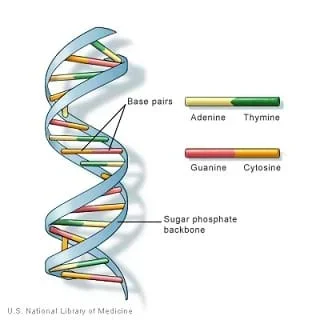 If an engineered biosensor bonds with a target strand of DNA, we can detect its presence by a shift in the interference pattern it produces.Copyright U.S. National Library of Medicine http://ghr.nlm.nih.gov/handbook/basics/dna
By this point in the unit, students have learned all the necessary information and conceptualized a design for how an optical biosensor could be used to detect a target strand of DNA associated with a cancer-causing gene as their solution to the unit's challenge question. Now student groups act as engineers again, using a poster format to communicate and prove the validity of the design. Successful posters include a description of refraction, explanations of refraction in a thin film, and the factors that can alter the interference pattern of a thin film. The posters culminate with an explanation of what is expected to be seen in a biosensing device of this type if it were coupled to a target molecule, proven with a specific example and illustrated with drawings and diagrams throughout. All the poster elements combine to prove the accuracy and viability of this method of gene detection. Together with its associated lesson, this activity functions as part of the summative assessment for this unit.
Many brilliant engineering designs are never realized or are delayed for decades, not because of error or unreliability of the design, but because they were not adequately disseminated to the larger production and consumer marketplace. If engineers are to succeed at designing successful products, they must be able to design the products AND successfully communicate their effectiveness and usefulness to companies and individuals who have the means of bringing them to manufacture and distribution. In this activity, students practice communicating ideas effectively by using a poster format to logically and cohesively present their solutions for gene detection in a way that people unfamiliar with the topic can be convinced of their value.
After this activity, students should be able to:
- Explain thin film refraction and the factors that influence it.
- Illustrate thin film refraction in an accurate diagram.
- Explain the experimental results of using an optical biosensor, and prove these results with a mathematical example.
- STEL-7DD Apply a broad range of making skills to their design process.
Grades 9-12
Do you agree with this alignment?
- HS-ETS1-1 Analyze a major global challenge to specify qualitative and quantitative criteria and constraints for solutions that account for societal needs and wants.
Grades 9-12
This resource focuses on the following Three Dimensional Learning aspects of NGSS:
Science & Engineering Practices- Analyze complex real-world problems by specifying criteria and constraints for successful solutions.Do you agree with this alignment?
Disciplinary Core Ideas- Criteria and constraints also include satisfying any requirements set by society, such as taking issues of risk mitigation into account, and they should be quantified to the extent possible and stated in such a way that one can tell if a given design meets them.Do you agree with this alignment?
- Humanity faces major global challenges today, such as the need for supplies of clean water and food or for energy sources that minimize pollution, which can be addressed through engineering. These global challenges also may have manifestations in local communities.Do you agree with this alignment?
Crosscutting Concepts- New technologies can have deep impacts on society and the environment, including some that were not anticipated. Analysis of costs and benefits is a critical aspect of decisions about technology.Do you agree with this alignment?
Do you agree with this alignment? - Analyze complex real-world problems by specifying criteria and constraints for successful solutions.
- 3231.4.8 Solve problems related to Snell's law [Index of refraction: n = (sin θr / sin θi); Snell's law: ni sin θi = nr sin θr].
Grades 9-12
Do you agree with this alignment?
Each group needs:
- poster board, ~22 x 28-in (56 x 71-cm), white or colored
- scissors
- glue
- colored paper
- Presenting the Optical Biosensor Requirements & Rubric (PDF), one per group (groups should already have this handout, given to them during the associated lesson)
- (optional) example completed poster or one from a previous class, to show students
- (optional) magazines, to find/cut out pictures for the poster
- (optional) computer with Internet access and a printer, to find/print images for the poster
Students must have:
- A complete understanding of the unit's challenge question.
- An understanding of optical thin films, including refraction and interference.
- The ability to solve problems using Snell's law.
Today is the day you get to show off what you know! We have learned a lot over the past few days. We started with a challenge question that we knew nothing about, and have brainstormed about the topic (Generate Ideas), brought in outside sources from the scientific community (Multiple Perspectives), and even performed our own experiments with refraction (Research and Revise) to see how we could use refraction and thin films to solve the challenge. We even learned and practiced using equations to prove that refraction works in the form of a biosensor (Test Your Mettle).
Now that we know a solution to the challenge question in all its details, we are ready to publish our work, and bring our wonderful idea to the community in the final phase of the Legacy Cycle, Go Public. To do so, each group will create a poster outlining its device, how it works, and all the relevant physics concepts that enable it to work. You will even get to brainstorm within your group to decide how you want your optical biosensor to look! You will prove the worthiness of our method by giving specific examples, complete with equations to make sure everyone who reads it will understand our work, and its validity.
To guide you, use the requirements & rubric handout; it details what to include on your poster and how to organize it. Take a look at your copy of the rubric; notice all the relevant information, including point values for the sub-components of the assignment. To make sure everyone understands, let's go over it briefly, and then I'll let you get started!
Background
This activity functions as part of the summative assessment for this unit, contributing to the last phase of the Legacy Cycle, Go Public, during which students present the results of their work. Student groups create posters that depict their solutions to the unit's challenge question— how optical biosensors might work to detect specific genes.
Before the Activity
- Student groups should each have a copy of the Presenting the Optical Biosensor Poster Requirements & Rubric (PDF), as handed out in the associated lesson; but if not, make replacement copies, as needed.
- Gather materials.
- (optional) Make an example poster to show students or have one handy one from a previous class.
- (optional) Reserve a computer lab with a printer for students to find and print images.
With the Students
- Present the Introduction/Motivation content to the class.
- Have students gather at tables or work spaces in their groups of three. Give each group one poster board and poster-making supplies: scissors, glue, colored paper.
- Ask students the pre-activity questions, as explained in the Assessment section and listed in the Investigating Questions section. Walk through how what they learned in the previous lessons and activities of the unit could be sequenced and presented on a summary poster. Emphasize the importance of being organized and logical in presenting information to the poster reader. Recall from the associated lesson tactics they can use to ensure a quality presentation of research results.
- Go through the requirements & rubric document in detail, outlining what students are expected to do
- Show them an example poster.
- Answer any question, and make sure all students understand the assignment.
- Be sure to include the role of the challenge question in the discussion, making sure students understand the challenge question and this activity's connection to it.
Challenge question: "In 2013, actress Angelina Jolie underwent a double mastectomy, not because she had been diagnosed with breast cancer, but merely to lower her cancer risk. But what if she never inherited the gene(s) that are linked to breast cancer and endured surgery unnecessarily? Can we create a new method of assessing people's genetic risks of breast cancer that is both efficient and cost-effective?"
- Inform students that in order to receive full credit for the "illustrations" portion of the rubric, posters must include drawings and/or diagrams that depict their own concepts of what their optical biosensors would look like. This tends to be difficult for students, so make sure they understand that it is purely conceptual! They do not need to build or test their devices (like real-world engineers would do), just draw one possibility for what it could look like. Full credit is derived from labeling the following: how the solution/DNA gets into the silicon, and how the reflected light is "captured" or "seen" when the phase shift occurs.
- Have student groups assign team member roles as such: technical consultant (to make sure information presented is accurate and complete, and create rough-draft illustrations), graphic designer (responsible for pleasing and effective layout and readability of poster, illustrations and images), and editor (to type or hand-write text and equations, helping to place them on the board for logical flow of information, and making sure that poster requirements are met). Remind groups to brainstorm as a team to determine how they want their biosensors to look.
- Give students the rest of the class period to work on their posters. Monitor their progress and answer questions. If class time is insufficient, permit students to work on their posters outside of class time, completing them by a specified due date.
- index of refraction
- The ratio of the speed of light in a material to its speed in a vacuum. The mathematical form is n = c/v, where c is the speed of light in a vacuum, and v is the speed of light in that material.
- interference
- The combining of two or more waves to form a single smaller or larger wave.
- optical biosensor
- A device that turns a biological stimulus into an electrical signal through the use of light.
- refraction
- The bending of light caused by a change in speed as it enters a different material.
- snell's law
- A scientific equation that relates the index of refraction of a substance to the angle at which light bends in that substance. The mathematical form is n1sinθ1 = n2sinθ2 , where n is the index of refraction (for substances 1 and 2) and θ is the angle at which light is refracted, as measured from a line perpendicular to the surface of the material (again for substances 1 and 2).
Pre-Activity Assessment
Review Questions: Review the previous three lessons and associated activities with students, posing the Investigating Questions to the class. Gauge the proportion of correct responses before moving on.
Activity Embedded Assessment
Poster Perusing: During the activity, monitor student poster-making progress for organization, clarity and accuracy. Address any errors that reappear from group to group with the entire class. Help them through any stages of feeing stuck or overwhelmed.
Post-Activity Assessment
Poster & Quiz: Grade the team posters using the Presenting the Optical Biosensor Poster Requirements & Rubric (PDF). Then, together with students' individual quiz results from the associated lesson, assess student learning for the entire unit as well as this concluding lesson and activity.
- If a computer lab is available for students to find and print images, make sure the messy gluing and cutting are permitted in the lab. If not, provide a suitable space for students to perform these activities away from the computer equipment.
Students often have trouble getting started, since the poster includes so much information. It is helpful to review the sequence of lessons that comprise this unit to give them some structure, as well as hints to jump-start their creativity.
- For lower grades, require less detail, or remove the mathematical example portion of the rubric.
- For upper grades, require more detail, such as an explanation of how light could be applied to the sensor, such as lasers turned at specific angles.
Klein, Stacy S., Harris, Alene H. "A User's Guide to the Legacy Cycle." Journal of Education and Human Development. Vol. 1, No. 1, 2007. http://www.scientificjournals.org/journals2007/articles/1088.pdf
- Tell Me the Odds (of Cancer)
- Tell Me Doc—Will I Get Cancer?
- What Does Light See?
- Quantifying Refraction
- See the Genes: Communicating Your Work, Findings and Ideas
- Show Me the Genes: Making Posters to Communicate Solutions
Contributors
Caleb Swartz
Supporting Program
VU Bioengineering RET Program, School of Engineering, Vanderbilt University
Acknowledgements
The contents of this digital library curriculum were developed under National Science Foundation RET grant nos. 0338092 and 0742871. However, these contents do not necessarily represent the policies of the National Science Foundation, and you should not assume endorsement by the federal government.
Copyright
2014 by Regents of the University of Colorado; original © 2012 Vanderbilt University