
Chromatography Lab
To increase students' awareness of possible invisible pollutants in drinking water sources, students perform an exciting lab requiring them to think about how solutions and mixtures exist even in unsuspecting places such as ink. They use alcohol and chromatography paper to separate the components of black and colored marker ink. Students witness first-hand how components of a solution can be separated, even when those individual components are not visible in solution.
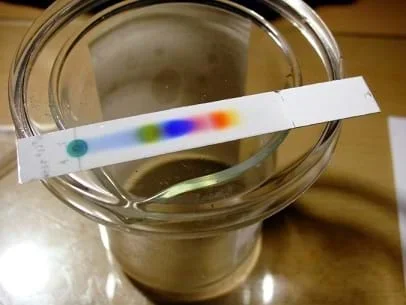 Environmental engineers use separation methods to remove pollutants from drinking water sources. The ink chromatography method separates components that may not visible in the original ink sample.Copyright 2004 Natrij, Wikimedia Commons http://commons.wikimedia.org/wiki/File:TLC_black_ink.jpg
A firm understanding of solutions and mixtures and their components is essential for environmental engineers whose challenge is to prepare solutions to monitor and test groundwater for contaminants, and to develop remediation processes that separate pollutants from their water solutions.
After this activity, students should be able to:
- Describe how chromatography works and what happens during this process to black or colored ink.
- Explain why being able to separate solutions into their components is important to environmental engineering and water quality.
- STEL-3G Explain how knowledge gained from other content areas affects the development of technological products and systems.
Grades 6-8
Do you agree with this alignment?
- Science understanding is developed through the use of science process skills, scientific knowledge, scientific investigation, reasoning, and critical think
Grades 6-8
Do you agree with this alignment?
- MS-PS1-2 Analyze and interpret data on the properties of substances before and after the substances interact to determine if a chemical reaction has occurred.
Grades 6-8
This resource focuses on the following Three Dimensional Learning aspects of NGSS:
Science & Engineering Practices- Analyze and interpret data to determine similarities and differences in findings.Do you agree with this alignment?
- Science knowledge is based upon logical and conceptual connections between evidence and explanations.Do you agree with this alignment?
Disciplinary Core Ideas- Each pure substance has characteristic physical and chemical properties (for any bulk quantity under given conditions) that can be used to identify it.Do you agree with this alignment?
- Substances react chemically in characteristic ways. In a chemical process, the atoms that make up the original substances are regrouped into different molecules, and these new substances have different properties from those of the reactants.Do you agree with this alignment?
Crosscutting Concepts- Macroscopic patterns are related to the nature of microscopic and atomic-level structure.Do you agree with this alignment?
Do you agree with this alignment? - Analyze and interpret data to determine similarities and differences in findings.
Each group needs:
- Whatman chromatography paper, at least 4 two-inch-wide strips; available at amazon.com
- pencil
- Sharpie® black ink marker; can be shared among teams
- Sharpie color markers, of various colors; can be shared among teams
- isopropyl alcohol (rubbing alcohol); higher proof or percent rubbing alcohol is best
- two 500-ml beakers
- Chromatography Lab Worksheet (PDF), one per student
Who has heard of chromatography? Chromatography is a way to look at complex mixtures by separating them into their components. The separation of a mixture into its components is a physical process; that is, because the components of the mixture are not chemically combined, they can be separated by physical means. Criminal investigators use this technology to identify substances such as drugs, blood, ink and other fluids.
We have already discussed environmental engineering situations that require water remediation. Can you name some for me? (Listen to student responses.) Yes, examples might include industrial oil spills or chemical leaks into drinking water sources. In order to develop and apply methods of water remediation, environmental engineers, must also be able to separate mixtures to remove the pollutant components.
Here's how chromatography works: Different inks have different properties, such as how much they can be dissolved in solvents. When you place chromatography paper into a solvent, the solvent begins to move up the paper. As the solvent rises, it dissolves the ink on the paper and separates the ink into its components. The farther the ink travels, the more it is attracted to the solvent.
Understanding chemical reactions can also help environment engineers remediate contaminants in water. For example, engineers can use chemical oxidants to degrade certain contaminants; in other words, the contaminant reacts with the treatment chemical to produce a product that is benign, or harmless, unlike the contaminant. Some common indicators of reaction include: changes in odor, temperature, or color, production of gas, or precipitation. However, the only way to be absolutely certain of whether a chemical reaction has occurred is to perform a chemical analysis to determine whether a new chemical is present.
A good understanding of solutions and mixtures and their components, in addition to reaction, is essential for environmental engineers. Most experiments and data gathering done for the purpose of improving groundwater quality involve the preparation of solutions to monitor and test contaminated water.
Before the Activity
- Gather materials and make copies of the Chromatography Lab Worksheet (PDF).
- Cut the chromatography paper into strips about two-inches wide. Cut at least four strips for each group.
With the Students
- Divide the class into groups of three students each. Hand out the worksheets.
- Take the strips of chromatography paper and fold both pieces about an inch from the top.
- Use a black Sharpie to draw a horizontal line near the other end of the chromatography paper. Make the line about as high off the bottom as the width of your thumb.
- Use a pencil to suspend the paper in each beaker, making sure the strip does not touch the sides of the beaker.
- Carefully add water to one beaker and alcohol to the other. Add just enough of each liquid so that it touches the bottom of the hanging strip.
- Watch what happens!! Once you see the separation is complete you, get new strips and repeat using ink from a colored Sharpie marker.
- If time permits, have students test other colored Sharpies to see different color separations.
- Have students answer the questions on their worksheets and hand them in for grading.
- Conclude by leading a wrap-up class discussion to compare results and conclusions; see the questions in the Assessment section.
- solute
- The component of a solution in the smallest amount.
- solution
- Mixture made of two or more substances.
- solvent
- The component of a solution in the largest amount.
Pre-Activity Assessment
Predictions: Have students write down predictions for what they think will happen during the activity. Have them identify the components of a solution (that is, solute[s] and solvent). Remind students that we are interested in whether a reaction occurs during the experiment. Review the indicators of reaction (changes in odor, temperature, or color, production of gas, or precipitation.) Ask a few student volunteers to share their answers with the class.
Activity Embedded Assessment
What's Going On? While students are conducting the lab, guided by the Chromatography Lab Worksheet (PDF), walk around the room and ask them questions to keep them engaged and on task. Example questions:
- Why doesn't the black Sharpie marker ink separate in water? (Answer: The separation depends on how soluble the ink in the marker is in either water or alcohol. The ink in the black marker is not soluble in water and therefore does not separate. This is also why this type of marker is considered a "permanent" marker—because it is water-insoluble and thus cannot be washed off using water! For more advanced students, explain that the alcohol is a better solvent for chromatographic separation [dissolving the ink] than water due to polar and non-polar interactions.)
- Do you see any of the indicators of reaction? Do you think that a reaction has occurred? (For the teacher: Make sure to discuss the color change indicator with students. Students may think that a reaction has occurred because the ink separates into its color components when immersed in the solvent, so it might appear that the ink has changed color. However, the appearance of the color components is not indicating a chemical reaction, just a separation. One indication that a reaction has not occurred is that no energy change has taken place. All of the indicators of reaction correspond to energy change.)
Post-Activity Assessment
Worksheet: Have students answer the Chromatography Lab Worksheet questions and hand them in for grading (see answers in the Wrap-Up Discussion, below). Review their answers to gauge their comprehension of the material.
Wrap-Up Discussion: At lab end, bring students together as a class and ask them the following questions about how chromatography works, what happens to the ink during this process and its real-world relevance. Make sure everyone understands the answers:
- What were the two solvents used in our lab activity today? (Answer: Water and isopropyl alcohol.)
- Black ink is more attracted to which solvent? How do you know? (Answer: The black ink is more attracted to the isopropyl alcohol. We observed ink separation in the isopropyl alcohol and no ink separation in the water.)
- What colors are present in black ink? (Answer: This varies from group to group, but typically the most common colors are purple, blue and yellow. In addition, black is still visible in the separation.)
- What do these colors represent? (Answer: Each color represents the different solutes or ink components used to make the black ink. We cannot see each of these individual components unless a separation occurs. This separation only occurs when a solvent is used in which the ink is soluble.)
- Why might the ability to separate solutions into their components be important to environmental engineers and water quality? (Answer: Environmental engineers must understand all about solutions and mixtures and their components because most experiments and data gathering done for the purpose of improving groundwater quality involve the preparation of solutions to monitor and test contaminated water. Only if we can separate from water the usually invisible water pollutant chemicals can we design remediation methods to clean the water!)
When disposing of the isopropyl alcohol, pour the remaining alcohol back into the original bottle to be disposed of as flammable waste.
Make sure students do not draw marker lines too close to the crease in the chromatography paper. If they do, the separation takes a long time because the alcohol must travel further than if ink lines are drawn near the bottom half of the paper.
Students can easily perform this lab activity at home to test different colored markers and different marker types (such as dry erase board markers). Designing inks with different properties and characteristics is a vast chemical engineering industry.
Contributors
Jessica Ray; Phyllis Balcerzak; Barry Williams
Supporting Program
GK-12 Program, School of Engineering and Applied Science, Washington University in St. Louis
Acknowledgements
This curriculum was developed with support from National Science Foundation GK-12 grant number DGE 0538541. However, these contents do not necessarily represent the policies of the NSF, and you should not assume endorsement by the federal government.
Copyright
2013 by Regents of the University of Colorado; original © 2010 Washington University in St. Louis