
Density Column Lab - Part 1
In this first part of a two-part lab activity, students use triple balance beams and graduated cylinders to take measurements and calculate the densities of several common, irregularly shaped objects with the purpose to resolve confusion about mass and density. After this activity, conduct the associated Density Column Lab - Part 2 activity before presenting the associated Density & Miscibility lesson for discussion about concepts that explain what students have observed.
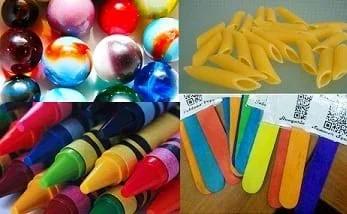 What are the relative masses and densities of these everyday items?Copyright (top left) 2011 Glenda Green, Wikimedia Commons, (top right) 2009 Stilfehler, Wikimedia Commons, (lower left) State of Oklahoma, (lower right) 2011 Rachel Kassman, Wikimedia Commons http://commons.wikimedia.org/wiki/File:Marbles_Background.jpg http://commons.wikimedia.org/wiki/File:Penne_rigate.jpg https://www.ok.gov/strongandhealthy/Tools_for_Schools/index.html http://commons.wikimedia.org/wiki/File:Materials_pre-placement.jpg
To monitor and improve water quality (if necessary), it is vital to for environmental engineers to know all of the physical and chemical properties of the contaminants. Properties such as density and hydrophobicity must be considered when determining the best way to remediate contaminated sites. For example, the differing densities and immiscibilities of oil and water prove beneficial to environmental engineers when cleaning up oil spills.
After this activity, students should be able to:
- Explain the difference and relationship between mass and density.
- Take accurate measurements of mass and volume using a triple balance beam and reading a meniscus, respectively.
- CCSS.Math.Content.6.NS.B.2 Fluently divide multi-digit numbers using the standard algorithm.
Grade 6
Do you agree with this alignment? - CCSS.Math.Content.6.NS.B.3 Fluently add, subtract, multiply, and divide multi-digit decimals using the standard algorithm for each operation.
Grade 6
Do you agree with this alignment? - CCSS.Math.Content.6.RP.A.3d Use ratio reasoning to convert measurement units; manipulate and transform units appropriately when multiplying or dividing quantities.
Grade 6
Do you agree with this alignment? - CCSS.Math.Content.6.SP.B.4 Display numerical data in plots on a number line, including dot plots, histograms, and box plots.
Grade 6
Do you agree with this alignment? - CCSS.Math.Content.6.SP.B.5 Summarize numerical data sets in relation to their context, such as by:
Grade 6
Do you agree with this alignment? - CCSS.Math.Content.8.SP.A Investigate patterns of association in bivariate data.
Grade 8
Do you agree with this alignment? - CCSS.Math.Content.8.SP.A.1 Construct and interpret scatter plots for bivariate measurement data to investigate patterns of association between two quantities. Describe patterns such as clustering, outliers, positive or negative association, linear association, and nonlinear association.
Grade 8
Do you agree with this alignment? - CCSS.Math.Content.HSS-ID.B.6 Represent data on two quantitative variables on a scatter plot, and describe how the variables are related.
Grades 9-12
Do you agree with this alignment?
- STEL-3G Explain how knowledge gained from other content areas affects the development of technological products and systems.
Grades 6-8
Do you agree with this alignment?
- CCSS.Math.Content.6.NS.B.2 Fluently divide multi-digit numbers using the standard algorithm.
Grade 6
Do you agree with this alignment? - CCSS.Math.Content.6.NS.B.3 Fluently add, subtract, multiply, and divide multi-digit decimals using the standard algorithm for each operation.
Grade 6
Do you agree with this alignment? - CCSS.Math.Content.6.RP.A.3d Use ratio reasoning to convert measurement units; manipulate and transform units appropriately when multiplying or dividing quantities.
Grade 6
Do you agree with this alignment? - CCSS.Math.Content.6.SP.B.4 Display numerical data in plots on a number line, including dot plots, histograms, and box plots.
Grade 6
Do you agree with this alignment? - CCSS.Math.Content.6.SP.B.5 Summarize numerical data sets in relation to their context, such as by:
Grade 6
Do you agree with this alignment? - CCSS.Math.Content.8.SP.A Investigate patterns of association in bivariate data.
Grade 8
Do you agree with this alignment? - CCSS.Math.Content.8.SP.A.1 Construct and interpret scatter plots for bivariate measurement data to investigate patterns of association between two quantities. Describe patterns such as clustering, outliers, positive or negative association, linear association, and nonlinear association.
Grade 8
Do you agree with this alignment? - CCSS.Math.Content.HSS-ID.B.6 Represent data on two quantitative variables on a scatter plot, and describe how the variables are related.
Grades 9-12
Do you agree with this alignment?
- Science understanding is developed through the use of science process skills, scientific knowledge, scientific investigation, reasoning, and critical think
Grades 6-8
Do you agree with this alignment?
Each group needs:
- 4 marbles
- 4 Popsicle or wooden craft stick pieces (break wooden sticks into 1-inch pieces)
- 4 crayon pieces (break crayons into 1-inch pieces)
- 4 pasta noodles (dry, uncooked)
- triple balance beam
- 100-ml graduated cylinder
- tap water
- Density Column Lab – Part 1 Worksheet (PDF), one per person
Have students complete the Introduction to Water Chemistry lesson before conducting this activity.
Environmental engineers rely on a good understanding the chemical and physical properties of materials. We've already learned about measuring pH, which is one important chemical property, especially for environmental engineers who focus on water quality. What are some important physical properties that environmental engineers might also be concerned about? (Listen to student ideas. Possible answers: Weight, mass, area, volume, density.) We are going to focus on mass and density in today's activity.
Who can explain to me what density means? Or how to calculate density? (Listen to student responses.) The density of an object is a measure of the mass per volume. If we had an equal volume, let's say enough to fill this whole classroom, of feathers and of bowling balls, which would have more mass? (Answer: A room full of bowling balls.) Yes, a room full of bowling balls would be more massive than a room full of feathers, so this means that bowling balls have a greater density than feathers.
To calculate density, we must measure the mass of an object and its volume. Then we divide the mass by the volume. This gives us the density of that object.
This is part 1 of a two-part lab activity. You will use a triple balance beam and a graduated cylinder to take measurements and calculate the densities of several common, irregularly shaped objects.
Note: The lab is meant to be inquiry-based, so the worksheet has no written procedure.
Before the Activity
- Gather materials and make copies of the Density Column Lab – Part 1 Worksheet (PDF).
- At each lab station, place four or five of each of the four items (marbles, Popsicle stick pieces, crayon pieces, pasta noodles), as well as all of the other lab supplies.
With the Students
- Divide the class into groups of five students each.
- Hand out the lab worksheets and have students document their density predictions.
- Measure the mass of each item to obtain the average mass for each component of the density column. Begin with one of the four items. Place all of the pieces of the particular item on the triple balance beam and record the mass. Divide the mass by the number of objects to obtain the average mass of each piece and record it in the data table.
- Next, fill the graduated cylinder with an initial volume of water (at least 50 ml). Record the initial volume of water you chose. (As necessary, guide students on how to read the water level in the graduated cylinder; explain about the meniscus.)
- To find the average volume of each of the four items, place all the pieces of the item in the graduated cylinder. Be sure the items are submerged. Record the ending volume. Perform a similar division calculation to obtain the average volume of each piece.
- Repeat this process for all the remaining items.
- Use the data from the items (the average mass and average volume) to calculate the density of each object. Write on the board: density = mass per unit volume.
- Have students answer the questions on their worksheets and hand them in for grading.
- Conclude by leading a wrap-up class discussion to compare results and conclusions; see questions in the Assessment section.
- density
- Mass per unit volume.
- mass
- The amount of matter in a given object.
- meniscus
- The convex or concave upper surface of a column of liquid. The curvature is caused by surface tension.
- volume
- The amount of space an object takes up.
Pre-Activity Assessment
Lesson Recap: Have students discuss as a class the concepts presented in the pre-requisite lesson.
Predictions: Direct students to the Density Column Lab – Part 1 Worksheet (PDF), to rank the test items based on what they believe to be the most and the least dense. Expect most students to use mass to make their assumptions.
Activity Embedded Assessment
What's Going On? While students are performing the lab, walk around and ask them questions to keep them engaged and on task. Observe their lab procedures to gauge their comprehension of the material. Example questions:
- Why do we measure the volume this way as opposed to L x W x H? (Answer: Length x width x height, or L x W x H, is the volume equation for rectangular prisms. None of the shapes of our test items are exactly that shape, so the results from doing it that way would be inaccurate.)
- How do we determine the mass and volume of one of the objects? (Answer: The mass and volume of one object is determined as an average of four samples of that object. We place all four of a certain object on a scale together to determine a total mass. Then the total mass is divided by four to calculate the average mass of one of that particular object. The average volume is determined in the same way except that items are placed in the graduated cylinder of water and the total volume is determined by the water displacement.)
- What is the density of water? (Answer: 1,000 kg/m3 or 1 g/ml or approximately 8.3 lbs per gallon.)
Post-Activity Assessment
Worksheet: Have students answer the worksheet questions and hand them in for grading (see answers in the Wrap-Up Discussion, below). Review their answers to gauge their comprehension of the material.
Wrap-Up: At lab end, bring students together as a class and ask the following questions. Make sure everyone understands the answers:
- Rank the following items based on their calculated densities, with 1 being the least dense and 4 being the most dense. (Answer: The ranking is: 1 = Popsicle stick, 2 = pasta, 3 = crayon, 4 = marble.)
- Were your predictions correct? What did you learn about mass and density? (Answers will vary, depending upon students' predictions. Expect them to mention that mass can be measured directly using a scale or balance, while density is calculated using an object's mass and volume. Expect them to explain that the density of an object is a measure of the amount of mass per unit volume of an object.)
If the marbles roll off the balance beam, place them in a container and then measure the mass of the empty container alone in order to determine the mass of the marbles.
The Popsicle stick pieces may need to be submerged to get more accurate volume readings since they are less dense than water. Make sure students do not place their fingers in the water when taking measurements.
Remember to measure the mass of the items before measuring the volume since wet items weigh more.
Next, conduct the associated Density Column Lab - Part 2 activity as the second part of this activity. Part 2 focuses on the densities of different liquids that do not mix together.
Comparing the density of different liquids: How do the densities of vegetable oil, water and corn syrup help them to form layers in a cup? Published 2007. Activity 7.3, Investigation 7: Density, Inquiry in Action, American Chemical Society. 2007. Last accessed 2010. (Inspiration for this activity) http://www.inquiryinaction.org/pdf/chapter7/7.3_teacher.pdf
Contributors
Jessica Ray; Phyllis Balcerzak; Barry Williams
Supporting Program
GK-12 Program, School of Engineering and Applied Science, Washington University in St. Louis
Acknowledgements
This curriculum was developed with support from National Science Foundation GK-12 grant number DGE 0538541. However, these contents do not necessarily represent the policies of the NSF, and you should not assume endorsement by the federal government.
Copyright
2013 by Regents of the University of Colorado; original © 2010 Washington University in St. Louis