
Environmental Engineering and Water Chemistry
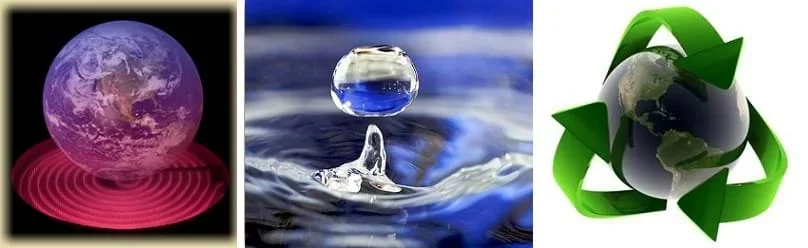 Environmental Engneers help protect the Earth and the environmentCopyright (left to right) Arizona Attorney General Tom Horne's Kids' Page; 2008 José Manuel Suárez, Wikimedia Commons; Howard County, Maryland http://kids.azag.gov/content/teens_globalwarming http://commons.wikimedia.org/wiki/File:Water_drop_001.jpg http://cc.howardcountymd.gov/displayprimary.aspx?id=6442459560
Begin this unit by conducting the environmental engineering sub-unit: Introduction to Environmental Engineering lesson, which begins with a PowerPoint presentation, and move to its associated activity, Thinking Green!, as a prelude to the next sub-unit.
Next, conduct the water chemistry sub-unit: Introduction to Water Chemistry lesson, followed by its associated activities, Chromatography Lab, Red Cabbage Chemistry and Water Remediation Lab, which can be taught in any order. Then conduct a two-part lab, presented as Density Column Lab – Part 1 and Density Column Lab - Part 2 activities, and conclude by presenting the Density & Miscibility lesson.
Environmental engineers are specialists in a wide variety of topics concerning our natural world, energy and the sustainability of our planet. Currently, areas of peak interest include global climate change, reducing atmospheric carbon dioxide, alternative fuel sources, and groundwater quality. Engineers have introduced geologic carbon sequestration as an option for capturing anthropogenic carbon dioxide released from industrial plants and on-road and off-road vehicles. Other engineers have investigated ethanol, hydrogen and algae as creative fuel alternatives to gasoline. Because of the importance of worldwide clean drinking water, some engineers have developed remediation technologies for contaminated groundwater. Skills important to engineers include problem solving and design, preparing presentations and lectures, communication and creativity, as well as a good working knowledge of the physical and chemical properties and behavioral characteristics of water and contaminants.
- Knowledge gained from other fields of study has a direct effect on the development of technological products and systems.
Grades 6-8
Do you agree with this alignment? - The management of waste produced by technological systems is an important societal issue.
Grades 6-8
Do you agree with this alignment? - Humans can devise technologies to conserve water, soil, and energy through such techniques as reusing, reducing, and recycling.
Grades 9-12
Do you agree with this alignment?
- Science and technology affect, and are affected by, society
Grades K-5
Do you agree with this alignment? - Human activity is dependent upon and affects Earth's resources and systems
Grades 6-7
Do you agree with this alignment? - Science understanding is developed through the use of science process skills, scientific knowledge, scientific investigation, reasoning, and critical think
Grades 6-8
Do you agree with this alignment?
- MS-ETS1-1 Define the criteria and constraints of a design problem with sufficient precision to ensure a successful solution, taking into account relevant scientific principles and potential impacts on people and the natural environment that may limit possible solutions.
Grades 6-8
This resource focuses on the following Three Dimensional Learning aspects of NGSS:
Science & Engineering Practices- Define a design problem that can be solved through the development of an object, tool, process or system and includes multiple criteria and constraints, including scientific knowledge that may limit possible solutions.Do you agree with this alignment?
Disciplinary Core Ideas- The more precisely a design task's criteria and constraints can be defined, the more likely it is that the designed solution will be successful. Specification of constraints includes consideration of scientific principles and other relevant knowledge that is likely to limit possible solutions.Do you agree with this alignment?
Crosscutting Concepts- The uses of technologies and any limitations on their use are driven by individual or societal needs, desires, and values; by the findings of scientific research; and by differences in such factors as climate, natural resources, and economic conditions.Do you agree with this alignment?
- All human activity draws on natural resources and has both short and long-term consequences, positive as well as negative, for the health of people and the natural environment.Do you agree with this alignment?
Do you agree with this alignment? - Define a design problem that can be solved through the development of an object, tool, process or system and includes multiple criteria and constraints, including scientific knowledge that may limit possible solutions.
- MS-PS1-2 Analyze and interpret data on the properties of substances before and after the substances interact to determine if a chemical reaction has occurred.
Grades 6-8
This resource focuses on the following Three Dimensional Learning aspects of NGSS:
Science & Engineering Practices- Analyze and interpret data to determine similarities and differences in findings.Do you agree with this alignment?
- Science knowledge is based upon logical and conceptual connections between evidence and explanations.Do you agree with this alignment?
Disciplinary Core Ideas- Each pure substance has characteristic physical and chemical properties (for any bulk quantity under given conditions) that can be used to identify it.Do you agree with this alignment?
- Substances react chemically in characteristic ways. In a chemical process, the atoms that make up the original substances are regrouped into different molecules, and these new substances have different properties from those of the reactants.Do you agree with this alignment?
Crosscutting Concepts- Macroscopic patterns are related to the nature of microscopic and atomic-level structure.Do you agree with this alignment?
Do you agree with this alignment? - Analyze and interpret data to determine similarities and differences in findings.
- Day 1: Introduction to Environmental Engineering lesson
- Day 2: Thinking Green! activity
- Day 3: Introduction to Water Chemistry lesson
- Day 4: Chromatography Lab activity
- Day 5: Water Remediation Lab activity
- Day 6: Red Cabbage Chemistry activity
- Day 7: Density & Miscibility lesson
- Day 8: Density Column Lab - Part 1 activity
- Day 9: Density Column Lab - Part 2 activity
Contributors
Jessica Ray; Phyllis Balcerzak; Barry Williams; Carleigh Samson
Supporting Program
GK-12 Program, School of Engineering and Applied Science, Washington University in St. Louis
Acknowledgements
This curriculum was developed with support from National Science Foundation GK-12 grant number DGE 0538541. However, these contents do not necessarily represent the policies of the NSF, and you should not assume endorsement by the federal government.
Copyright
2013 by Regents of the University of Colorado; original © 2010 Washington University in St. Louis