
Bone Mineral Density and Logarithms
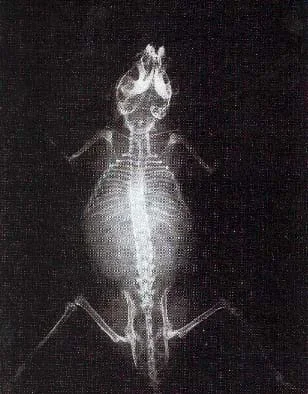 A mouse image made from a cabinet x-ray system.Copyright Dr. Edwin Donnelly, VUMC; used with permission
This "legacy cycle" unit is structured with a contextually-based Grand Challenge followed by a sequence of instruction in which students first offer initial predictions (Generate Ideas) and then gather information from multiple sources (Multiple Perspectives) . This is followed by Research and Revise as students integrate and extend their knowledge through a variety of learning activities. The cycle concludes with formative (Test Your Mettle) and summative (Go Public) assessments that lead students towards answering the Challenge question. See below for the progression of the legacy cycle through the unit. Research and ideas behind this way of learning may be found in How People Learn,(Bransford, Brown & Cocking, National Academy Press, 2000); see the entire text at https://www.nap.edu/read/9853/chapter/1.
The "legacy cycle" is similar to the "engineering design process" in that they both involve identifying an existing societal need, combining science and math to develop solutions, and using the research conclusions to design a clear, conceived solution to the original challenge. Though the engineering design process and the legacy cycle depend on correct and accurate solutions, each focuses particularly on how the solution is devised and presented. See an overview of the engineering design process at https://www.teachengineering.org/engrdesignprocess.php
Biomedical engineering consists of the application of engineering principles and techniques to the fields of medicine and life sciences. The process of calculating a small specimen bone mineral density image using a cabinet x-ray system us useful in determining the effectiveness of medications and treatments in medical research.
- CCSS.Math.Content.HSF-BF.B.5 (+) Understand the inverse relationship between exponents and logarithms and use this relationship to solve problems involving logarithms and exponents.
Grades 9-12
Do you agree with this alignment?
- Day 1-2: Bone Density Challenge Introduction lesson
- Day 3: Exploring Bone Mineral Density activity
- Day 4: Bone Density Math and Logarithm Introduction lesson
- Day 5: Common and Natural Logarithms and Solving Equations lesson
- Day 6: Linear Regression of Bone Mineral Density Scanners activity
- Day 7: Bone Mineral Density Math and Beer's Law lesson
- Day 8: Light Intensity Lab activity
Contributors
Kristyn Shaffer; Megan Johnston
Supporting Program
VU Bioengineering RET Program, School of Engineering, Vanderbilt University
Acknowledgements
The contents of this digital library curriculum were developed under National Science Foundation RET grant nos. 0338092 and 0742871. However, these contents do not necessarily represent the policies of the NSF, and you should not assume endorsement by the federal government.
Copyright
2013 by Regents of the University of Colorado; original © 2006 Vanderbilt University