
Bone Density Math and Logarithm Introduction
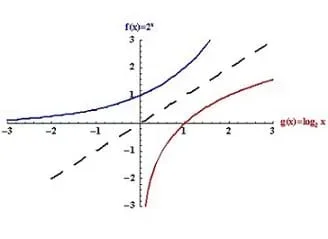 Exponential and logarithm graph.Copyright 2006 Kristyn Shaffer, Vanderbilt University
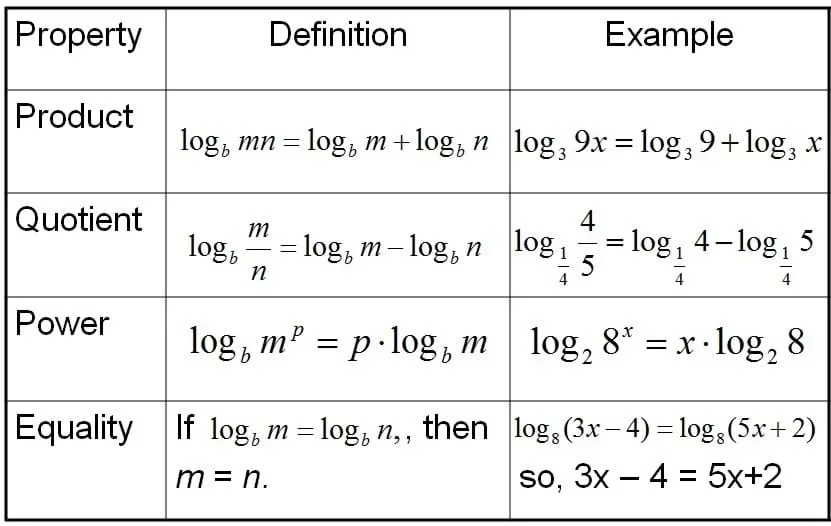
In their reading from activity 1 of this unit, students should have discovered the term "logarithm." It is at this point that they begin their study of logarithms. Specifically, students examine the definition, history and relationship to exponents; they rewrite exponents as logarithms and vice versa, evaluating expressions, solving for a missing piece. Students then study the properties of logarithms (multiplication/addition, division/subtraction, exponents). They complete a set of practice problems to apply the skills they have learned (rewriting logarithms and exponents, evaluating expressions, solving/examining equations for a missing variable.) Then they complete a short quiz covering what they have studied thus far concerning logarithms (problems similar to the practice problems). They consider how what they have learned moves them closer to answering the unit's challenge question.
Students learn the equation needed to calculate bone mineral density, which is a calculation that biomedical engineers make all the time. Through this lesson, students come to realize that they have not learned all the necessary math skills in order to calculate bone mineral density but gain the motivation to learn about logarithms.
After this lesson, students should be able to:
- Define logarithms as exponents.
- Rewrite logarithms as exponents and vice versa.
- Apply the properties of logarithms (products, quotient, power and equality) to solve equations.
- CCSS.Math.Content.HSF-BF.B.5 (+) Understand the inverse relationship between exponents and logarithms and use this relationship to solve problems involving logarithms and exponents.
Grades 9-12
Do you agree with this alignment?
- STEL-3H Analyze how technology transfer occurs when a user applies an existing innovation developed for one function to a different purpose.
Grades 9-12
Do you agree with this alignment?
- CCSS.Math.Content.HSF-BF.B.5 (+) Understand the inverse relationship between exponents and logarithms and use this relationship to solve problems involving logarithms and exponents.
Grades 9-12
Do you agree with this alignment?
- History of Logarithms Handout (doc)
- History of Logarithms Handout (pdf)
- Exponential Functions Graphs Notes (doc)
- Exponential Functions Graphs Notes (pdf)
- BMD Math and Logarithms Introduction (ppt)
- BMD Math and Logarithms Introduction (pdf)
- Properties of Logarithms (ppt)
- Properties of Logarithms (pdf)
- Log Properties Practice Problems (doc)
- Log Properties Practice Problems (pdf)
- Log Properties Practice Problems Answers (doc)
- Log Properties Practice Problems Answers (pdf)
- Log Properties Quiz (doc)
- Log Properties Quiz (pdf)
- Log Properties Quiz Answers (doc)
- Log Properties Quiz Answers (pdf)
Students need to have already covered exponential functions.
On Day 1, present to the class the BMD Math and Logarithms Introduction (PPT), a PowerPoint® file. Before starting, hand out the History of Logarithms Handout (PDF) and Exponential Functions Graphs Notes (PDF) for students to take notes on while you go through the presentation content.
On Day 2, present the Properties of Logarithms (PPT), another PowerPoint® file. Then at lesson end or as homework, assign students to complete the Log Properties Practice Problems (PDF), a sheet of practice problems. Also administer the Log Properties Quiz (PDF).
 Copyright 2006 Kristyn Shaffer, Vanderbilt University
Conclude with a class discussion: How might what you have learned in this lesson apply to the challenge question? How much closer are you to answering the questions? What do you still have to learn?
Let's jump right into the equation that real-world engineers use to find bone mineral density. Do not be concerned about the many symbols and variables that you are unfamiliar with. I just want to give you idea of the larger picture of the unit. Once you see these equations, we will start in with logarithms by relating them to exponents, which is something that you are all familiar with.
Practice Problems: At lesson end or as homework, assign students to complete the Log Properties Practice Problems (PDF). Review their answers to assess their depth of comprehension.
Quiz: Administer the eight-question multiple-choice Log Properties Quiz (PDF) on logarithm properties. Review students' answers to gauge their comprehension.
- Bone Mineral Density and Logarithms
- Bone Density Challenge Introduction
- Bone Density Math and Logarithm Introduction
- Common and Natural Logarithms and Solving Equations
- Bone Mineral Density Math and Beer's Law
Contributors
Kristyn Shaffer; Megan Johnston
Supporting Program
VU Bioengineering RET Program, School of Engineering, Vanderbilt University
Acknowledgements
The contents of this digital library curriculum were developed under National Science Foundation RET grant nos. 0338092 and 0742871. However, these contents do not necessarily represent the policies of the NSF, and you should not assume endorsement by the federal government.
Copyright
2013 by Regents of the University of Colorado; original © 2006 Vanderbilt University