
Weather Basics
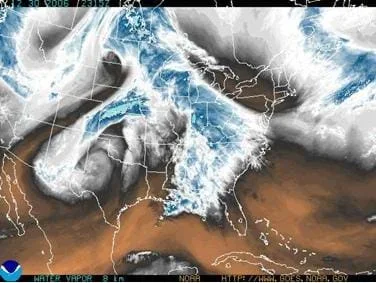 Students learn about the basics of weatherCopyright NOAA Satellite and Information Service http://www.goes.noaa.gov/GIFS/ECW1.JPG
Students are introduced to the basics of the Earth's weather. Concepts include fundamental causes of common weather phenomena such as temperature changes, wind, clouds, rain and snow. The different factors that affect the weather and the instruments that measure weather data are also addressed.
Engineers analyze information about weather when designing instruments such as barometers, thermometers and anemometers, as well as software that integrates complex weather information for meteorologists to use. Civil engineers utilize weather data when designing houses and other structures, to ensure that those designs are appropriate for the climate of their locations. Environmental engineers analyze weather measurements to determine the placement and effectiveness of renewable energy technologies, such as wind farms and solar arrays. Engineers also serve an important role in designing products that enable people to more comfortably adjust to the weather (for example, waterproof jackets, heated driveways and sunscreen, among many other weather-resistant goods).
After this lesson, students should be able to:
- Describe the role of the sun in the Earth's weather systems.
- List four factors that influence weather systems and the instruments used to measure them.
- Explain several ways that engineers analyze and use weather measurements to inform their designs.
- Develop, communicate and justify an evidence-based scientific explanation to account for Earth's different climates
Grade 8
Do you agree with this alignment? - Differentiate between basic and severe weather conditions, and develop an appropriate action plan for personal safety and the safety of others
Grade 8
Do you agree with this alignment?
- STEL-1J Develop innovative products and systems that solve problems and extend capabilities based on individual or collective needs and wants.
Grades 6-8
Do you agree with this alignment? - STEL-3G Explain how knowledge gained from other content areas affects the development of technological products and systems.
Grades 6-8
Do you agree with this alignment?
- MS-ESS2-6 Develop and use a model to describe how unequal heating and rotation of the Earth cause patterns of atmospheric and oceanic circulation that determine regional climates.
Grades 6-8
This resource focuses on the following Three Dimensional Learning aspects of NGSS:
Science & Engineering Practices- Develop and use a model to describe phenomena.Do you agree with this alignment?
Disciplinary Core Ideas- Variations in density due to variations in temperature and salinity drive a global pattern of interconnected ocean currents.Do you agree with this alignment?
- Weather and climate are influenced by interactions involving sunlight, the ocean, the atmosphere, ice, landforms, and living things. These interactions vary with latitude, altitude, and local and regional geography, all of which can affect oceanic and atmospheric flow patterns.Do you agree with this alignment?
- The ocean exerts a major influence on weather and climate by absorbing energy from the sun, releasing it over time, and globally redistributing it through ocean currents.Do you agree with this alignment?
Crosscutting Concepts- Models can be used to represent systems and their interactions—such as inputs, processes and outputs— and energy, matter, and information flows within systems.Do you agree with this alignment?
Do you agree with this alignment? - Develop and use a model to describe phenomena.
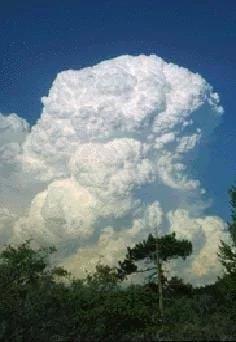 Figure 3. Cumulus clouds.Copyright Web Weather for Kids, University Corporation for Atmospheric Research (UCAR) http://www.eo.ucar.edu/webweather/cumulus.html
The sun is the main factor in the Earth's weather systems. The sun takes up as much space as 1.3 million Earths put together and is about 27,000,000°F (14,999,982°C) at its core and 10,000°F (5,538°C) at its surface. Very hot! Light from the sun travels 186,000 miles per second, so even though the sun is located 92,980,000 miles away, it only takes 8 minutes and 20 seconds for light from the sun to reach the Earth's surface.
When the sun's rays hit the Earth directly, they heat the Earth more than when they hit it at an angle. This fact explains why we experience seasonal temperature variations. During the summer, for example, the Earth's angle allows the sun's rays to hit a given region directly, whereas during the winter, the same rays would hit that region at an angle, allowing warmer temperatures during the summer than the winter.
The Earth's atmosphere is broken up into five layers. The troposphere refers to the atmospheric layer closest to the Earth's surface, extending from the surface itself out 7 miles. Weather occurs in the troposphere. The other four layers, from closest to the Earth to farthest away, are the stratosphere, mesosphere, thermosphere and exosphere.
The Earth's atmosphere holds some of the heat our planet receives from the sun. Without the atmosphere, it would be freezing cold during the night. The moon, for example, does not have an atmosphere, and its temperatures typically measure approximately 250°F on the side facing the sun but a very low -290°F on the side facing away from the sun.
Three basic types of clouds occur in the Earth's atmosphere and give us an easy visual of the weather forecast — cumulus, stratus and cirrus.
 Figure 4. Stratus clouds.Copyright Web Weather for Kids, University Corporation for Atmospheric Research (UCAR) http://www.eo.ucar.edu/webweather/stratus.html
Cumulus clouds resemble cotton balls — large and puffy, but flat along the bottom (see Figure 3). These clouds are formed by warm air rising quickly over a small area.
Stratus clouds, as shown in Figure 4, are layered and streaky, with indistinct edges. They are formed by a large, moist air mass rising slowly.
Cirrus clouds are white, wispy, thin and broad, giving them the appearance of feathers in the sky!
While there are only three primary cloud types (cumulus, stratus, and cirrus) other, more specific, cloud types can be formed from these basics. For example, cumulonimbus clouds form out of cumulous clouds. As the name suggests (nimbus means rain-producing), these clouds can bring rain, snow, or hail. Nimbostratus clouds form from stratus clouds and are also able to produce rain or snow. The clouds vary because they are formed at different heights, wind speeds, and temperatures, all in the presence of varying amounts of water vapor.
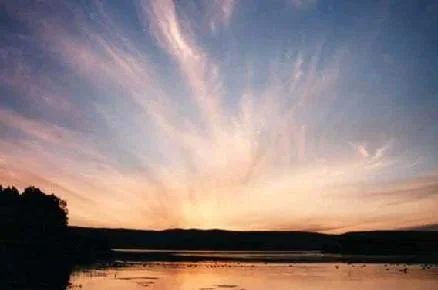 Figure 5. Cirrus clouds.Copyright Jet Propulsion Laboratory, California Institute of Technology http://www.jpl.nasa.gov/images/earth/cirrus_browse.jpg
Have you ever left your house without a jacket on what turned out to be a freezing cold day? Or, have you ever been caught in the rain without an umbrella because you thought it was going to be a nice, sunny day? All of us have probably had days when we were dressed inappropriately for the weather — maybe sometimes due to incorrect weather forecasts or weather that changes abruptly. Weather is a chaotic and ever-changing system, making it sometimes difficult to predict. Meteorologists are responsible for forecasting the weather up to a few days in advance, which — due to the nature of the Earth's atmosphere — can be a tricky job. Engineers are responsible for analyzing those changing weather patterns in our atmosphere and using that information to design sensitive instruments to collect the weather data from the ground, in the air or even in space. Do meteorologists and engineers work together? You bet!
Weather can, at times, change quickly and unexpectedly; at other times, it seems steady and reliable, or slow to change. Some weather patterns can be cause for concern or even life threatening, such as a severe blizzard causing unsafe road conditions or a lengthy drought destroying crops and leaving people without a water source. In these cases, being able to predict weather and adjust to it is not only important for comfort, but for survival as well.
When we say weather, we are talking about things taking place in the Earth's atmosphere over the short term, such as hours or days. Most of our weather is directed by the sun. Areas close to the equator receive more energy from the sun than those closer to the Earth's poles and within those areas, the various surfaces (such as oceans, forests, deserts, etc.) have different abilities to soak up the sun's rays. The resulting temperatures have the biggest affect on the Earth's weather. How is temperature measured? It is measured with an instrument called a thermometer. The tilt of the Earth (which leads to the different seasons) also affects the amount of direct sunlight a specific area receives, leading to even more temperature differences.
These temperature differences affect the atmospheric (or air) pressure around us. When air is heated, it expands, which lowers the air pressure. The reverse is also true. Differences in air pressure can cause all types of weather. For example, air naturally moves from areas of high pressure to areas of low pressure, and this movement causes wind. Also, different air pressures are associated with different types of weather. Moving air masses and air pressure are two factors that help us determine what the weather is going to be in an area on a given day. A barometer is the instrument that helps us measure the air pressure around us. An anemometer is the instrument that helps us determine the speed that the air is moving.
Humidity also affects the weather. The amount of humidity, or water vapor in the air, indicates the likelihood of precipitation, dew or fog. The presence of water vapor in the air is also dictated by the sun, as solar energy powers the Earth's water cycle. The water cycle is the term used to describe the continuous movement of water over, above and beneath the Earth's surface, which includes (among other things) evaporation, precipitation and condensation, as illustrated in Figure 2.
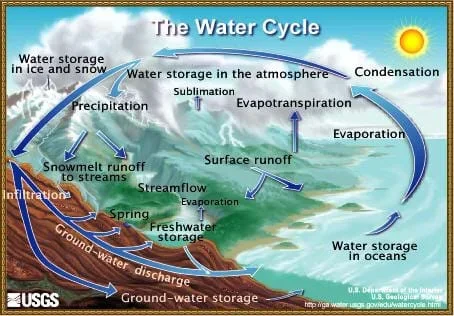 Figure 2. The Earth's weather cycle.Copyright U.S. Department of the Interior, U.S. Geological Survey http://ga.water.usgs.gov/edu/graphics/wcmaindiagram2.jpg
Evaporation is the process by which liquid water from our planet's surface is transformed into gaseous water in the atmosphere. Precipitation is condensed water vapor that falls to the Earth's surface in the form of rain, snow, hail or sleet. Condensation describes the transformation of water vapor into liquid water droplets in the air, producing clouds and or fog. Humidity is measured by an instrument called a hygrometer.
Some common forms of weather on Earth include wind, clouds, rain and snow. More extreme weather, such as blizzards, tornadoes and hurricanes, occur much less frequently. These phenomena occur almost uniquely in the layer of the atmosphere closest to the Earth's surface, referred to as the troposphere.
The Earth's weather is constantly changing. Weather can also alter the Earth, including erosion of rocks and soil into tiny particles that can change the chemistry of the Earth's surface. Over time, mountains can be formed or torn down completely, due to weathering. Human activity can also impact the weather, through agriculture, industry and even everyday use of cars and electricity. These affects can lead to extreme weather, such as drought, flooding and storms. Because of the threat to weather from human activity that might cause reduction in food, resources and human health, humans have tried to control the weather. Engineers have worked to develop technologies to manage flooding, increase precipitation and reduce hail.
Engineers are not only involved in weather forecasting, but using weather measurements to inform their design of many other things. Civil engineers analyze weather data to help them design houses, bridges and other structures that are appropriate for the weather and climate in that area. Environmental engineers also study weather data to determine where to place energy technologies, such as wind farms and solar arrays. Materials engineers work with the way different materials are affected by weather — they even design clothing for different climates. (Refer to the hands-on associated activity Dress for Succes for student teams to design and analyze types of materials for functionality and durability under specific weather conditions.) Computer engineers might develop the software that helps put all of the weather measurements together in a way that makes sense for meteorologists and communities. And then there is a whole group of engineers that work with extreme weather, designing instruments, structures and processes to keep us safe from things like storms, blizzards and hurricanes.
As we have learned, weather can be unpredictable and confusing or consistent and steady, and its effects can be dangerous or not even noticeable. It all depends on what is happening in the atmosphere. What are the four factors we discussed that affect the weather we experience? (Answer: temperature, humidity, air movement and air pressure)
The ability to detect weather patterns and adjust to them is important to our comfort and, sometimes, is necessary for our survival. With the different instruments designed by engineers to help meteorologists in their weather forecasts, we can understand what is going on with the Earth's weather. We can use this information to see how the Earth is changing and how human activity affects the weather.
Engineers also use weather information to inform their other designs. Weather plays an important role in the design of structures, renewable energy technologies, extreme weather protection systems and even high-tech clothing.
- air pressure
- The weight of the Earth's atmosphere over an area.
- anemometer
- An instrument that measures wind speed.
- atmosphere
- Five different layers of air that surround the Earth.
- barometer
- An instrument that measures air pressure.
- climate
- The average atmospheric conditions a region tends to have over many years.
- hygrometer
- The instrument used to measure humidity.
- humidity
- The amount of water vapor in the air.
- meteorologist
- A scientist who specializes in the study and forecasting of weather
- precipitation
- Condensed water vapor that falls to the Earth's surface.
- troposphere
- The lowest portion of the Earth's atmosphere.
- water vapor
- Water in the gas phase that is present in the air.
- weather
- Phenomena in the atmosphere of a planet over short periods of time, such as hours or days.
- wind speed
- The speed of moving air.
Pre-Lesson Assessment
Discussion Questions: Ask students the following questions and discuss as a class. Write student responses on the classroom board.
- What visual observations would you use to predict the weather? (Possible examples: If the sky is filled with big, black clouds, expect it to rain; if no clouds are in the sky, expect it to be very windy.
- Where can you find weather forecasts? (Possible answers: Watch the TV or Internet news, call a weather line, listen to the radio, read the weather section of the local newspaper.)
- Based on today's weather, what do you think tomorrow's weather will be like? Why?
Post-Introduction Assessment
Question/Answer: Have students answer the following questions and discuss as a class.
- What controls most of the Earth's weather? Why? (Answer: The sun; areas close to the equator receive more energy from the sun than those closer to the Earth's poles and within those areas, the various surfaces [such as oceans, forests, deserts, etc.] have different abilities to soak up the sun's rays. The resulting temperatures have the biggest affect on the Earth's weather.)
- Does human activity impact the weather? How? (Answer: Humans can impact the weather through agriculture, industry and even everyday use of cars and electricity.)
- Does the impact of human activity really make a difference? (Answer: Human effects, such as acid rain and greenhouse gases, can lead to extreme weather, such as drought, flooding and storms.)
- List several technologies or processes designed by engineers considering weather measurements. (Possible answers: Houses, bridges, software, renewable energy resources [such as wind farms and solar arrays], materials, technologies to reduce hail.)
Matching: Create a list of the weather factors, and instruments used to measure them, on the board. Randomly write the weather factor on the left side of the board and the instruments on the right side of the board. As a class, have the students match the correct sides together. For example:
temperature ~ thermometer
humidity ~ hygrometer
air pressure ~ barometer
air movement ~ anemometer
Lesson Summary Assessment
Weather Forecast: Have students look at a weather forecast for their entire state or country. Are the individual measurements of humidity (rain), temperature, air pressure and air movement (wind) available? How are the individual measurements displayed? Engineers help design the instruments that take these measurements on ground or from space. Engineers also develop the software to generate the displays of how weather systems are moving and changing each day. Does the display for the weather forecast give you all the information you need? Are there different ways to display the information? What do you think is the most useful display? Have students think about all of these questions and design their own display of weather forecasting information for the weather in their area.
Have students research the effect of human activity on the weather. What have engineers done to help reduce these effects?
Have students compare and contrast weather in different cities in the United States. Have them write a paragraph explaining the difference in temperatures using such concepts as elevation, proximity to the ocean, distance from the equator, etc.
Have students look at the weather of different countries around the world and look for connections. Which countries are experiencing similar weather patterns and what is happening in their city? Have the students try to determine different country's current seasons. Do they see a pattern to the seasons of different places around the world?
National Oceanic and Atmospheric Administration (NOAA), National Environmental Satellite, Data, and Information Service, Satellite Services Division (SSD), accessed December 21, 2007. http://www.goes.noaa.gov/GIFS/ECW1.JPG
Perlman, Howard. U.S. Department of the Interior, U.S. Geological Survey, Water Science for Schools, December 18, 2007, accessed December 21, 2007. Originally found at: http://ga.water.usgs.gov/edu/graphics/wcmaindiagram2.jpg
Web Weather for Kids. The University Corporation for Atmospheric Research (UCAR). Accessed December 21, 2007. http://www.eo.ucar.edu/webweather/cumulus.html
Watanabe, Susan. National Aeronautics and Space Administration (NASA), Jet Propulsion Laboratory, California Institute of Technology, accessed December 21, 2007. http://www.jpl.nasa.gov/images/earth/cirrus_browse.jpg
Contributors
Marissa Forbes; Glen Sirakavit; Malinda Schaefer Zarske; Janet Yowell
Supporting Program
Integrated Teaching and Learning Program, College of Engineering, University of Colorado Boulder
Acknowledgements
The contents of this digital library curriculum were developed under grants from the Fund for the Improvement of Postsecondary Education (FIPSE), U.S. Department of Education and the National Science Foundation (GK-12 grant no. 0338362). However, these contents do not necessarily represent the policies of the Department of Education or National Science Foundation, and you should not assume endorsement by the federal government.
Copyright
2007 by Regents of the University of Colorado.