
Air Under Pressure
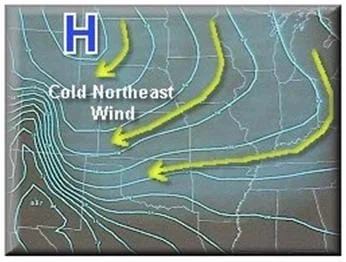 Students explore air massesCopyright NOAA, National Weather Service, Southern Region Headquarters, Little Rock, AR http://www.srh.noaa.gov/lzk/images/sfc122500a.jpg
Students are introduced to air masses, with an emphasis on the differences between and characteristics of high- versus low-pressure air systems. Students explore actual data by comparing maps of high- and low-pressure air masses to radar data showing where weather is occurring. Students also hear about weather forecasting instrumentation and how engineers work to improve these instruments for atmospheric measurements on Earth and in space.
Engineers are involved in many aspects of weather forecasting and weather-appropriate design. They develop instruments, including barometers to measure air pressure, which are essential to our understanding of the Earth's weather systems. Air pressure maps can be correlated to weather systems as they move across the country! Additionally, engineers design software to analyze and integrate complex weather information for meteorologists to use. They also help develop websites (and software) to present weather information in ways that people can understand. Civil engineers utilize weather data when designing roads, buildings and structures, to make sure their designs are suitable for the climate. Environmental engineers utilize weather measurements to determine the placement and effectiveness of renewal energy technologies, such as wind farms and solar arrays. Have students practice building and using forcasting equipment with the associated activity Building a Barometer.
After this lesson, students should be able to:
- Describe the effect of the sun on air masses in the Earth's atmosphere.
- Compare and contrast high- and low-pressure air systems.
- Describe how high- and low-pressure air systems are related to weather events.
- Explain that engineers design instrumentation, such as a barometer, to help analyze the Earth's weather systems.
- Differentiate between basic and severe weather conditions, and develop an appropriate action plan for personal safety and the safety of others
Grade 8
Do you agree with this alignment? - Use models to develop and communicate a weather prediction
Grade 8
Do you agree with this alignment?
- STEL-1J Develop innovative products and systems that solve problems and extend capabilities based on individual or collective needs and wants.
Grades 6-8
Do you agree with this alignment? - STEL-3G Explain how knowledge gained from other content areas affects the development of technological products and systems.
Grades 6-8
Do you agree with this alignment?
- MS-ESS2-5 Collect data to provide evidence for how the motions and complex interactions of air masses results in changes in weather conditions.
Grades 6-8
This resource focuses on the following Three Dimensional Learning aspects of NGSS:
Science & Engineering Practices- Collect data to produce data to serve as the basis for evidence to answer scientific questions or test design solutions under a range of conditions.Do you agree with this alignment?
Disciplinary Core Ideas- The complex patterns of the changes and the movement of water in the atmosphere, determined by winds, landforms, and ocean temperatures and currents, are major determinants of local weather patterns.Do you agree with this alignment?
- Because these patterns are so complex, weather can only be predicted probabilistically.Do you agree with this alignment?
Crosscutting Concepts- Cause and effect relationships may be used to predict phenomena in natural or designed systems.Do you agree with this alignment?
Do you agree with this alignment? - Collect data to produce data to serve as the basis for evidence to answer scientific questions or test design solutions under a range of conditions.
Why do air masses move around? The Earth's air masses move because the changes in air temperature also mean changes in air pressure and density. As the temperature of air increases, the air expands. The same amount of air occupies more space when it heats up than when it is cold. Density of air is equal to the mass of the air divided by its volume. So in other words, when air is heated, its volume increases, but its density decreases. Things with lower density float on top of things with higher density. For example, ice cubes float in water because water is denser than the ice cubes. The same phenomenon happens in our atmosphere: warm air rises because it "floats" on top of colder air. In other words, the rule of thumb is that hot air rises and cold air sinks. This simple principle actually guides much of the weather patterns we experience on Earth.
There are four major types of air masses that influence the weather in the United States: (1) continental tropical, (2) maritime tropical, (3) continental polar and (4) maritime polar. To simply things, maritime refers to air masses that form over oceans, while continental means air masses that formed over land. The air masses that form over oceans (maritime) are more humid than continental air masses that form over dry land. Air masses that form in the tropics have low air pressure, and air masses that form closer to the poles are higher air pressure.
Let's observe and explore actual weather data! There are multiple websites with archived and current weather data, one particular site is: http://www.hpc.ncep.noaa.gov/html/sfc_archive.shtml. Going to this site and clicking on "latest image" for any of the image types will show a larger image for that method of presenting the data. Options are color and black and white images of pressures and satellite images. There is also an option on this site to cycle through images for the last 3 or 7 days. Start with images only. Open the different types and explore the images! Identify high- and low-pressure systems on the "no observations" image and compare that with the weather apparent on the IR Satellite images. Once you have an understanding of the information being presented on the images feel free to move on to cycling through multiple days of data and comparing movement of the air masses to weather events. Where does the tumultuous weather occur? High pressure masses? Low pressure masses? Between the two? If your area had a recent weather event, try to determine the movement of air masses that caused it!
Have you ever blown up a balloon and let go of it without sealing it with a knot? What happens? That's right: it zips around in the air until the air is gone, and it is finally deflated. That occurs because there is a pressure difference between the air inside the balloon and the surrounding air. Even though we cannot always see or feel the air, it actually has a mass. It also has other physical properties, such as density and pressure. What does that mean for our atmosphere? Large bodies of air exist in our atmosphere where all the air within that region has a similar temperature, pressure and humidity. We call those bodies of air with similar characteristics air masses. Air masses change and shift all the time, but on any given day, there are many different air masses in our atmosphere, all with their own unique air pressure. Thinking back to the balloon example, we know that air pressure differences can cause air to move — similar to the balloon zipping around the room. The movement of those air masses in our atmosphere contributes to the weather we experience every day. Barometers are a common device that scientists use to measure air pressure and to predict weather patterns. Students can design their own simple barometer in the Building a Barometer activity.
We know that the sun plays a significant role in the weather we experience on Earth. But how does the sun relate to air masses? The sun heats up our atmosphere and the Earth's surface, but the heating takes place unevenly because the sun's rays hit different areas of the Earth at different angles. Variations on the Earth's surface provide even more room for uneven heating. The air above water, for example, is typically cooler than the air above land, and the air above lighter colored surfaces is typically cooler than the air above darker ones (very simply, because dark color absorb more heat). Because the sun heats pockets of air to different temperatures, the sun actually helps create the different air masses in our atmosphere.
High- and low-pressure areas are affected by the interaction of air and temperature (among other things) in our atmosphere. Areas of high air pressure are often characterized by light winds and clear skies. With no clouds to reflect the sunlight, high-pressure regions also usually experience higher daytime temperatures. Low-pressure areas then, are regions where the atmospheric pressure is lower than that of the surrounding area. Low-pressure areas are associated with winds and cloudy, overcast skies. Due to the clouds, the sun's rays have a harder time penetrating low-pressure regions, usually leading to lower temperatures. Falling air pressure usually indicates that a storm of some sort is approaching. On the other hand, rising air pressure is usually an indication that the weather is clearing up.
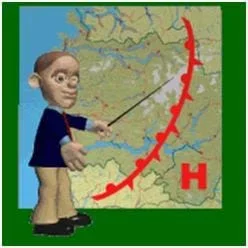 Copyright U.S. Centennial of Flight Commission http://www.centennialofflight.gov/2003FF/pressure/weatherman_pointing_lg_green.gif
Changes in weather happen due to many reasons, including moving air masses and air pressure, as well as humidity and temperature. All of these things work together as parts of the system of weather that affects us every day.
Today we want to remember that hot air rises and cold air sinks. The sun heats up our atmosphere and the Earth's surface, but the heating takes place unevenly because the sun's rays hit the Earth's surface at different angles. The many different angles can be influenced by the topography and variations on the Earth's surface itself. The moving air that circulates in our atmosphere is called an air mass and can involve high or low air pressure.
Also, areas of high air pressure are often characterized by light winds and clear skies. Low-pressure areas are associated with winds and cloudy, rainy skies. Usually, falling air pressure usually indicates that a storm of some sort is approaching; rising air pressure is usually an indication that the weather is going to be fair.
Engineers design the instruments — including barometers — to measure air pressure, which meteorologists use to help analyze the Earth's weather systems. Engineers are always trying to improve these instruments to make them more accurate, more efficient, or to utilize new technologies.
- air mass
- A large region of air that has similar temperature, pressure and humidity.
- air pressure
- The force caused by the weight of air pushing down on an area.
- anticyclones
- A name sometimes used to refer to high-pressure areas.
- barometer
- A tool used to measure air pressure.
- continental
- Refers to air masses that form over land.
- cyclones
- A name sometimes used to refer to low-pressure areas.
- high-pressure area
- Region of air where the air pressure is greater than that of the surrounding area.
- low air pressure
- Region of air where the air pressure is lower than that of the surrounding area.
- maritime
- Refers to air masses that form over oceans.
Pre-Lesson Assessment
Discussion Questions: Ask a few questions to get students to think about the upcoming lesson. After soliciting answers, explain that these questions will be answered during the lesson.
- Why does the weather change from day to day?
- How do engineers help us make weather predictions?
Post-Introduction Assessment
Voting: Ask a true/false question and have students vote by holding thumbs up for true and thumbs down for false. Tally the votes and write the totals on the board. Give the right answers.
- True or False: Cold air rises and hot air sinks. (Answer: False; hot air rises and cold air sinks.)
- True or False: Wind and storms are caused by the movement of air masses. (Answer: True)
- True or False: The sun helps create the different air masses in our atmosphere by heating the air to different temperatures. (Answer: True)
- True or False: Areas of low air pressure are often characterized by light winds and clear skies. (Answer: False; areas of high air pressure tell us that clear skies are ahead.)
- True or False: Engineers design the weather instruments that are used in forecasting the weather on TV or radio. (Answer: True; engineers design instruments to help all meteorologists make weather forecasts.)
- True or False: It is not possible to measure the Earth's weather from space. (Answer: False; in additional to designing instruments to help make weather forecasts, engineers also design instruments to help us predict the weather from space as well as on Earth.)
Lesson Summary Assessment
Explain It: Often, engineers are asked to explain complex concepts to an audience that has little prior knowledge of the topic. Have students write short paragraphs or stories to explain air pressure to younger students. From what they learned today, have them include information on how engineers help us understand air pressure and weather.
Think about Constraints: Engineers must consider the economic, social and environmental impacts of their designs on their audiences. For weather forecasting, the audience includes all of us who listen to weather reports and forecasts. As a class, generate a list of how weather forecasts (and its accuracy) affect us socially, economically and environmentally. For example, we may decide what to wear and when to be outside by listening to a weather forecast (social); a weather forecast might help us decide what clothing to buy or what type of building material we use for a house (economic); a weather forecast could also help us learn about the amount of rain or snow available for drinking water (environmental).
Air Pressure and Flight: Have students investigate and write about how engineers have used the principles of air pressure to make things fly. For example, engineers design hot air balloons using their understanding of air pressure and knowing that hot air rises, while cold air sinks. Hot air balloons function using a flame to heat the air trapped in the balloon. As the balloon air gets hotter, its density decreases, causing the balloon to float on top of colder air, rising and lifting it up and away.
Acrostic Poem: Encourage students to synthesize and evaluate their learning by having them write an acrostic poem. To do this, ask them to write the word WEATHER vertically on a piece of paper. Then, have them use each letter in the word as the first letter of a word or phrase related to weather. For example, W = Wind, E = Elevation, A = Atmosphere, T = Tornado, H = Heat, E = Evaporation, R = Rain, etc.
National Weather Service, NOAA. Accessed December 18, 2010. (click on National Maps, Radar, Satellite tabs) http://www.srh.noaa.gov/lzk/images/sfc122500a.jpg
U.S. Centennial of Flight Commission. Accessed December 18, 2010. (Animated graphic of weatherman) http://www.centennialofflight.gov/2003FF/pressure/weatherman_pointing_lg_green.gif
Contributors
Marissa Forbes; Glen Sirakavit; Malinda Schaefer Zarske; Janet Yowell
Supporting Program
Integrated Teaching and Learning Program, College of Engineering, University of Colorado Boulder
Acknowledgements
The contents of this digital library curriculum were developed under grants from the Fund for the Improvement of Postsecondary Education (FIPSE), U.S. Department of Education and the National Science Foundation (GK-12 grant no. 0338362). However, these contents do not necessarily represent the policies of the Department of Education or National Science Foundation, and you should not assume endorsement by the federal government.
Copyright
2007 by Regents of the University of Colorado.