
Hurricanes
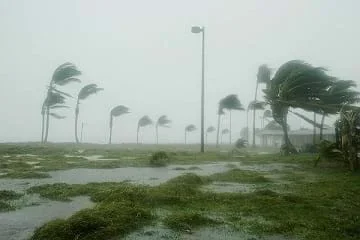 What causes hurricanes?Copyright Wikimedia Commons https://commons.wikimedia.org/wiki/File:US_Navy_050709-N-0000B-004_Hurricane_Dennis_batters_palm_trees_and_floods_parts_of_Naval_Air_Station_(NAS)_Key_West%5Ersquo,s_Truman_Annex.jpg
Students learn what causes hurricanes and what engineers do to help protect people from destruction caused by hurricane winds and rain. Research and data collection vessels allow for scientists and engineers to model and predict weather patterns and provide forecasts and storm warnings to the public. Engineers are also involved in the design and building of flood-prevention systems, such as levees and floodwalls. During the 2005 hurricane season, levees failed in the greater New Orleans area, contributing to the vast flooding and destruction of the historic city. In the associated activity, students learn how levees work, and they build their own levees and put them to the test!
Scientists and engineers create mathematical models that help predict when and where hurricanes might hit coastal regions. This information helps save lives by providing warning to citizens so that they can evacuate the area well in advance. Civil engineers further protect residents by building infrastructure, such as levees, to prevent flooding during hurricanes. Furthermore, when civil engineers design roads, buildings and bridges in coastal regions, they must take into account the potential for hurricanes so that their structures can withstand high-force winds.
After this lesson, students should be able to:
- Explain what a natural disaster is.
- Explain what a hurricane is and how it is formed.
- List three technologies that engineers use to prevent flooding due to hurricanes.
- Describe a levee and where it might be used.
- Differentiate between basic and severe weather conditions, and develop an appropriate action plan for personal safety and the safety of others
Grade 8
Do you agree with this alignment?
- STEL-1J Develop innovative products and systems that solve problems and extend capabilities based on individual or collective needs and wants.
Grades 6-8
Do you agree with this alignment? - STEL-7S Create solutions to problems by identifying and applying human factors in design.
Grades 6-8
Do you agree with this alignment?
- CCC.8.6-8.10 The uses of technologies and any limitations on their use are driven by individual or societal needs, desires, and values; by the findings of scientific research; and by differences in such factors as climate, natural resources, and economic conditions.
Grades 6-8
Do you agree with this alignment? - CCC.6.6-8.3 Structures can be designed to serve particular functions.
Grades 6-8
Do you agree with this alignment?
Tropical cyclones form over tropical waters (between 8° and 20° latitude) in areas of high humidity, light winds and warm sea surface temperatures (typically 26.5°C [80°F] or greater). These conditions usually prevail in the summer and early fall months of the tropical North Atlantic and North Pacific Oceans, and for this reason, hurricane "season" in the northern hemisphere runs from June through November.
From: Hurricanes: The Greatest Storms on Earth, by Steve Graham and Holli Riebeek, Earth Observatory, NASA, http://earthobservatory.nasa.gov/Features/Hurricanes/
Hurricane formation starts with the appearance of a cluster of thunderstorms over the warm, tropical oceans. This cluster of thunderstorms is called a tropical disturbance. Tropical thunderstorms are created by the convergence of surface winds. In ideal conditions, these tropical disturbances grow into more organized storms, developing the classic cyclone shape and circular wind pattern (clockwise in the Southern Hemisphere, counter-clockwise in the Northern Hemisphere). During such a disturbance, the air pressure drops due to water vapor condensation, and heat is released due to the phase change. The surrounding air then heats up and rises, as it becomes less dense. As this hot air rises, it expands and cools, which eventually causes more condensation. The warm air temperatures causes further pressure drops, which provides the right conditions for faster inflow of air at the surface, giving birth to stronger winds. If the storm is at least 500 km from the equator, the Coriolis effect causes the winds to cycle in a counterclockwise pattern.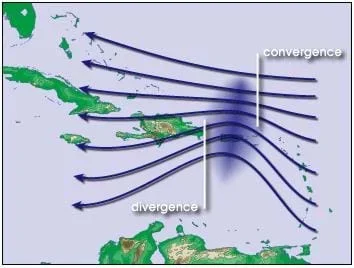 Figure 2. Waves that occur within the dominant easterly winds over the tropical Atlantic cause converging and diverging winds. The convergence forces air to rise, triggering numerous thunderstorms that can become hurricanes.Copyright Robert Simmon, NASA GSFC, Earth Observatory, NASA http://earthobservatory.nasa.gov/Features/Hurricanes/
Unfortunately, while levees effectively hold back water to prevent flooding, they can fail in several ways. Overtopping, when water simply flows over the top of a levee, occurs when a levee is not high enough to keep out the floodwaters. A breach in a levee can occur for several reasons, but oftentimes simply by water seeping through a weak portion of the levee, possibly through weaker soil layers or even perhaps along tree roots. Also, since many levees are simply compacted earth, if a levee becomes supersaturated, it may begin to flake away, eventually breaking completely and allowing floodwaters to flow in and completely destroy the levee.
Water, an essential resource for all of life can also be a great hazard. Moving water is a powerful force, as any kayaker or surfer would be sure to tell you. Moving water can surpass almost any barrier, or at least attempt to do so. When high storm and rainwater continually slaps against a protective levee, the levee absorbs the force of the moving water and keeps it in place. If a slight defect or weakness exists in the levee, the forceful moving water pushes against it in an effort to keep moving on the path of least resistance. These weak layers are difficult to identify before a flood and may break suddenly without much warning during a flood. It is up to engineers to design and build levees to address specific environmental and use conditions, including soil type, weather patterns, utility use (does the levee need a road across the top), etc.
(Use the attached PowerPoint® presentation, All About Levees (PPT), to accompany this introduction.)
Do you know what natural disasters are? Have you ever experienced one? (Listen to student responses). Natural disasters are natural events like floods, earthquakes, and hurricanes that cause significant damage and sometimes even loss of life. These natural disasters can make basic human needs like food, water, and shelter inaccessible due to compromised infrastructure.
How many of you have heard of Hurricane Katrina? What can you tell me about it? Approximately 80% of New Orleans was flooded in the aftermath of Hurricane Katrina. Today we'll think about what engineers can do to prevent a similar disaster from happening again.
Some people confuse hurricanes with tornados. While they are both destructive, naturally-occurring phenomena, they occur in different types of regions, are caused by different elements and have very different characteristics. Today, we are going to learn about hurricanes. A hurricane is an enormous rotating storm — 20-30 miles wide at its "eye" up to 400-500 miles wide at its maximum — that is centered around an area of very low pressure. Hurricane winds are so strong and powerful that they usually destruct whatever gets in its way (structures, cars, trees, etc.); gale force winds (39-54 mph) get stronger and stronger, finally turning into hurricane force winds that blow at at an average speed of more than 74 miles per hour. Compare that to the speed a car travels on the highway. How fast do you think cars travel? (Answers will vary, but may be ~65 mph). Right! So these winds are even faster than that! These strong winds pull debris — both large and small — into the eye of the hurricane, violently rotate the debris around and then spit it back out again, leaving a path of destruction behind.
Hurricanes are so tall (up to 10 miles) and so wide (up to 500 miles) that one could completely cover the state of Texas with some extending into surrounding states. That is huge! These storms move forward like an immense spinning top, at speeds of about 20 miles per hour. (If students are confused, explain that the whole storm moves at 20 mph, but the winds within it are going 74 mph.)
How do hurricanes form? A few things must happen for this powerful, natural phenomenon to occur. First, you need a source of very warm, moist air. Where on the globe do you think we might find a lot of warm, wet air? That's right! Warm regions of the ocean. As these ocean waters evaporate, they form warm, moist air. Next, we need wind to blow in a very specific way in order to cause the huge tropical storm that is a hurricane: spinning slightly near the surface of the water. Next, winds at higher levels need to be blowing in slightly different directions from those below it. And finally, the storm needs a little "push" from the Coriolis force (this is the large-scale curving of wind that causes wind to turn to the right in the Northern Hemisphere and to the left in the Southern Hemisphere).
Unfortunately, some coastal areas get hit season after season by hurricanes. The people who live in these areas are well aware of the risk living in a hurricane zone. However, each city or region that is commonly hit by these large storms has an emergency plan in place to help predict and prevent large scale disasters from taking place so that its residents remain as safe as possible and informed. Though it is impossible to stop a hurricane from hitting (at least in this day, it is impossible!), it is possible to track and predict its course to enable evacuation of residents. These early warning systems help inform people of when they need to leave the city so that they do not get become hurricane casualties.
So if city planners know that their city gets hit by hurricanes quite frequently, what do they do to protect the town's residents? Well, they create infrastructure that is considered "hurricane proof," or as close to being hurricane proof as current technology can provide. So, once a storm does hit, the buildings, roads and bridges must be strong enough to survive. Therefore, civil and structural engineers working in coastal regions make sure that their designs are strong enough to withstand the full force of strong hurricane winds.
Along with predictive equipment and hurricane-resistant structures, many cities also have systems in place to prevent large-scale flooding using barriers, such as levees, pumps and floodwalls. A levee (from the French verb lever, to raise) is an embankment created to prevent the overflow of a river or other water source. Levees are used in many regions of the southeast US. In many of the regions that were affected by Hurricane Katrina in 2005, levees and floodwalls failed, resulting in widespread flooding.
The main purpose of levees is to protect people from the flooding of nearby rivers or lakes. Levees are usually built by piling up earth (and firmly packing it and adding more earth in layers over and over) on a cleared, level surface. They are wide at the bottom and level at the top, with extra room for sandbags or temporary embankments if needed for reinforcement. Some areas that see a lot of flooding may have several levees.
Engineers design and build levees and other flood-protection systems in frequently-hit places such as New Orleans. During Hurricane Katrina, New Orleans at first seemed to withstand the storm without much destruction. However, after the storm passed, breaches (breaks) in several levees occurred. Also, some of the pumps used to extract water also broke. This led to the widespread flooding that eventually devastated the city. In today's activity, you become an engineer designing a new levee system for New Orleans to prevent another hurricane from causing such total devastation to a city. Following the lesson students can act as engineers by designing their own levees with the associated activity Protecting Our City with Levees.
Engineers are involved in many different projects from levees, to the reconstruction of roads, offices, homes, utilities, etc. Disaster prevention is a key part of any city's plan, as to reconstruct and rebuild is both a timely and costly process. Engineers working to redesign and rebuild levees in the south must be extremely cautious in designing to the highest standard possible. People living in coastal areas that are frequently hit by hurricanes depend on these engineers for their safety.
- breach
- When water seeps into a weak portion of a levee, causing it to break or leak in such a way that it is no longer effectively holding back water.
- coriolis force
- The large-scale curving of wind that causes wind to turn to the right in the Northern Hemisphere and to the left in the Southern Hemisphere.
- hurricane
- A tropical storm with winds of 39 miles per hour or higher and occurring in warm tropic waters.
- levee
- A human-made barrier of earth intended to hold back water.
- overtopping
- When water flows over the top of a levee because the levee is not high enough to keep out the floodwaters
- natural disaster
- A natural event such as a flood, earthquake, or hurricane that causes great damage or loss of life.
Pre-Lesson Assessment
Think, Pair, Share: Ask students to think about the following questions with a partner, then share with the class. Who here has ever heard of a levee? What is it? Who is involved in its design? Can we think of a recent event that involved levees?
Post-Introduction Assessment
Idea Web: Ask groups of three students to come up with a list of different technologies that relate to hurricane protection. Have them write down their ideas and how they could be used to protect people in the event of hurricanes. Encourage them to think of ideas beyond those listed in the lesson. Below are a few examples:
- Levees for protecting against flooding
- Boats to rescue people during floods
- Buses to evacuate residents
- Hospital equipment to treat injured people
Lesson Summary Assessment
Brainstorm: Ask students to think of other emergency prevention technologies that involve engineers. Have them think of local or state emergencies and identify some of the technologies in place. (For example, in San Francisco, engineers design buildings to meet earthquake codes.)
Ask students to research and make models of different emergency prevention technologies to share with the class. These could be tested much like the levees. For example, an earthquake-proof building could be tested on an oscillating sander, a mini tsunami can be created in a large Tupperware dish, etc.
"Hurricane Katrina," Wikipedia, The Free Encyclopedia, last modified May 22, 2009, accessed May 28, 2009. http://en.wikipedia.org/wiki/Hurricane_katrina
Landsea, Chris. "How do tropical cyclones form? FAQ: Hurricanes, Typhoons and Tropical Cyclones," Hurricane Research Division, Atlantic Oceanographic and Meteorological
Laboratory, U.S. Department of Commerce, NOAA, OOAR, NOML, ccessed May 27, 2009. http://www.aoml.noaa.gov/hrd/tcfaq/A15.html
Williams, Jack. "Understanding the Coriolis Force," 2003. USA Today. Accessed May 27, 2009. http://www.usatoday.com/weather/resources/askjack/archives-hurricane-science.htm
Graham, Steve, and Holli Riebeek. Hurricanes: The Greatest Storms on Earth. Posted November 1, 2006. Earth Observatory, NASA. Accessed January 10, 2009. http://earthobservatory.nasa.gov/Features/Hurricanes/
Contributors
Kate Beggs; Brian Kay; Abby Watrous; Karen King; Janet Yowell; Denise W. Carlson
Supporting Program
Integrated Teaching and Learning Program, College of Engineering, University of Colorado Boulder
Acknowledgements
The contents of these digital library curricula were developed by the Integrated Teaching and Learning Program under National Science Foundation GK-12 grant no. 0338326. However, these contents do not necessarily represent the policies of the National Science Foundation, and you should not assume endorsement by the federal government.
Copyright
2009 by Regents of the University of Colorado.