
A House for Me: Materials and Design for Different Climates
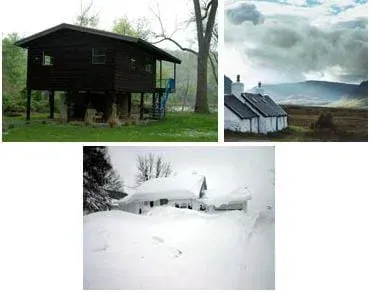 For a house to best protect its inhabitants, it must be designed to suit the climate and building resources of its location.Copyright (bottom) NOAA, (left) FEMA, (right) 2004 Microsoft Corporation, One Microsoft Way, Redmond, WA 98052-6399 USA. All rights reserved. http://www.noaa.gov/features/02_monitoring/images/snow1.jpg http://www.fema.gov/photolibrary/photo_details.do;jsessionid=A046FDBC1D403C052CB2D57EFB2684C0.WorkerPublic3?id=12792
Students brainstorm and discuss the different types of materials used to build houses in various climates. They build small models of houses and test them in different climates.
Civil and environmental engineers are involved in designing structures. They must take into consideration the climate and type of land where they are building to ensure that the type of structure chosen will suit the environment. If an area is known for earthquakes, precautions must be taken to build a structure that can withstand as much of the impact of the earthquake as possible. If the area is extremely wet, the foundation must be made deep enough and solid enough for the house not to sink or slide.
- The impact climates have on the building of structures
- Details about several types of climates
- Basic structural design
- Basic experimental skills
- CCSS.Math.Content.3.MD.C.6 Measure areas by counting unit squares (square cm, square m, square in, square ft, and improvised units).
Grade 3
Do you agree with this alignment?
- Models are used to communicate and test design ideas and processes.
Grades 3-5
Do you agree with this alignment? - STEL-1H Design solutions by safely using tools, materials, and skills.
Grades 3-5
Do you agree with this alignment? - STEL-1I Explain how solutions to problems are shaped by economic, political, and cultural forces.
Grades 3-5
Do you agree with this alignment? - STEL-2I Describe the properties of different materials.
Grades 3-5
Do you agree with this alignment? - STEL-5D Determine factors that influence changes in a society's technological systems or infrastructure.
Grades 3-5
Do you agree with this alignment? - STEL-6B Create representations of the tools people made, how they cultivated food, made clothing, and built shelters to protect themselves.
Grades 3-5
Do you agree with this alignment? - STEL-7J Evaluate designs based on criteria, constraints, and standards.
Grades 3-5
Do you agree with this alignment?
- Differentiate between weather and climate.
Grades 3-5
Do you agree with this alignment? - Identify materials used to accomplish a design task based on a specific property, e.g., strength, hardness, and flexibility.
Grades 3-5
Do you agree with this alignment? - Identify a problem that reflects the need for shelter, storage, or convenience.
Grades 3-5
Do you agree with this alignment? - Identify relevant design features (e.g., size, shape, weight) for building a prototype of a solution to a given problem.
Grades 3-5
Do you agree with this alignment?
- 3-5-ETS1-1 Define a simple design problem reflecting a need or a want that includes specified criteria for success and constraints on materials, time, or cost.
Grades 3-5
This resource focuses on the following Three Dimensional Learning aspects of NGSS:
Science & Engineering Practices- Define a simple design problem that can be solved through the development of an object, tool, process, or system and includes several criteria for success and constraints on materials, time, or cost.Do you agree with this alignment?
Disciplinary Core Ideas- Possible solutions to a problem are limited by available materials and resources (constraints). The success of a designed solution is determined by considering the desired features of a solution (criteria). Different proposals for solutions can be compared on the basis of how well each one meets the specified criteria for success or how well each takes the constraints into account.Do you agree with this alignment?
Crosscutting Concepts- People's needs and wants change over time, as do their demands for new and improved technologies.Do you agree with this alignment?
Do you agree with this alignment? - Define a simple design problem that can be solved through the development of an object, tool, process, or system and includes several criteria for success and constraints on materials, time, or cost.
- 3-5-ETS1-2 Generate and compare multiple possible solutions to a problem based on how well each is likely to meet the criteria and constraints of the problem.
Grades 3-5
This resource focuses on the following Three Dimensional Learning aspects of NGSS:
Science & Engineering Practices- Generate and compare multiple solutions to a problem based on how well they meet the criteria and constraints of the design problem.Do you agree with this alignment?
Disciplinary Core Ideas- Research on a problem should be carried out before beginning to design a solution. Testing a solution involves investigating how well it performs under a range of likely conditions.Do you agree with this alignment?
- At whatever stage, communicating with peers about proposed solutions is an important part of the design process, and shared ideas can lead to improved designs.Do you agree with this alignment?
Crosscutting Concepts- Engineers improve existing technologies or develop new ones to increase their benefits, to decrease known risks, and to meet societal demands.Do you agree with this alignment?
Do you agree with this alignment? - Generate and compare multiple solutions to a problem based on how well they meet the criteria and constraints of the design problem.
- 3-ESS2-2 Obtain and combine information to describe climates in different regions of the world.
Grade 3
This resource focuses on the following Three Dimensional Learning aspects of NGSS:
Science & Engineering Practices- Obtain and combine information from books and other reliable media to explain phenomena.Do you agree with this alignment?
Disciplinary Core Ideas- Climate describes a range of an area's typical weather conditions and the extent to which those conditions vary over years.Do you agree with this alignment?
Crosscutting Concepts- Patterns of change can be used to make predictions.Do you agree with this alignment?
Do you agree with this alignment? - Obtain and combine information from books and other reliable media to explain phenomena.
- hay or long grass
- clay
- Popsicle sticks
- sugar cubes
- LEGOs
- small stones
- flour (snow)
- fan (wind)
- water (rain)
- hairdryer (heat)
If you could live anywhere in the world and in the climate of your choice, what kind of a house would you construct? What would you need to build your house so that it could withstand the climate? In the next two classes you are going to use the given materials to create a house of your choice. You will need to choose materials that are suitable for the climate you have chosen to live in. Your house must still be standing after we have huffed, puffed, and tried to blow your house down!!
Background
People in different parts of the world have different materials that they can use to build their homes and other structures. When building a home, they think about how to best use these materials to build a house that works well for where and how they live. In the southwestern part of the US, where people have a lot of clay and little wood, they build houses from adobe, a mixture of clay, straw and water.
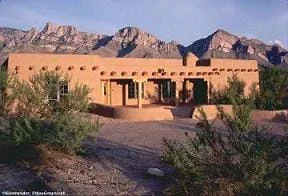 An example adobe house.Copyright Microsoft Corporation, 1983-2001
Adobe houses have very thick walls that keep them cool in the hot dry desert weather. Adobe houses would not be good in places where it rains a lot because too much water makes adobe crumble. The weather in certain tropical islands in the Pacific ocean is hot, but wet. People there make their homes from materials that are easy to find, such as palm leaves, woven grasses and bamboo. Sometimes they build the houses on stilts to keep them off the wet ground and let the breezes move under the house, helping to keep it cool.
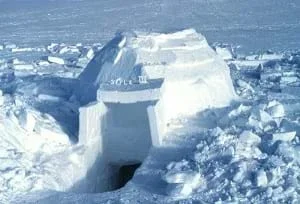 An example igloo.Copyright https://en.wikipedia.org/wiki/Igloo#/media/File:Igloo.jpg
In ages past, the Eskimos in Alaska and Canada built their houses out of sod or snow. These dome-shaped houses are called igloos. The dome shape of the igloo makes it very strong and able to withstand powerful winter storms. Some Native Americans built dome-shaped houses made of poles, leaves and tree bark. These houses were called wigwams. Native American tribes that moved a lot often built cone-shaped tepees using buffalo skins or bark. Tepees could be easily built and taken apart quickly. Some Native Americans lived in more permanent structures called lodges made from logs and sod.
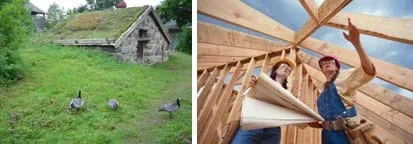 A stone house with a sod-covered roof, and a house structure made of wood.Copyright 2004 Microsoft Corporation, One Microsoft Way, Redmond, WA 98052-6399 USA. All rights reserved.
When early American settlers came to New England, they found the ground covered with large stones. They used these stones to build houses and walls that you still see in New England today. The northwest part of the US and Canada has plenty of forests, so most houses in these areas are made of wood. In areas of China with few forests, it is rare to have a wooden house. Instead, the Chinese people use tile, concrete and stone to build beautiful pagodas and other structures.
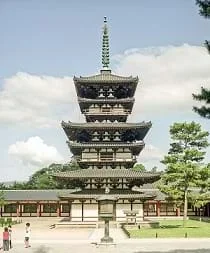 An example pagoda.Copyright https://en.wikipedia.org/wiki/T%C5%8D#/media/File:YakushijiPagoda.jpg
In parts of Africa, where tall grasses grow, people weave the stems of dried grass together to make thatch huts. In Tibet, some people even make their houses out of wool! They shear the wool from ox-like animals called yaks. The wool walls keep the houses warm through the cold winter months. Most houses in the US today are built of wood, brick, stone, concrete, aluminum or even glass!
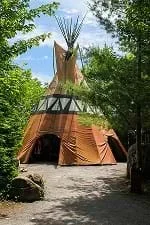 An example teepee.Copyright https://fr.wikipedia.org/wiki/Tipi#/media/File:Tee-pee_g%C3%A9ant_sur_le_site_traditionnel_huron_Onho%C3%BCa_chetek8e,_Wendake.jpg
Recommended Resources:
Biomes are distinct ecological communities of plants and animals living together in particular climates. Learn more about biomes at: http://kids.nceas.ucsb.edu/biomes/index.html
See photos of snow-block igloo construction at: https://www.wikihow.com/Build-an-Igloo
See many photographs of teepees at: http://www.photovault.com/Link/Cities/Southwest/Teepee.html
Hoberman, Mary Ann. A House Is a House for Me. The Viking Press: New York, NY, 1978.
Before the Activity
- Gather materials.
- Read Mary Ann Hoberman's book, A House Is a House for Me.
With the Students
Present the Engineering Design Challenge:
- Have the class think about why people need houses, what materials are needed to build a house, and what the various parts of a house include.
- Pair students and have each team choose an environment where the students want their house built. Have students figure out what type of climate their house must be able to handle in that environment. Instruct them to design and sketch a house to withstand that climate.
- Have each group to present their concept to the rest of the class. Have the class comment and make suggestions on each other's ideas.
Build:
- Have the groups build their designs with the available materials. Have students construct their houses on an 8.5 x 11 piece of paper with a grid printed on it.
- Estimate the area of the house by counting the squares.
Test:
- Test the houses against the elements that would be appropriate for the climate they built their houses to withstand.
- Compare each of the groups' houses and discuss what materials are needed in different climates.
- climate
- A region with specified weather conditions; the average weather conditions of a particular place or region over a period of years.
- adobe
- A brick or building material made of a sun-dried mixture of earth and straw.
- igloo
- An Eskimo house usually made of wood, sod or stone when permanent, or of blocks of snow or ice in the form of a dome when built for temporary use.
- pagoda
- A Far Eastern tower of several stories erected as a temple or memorial.
- tepee
- A cone-shaped tent usually of skins used as a home by some Native Americans.
- lodge
- A house set apart for residence in a special season.
- wigwam
- A hut of the Native Americans of the Great Lakes region and eastward that usually has an arched frame of poles covered with bark, rush mats or hides.
- hut
- A small and often temporary dwelling or shelter.
- climograph
- A graph that demonstrates the precipitation and temperature for an area.
- tree house
- A structure (as a playhouse) built among the branches of a tree.
- arctic
- The northernmost area of the Earth centered on the North Pole, characterized by long, cold winters and short, cool summers.
- taiga
- A subarctic, evergreen coniferous forest of northern Eurasia located just south of the tundra and dominated by firs and spruces.
Final Evaluation: Use the attached rubric to evaluate student teams' success in three areas: quality of design and construction, performance of house against climate tests, and demonstrated understanding of concepts. Show students the rubric criteria in advance to clarify the grading process.
Have students read and then discuss an example in west Africa where a school was built to work with the climate and local materials and labor to withstand weather conditions ranging from blazing sun to torrential showers. The designer, a native of the community, reverse engineered everything he was taught at school, using principles of heat to figure out natural cooling, and learning to design windows that would protect from the blazing sun but still offer ventilation. See "Homegrown Hero" in the Architectural Digest at: https://www.architecturaldigest.com/story/diebedo-francis-kere-opera-village-burkina-faso-article.
Kessler, James H. and Andrea Bennett. The Best of WonderScience: Elementary Science Activities. page 20. Boston, MA: Delmar Publishers, 1997. ISBN: 0827380941
- Environmental Challenges in China: Rural Villages to Big Cities
- Introduction to Environmental Challenges in China
- Design & Materials: Homes for Different Climates
- Construct and Test Roofs for Different Climates
- A House for Me: Materials and Design for Different Climates
- Rural Energy in China: How Can Engineers Make a Difference?
Supporting Program
Center for Engineering Educational Outreach, Tufts University
Copyright
2013 by Regents of the University of Colorado; original © 2004 Worcester Polytechnic Institute