
Optimize! Cleaner Energy Options for Rural China
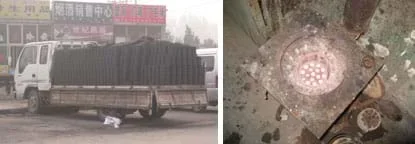 Ready for sale in China, a truckload of honeycomb coal briquettes, a commonly available, non-renewable fuel that is a source of air pollution when burned in indoor cookstoves like this one.
Students work in engineering teams to optimize cleaner energy solutions for cooking and heating in rural China. They choose between various options for heating, cooking, hot water, and lights and other electricity, balancing between the cost and health effects of different energy choices.
Engineers bring clean energy solutions to rural villages around the world — solutions that are robust, affordable, sustainable and culturally appropriate. To do so effectively, they must optimize the benefits of various energy types with the costs to the families. As people tell engineers around the world: "It's not a solution if we can't afford it."
After this activity, students should be able to:
- Explain what optimization means (to consider a variety of factors and inputs and find the best solution).
- Explain three challenges facing families in rural China (poverty, lack of access to education, lack of access to health care, environmental pollution, use of solid fuels leading to indoor air pollution).
- Describe three solutions engineers design to help rural families use cleaner energy for heating and cooking (biogas digesters, solar hot water systems, improved cookstoves).
- 5.4.2.a Graph points on the coordinate plane to solve real-world and mathematical problems.
Grade 5
Do you agree with this alignment? - 7.1.2.c Solve real-world and mathematical problems involving the four operations with rational numbers.
Grade 7
Do you agree with this alignment?
- Research and critically evaluate data and information about the advantages and disadvantages of using fossil fuels and alternative energy sources
Grade 6
Do you agree with this alignment?
- CCSS.Math.Content.5.G.A.2 Represent real world and mathematical problems by graphing points in the first quadrant of the coordinate plane, and interpret coordinate values of points in the context of the situation.
Grade 5
Do you agree with this alignment? - CCSS.Math.Content.6.NS.B.3 Fluently add, subtract, multiply, and divide multi-digit decimals using the standard algorithm for each operation.
Grade 6
Do you agree with this alignment? - CCSS.Math.Content.6.RP.A.3c Find a percent of a quantity as a rate per 100 (e.g., 30% of a quantity means 30/100 times the quantity); solve problems involving finding the whole, given a part and the percent.
Grade 6
Do you agree with this alignment? - CCSS.Math.Content.7.RP.A.2 Recognize and represent proportional relationships between quantities.
Grade 7
Do you agree with this alignment?
- The management of waste produced by technological systems is an important societal issue.
Grades 6-8
Do you agree with this alignment? - STEL-3E Analyze how different technological systems often interact with economic, environmental, and social systems.
Grades 6-8
Do you agree with this alignment? - STEL-4L Analyze how the creation and use of technologies consumes renewable and non-renewable resources and creates waste.
Grades 6-8
Do you agree with this alignment?
- 5-ESS3-1 Obtain and combine information about ways individual communities use science ideas to protect the Earth's resources and environment.
Grade 5
This resource focuses on the following Three Dimensional Learning aspects of NGSS:
Science & Engineering Practices- Obtain and combine information from books and/or other reliable media to explain phenomena or solutions to a design problem.Do you agree with this alignment?
Disciplinary Core Ideas- Human activities in agriculture, industry, and everyday life have had major effects on the land, vegetation, streams, ocean, air, and even outer space. But individuals and communities are doing things to help protect Earth's resources and environments.Do you agree with this alignment?
Crosscutting Concepts- A system can be described in terms of its components and their interactions.Do you agree with this alignment?
- Science findings are limited to questions that can be answered with empirical evidence.Do you agree with this alignment?
Do you agree with this alignment? - Obtain and combine information from books and/or other reliable media to explain phenomena or solutions to a design problem.
- MS-ETS1-1 Define the criteria and constraints of a design problem with sufficient precision to ensure a successful solution, taking into account relevant scientific principles and potential impacts on people and the natural environment that may limit possible solutions.
Grades 6-8
This resource focuses on the following Three Dimensional Learning aspects of NGSS:
Science & Engineering Practices- Define a design problem that can be solved through the development of an object, tool, process or system and includes multiple criteria and constraints, including scientific knowledge that may limit possible solutions.Do you agree with this alignment?
Disciplinary Core Ideas- The more precisely a design task's criteria and constraints can be defined, the more likely it is that the designed solution will be successful. Specification of constraints includes consideration of scientific principles and other relevant knowledge that is likely to limit possible solutions.Do you agree with this alignment?
Crosscutting Concepts- The uses of technologies and any limitations on their use are driven by individual or societal needs, desires, and values; by the findings of scientific research; and by differences in such factors as climate, natural resources, and economic conditions.Do you agree with this alignment?
- All human activity draws on natural resources and has both short and long-term consequences, positive as well as negative, for the health of people and the natural environment.Do you agree with this alignment?
Do you agree with this alignment? - Define a design problem that can be solved through the development of an object, tool, process or system and includes multiple criteria and constraints, including scientific knowledge that may limit possible solutions.
- MS-ETS1-2 Evaluate competing design solutions using a systematic process to determine how well they meet the criteria and constraints of the problem.
Grades 6-8
This resource focuses on the following Three Dimensional Learning aspects of NGSS:
Science & Engineering Practices- Evaluate competing design solutions based on jointly developed and agreed-upon design criteria.Do you agree with this alignment?
Disciplinary Core Ideas- There are systematic processes for evaluating solutions with respect to how well they meet the criteria and constraints of a problem.Do you agree with this alignment?
Do you agree with this alignment? - Evaluate competing design solutions based on jointly developed and agreed-upon design criteria.
Each group needs:
Students should be able to choose options from a table, find the largest or smallest number in a set, and add sets of numbers in the thousands.
(Lead into this activity using the Introduction, slide presentation, and energy game provided in the associated lesson, Rural Energy in China: How Can Engineers Make a Difference?))
(Begin by asking the pre-activity questions in the Assessment section.)
In our lessons and activities so far, you've already learned about some of the environmental challenges facing China. You've learned about outdoor and indoor air pollution, about five types of renewable energies, and some great ways that kids and adults can save energy through energy efficiency. We've also talked about how different types of houses are more suitable for certain climates in China. Today we're going to learn about how engineers help people in the villages of China use cleaner energies to reduce their exposure to indoor air pollution and help their health. Engineers can make a big impact in helping people be healthier. That's one of the most wonderful things about engineers — how they can make a practical difference to change people's lives for the better!
Today, you will practice optimizing. You will work in engineering teams to optimize the best solution to help rural families in China use cleaner energy for cooking their meals and heating their homes. Do you remember what we mean by optimization? Optimization means to consider all the factors involved in solving a problem, and choose the best solution. Optimization often includes making a number of trade-offs. For example, when engineers want to help people who do not have much money, they might not be able to choose the best solution because the people may not be able to afford it. So, they have to choose a solution that is good, but that people can afford. Are you ready? Let's get started!
Background
One method that engineers frequently employ in decision making is optimization. Optimization involves carefully weighing all the costs, benefits and drawbacks of various options to choose the best one for a given situation. Engineers working in developing communities consider many important factors when thinking about solutions that may be effective in bringing cleaner energy, sanitation or clean water to people in need. Factors that might need to be optimized include cost of implementation, emissions and other types of pollution, user functionality, operation and maintenance costs, expense to the community, types of supplies and equipment used, and other sustainability issues.
If students need a little clarification to understand the concept of optimization, hold a short discussion in which you discuss everyday and engineering scenarios that require optimization. Example scenarios:
- If you are making a peanut butter and jelly sandwich, you need to optimize the amount of jelly. Too little and you cannot taste the flavor; too much and it squishes out everywhere.
- You can wear more sweaters in the winter to stay warm and keep your heating bills low, but you can end up looking like a teddy bear if you wear 10 sweaters. What is the optimal balance between extra clothes, saving money, and not looking like a bear?
- We like cars with sunroofs, but cars must have enough steel in them to be strong enough to withstand the forces of traveling at high speeds and protecting people in crashes. So engineers design cars to optimize the area of the sun roof and strength of the roof.
- Engineers create playgrounds so kids can explore and have fun, but they also want the kids to stay safe. So they design playgrounds to balance adventure with safety.
- Engineers often work on big projects that are expensive, but they also have to try to stay on their timeline and get the job done by the deadline. If they want to finish more quickly, they might have to spend more money, but they also need to stay on budget, so they optimize between time and money.
- While farmers in the past used biomass to a great extent, the use of coal in rural areas in China is increasing. China is already struggling with significant air pollution, and the increased emissions from rural coal use only exacerbate the problem. However, coal is one of the least expensive energy options, so if we'd like farmers to use biomass in a sustainable way, we need to make sure that it is equal to or less than the price of coal.
Before the Activity
- With students, review content in the associated lesson, including its PowerPoint presentation.
- Make copies of the Scatter Plot Worksheet (PDF) and Optimization Worksheet (PDF).
- Review the worksheet answers.
With the Students
- Show students the worksheets and explain how to complete them.
- Assign partners or let students self-select into teams of two.
- Give students time to go through the worksheets in their groups.
- Assist students with the worksheets as needed. Students may especially need help with graphing the points on the Scatter Plot Worksheet.
- Review the Scatter Plot Worksheet as a class.
- Review the Optimization Worksheet together as a class.
- If time allows, write each teams' total cost and total emission level results on the board. Have each team describe how it came to decide on the best solution to help a family use cleaner energy for cooking and heating.
- Discuss as a class why each group may have different answers for total cost and total emission levels (as described in the Assessment section). This is a key part of optimization. Based on how teams make decisions, different groups (and in real life, different teams of engineers) may optimize differently and find different solutions.
- Administer the Post-Unit Quiz and creative reflection wrap-up assignment; see the Assessment section.
- non-solid fuels
- Liquid or gaseous fuels such as electricity, propane and gas.
- optimization
- Considering a variety of factors and choosing the best solution for the situation.
- solid fuels
- Non-liquid fuels such as coal, biomass, wood, dung or dried plant material. In China, they also burn straw, rice husks, corn husks corn stalks and corn cobs. Briquettes are cylindrical pieces of charcoal with holes in the middle, known as "honeycomb" coal that are often used to fuel cookstoves; their mix of clay and coal burns very dirtily.
Pre-Activity Assessment
Opening Discussion: How Do We Cook at Home?: Talk with the students about the types of energy they use at home. Do they know where their energy comes from? Talk about how different types of energy are cleaner than others.
Activity Embedded Assessment
Worksheet Observation and Assistance: Assist students and talk with them individually as they work on their worksheets in groups. Use the Scatter Plot Worksheet to talk about how engineers use graphs as a way to pictorially represent the data they collecting and examining. The saying, "a picture is worth a thousand words," is certainly true when it comes to graphs! Encourage students to clearly label each point on their graphs. Also notice and compliment good engineering teamwork. Collect and grade worksheets to gauge student comprehension of the subject matter. Alternatively, write worksheet results in a table on the classroom board to provide an overview for discussion of options selected by different groups.
Post-Activity Assessment
Who Has the Lowest Answer? As a class, take turns reviewing each teams' answers. See who has the lowest answer in terms of cost, and who has the lowest answer for total emissions. Write the answer for cost and emissions for each team on the classroom board. You may find that students argue about which is most important — lower costs or lower emissions — which provides a great jumping-off place for a discussion on how engineers often have to make difficult choices. Usually, more than one good solution exists to solve engineering challenges (hence the phrase, "open-ended design"). Talk about the concept of trade-offs (optimization). Engineers must be realistic about which options are feasible for people, and may need to make trade-offs between which energy source would be idea for people to use vs. what is available, appropriate and affordable for a specific community.
Unit Summary Assessment
Quiz & Reflection: Gauge the impact of the curricular unit on students' learning by administering a Post-Unit Quiz and a creative reflection wrap-up assignment after concluding this lesson/activity set. See a description and the quiz attachment in the Assessment section of the Environmental Challenges in China unit.
Younger students may be challenged in adding the numbers together and conceptualizing the idea of optimization. If this is the case, do the worksheets and discuss as a class.
Have students research how people in developing communities in Africa or India use fuel for cooking and heating. What sorts of cleaner options are used in these regions?
Work with other teachers in your school to connect what students are learning to other subject areas, such as art, mathematics, social studies, geography and history. China is a fascinating country with a long history and intricate culture and myriad ways exist to incorporate every subject into the study of China. Additionally, energy use may well be the defining issue of these students' lifetimes, and it is worth taking time to ponder their roles as current and future energy consumers in a global landscape.
Assign students to write two-page research papers on challenges facing families in rural China and ways that engineers are designing and implementing solutions to make a difference.
- For lower grades, conduct and review the worksheets as a class.
- For upper grades, talk about engineering criteria and constraints engineers must consider when designing solutions for developing communities, and brainstorm other scenarios in which engineers are required to optimize (begin with the examples provided in the Procedure > Background section).
Contributors
Abigail T. Watrous; Stephanie Rivale; Janet Yowell; Denise W. Carlson
Supporting Program
Integrated Teaching and Learning Program, College of Engineering, University of Colorado Boulder
Acknowledgements
The contents of this digital library curriculum were developed under a grant from the Fund for the Improvement of Postsecondary Education (FIPSE), U.S. Department of Education and National Science Foundation GK-12 grant no. 0338326. However, these contents do not necessarily represent the policies of the Department of Education or National Science Foundation, and you should not assume endorsement by the federal government.
Copyright
2009 by Regents of the University of Colorado.