
Environmental Challenges in China: Rural Villages to Big Cities
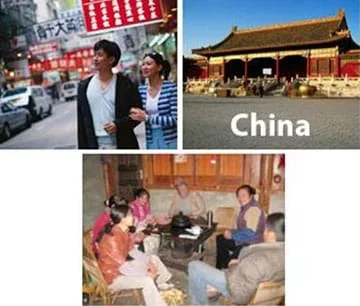 The country of China is a huge landmass with a massive population and ancient culture, growing and changing from old ways to new, and facing environmental, energy and health challenges along the way.
China's rapid economic growth and industrialization has resulted in an increase in environmental pollution. The country is struggling with water pollution, soil erosion, desertification, and air pollution.
Through three lessons and their associated activities, students learn about some of the environmental challenges facing rural and urban China in the areas of energy use, air pollution, climate-driven home and roof design, and optimization.
In the introductory lesson, students learn about the sources of indoor and outdoor pollution in China, its composition of carbon dioxide and particulate matters, and its health effects. Two helpful approaches involve conserving energy (including energy efficiency) and using "clean" energy. In the associated activity, students discover how they can save energy.
In the second lesson, students learn about different climates in China and how this is reflected in smart house design, as they perform an associated design-build-test activity.
In the third lesson and its associated activity, students learn about renewable energy, solid fuels and the concept of optimization, and how engineers are working to solve the challenges of protecting the environment and public health. They reflect upon all they have learned in a creative wrap-up assessment activity. A short pre/post unit quiz is provided for overall unit assessment.
Civil and environmental engineers are concerned about the increasing presence of indoor and outdoor air pollution in China, and its impact on public and planet health. To meet growing energy demands and reduce environmental pollution, scientists and engineers from around the world are looking for ways to replace polluting and non-renewable energy sources with cleaner sources of energy, design homes that are appropriate for local climates and resources, and save energy and increase energy efficiencies in the heating, cooling and cooking needs for homes. Today's engineers must be truly global engineers, understanding how factors around the world combine to affect our daily lives and creating design solutions that are affordable, robust, sustainable and culturally appropriate.
- The use of technology affects humans in various ways, including their safety, comfort, choices, and attitudes about technology's development and use.
Grades 6-8
Do you agree with this alignment? - Economic, political, and cultural issues are influenced by the development and use of technology.
Grades 6-8
Do you agree with this alignment? - The management of waste produced by technological systems is an important societal issue.
Grades 6-8
Do you agree with this alignment?
- MS-ESS3-4 Construct an argument supported by evidence for how increases in human population and per-capita consumption of natural resources impact Earth's systems.
Grades 6-8
This resource focuses on the following Three Dimensional Learning aspects of NGSS:
Science & Engineering Practices- Construct an oral and written argument supported by empirical evidence and scientific reasoning to support or refute an explanation or a model for a phenomenon or a solution to a problem.Do you agree with this alignment?
Disciplinary Core Ideas- Typically as human populations and per-capita consumption of natural resources increase, so do the negative impacts on Earth unless the activities and technologies involved are engineered otherwise.Do you agree with this alignment?
Crosscutting Concepts- Cause and effect relationships may be used to predict phenomena in natural or designed systems.Do you agree with this alignment?
- Scientific knowledge can describe the consequences of actions but does not necessarily prescribe the decisions that society takes.Do you agree with this alignment?
- All human activity draws on natural resources and has both short and long-term consequences, positive as well as negative, for the health of people and the natural environment.Do you agree with this alignment?
Do you agree with this alignment? - Construct an oral and written argument supported by empirical evidence and scientific reasoning to support or refute an explanation or a model for a phenomenon or a solution to a problem.
- MS-ETS1-2 Evaluate competing design solutions using a systematic process to determine how well they meet the criteria and constraints of the problem.
Grades 6-8
This resource focuses on the following Three Dimensional Learning aspects of NGSS:
Science & Engineering Practices- Evaluate competing design solutions based on jointly developed and agreed-upon design criteria.Do you agree with this alignment?
Disciplinary Core Ideas- There are systematic processes for evaluating solutions with respect to how well they meet the criteria and constraints of a problem.Do you agree with this alignment?
Do you agree with this alignment? - Evaluate competing design solutions based on jointly developed and agreed-upon design criteria.
This unit was developed to be conducted over approximately seven 50-minute class periods. See Table 1 for the suggested order to conduct the lessons and activities that comprise this unit.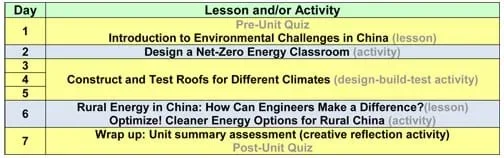 Table 1. Environmental Challenge in China unit schedule.
- Environmental Challenges in China: Rural Villages to Big Cities
A good reference (and source of excellent introductory photographs) and source of extension ideas for this unit is "Choking on Growth," a New York Times 10-part series on environmental challenges in China (topics: overview, water crisis, activists, three-gorges dam, energy, wildlife threatened, polluting trucks, farming fish, two steel towns, green Olympics under gray skies). See http://www.nytimes.com/interactive/2007/12/29/world/asia/choking_on_growth_10.html
Learn more about the engineering research that prompted this curricular unit:
- NSF recognizes CEAE graduate student and new Fulbright Fellow, Abby Watrous, and faculty advisor, Professor John Zhai, for environmental/energy research in China. Posted December 28, 2010. Civil, Environmental and Architectural Engineering, University of Colorado Boulder. Accessed August 6, 2011. http://ceae.colorado.edu/2010/12/28/nsf-recognizes-ceae-graduate-student-and-new-fulbright-fellow-abby-watrous-and-faculty-advisor-professor-john-zhai-for-environmentalenergy-research-in-china/
- Renewable Energy: A Reality Check in Rural China. Posted June 29, 2009. ScienceNation, National Science Foundation. Accessed August 6, 2011. (Includes 5-minute video recap) http://www.nsf.gov/news/special_reports/science_nation/renewableenergy.jsp
- Watrous, Abigail T. My Research: I Burn Stuff. Posted June 5, 2008. Discovery, Behind the Scenes, LiveScience, National Science Foundation. Accessed August 6, 2011. http://www.nsf.gov/discoveries/disc_summ.jsp?org=NSF&cntn_id=111637&preview=false
Contributors
Abigail T. Watrous; Stephanie Rivale; Janet Yowell; Denise W. Carlson
Supporting Program
Integrated Teaching and Learning Program, College of Engineering, University of Colorado Boulder
Acknowledgements
This digital library content was developed by the Integrated Teaching and Learning Program under National Science Foundation grant no. 0946502. However, these contents do not necessarily represent the policies of the National Science Foundation, and you should not assume endorsement by the federal government.
This material was developed in part during Abby Watrous' China Fulbright fellowship in 2009-10. Sincere thanks to the U.S. State Department and the Fulbright Program for their support.
Copyright
2009 by Regents of the University of Colorado