
Construct and Test Roofs for Different Climates
We design and create objects to make our lives easier and more comfortable. The houses in which we live are excellent examples of this. Depending on your local climate, the features of your house have been designed to satisfy your particular environmental needs: protection from hot, cold, windy and/or rainy weather. In this activity, students design and build model houses, then test them against various climate elements, and then re-design and improve them. Using books, websites and photos, students learn about the different types of roofs found on various houses in different environments throughout the world.
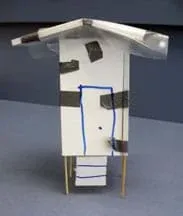 Example model tropical house designed and built by a student.
Civil engineers design structures that are appropriate for their environment. Depending on the climate, different materials are used for the roofs of buildings. Some materials work better in warmer climates to keep buildings cooler, while others work better in colder climates that need additional insulation. A design that works for one climate may not be ideal for another climate.
- Students are able to choose and use materials and tools to create model houses with specific features.
- Students can describe how houses in different environments are built differently (material choices, house design, construction methods).
- Students can explain how different climates suggest design strategies and techniques to best create human shelters.
- Students can describe in their own words the core steps of the engineering design process (design, build, test).
- Students will develop an understanding of the attributes of design.
Grades K-12
Do you agree with this alignment? - Students will develop an understanding of engineering design.
Grades K-12
Do you agree with this alignment? - Students will develop abilities to apply the design process.
Grades K-12
Do you agree with this alignment? - Models are used to communicate and test design ideas and processes.
Grades 3-5
Do you agree with this alignment? - Identify and collect information about everyday problems that can be solved by technology, and generate ideas and requirements for solving a problem.
Grades 3-5
Do you agree with this alignment? - Test and evaluate the solutions for the design problem.
Grades 3-5
Do you agree with this alignment? - STEL-1H Design solutions by safely using tools, materials, and skills.
Grades 3-5
Do you agree with this alignment? - STEL-2I Describe the properties of different materials.
Grades 3-5
Do you agree with this alignment? - STEL-7I Apply the technology and engineering design process.
Grades 3-5
Do you agree with this alignment? - STEL-7J Evaluate designs based on criteria, constraints, and standards.
Grades 3-5
Do you agree with this alignment? - STEL-7M Evaluate the strengths and weaknesses of existing design solutions, including their own solutions.
Grades 3-5
Do you agree with this alignment?
- 3.3-5-ETS1-1 Define a simple design problem that reflects a need or a want. Include criteria for success and constraints on materials, time, or cost that a potential solution must meet.
Grade 3
Do you agree with this alignment? - 3.3-5-ETS1-2 Generate several possible solutions to a given design problem. Compare each solution based on how well each is likely to meet the criteria and constraints of the design problem.
Grade 3
Do you agree with this alignment? - 4.3-5-ETS1-3 Plan and carry out tests of one or more design features of a given model or prototype in which variables are controlled and failure points are considered to identify which features need to be improved. Apply the results of tests to redesign a model or prototype.
Grade 4
Do you agree with this alignment? - 4.3-5-ETS1-5(MA) Evaluate relevant design features that must be considered in building a model or prototype of a solution to a given design problem.
Grade 4
Do you agree with this alignment? - Identify a problem that reflects the need for shelter, storage, or convenience.
Grades 3-5
Do you agree with this alignment?
- 3-5-ETS1-1 Define a simple design problem reflecting a need or a want that includes specified criteria for success and constraints on materials, time, or cost.
Grades 3-5
This resource focuses on the following Three Dimensional Learning aspects of NGSS:
Science & Engineering Practices- Define a simple design problem that can be solved through the development of an object, tool, process, or system and includes several criteria for success and constraints on materials, time, or cost.Do you agree with this alignment?
Disciplinary Core Ideas- Possible solutions to a problem are limited by available materials and resources (constraints). The success of a designed solution is determined by considering the desired features of a solution (criteria). Different proposals for solutions can be compared on the basis of how well each one meets the specified criteria for success or how well each takes the constraints into account.Do you agree with this alignment?
Crosscutting Concepts- People's needs and wants change over time, as do their demands for new and improved technologies.Do you agree with this alignment?
Do you agree with this alignment? - Define a simple design problem that can be solved through the development of an object, tool, process, or system and includes several criteria for success and constraints on materials, time, or cost.
- 3-5-ETS1-2 Generate and compare multiple possible solutions to a problem based on how well each is likely to meet the criteria and constraints of the problem.
Grades 3-5
This resource focuses on the following Three Dimensional Learning aspects of NGSS:
Science & Engineering Practices- Generate and compare multiple solutions to a problem based on how well they meet the criteria and constraints of the design problem.Do you agree with this alignment?
Disciplinary Core Ideas- Research on a problem should be carried out before beginning to design a solution. Testing a solution involves investigating how well it performs under a range of likely conditions.Do you agree with this alignment?
- At whatever stage, communicating with peers about proposed solutions is an important part of the design process, and shared ideas can lead to improved designs.Do you agree with this alignment?
Crosscutting Concepts- Engineers improve existing technologies or develop new ones to increase their benefits, to decrease known risks, and to meet societal demands.Do you agree with this alignment?
Do you agree with this alignment? - Generate and compare multiple solutions to a problem based on how well they meet the criteria and constraints of the design problem.
- 3-5-ETS1-3 Plan and carry out fair tests in which variables are controlled and failure points are considered to identify aspects of a model or prototype that can be improved.
Grades 3-5
This resource focuses on the following Three Dimensional Learning aspects of NGSS:
Science & Engineering Practices- Plan and conduct an investigation collaboratively to produce data to serve as the basis for evidence, using fair tests in which variables are controlled and the number of trials considered.Do you agree with this alignment?
Disciplinary Core Ideas- Tests are often designed to identify failure points or difficulties, which suggest the elements of the design that need to be improved.Do you agree with this alignment?
- Different solutions need to be tested in order to determine which of them best solves the problem, given the criteria and the constraints.Do you agree with this alignment?
Do you agree with this alignment? - Plan and conduct an investigation collaboratively to produce data to serve as the basis for evidence, using fair tests in which variables are controlled and the number of trials considered.
- an assortment of materials for students to create model homes; use what you have available; suggestions: cardboard, poster board, foam core board, sticks, straws, Popsicle sticks, toothpicks, golf tees, old cloth, foil, felt, straw, rocks, clay, wood, beans, Play-doh, string, duct tape, paper clips, mosaic tiles, etc.
- various roofing materials (use whatever is available, such as cardboard, clay for adobe houses, hay or long grass for grass huts, corkboard, saran wrap for roof for tropics houses, etc.)
- classroom tools, such as pencils, pens, markers, rulers, scissors, glue and tape
- (optional) additional tools, such as hammer, nails, screwdriver, screws, pliers, various mechanical fasteners, tape measures
- weather elements: water, strainer, ice cubes, hair dryer to produce wind, coins, washers
- "Houses and Homes" by Ann Morris ($18, check your local library)
- Student Activity Worksheet (PDF)or Climate Appropriate House Design Worksheet (PDF), one per group
- (if focusing on China) Climate Background Design Information for China (PDF), one copy for teacher
- Fabric Wear and Tear Chart (doc)
- Fabric Wear and Tear Chart (pdf)
- Climate Appropriate House Design Worksheet (doc)
- Climate Appropriate House Design Worksheet (pdf)
- Climate Background Design Information for China (doc)
- Climate Background Design Information for China (pdf)
- Rubric for Performance Assessment (doc)
- Rubric for Performance Assessment (pdf)
What does the roof of your house look like? Do you know what your roof is made of? Do you think people who live in tropical areas or desert areas have the same type of roof as you do? Do you think the materials that are used are the same in different climates? In this activity, you will choose the type of climate you would like to live in, desert, tropics or arctic. You will build a model house with a roof designed to withstand the climate.
Background
(If your focus is on designing houses for various climates in China, you may want to begin the activity with the 14 slides of the PowerPoint presentation provided in the associated lesson, Homes for Different Climates.)
People in different parts of the world use different materials to build their homes and other structures. When building homes, they must think about how to use these materials to build houses that work well for where and how they live.
In the southwestern part of the U.S. where the land contains a lot of clay and few trees, people build houses from adobe, a mixture of clay, straw and water. Adobe houses have thick walls that keep the inside cool in the hot dry desert weather. Adobe houses would not be good in places where it rains a lot because too much water makes adobe crumble.
The weather in certain tropical islands in the Pacific Ocean is hot, but wet. People who live there make their homes from materials that are easy to find such as palm leaves, woven grasses and bamboo. Sometimes they build the houses on stilts to keep them off the wet ground and to let the breezes move under the house, helping to keep it cool.
Most Eskimos in Alaska and Canada build their houses out of sod or snow. These dome-shaped houses are called igloos. The dome shape of the igloo makes it very strong and able to withstand powerful winter storms. The thickness of the igloo also makes it a good insulator.
In the past, American Indians built dome-shaped houses made of poles, leaves and tree bark., called wigwams. Some Indian tribes that moved frequently built cone-shaped tepees out of buffalo skins or bark. Tepees could be easily built and taken apart quickly. Some Indians lived in more permanent structures called lodges made from logs and sod.
When early American settlers came to New England, they found the ground covered with large stones. They used these stones to build houses, barns and fences that you still see in the region today. The northwest part of the U.S. and Canada has plenty of forests, so most houses are made of wood.
In parts of China where there are few forests, it is rare to see wooden houses. More often, they use tile, concrete and stone to build beautiful, multi-storied pagodas and other buildings. The land mass of China is so large and varied that almost every climate can be found. (See the associated lesson for more background information as pertains to climates and China).
In parts of Africa, where tall grasses grow, people weave the stems of dried grasses together to make thatch huts.
In Tibet, some people even make their houses out of wool! They shear the wool from ox-like animals called yaks. The wool walls keep the houses warm through the cold winter months.
Most houses in the U.S. today are built of a combination of wood, brick, stone, concrete, steel, aluminum, and glass.
Recommended Resources:
The Book of Roofs website has good pictures and information on roofs: http://www.book-of-roofs.net/
The Wikipedia entry for "Roof" has great information and many photographs: https://en.wikipedia.org/wiki/Roof
Preparation
- Gather materials for making model houses and roofs.
- Make copies of the Student Activity Worksheet (PDF) or Climate Appropriate House Design Worksheet (PDF). The first worksheet is a bit simpler than the second one.
- If focusing on China, share with students the three locations and climates described on the attached Climate Background Design Information for China (PDF).
With the Students
- To start, read students the book "Houses and Homes" by Ann Morris, and show them the wide range of photographs of houses around the world. Follow with a brief class discussion.
- Discuss climate and weather conditions of various world regions, how the homes for the region are constructed, and the materials used. Identify the regions discussed on a globe or world map.
- Discuss the appropriate materials necessary to survive under the given climate and environmental conditions of a particular region.
- Divide the class into pairs or small groups. Hand out the worksheet.
- Review with students the engineering design process. In this activity, we are acting as engineers as we design, build, test and improve our model houses. Who can tell me the steps of the design process? (Ask, research, imagine, plan, create, test, and improve.) Let's get started.
- Have teams choose regions for which they will construct model homes. If focusing on China, provide students with the background information and climate information for three cities in China.
- Have students do some research, looking through books and online for ideas about environmental conditions in different climates, and suitable designs, construction methods and materials to use.
- Then, using the appropriate available materials, have groups build their model houses.
Example goals and tests for building the houses and roofs:
- Desert climate – Should be able to keep an ice cube from melting. Place an ice cube in the center of the model house and expose the house to wind and heat from a blow dryer for a specified amount of time (1-2 minutes). If the ice cube does not melt, then the building can withstand the elements of heat and wind.
- Arctic climate – Should be able to support snow. Gradually add coins or washers to the roof at varying weights to determine if the structure can withstand a large amount of weight from snow. The house should be able to support a specified number (+/-10) of washers or coins to pass a "snow load" test.
- Tropics – Should be waterproof. Place the house in a platform in an empty pan, and pour water through a strainer to simulate rain. Place dry tissue or other absorbent material in the house first to determine if the house leaks in the "rain." To pass the test, the house must not collapse or leak. Use a standard amount of water (1-2 quarts).
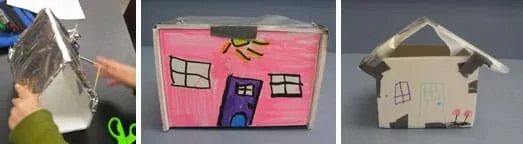 Example model houses designed and built by students.Copyright 2011 Abigail T. Watrous, ITL Program, College of Engineering, University of Colorado Boulder
- After all the model houses are completed, test each house.
- As a class, discuss the results and encourage students to offer suggestions on how each house could be improved. Remember to consider both materials and structural design (for example, roof angles) for the respective regions.
- After the initial assessment of the houses, ask student teams to list three positive and three negative aspects of their houses. Mention that this is a typical part of the engineering design process (analyze test results and improve the design). They should collaboratively decide (and list) how they would improve their houses if they were given the opportunity and how they would construct another (better) model for that region.
- Then have each group trade their house with another group who will list the other adjustments that they think should be made in the design or construction of the house.
- Then they share what they think should be fixed and why they would make the changes. The two groups should compare their lists and discuss the differences and similarities.
- Give teams time to redesign their homes and construct revised models. Test the second models, using the same criteria as the first.
- adobe
- A brick or building material made of a sun-dried mixture of earth and straw.
- appropriate
- Suitable or fitting for a specific purpose, given relevant conditions. For example: Making a house of ice (like an igloo) is not appropriate for the climate of the Bahamas.
- igloo
- An Eskimo house usually made of wood, sod or stone when permanent or of blocks of snow or ice in the form of a dome when built for temporary use.
- hut
- A small and often temporary dwelling or shelter.
Worksheet: Assess student comprehension by observing and assisting students as they process through the worksheet to research, brainstorm, design, build, and improve their model home designs.
Concluding Evaluation: Use the attached rubric to evaluate student teams' success in three areas: quality of design and construction, performance of house against climate tests, and demonstrated understanding of concepts. Show students the rubric criteria in advance to clarify the grading process.
In this activity, students are following the design-build-test process, which is the core of the engineering design process. Learn more about the steps of the engineering design process at https://www.teachengineering.org/engrdesignprocess.php
Morris, Ann. Houses and Homes. Mulberry Books. 1995. (If you do not have access to this book, which is rich in photographs of a diverse assortment of homes from around the world, show students some of the photos by "browsing" the book at the Harper Collins Publisher website.) http://www.harpercollins.com/book/index.aspx?isbn=9780688101688
- Environmental Challenges in China: Rural Villages to Big Cities
Contributors
Martha Cyr; Abigail T. Waltrous (University of Colorado Boulder); Denise W. Carlson (University of Colorado Boulder)
Supporting Program
Center for Engineering Educational Outreach, Tufts University
Copyright
2013 by Regents of the University of Colorado; original © 2004 Worcester Polytechnic Institute