
Rural Energy in China: How Can Engineers Make a Difference?
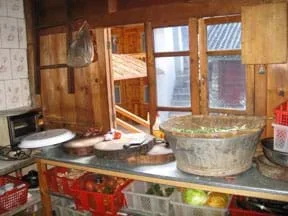 A kitchen in rural Yunnan Province, China.
Students learn about five types of renewable energy that are part of engineering solutions to help people in rural communities use less and cleaner energy for cooking and heating. Specifically, students learn about the pollution and health challenges facing families in rural China, and they are introduced to the concept of optimization. Through an energy game, students differentiate between renewable and non-renewable sources of energy.
Engineering is all about developing solutions to help meet people's needs. Engineers can make a difference by designing solutions to help people in rural communities use less and cleaner energy for cooking and heating. In rural China, many families have limited incomes and rely on solid fuels such as coal and biomass to cook meals and heat homes and water. Design solutions must be affordable, robust, sustainable and culturally appropriate so they can make a real difference in the health of the families who use them, as well as the environment.
After this lesson, students should be able to:
- Explain the difference between renewable and non-renewable energy.
- Name five different types of renewable energy sources.
- Describe solid fuels and how they differ from non-solid fuels.
- Explain why solid fuels can be harmful to people's health.
- Identify and evaluate types and availability of renewable and nonrenewable resources
Grade 6
Do you agree with this alignment?
- The management of waste produced by technological systems is an important societal issue.
Grades 6-8
Do you agree with this alignment? - STEL-3E Analyze how different technological systems often interact with economic, environmental, and social systems.
Grades 6-8
Do you agree with this alignment? - STEL-4L Analyze how the creation and use of technologies consumes renewable and non-renewable resources and creates waste.
Grades 6-8
Do you agree with this alignment?
- 5-ESS3-1 Obtain and combine information about ways individual communities use science ideas to protect the Earth's resources and environment.
Grade 5
This resource focuses on the following Three Dimensional Learning aspects of NGSS:
Science & Engineering Practices- Obtain and combine information from books and/or other reliable media to explain phenomena or solutions to a design problem.Do you agree with this alignment?
Disciplinary Core Ideas- Human activities in agriculture, industry, and everyday life have had major effects on the land, vegetation, streams, ocean, air, and even outer space. But individuals and communities are doing things to help protect Earth's resources and environments.Do you agree with this alignment?
Crosscutting Concepts- A system can be described in terms of its components and their interactions.Do you agree with this alignment?
- Science findings are limited to questions that can be answered with empirical evidence.Do you agree with this alignment?
Do you agree with this alignment? - Obtain and combine information from books and/or other reliable media to explain phenomena or solutions to a design problem.
- MS-ETS1-2 Evaluate competing design solutions using a systematic process to determine how well they meet the criteria and constraints of the problem.
Grades 6-8
This resource focuses on the following Three Dimensional Learning aspects of NGSS:
Science & Engineering Practices- Evaluate competing design solutions based on jointly developed and agreed-upon design criteria.Do you agree with this alignment?
Disciplinary Core Ideas- There are systematic processes for evaluating solutions with respect to how well they meet the criteria and constraints of a problem.Do you agree with this alignment?
Do you agree with this alignment? - Evaluate competing design solutions based on jointly developed and agreed-upon design criteria.
More than 700 million people currently live in rural China. While this number is changing rapidly as people migrate to cities, many millions still live in rural areas and burn solid fuels for cooking and heating. The World Health Organization has identified cooking with solid fuels as one of the leading causes of death. Smoke from solid fuels can contain harmful gases and particles, such as carbon monoxide and particulate matter. Health effects can include acute respiratory infection, chronic obstructive pulmonary disease, and lung cancer.
Improved cookstoves are one of the most effective ways that families can decrease their exposure to emissions from use of solid fuels. These stoves use less fuel and produce fewer emissions than their traditional counterparts, and are robust and affordable as well. The Global Alliance for Clean Cookstoves is one initiative working to bring improved cookstoves to millions of families around the world.
The attached Energy in Rural China (PPT) PowerPoint presentation provides good background information to review with students the five types of renewable energy, and lead them through a game to review which energy sources are renewable and which are non-renewable. Renewable sources of energy include solar, water (hydro), wind, geothermal and biomass. Non-renewable sources of energy include coal, natural gas, nuclear, gasoline and oil. Three ways engineers help bring cleaner energy to families with limited resources include biogas digesters, solar hot water systems, and improved cookstoves. Optimization means carefully weighing all the costs, benefits, and drawbacks of various options to choose the best one.
In the associated activity, students are introduced to cleaner energy options for families in rural China, along with numbers to help them gauge the relative health and environmental benefits and relative costs.
(In advance, prepare computer projector [or overhead transparencies] to show students the attached Energy in Rural China (PPT) PowerPoint presentation. Its 31 slides cover five types of renewable energy, an energy game, energy usage in rural China, the concept of optimization, ways engineers help people use cleaner sources of energy, and a lead-in to the associated activity Optimize! Cleaner Energy Options for Rural China . For the energy game, 12 slides each show a type of energy and students sit or stand to indicate whether it is a renewable or non-renewable source of energy [slides are "animated" so a mouse or space bar click reveals the answer].)
Have you ever helped someone in your family cook dinner? What kind of stove did you use? If you live in the U.S., you probably used either a gas or electric stove. These stoves were designed by engineers to provide a clean way for us to cook our meals.
Have you ever gone camping and built a campfire? Maybe you even roasted hot dogs or made s'mores with your friends. Do you remember the smoky smell that comes from an outdoor campfire? Perhaps you can remember that your throat hurt a little bit if you stood too close to the smoke. It is okay for your health to enjoy a safe campfire every once in a while, but can you imagine what would happen if you cooked all of your meals over a campfire?
Fires produce something called "particulate matter" (we talked about this a little bit in an earlier lesson when we talked about air pollution). If we breath in the particulate matter in the air, it can get deep into our lungs and cause serious health problems.
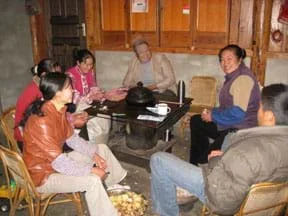 A Chinese family and friends around their stove.Copyright 2008 Abigail T. Watrous, ITL Program, College of Engineering, University of Colorado Boulder
Many, many families in rural parts of China do not have enough money to use gas stoves or electric stoves, or they are not located in regions that have the infrastructure to distribute gas and/or electricity to every home. So, they cook all of their meals over small fires in their kitchens. These fires are often powered by coal, or by biomass such as wood, corn husks or other dried natural materials. These types of fuels are called "solid fuels." The smoke from these fires contains particulate matter that pollutes the indoor air quality, and can really hurt the health of the moms who are cooking, the kids who are helping, and other people living in the house.
Engineers are concerned about the health problems that cooking with solid fuels causes for these families. They are creating solutions so that families can find ways to cook their meals that are not so damaging to their health.
Engineers want to help these families, but they also know that the families do not have much money to spend on new appliances. Some solutions are good for people's health, but are expensive. Other solutions are inexpensive, but are not as good for people's health, or the health of the environment. This means that engineers must optimize. What does "optimize" mean? It means thinking about all the parts of the problem and making the best decision that we can make. For example, if you have only one hour for recess, and you want to play on the swings and also talk with your friends, then you can optimize by choosing to spend half an hour with your friends and then play on the swings for half an hour. That's a simple example — because optimization can sometimes be complicated!
(Show students the attached PowerPoint presentation including the energy game. Then proceed to conduct the associated activity.)
Who can name a type of energy source and tell me whether it is considered a renewable or non-renewable source? (Listen to student suggestions, correcting as necessary. Renewable sources of energy include solar, water [hydro], wind, geothermal and biomass. Non-renewable sources of energy include coal, natural gas, nuclear, gasoline and oil.) What is the difference between renewable and non-renewable energy sources? (Renewable means it can be used over and over again, and its source never ends. Non-renewable means that when we use it, it gets used up for good, such as fossil fuels that we mine from below the Earth's crust.) What are solid fuels? And how are they different from non-solid fuels? (Answer: Solid fuels are not liquid in form. Solid fuel examples: coal, biomass, wood, dung, dried corn cobs. Non-solid fuels are in liquid or gaseous form, for example, oil, propane, gas or biogas.)
What is the problem with how so many families in rural areas of China (and many other countries) cook and heat in their homes? (Possible answers: Cooking and heating with fires and stoves that produce heavy amounts of particulate matter pollute the indoor air and cause health problems for people. It also reduces the quality of outdoor air.) So why are solid fuels harmful to people's health? (Answer: Same as previous.)
What could be done to improve the situation? (Listen to student answers. Possible answers: Improve venting of indoor stoves to the outside of houses, use biogas digesters that efficiently consume waste products without particulate emissions, install solar hot water systems, and use improved cookstoves that do not generate air polluting emissions.) With so many options, how do we know what is best? (We must optimize.) What does optimization mean? (Answer: Considering all the factors and making the best decision for the situation. The best solution may be a compromise or balance of the options available.) For example, an important engineering lesson to consider when designing solutions: "It's not a solution if we can't afford it."
- emission
- In this case, refers to what is produced by burning fuels (such as carbon dioxide, particulate matter 2.5, or other types of pollution).
- non-renewable energy
- Energy that is used up once we use it, such as coal, oil or gasoline.
- non-solid fuel
- Fuels that are in liquid or gaseous form, such as oil, propane, gas or biogas (methane).
- optimization
- Considering a variety of factors and choosing the best solution.
- renewable energy
- Energy from natural sources that we can use over and over, such as wind, water, solar, biomass or geothermal.
- solid fuel
- Non-liquid fuels, such as coal, biomass, wood, dung or dried cornstalks.
Post-Introduction Assessment
Energy Game: Conduct the Energy Game in the associated Energy in Rural China (PPT) PowerPoint presentation as a way to quickly visually assess students' overall knowledge of which types of energy are renewable and which are non-renewable. For the energy game, 12 slides each show a type of energy and students either sit or stand to indicate whether it is a renewable or non-renewable source of energy. The slides are "animated" so a mouse or space bar click reveals the answer, before going on to the next slide.
Lesson Summary Assessment
Worksheet or Quiz: After completing the associated activity, have students complete the Learning about Renewable Energy Handout (PDF) as either a worksheet or quiz. Review their answers to gauge their mastery of the subject matter.
Unit Summary Assessment: Gauge the impact of the curricular unit on students' learning by administering a Post-Unit Quiz and a creative reflection wrap-up assignment after concluding this lesson/activity set. See a description and the quiz attachment in the Assessment section of the Environmental Challenge in China unit.
Assign students to do some web research on clean cookstoves, such as the work being done by the Global Alliance for Clean Cookstoves. See http://cleancookstoves.org/
Give students time for web research in a computer lab at school or at home to look into how engineers design creative solutions to needs in developing communities. Examples:
- See cookstoves designed by Envirofit at http://www.envirofit.org/
- Learn about projects developed at the International Development Design Summit at http://iddsummit.org/about
- See ideas for shelter, health, water, education, energy and transport in the Design for the Other 90%, Cooper-Hewitt Design Museum exhibit at http://other90.cooperhewitt.org/
Watch many short videos about the worldwide problem of cookstoves and health at YouTube. For example, see this 31-second video called, Envirofit is Working on a Solution to Global Indoor Air Pollution, at http://www.youtube.com/watch?v=E930gujYAg8
Biogas FAQs. Electrigaz USA, Ithaca, NY. Accessed July 31, 2011. http://www.electrigaz.com/faq_en.htm
Global Alliance for Clean Cookstoves. United Nations Foundation. Accessed June 25, 2011. (a public-private initiative to save lives, improve livelihoods, empower women, and combat climate change by creating a thriving global market for clean and efficient household cooking solutions) http://cleancookstoves.org
Graham-Harrison, Emma. Energy-Hungry China Warms to Solar Water Heaters. Published June 5, 2006. PlanetArk Environmental Foundation, Sidney, Australia. Accessed July 31, 2011. http://www.planetark.org/dailynewsstory.cfm?newsid=36636
Indoor Air Pollution. World Health Organization. Accessed June 25, 2011. http://www.who.int/indoorair/en/
Kangmin, Li and Ho, Mae-Wan. Biogas China. ISIS Report 02/20/06. Institute of Science in Society, London, UK. Accessed July 30, 2011. (Source of information and diagram of "China dome" biogas digester in the PowerPoint Presentation) http://www.i-sis.org.uk/BiogasChina.php
Merriam Webster Dictionary http://www.merriam-webster.com/
Schwartz, Ariel. Envirofit's $25 Clean-Burning Cooking Stove Is Ready for the Developing World. Published July 8, 2009. Fast Company Magazine. Accessed July 31, 2011. http://www.fastcompany.com/blog/ariel-schwartz/sustainability/envirofit-releases-28-clean-burning-cooking-stove-developing-worl
Wilmsen, Emily Narvaes. International Design Award for Clean Cookstove. Published August 3, 2009. Today @ Colorado State, Colorado State University, Ft. Collins, CO. Accessed `July 31, 2011. http://www.today.colostate.edu/story.aspx?id=1904
- Environmental Challenges in China: Rural Villages to Big Cities
- Introduction to Environmental Challenges in China
- Design & Materials: Homes for Different Climates
- Rural Energy in China: How Can Engineers Make a Difference?
Contributors
Abigail T. Watrous; Stephanie Rivale; Janet Yowell; Denise W. Carlson
Supporting Program
Integrated Teaching and Learning Program, College of Engineering, University of Colorado Boulder
Acknowledgements
The contents of this digital library curriculum were developed under a grant from the Fund for the Improvement of Postsecondary Education (FIPSE), U.S. Department of Education and National Science Foundation GK-12 grant no. 0338326. However, these contents do not necessarily represent the policies of the Department of Education or National Science Foundation, and you should not assume endorsement by the federal government.
Copyright
2009 by Regents of the University of Colorado.