
Completing the Circuit
In the everyday electrical devices we use – calculators, remote controls and cell phones – a voltage source such as a battery is required to close the circuit and operate the device. In this hands-on activity, students engage in the science and engineering practice of making observations as they use batteries, wires, small light bulbs and light bulb holders to explore the phenomenon of electricity and learn the difference between an open circuit and a closed circuit. Students engage in the disciplinary core ideas and crosscutting concepts of electric current and energy transfer as they make sense of the idea that electric current only occurs in a closed circuit.
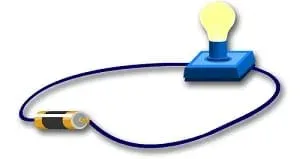 Students explore electric current through a closed circuitCopyright UK Power Networks http://powerup.ukpowernetworks.co.uk/media/21651/37_nogapincircuit.jpg
Electrical engineers design the circuits and batteries that are in the devices and appliances that we use every day. Circuits can be found in music players, computers, video games, appliances, microwaves, phones, televisions, cameras, medical equipment, vehicles and so many more products. Engineers take seriously the responsibility of designing circuits that work dependably and safely. While new devices are constantly being developed around the world, engineers strive to create safer, more efficient products that ultimately help improve people's lives.
After this activity, students should be able to:
- Define, recognize, build and draw a closed circuit.
- Explain why a closed circuit is required for any electrical device to operate.
- Describe the transformations of energy that occur in the circuit.
- Use correct operations and appropriate methods to solve Ohm's law problems.
- 5.1.2.c Add, subtract, multiply, and divide decimals to hundredths.
Grade 5
Do you agree with this alignment? - 4.2.1.a.iv Find the unknown in simple equations.
Grade 4
Do you agree with this alignment?
- Show that electricity in circuits requires a complete loop through which current can pass
Grade 4
Do you agree with this alignment?
- CCSS.Math.Content.4.OA.A Use the four operations with whole numbers to solve problems.
Grade 4
Do you agree with this alignment? - CCSS.Math.Content.4.OA.A.2 Multiply or divide to solve word problems involving multiplicative comparison, e.g., by using drawings and equations with a symbol for the unknown number to represent the problem, distinguishing multiplicative comparison from additive comparison.
Grade 4
Do you agree with this alignment? - CCSS.Math.Content.5.NBT.B.5 Fluently multiply multi-digit whole numbers using the standard algorithm.
Grade 5
Do you agree with this alignment?
- Tools, machines, products, and systems use energy in order to do work.
Grades 3-5
Do you agree with this alignment?
- 4-PS3-2 Make observations to provide evidence that energy can be transferred from place to place by sound, light, heat, and electric currents.
Grade 4
This resource focuses on the following Three Dimensional Learning aspects of NGSS:
Science & Engineering Practices- Make observations to produce data to serve as the basis for evidence for an explanation of a phenomenon or test a design solution.Do you agree with this alignment?
Disciplinary Core Ideas- Energy can be moved from place to place by moving objects or through sound, light, or electric currents.Do you agree with this alignment?
- Energy is present whenever there are moving objects, sound, light, or heat. When objects collide, energy can be transferred from one object to another, thereby changing their motion. In such collisions, some energy is typically also transferred to the surrounding air; as a result, the air gets heated and sound is produced.Do you agree with this alignment?
- Light also transfers energy from place to place.Do you agree with this alignment?
- Energy can also be transferred from place to place by electric currents, which can then be used locally to produce motion, sound, heat, or light. The currents may have been produced to begin with by transforming the energy of motion into electrical energy.Do you agree with this alignment?
Crosscutting Concepts- Energy can be transferred in various ways and between objects.Do you agree with this alignment?
Do you agree with this alignment? - Make observations to produce data to serve as the basis for evidence for an explanation of a phenomenon or test a design solution.
Each group needs:
- 1 D-cell battery
- 5-7 in (13 - 18 cm) insulated wire (gauge AWG 22) (available at most hardware stores)
- 1 small light bulb holder (#40) (optional; available at most hardware stores)
- 1 small light bulb (#40) (available at most hardware stores)
- small wire strippers or sandpaper (to remove insulation at wire ends)
- tape (scotch, masking or electrical)
- 1 Completing the Circuit Worksheet (PDF)
- 1 Ohm's Law Math Worksheet (PDF)
Note: These materials (except the tape and worksheets) can be reused in numerous other electricity activities. When the batteries wear out, dispose of them at a hazardous waste disposal site.
Have you ever changed the light bulb in a lamp? Or, have you ever watched an adult change a light bulb in a lamp or light fixture? (Some students will answer yes.) Why did you change the light bulb? (Possible answers: The lamp would not turn on, the light bulb stopped working.) What happened when the new light bulb was placed in the lamp. (Answer: The lamp worked and the light bulb lit up.)
When light bulb is broken or burned out, it does not light because the lamp's circuit is open. (Draw an open circle on the board, one that does not connect the end to the beginning). However, when a new light bulb is placed in the lamp, the lamp's circuit is closed (draw a closed circle on the board) and the electrons can move around the circuit and light the light bulb.
Do you recall what you have learned about atoms? Well atoms are made of smaller particles called protons, neutrons and electrons. The electrons carry a negative electric charge and can quickly pass from one atom to another atom within a material. This "flow" of electrons from one end of the material to the opposite end is called current electricity.
During our activity today, you will discover that a flow of electrons is needed to light a light bulb in a lamp. However, things can happen that will stop the electrons from moving and turn off the light bulb. What might possibly stop electrons from moving? (Give students a few quiet moments to think about this.) Well, today you will solve this "mystery" during the activity.
Do you have any circuits in your house? Who designs these circuits? (Listen to student ideas.) It is electrical engineers who design circuits that are in the devices and appliances that we use every day. These circuits can be found in toasters, microwaves, cell phones, DVD players, video games and, even in cars and trucks. Can you imagine life without some of these items that we rely on for everyday tasks and entertainment? It is the responsibility of engineers to design circuits that work safely and properly. That way, your television will not stop functioning in the middle of your favorite TV show!
Background
Any path through which charges can move is called an electric circuit.
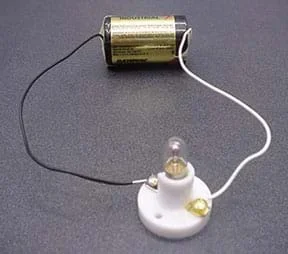 Figure 1. An example simple closed circuit created using a battery, wire, light bulb holder and light bulb.Copyright 2003 Joe Friedrichsen, ITL Program, College of Engineering, University of Colorado Boulder
If there is a break in the path there cannot be a current (the flow of electric charge), and the circuit is called an open circuit. However, if the path for movement of charge is complete, then the circuit is closed; there can only be a current in a closed circuit. Electrons cannot pile up or disappear in a circuit. A circuit can be as simple as a wire connected to both terminals of a battery, or as complicated as the integrated circuits that are found in a home computer.
Before the Activity
- Cut enough lengths of wire for each pair of students.
- Make copies of the two worksheets.
With the Students
- Ask the students: What is the difference between an open and a closed circuit? (Answer: A closed circuit is a circuit with a complete path, which allows charge to flow [current]. An open circuit is a circuit with a break in the path, so that charge is unable to move. See Figure 1 for an example closed circuit.) What is voltage? (Answer: Voltage is the difference in electrical potential between two points in a circuit. It may be helpful to present voltage as the "electrical pressure" that causes the electrons to move in a conductor.)
- Have each student team take a battery, a light bulb, light bulb holder and a piece of wire.
- Using wire strippers or sandpaper, carefully remove about 1/4-3/8 in (approximately 6-10 mm) of insulation from the ends of the wire.
- Try to connect the battery, light bulb, light bulb holder and wire so the bulb lights up. Use tape if necessary. How many ways can you connect the light bulb/light bulb holder to the battery so the bulb lights up? (Answer: None. You only have one wire!)
- Now, cut your wire into two pieces. Again, remove about 1/4-3/8 in (approx. 6-10 mm) of insulation from the ends of each piece of wire.
- Try to connect the battery, light bulb, light bulb holder and two pieces of wire so the bulb lights up. How many ways can you connect the light bulb/light bulb holder to the battery so the bulb lights up? Draw all the ways you found. Try to find at least two ways to do this.
- Now, briefly connect the battery terminals with just a piece of wire. (Note: this should be a very brief test just to get a sense of the energy in the circuit.) What do you notice about the battery and the wire? (Answer: The battery and wire are warm.) In particular, how do your fingers feel as they hold the wire at the battery terminals? (Answer: Students' fingers should feel a little warm.) How do the battery, bulb and wire feel after you have done all the steps in the activity? (Answer: The battery, bulb and wire are warm after doing the activity.)
- In pairs, have students complete the Completing the Circuit Worksheet (PDF).
- (optional) Working in pairs, have students complete the Ohm's Law Math Worksheet (PDF).
Pre-Activity Assessment
Question/Answer: Ask students questions and have them raise their hands to respond. Write answers on the board and discuss as a class.
- What is the difference between an open and a closed circuit? (Answer: A closed circuit is a circuit with a complete path, which allows charge to flow [current]. An open circuit is a circuit with a break in the path, and thus, charge is unable to move.)
- What is voltage? (Answer: The difference in electrical potential between two points in a circuit. You can think of voltage as the "electrical pressure" that causes the electrons to move in a conductor.)
Activity Embedded Assessment
Question/Answer: Ask students questions and have them raise their hands to respond. Write answers on the board and discuss as a class.
- How many connections to the battery are necessary for the light bulb to light up? (Answer: Two. A connection to the positive terminal and a connection to the negative terminal.)
- After connecting the battery terminals with just a piece of wire, what did you notice about the battery and the wire? (Answer: The battery and wire were warm.) In particular, how do your fingers feel as they held the wire at the battery terminals? (Answer: Students' fingers should feel a little warm.)
- How did the battery, bulb and wire feel after you completed all the steps in the activity? (Answer: The battery, bulb and wire were warm after doing the activity.)
Worksheet/Pairs Check: Have students work in pairs on the Completing the Circuit Worksheet. After student teams finish their worksheets, have them compare answers with a peer group, giving all students time to finish the worksheet.
Post-Activity Assessment
Math Worksheet/Pairs Check: Have students work in pairs on the Ohm's Law Math Worksheet. After student teams finish their worksheets, have them compare answers with a peer group, giving all students time to finish the worksheet.
Drawing and Class Discussion: Have students depict their subject area knowledge gained by sketching and labeling some of the concepts or activities. For example,
- Have each group write their own definitions for closed and open circuits. Next to each definition draw a circuit — with one bulb, one battery and wire — that is either open or closed.
- Ask each group to draw as many unique ways to construct a closed circuit with only one bulb, one battery and one piece of wire, as they can. Compare the groups' results as a class and discuss the validity of each drawing.
- Ask students not to touch their circuits (wire, bulb and battery) to their mouths in any way because of the possibility of electric shock (not to mention the fact they are probably dirty, too).
- Only connect the battery terminals with just a piece of wire for a short period of time (as seen in step 7 under the Procedure section). Keeping the wire connected to the terminal for a long period could result in a hazard.
This activity can be done without light bulb holders.
If students forget to strip the insulation off the ends of the wire, the wire will not make good electrical contact with the battery terminals.
It may be helpful to make the comparison between "circuit" and "circle" for the students.
Battery Variations: Construct three simple circuits, the first using an AAA battery, the second using an AA battery, and the third using a D-cell battery. Ask students to predict which of the three will be the brightest. Ask the students to compare the brightness of the bulbs in each circuit. (Answer: All batteries should appear the same brightness since the voltages of all three batteries are the same.)
- For lower grades, choose one or two real-world problems on the Ohm's Law Math Worksheet and complete together, as a class.
- For upper grades, complete the activity as is, and have students complete Ohm's Law Math Worksheet individually.
Contributors
Xochitl Zamora Thompson; Sabre Duren; Joe Friedrichsen; Daria Kotys-Schwartz; Malinda Schaefer Zarske; Denise W. Carlson; Janet Yowell
Supporting Program
Integrated Teaching and Learning Program, College of Engineering, University of Colorado Boulder
Acknowledgements
The contents of this digital library curriculum were developed under a grant from the Fund for the Improvement of Postsecondary Education (FIPSE), U.S. Department of Education and National Science Foundation GK-12 grant no. 0338326. However, these contents do not necessarily represent the policies of the Department of Education or National Science Foundation, and you should not assume endorsement by the federal government.
Copyright
2004 by Regents of the University of Colorado.