
Two-Cell Battery
By engaging in the science and engineering practice of applying scientific ideas to solve design problems, students explore the phenomenon of electricity and build their own two-cell batteries. To make sense of this phenomenon, students determine which electrolyte solution is best suited for making batteries. During this activity, students discover the disciplinary core ideas of energy transfer and design criteria and constraints while applying the crosscutting concepts of teamwork and design.
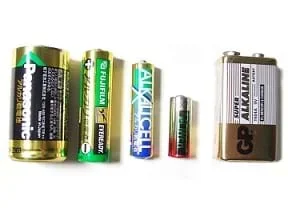 Students build their own two-cell batteryCopyright Wikimedia Commons http://upload.wikimedia.org/wikipedia/commons/2/21/Alkali_battery_5.jpg
For some engineers, designing amazing batteries is their specialty. Electrical engineers continually conduct research to improve the efficiency of rechargeable batteries that are used in laptops, cell phones, digital cameras and electric cars. Some engineers are developing extremely tiny batteries that are smaller than the width of a human hair. These batteries provide power for microelectromechanical systems (MEMS) located in devices for specialized use in the medical and aerospace industries.
After this activity, students should be able to:
- Describe the energy transformations that take place when a battery is connected in a circuit.
- Explain that an electrolyte is needed for a battery to produce current electricity.
- Construct and interpret a graph of current produced by a battery as a function of electrolyte concentration.
- 5.3.1 Visual displays are used to interpret data.
Grade 5
Do you agree with this alignment? - 3.3.1.a Represent and interpret data.
Grade 3
Do you agree with this alignment?
- Show that electricity in circuits requires a complete loop through which current can pass
Grade 4
Do you agree with this alignment? - Describe the energy transformation that takes place in electrical circuits where light, heat, sound, and magnetic effects are produced
Grade 4
Do you agree with this alignment?
- CCSS.Math.Content.4.MD.B Represent and interpret data.
Grade 4
Do you agree with this alignment? - CCSS.Math.Practice.MP2 Reason abstractly and quantitatively.
Grades K-12
Do you agree with this alignment?
- The process of experimentation, which is common in science, can also be used to solve technological problems.
Grades 3-5
Do you agree with this alignment? - Tools, machines, products, and systems use energy in order to do work.
Grades 3-5
Do you agree with this alignment?
- 4-PS3-2 Make observations to provide evidence that energy can be transferred from place to place by sound, light, heat, and electric currents.
Grade 4
This resource focuses on the following Three Dimensional Learning aspects of NGSS:
Science & Engineering Practices- Make observations to produce data to serve as the basis for evidence for an explanation of a phenomenon or test a design solution.Do you agree with this alignment?
- Analyze and interpret data to make sense of phenomena using logical reasoning.Do you agree with this alignment?
- Use a model to test interactions concerning the functioning of a natural system.Do you agree with this alignment?
Disciplinary Core Ideas- Energy can be moved from place to place by moving objects or through sound, light, or electric currents.Do you agree with this alignment?
- Energy can also be transferred from place to place by electric currents, which can then be used locally to produce motion, sound, heat, or light. The currents may have been produced to begin with by transforming the energy of motion into electrical energy.Do you agree with this alignment?
Crosscutting Concepts- Energy can be transferred in various ways and between objects.Do you agree with this alignment?
Do you agree with this alignment? - Make observations to produce data to serve as the basis for evidence for an explanation of a phenomenon or test a design solution.
Each group needs:
- 2 pieces aluminum foil: 8 in x 12 in (20 cm x 30 cm)
- 2 wide-mouth glass jars (must be able to hold at least 150 ml)
- 2 small paper cups (such as Dixie cups), cut at ¾ in from the cup bottom, or 2 plastic caps from milk jugs
- 3 pieces (one: 12 in [30 cm] and two: 31.5 in [80 cm]) of non-insulated copper wire (gauge AWG 20) (available at most hardware stores); a total of 75 in (200 cm) per group. Or, if you have insulated wire, it will work if you strip the insulation off the ends.
- masking tape
- wire cutters
- marking pens
- Two-Cell Battery Worksheet (PDF)
For a Battery Testing Station for the entire class to share:
- containers for the electrolyte solutions (must be able to hold at least 150 ml); wide-mouth glass jars work well
- electrolyte solutions (make in advance with water and vinegar, citrus juice [such as lemon] or salt; see Procedure section)
- a few graduated cylinders (10–25 ml) or liquid measuring cups or jars with volumes marked on the side
- 3 pairs of safety glasses or goggles
- 1 DC ammeter (to measure current in amperes) (available at most hardware or electronics shops)
- paper towels
For a Cleaning Station for the entire class to share:
- water and sink, or, if no drain is available, a large empty container to collect the used electrolyte solutions
- (optional) paper towels
(Before starting the activity, ask students to brainstorm.) From where does electricity come? (Possible ideas: A wall outlet, power plant, photovoltaic/solar cells, batteries, etc. If no student mentions a battery, ask them the next question.) Do you think electricity can come from a battery? (Answer: Yes) Have you ever wondered what is inside of a battery? How do engineers decide what liquid or paste to use in this can full of chemicals?
What is inside a battery that helps produce current electricity? (Possible ideas: Chemicals, paste or a bunch of electrons.) Well, inside a battery are two metal plates or posts called electrodes where chemical reactions take place and produce electrons. Also inside is a solution called an electrolyte, which allows charge to move in the solution and balances the movement of electrons. During today's activity, you will create your own two-cell batteries and learn how engineers determine what type of electrolyte is best to use in batteries!
(Show students a battery.) Have you ever looked closely at a battery and seen a small number with the letter "V" next to it? What does the letter represent? (Answer: Volts) During today's activity, you will learn how to determine the number of volts a battery produces.
(Remind students.) Remember what you've learned about atoms...? Atoms are made of smaller parts called protons, neutrons and electrons. The electrons carry a negative electric charge, move from atom to atom, and create current electricity.
How many different applications can you think of that use batteries? (Listen to student ideas.) How do you think that engineers might be involved with batteries? (Listen to student ideas.) Well, engineers design all the types of batteries that we use every day. Some engineers conduct research to improve the efficiency of rechargeable batteries. Other engineers work to improve rechargeable lithium batteries that are used for laptops, digital cameras and electric cars so they last longer and are able to be re-charged for additional cycles. Other engineers also are developing an extremely small battery to power microelectromechanical systems (MEMS). MEMS devices, which are used in medical and aerospace industries, are smaller than the width of a human hair. That's a small battery!
Background
A typical wet-cell battery has two terminals, a liquid electrolyte and two electrodes, called the anode and the cathode.
During this activity, students make their own two-cell batteries with aluminum and copper electrodes immersed in a prepared electrolyte solution. We use two cells connected in series (one after the other) to make this battery because the voltage produced by each cell is so low; connecting the two cells in series doubles the voltage produced.
In each cell, the aluminum foil serves as the anode. The aluminum foil oxidizes, producing aluminum cations (Al3+) that go into the solution and leave the aluminum electrode with excess electrons. These electrons move through the foil in container A, up to the copper wire (which is connected to the ammeter), and through the ammeter to the coiled copper wire in container B.
In each cell, the copper wire is the cathode. Electrons combine with copper cations in the solution and form elemental copper. The same oxidation process takes place at the aluminum anode in container B as was described for container A. Therefore, there is a movement of electrons from the foil in container B through the copper wire to the coiled wire in container A. Again, these electrons combine with the copper cations in the solution in container A. The electrolyte in both cells serves to balance the movement of electrons by providing ions. Each cell produces a voltage of about 2 V, so the total voltage for the battery is about 4 V.
Before the Activity
- Cut two 8 in x 12 in (20 cm x 30 cm) pieces of aluminum foil for each team.
- Cut one 12 in (30 cm) piece and two 31.5 in (80 cm) pieces of wire for each team. Note that insulated wire can be used, as long as it is stripped at the ends.
- Decide which electrolytes to use. (Suggestion: For a class of 27 students working in nine teams of three students each, use three different electrolytes [vinegar, citrus juice, salt] in three different strengths [weak, medium, strong].)
- Prepare the electrolyte solutions, making about 400 mL of each solution. Make sure to label them. The whole class can use the same type of solution at different strengths, or different teams can have different types of solutions at a range of strengths (see examples below):
- Weak solution: 5 ml (~1 teaspoon) of [vinegar or citrus juice or salt] for every 100 ml water
- Medium solution: 15 ml (~1 tablespoon) of [vinegar or citrus juice or salt] for every 100 ml water
- Strong solution: 40 ml (~2.5 tablespoon) of [vinegar or citrus juice or salt] for every 100 ml water
If the number of teams is not a multiple of three (one team using the weak solution, one using the medium solution, and one using the strong solution), prepare more electrolyte solutions for the remaining teams, making them incrementally stronger.
- Prepare a Battery Testing Station for the entire class to use: 3 pairs of goggles, a DC ammeter, graduated cylinders, all the containers of prepared electrolyte and paper towels.
- Set up a Cleaning Station.
- Make copies of the Two-Cell Battery Worksheet (PDF), one per team.
With the Students
Have each team construct its two-cell battery at a desk. After all the groups have finished, gather the class around the battery testing station to observe what happens when electrolyte is added to each team's battery.
Constructing the Battery:
- Put a piece of tape on each glass container. Label one container A and the other B.
- Have students roll each piece of foil so the long side of the roll is about 12 in (30 cm). Crumple about 1/4 of one end on each roll.
- Place one aluminum foil roll in each container, placing the crumpled end on the bottom of the container. Carefully flatten the rolled part of the foil against the side of each container.
- Place a paper cup bottom (or milk cap) on top of the crumpled foil in each container; the aluminum foil column should go up and around the side of the paper cup (or milk cap) (see Figure 1).
- Carefully wind one end of the 12 in (30 cm) piece of copper wire around the top of the foil roll in container A. Make a couple winds with the wire to get a good connection. Leave the other end of the wire free.
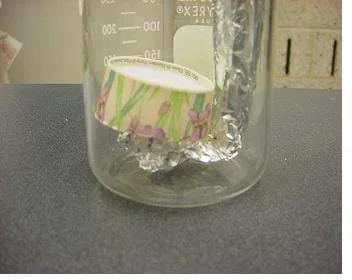 Figure 1. The aluminum foil column (anode) crumpled at the bottom and covered by a paper cup bottom.Copyright 2003 Joe Friedrichsen, ITL Program, University of Colorado Boulder
- Coil about 22-24 in (55-60 cm) of the 31.5 in (80 cm) piece of wire into a ball. Place this ball on top of the paper cup bottom in container B. Make sure the copper wire is not touching the aluminum foil.
- Coil about 22-24 in (55-60 cm) of the second 31.5 in (80 cm) piece of wire into a ball. Place this ball on top of the paper cup bottom in container A. Make sure the copper wire is not touching the aluminum foil.
- Carefully wind the free end of the third piece of copper wire (the 31.5 in wire in container A) around the top of the foil roll in container B. Again, make a couple winds with the wire to get a good connection.
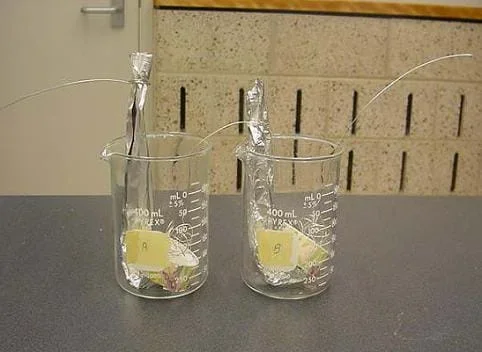 Figure 2. Activity set up: A completely assembled battery ready for testing.Copyright 2003 Joe Friedrichsen, ITL Program, University of Colorado Boulder
Testing the Battery. Repeat steps 9–15 for each team.
- Have students wear goggles when they test their batteries.
- Connect the free end of the wire from container A to one of the ammeter connections.
- Connect the free end of the wire from container B to the other ammeter connection.
- Obtain an electrolyte solution. Pour about 50 ml of the electrolyte solution into container A and about 50 ml of the same solution into container B. The solution should cover the wire coils in both containers completely; if not, carefully add more of the solution.
- Measure the current produced by the battery using a DC ammeter. Have one student from each team record the electrolyte concentration and current.
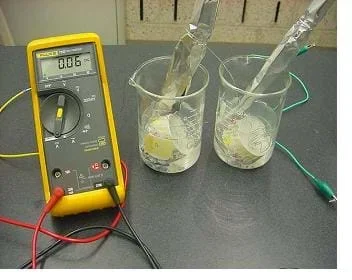 Figure 3. The current generated by an approximate 4mL/100mL solution of lemon juice.Copyright 2003 Joe Friedrichsen, ITL Program, University of Colorado Boulder
- Disconnect the wires from the ammeter.
- Pour the electrolyte solution back into its correct source container.
- After all students have tested their batteries, have teams disassemble their batteries. Have one member of each team take its materials to the Cleaning Station. Students should gently rinse containers A and B with a small amount of water. Pour this water in the sink or into a container provided for this purpose.
- Have teams report the electrolyte concentration and current produced by their batteries on the classroom board.
- In teams, have students complete the Two-Cell Battery Worksheet (PDF).
- As a math exercise, using the chart on the Two-Cell Battery Worksheet (PDF), have students construct graphs of current as a function of concentration and use the graphs to predict what the current might be at intermediate electrolyte concentrations.
- ammeter
- An instrument that measures electric current in amperes.
- cation
- An ion or group of ions having a positive charge and characteristically moving toward the negative electrode in electrolysis.
- electrolyte
- A material that dissolves in water, producing a solution that conducts electricity.
- ion
- An atom or a group of atoms that has acquired a net electric charge by gaining or losing one or more electrons.
Pre-Activity Assessment
Brainstorming: In small groups, have students engage in open discussion. Remind students that in brainstorming, no idea or suggestion is "silly." All ideas should be respectfully heard. Encourage wild ideas and discourage criticism of any ideas. Ask the students:
- From where does electricity come? (Possible answers: A wall outlet, power plant, photovoltaic/solar cells, batteries, etc.)
- What is inside batteries that helps produce current electricity? (Possible answers: Chemicals, paste, or a bunch of electrons.)
Activity Embedded Assessment
Question/Answer: Ask students questions and have them raise their hands to respond. Write answers on the board and discuss as a class.
- What causes the needle to move on a DC ammeter? (Answer: Chemical energy in the battery is converted to electrical energy in the copper wire, which causes the needle to move on a DC ammeter.)
Worksheet/Pairs Check: Have one student from each team record on the board the electrolyte concentration and current while using the DC ammeter. Have students work in groups to answer questions on the Two-Cell Battery Worksheet. After student teams finish their worksheets, have them compare answers with a peer group, giving all students time to finish their worksheets.
Post-Activity Assessment
Question/Answer: Ask students questions and have them raise their hands to respond. Write answers on the board and discuss as a class. Ask the students:
- What is the role of the aluminum foil and copper wire in the battery circuit? (Answer: Copper and aluminum are the electrodes in the battery. Chemical reactions take place at the electrodes producing electrons that move through the wires.)
- Was there an ammeter reading for the battery before you added electrolyte? (Answer: No. There is no ammeter reading for the battery until you add the electrolyte.)
- Which electrolyte solution produced the highest current reading? (Note: This depends on which electrolytes you use and on their concentration. Using a strong salt solution should give the highest current. A strong vinegar solution produces the next highest current.)
- Why do we need an electrolyte in a battery? (Answer: The electrolyte allows charge to move in the solution balancing the movement of electrons.)
- Require students to wear safety goggles at the Battery Testing Station in case any electrolyte splashes.
- Watch that students do not play with the copper wire, so they do not cut themselves or others.
Make sure students do not touch the copper wire and the aluminum foil. If the copper wire and aluminum foil contact each other, it produces a short circuit (which is a low-resistance connection established by accident between two points in an electric circuit, causing the current to flow through the area of low resistance [aluminum to copper wire] and bypass the intended circuit [the solution]). If a short circuit is created the students will not get any current reading (0.00 A) or will not obtain an accurate current reading on the DC ammeter for the solution.
Be sure to prepare enough electrolyte solution. Some containers may need up to 200 mL of solution, depending on their size.
After students have taken their last readings, have them each add a teaspoon of baking soda (a base) to a container with an acidic solution. Have them record what happens to the ammeter reading.
Connect several batteries together in series using wires with alligator clips. How many batteries does it take to light a #40 light bulb?
- For lower grades, conduct the activity as described, but do not complete the worksheet. Instead, have students measure and record the battery current for each electrolyte using a DC ammeter. Then, have them explain which electrolyte concentration produces a battery with the highest current.
- For higher grades, have students measure current using a DC ammeter, complete the worksheet, and create graphs of current as a function of electrolyte concentration. Use the graph to predict the current at intermediate electrolyte concentrations. Ask students to draw conclusions about how the current produced by a battery depends on the concentration of the electrolyte in the battery.
Making a "Wet Cell" Battery, Grade 9 Lesson Plan, Renewable Energy, The Infinite Power of Texas. Accessed March 2004. Formerly available at http://www.infinitepower.org/pdf/18-Lesson-Plan.pdf
Contributors
Xochitl Zamora Thompson; Sabre Duren; Joe Friedrichsen; Daria Kotys-Schwartz; Malinda Schaefer Zarske; Denise W. Carlson
Supporting Program
Integrated Teaching and Learning Program, College of Engineering, University of Colorado Boulder
Acknowledgements
The contents of this digital library curriculum were developed under a grant from the Fund for the Improvement of Postsecondary Education (FIPSE), U.S. Department of Education and National Science Foundation GK-12 grant no. 0338326. However, these contents do not necessarily represent the policies of the Department of Education or National Science Foundation, and you should not assume endorsement by the federal government.
Copyright
2004 by Regents of the University of Colorado.