
Parallel Circuitry & Ohm’s Law: Many Paths for Electricity
Students explore the composition and practical application of parallel circuitry, compared to series circuitry. Students design and build parallel circuits and investigate their characteristics, and apply Ohm's law.
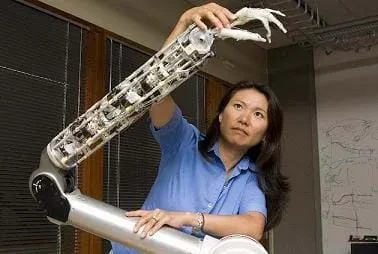 Yoky Matsuoka, an engineer who completed a Ph.D. in both electrical engineering and computer science, used her knowledge of electricy, neuroscience, and robotics to create a realistic robotic prosthetic arm.Copyright National Science Foundation http://www.nsf.gov/cise/csbytes/newsletter/vol1i7.html
Engineers have developed a very complicated circuit — called an integrated circuit — that combines thousands to millions of parallel and series circuits working together. One type of integrated circuit that works as a complete computation engine is a microprocessor, known as a central processing unit or a CPU. Microprocessors are essential in automobiles, video games, smoke detectors, DVD players, garage-door openers, cordless phones, clocks and calculators. Engineers continuously develop new technology so that they may use electricity to find solutions to everyday challenges — efforts that contribute to a healthier, happier, and safer environment.
After this lesson, students should be able to:
- Distinguish between series and parallel parts of a circuit.
- Describe how current changes in a parallel circuit when a light bulb is removed from or added to the circuit.
- Describe the connections among representations of circuit symbols
- Recognize that electrical engineers, materials scientists/engineers, mechanical engineers, and physicists contribute to the development of electronic technologies.
- 4.1.3.b.vi Assess the reasonableness of answers using mental computation and estimation strategies including rounding.
Grade 4
Do you agree with this alignment? - 4.2.1.a.iv Find the unknown in simple equations.
Grade 4
Do you agree with this alignment?
- Show that electricity in circuits requires a complete loop through which current can pass
Grade 4
Do you agree with this alignment? - Describe the energy transformation that takes place in electrical circuits where light, heat, sound, and magnetic effects are produced
Grade 4
Do you agree with this alignment?
- CCSS.Math.Content.4.NBT.B.5 Multiply a whole number of up to four digits by a one-digit whole number, and multiply two two-digit numbers, using strategies based on place value and the properties of operations. Illustrate and explain the calculation by using equations, rectangular arrays, and/or area models.
Grade 4
Do you agree with this alignment? - CCSS.Math.Content.6.EE.B.7 Solve real-world and mathematical problems by writing and solving equations of the form x + p = q and px = q for cases in which p, q and x are all nonnegative rational numbers.
Grade 6
Do you agree with this alignment?
- Tools, machines, products, and systems use energy in order to do work.
Grades 3-5
Do you agree with this alignment? - STEL-3D Explain how various relationships can exist between technology and engineering and other content areas.
Grades 3-5
Do you agree with this alignment?
- 4-PS3-2 Make observations to provide evidence that energy can be transferred from place to place by sound, light, heat, and electric currents.
Grade 4
This resource focuses on the following Three Dimensional Learning aspects of NGSS:
Science & Engineering Practices- Make observations to produce data to serve as the basis for evidence for an explanation of a phenomenon or test a design solution.Do you agree with this alignment?
Disciplinary Core Ideas- Energy can be moved from place to place by moving objects or through sound, light, or electric currents.Do you agree with this alignment?
- Energy is present whenever there are moving objects, sound, light, or heat. When objects collide, energy can be transferred from one object to another, thereby changing their motion. In such collisions, some energy is typically also transferred to the surrounding air; as a result, the air gets heated and sound is produced.Do you agree with this alignment?
- Light also transfers energy from place to place.Do you agree with this alignment?
- Energy can also be transferred from place to place by electric currents, which can then be used locally to produce motion, sound, heat, or light. The currents may have been produced to begin with by transforming the energy of motion into electrical energy.Do you agree with this alignment?
Crosscutting Concepts- Energy can be transferred in various ways and between objects.Do you agree with this alignment?
Do you agree with this alignment? - Make observations to produce data to serve as the basis for evidence for an explanation of a phenomenon or test a design solution.
Series circuits
Parallel Circuits
A parallel circuit and its corresponding circuit diagram are shown in Figure 2. Since there is more than one path for charge to flow as it moves through the circuit, the current is divided between the two bulbs. Therefore, the current is the same before the bulbs (at the node; intersection of two wires) and after the bulbs (at the node; intersection of two wires), but is divided at the bulbs. In other words, the total current in the circuit is equal to the sum of the currents in the parallel portions. Note, that if the bulbs have the same resistance the current is divided equally among them. On the other hand, if the bulbs have different resistances, the bulb with greater resistance has less current. The total resistance of the circuit decreases if the number of parallel paths increases. The voltage drop across each part of a parallel circuit is the same because each part is connected across the same two points. Students can practice constructing their own parallel circuits with the associated activity Bulbs & Batteries Side by Side.
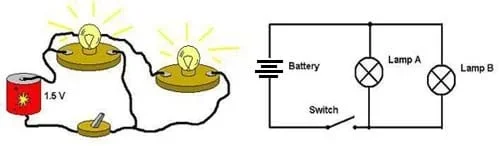 Figure 2. A series circuit (left) and the corresponding circuit diagram (right).Copyright Joe Friedrichsen, ITL Program and Laboratory, University of Colorado at Boulder, 2003.
When batteries are linked in parallel, the total current produced increases. For example, if we made a circuit using three 1.5 V batteries in parallel as the voltage source, the total voltage provided by the battery bank would still be 1.5 V. However, the current would be three times that of a single 1.5 V battery. Remember that the amount of current in the circuit depends on the resistances of the devices in the circuit. When an engineer designs a device, like a portable CD player, s/he decides how many batteries are needed in parallel to provide enough current. As you can see, electrical engineers must be very knowledgable about electcitity, yet get to be very creative in their work!
Electricity in the Home
When you plug an appliance into a wall outlet in your home, you are adding a parallel branch to a circuit that goes all the way to your local power plant. Connected to the wall outlets are two wires called lines; one line is called the live wire, while the other is the neutral wire. These lines supply alternating current (AC) at 110-120 V. Often, a third contact in a wall outlet is a ground wire. The ground wire is connected directly to the earth to direct current into the ground if the live wire accidentally touches metal on an appliance. This prevents anyone touching the appliance from receiving an electric shock. Of course, the appliance must be connected to the ground wire, either with an adaptor or a three-prong plug. Engineers are responsible for making appliances safe to use; proper grounding is an import design consideration and they are concerned at all times with public safety.
Electric Power
Whenever there is current in a circuit, electrical energy is being used to do some type of work and electrical energy is being transformed into another type of energy. This work might be turning the blades of a fan, lighting a room, or heating food. The rate at which this work is done by a charge in a circuit is electric power. Electric power is also the rate at which electrical energy is used, therefore, Power = Energy / Time. The electric power consumed by an appliance is P = I * V, where P is the electric power, I is the current in the appliance in amperes [A], and V is the voltage of the appliance in volts [V]. Therefore, electric power is expressed in watts (W), where 1 W = 1 A * V. The cost of electrical energy is given in cents per kilowatt-hour (kWh), where 1 kWh = 1000 Wh (Watt hour). A kilowatt-hour is the amount of electrical energy used in one hour at a rate of 1 kW. Designing appliances that consume power efficiently is an important objective for engineers that ultimately helps improve society.
Ask students to raise their hands if they have ever used a videogame, a remote control (for a television or other electronic device) or a keyboard. Ask if any of them ever had just one button or key stop working, while the rest of the videogame controller, remote control or keyboard continued to work. What is occurring electronically that causes this to happen? How can only one button be broken but the rest of the controller still work?
Ask the students if they have ever walked into a room that has multiple lights and they only turned on one. Remind students of the in series circuits they built previously. When one light bulb was taken out of the circuit, an open circuit was created and the electrons could not flow to light the other bulbs. Now ask them, how is it possible that you can turn on one light in a room, and it will work, yet you did not have to turn on all of the other lights?
Explain to students that these two examples use parallel circuits. Engineers connect things in parallel, so if one circuit part breaks the rest of the circuit still works.
Ask for three volunteers. Assign one volunteer to be the "battery" and two as 'light bulbs." (It may help to draw the appropriate symbols on pieces of paper and tape them to their shirts.) Have the students physically portray a series circuit by holding hands in a circle. Then have the students portray a parallel circuit by having the light bulbs and battery stand facing one direction with their arms touching the elbows of the person in front of them.
A very complicated circuit that combines thousands to millions of parallel and series circuits working together is called an integrated circuit (see Figure 1). A microprocessor, known as a central processing unit or a CPU, is a type of integrated circuit that works as a complete computation engine. These days, an average U.S. home has about 40 of these microprocessors in addition to the 10 or so in a typical personal computer alone. Microprocessors are in automobiles, video games, smoke detectors, DVD players, garage-door openers, cordless phones, clocks, and calculators. They are even being implanted in animals as an electronic identity tag.
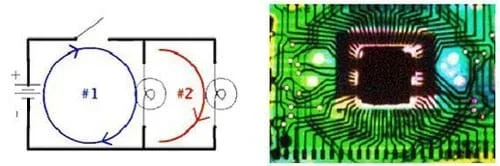 Figure 1. A circuit diagram of a simple parallel circuit (left) and an integrated circuit (right).Copyright http://whyfiles.larc.nasa.gov/text/kids/Problem_Board/problems/electricity/images/circuits05.gif (left) and http://www.lbl.gov/Education/HGP-images/integrated-circuit-small.gif (right)
Have students suggest examples of devices that contain computer chips; write the item names on the board. (Possible answers: Microwave oven, answering machine, car, DVD player, etc.) Then, draw a circuit with several components on the board (see Figure 3 for an example sketch). Ask the class to identify which components of the circuit are connected in series and which are connected in parallel
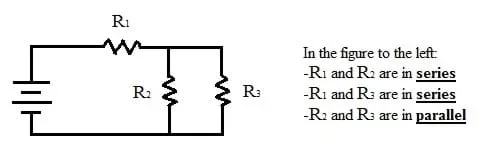 Figure 3. A circuit diagram composed of a battery and three resistors demonstrating series and parallel circuit components.Copyright 2012 Carleigh Samson, University of Colorado Boulder
Next, draw on the board a circuit diagram as seen in Figure 4. Use Ohm's law (I = V / R) to compare the current in three bulbs, each with increasing resistance connected in a parallel arrangement. (Answer: See Figure 4 calculations. Current is greatest in the bulb with the least resistance and least in the bulb with the greatest resistance.) Ask what happens to the voltage when batteries are connected in parallel? (Answer: The voltage across the terminals stays the same.)
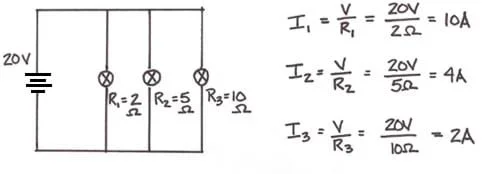 Figure 4. A parallel circuit composed of three light bulbs with increasing resistances (left), and Ohm's Law calculations to determine each bulb's current (right).Copyright Daria Kotys-Schwartz, ITL Program and Laboratory, University of Colorado at Boulder, 2004.
- integrated circuit
- A microelectronic circuit etched or imprinted on a semiconductor chip.
- parallel circuit
- An electric circuit providing more than one conducting path.
Pre-Lesson Assessment
Discussion Questions: Ask the students and discuss as a class:
- With what type of circuit would you want your house or video game wired, and why? (Answer: Students will probably recall the lesson on series circuit and explain how that type of circuit works. Discuss the pros and cons of series circuits.)
- If you remove one bulb from a series circuit with three bulbs, the circuit will be a(n) ____________ circuit. Open or closed? (Answer: Open.)
- What happens to the other bulbs in a series circuit if one bulb burns out? (Answer: They all go out.)
- When batteries are connected in series, the voltage across them ____________. Increases, decreases, or stays the same? (Answer: Increases to the total summative value of the battery voltage.)
Post-Introduction Assessment
Question/Answer: Ask the students questions and have them raise their hands to respond. Write answers on the board
- How is it possible that you can turn on one light in a room, and it works, without you having to turn on all of the other lights? (Answer: The wiring in a house is a parallel circuit.)
- What is the name for a very complicated circuit that combines thousands to millions of parallel and series circuits working together? (Answer: An integrated circuit or microprocessor.)
Lesson Summary Assessment
Numbered Heads: Divide the class into teams of three to five. Have the students on each team number off so each member has a different number. Ask the students questions (give them a time frame for solving each, if desired). The members of each team should work together to answer the questions. Everyone on the team must know the answer. Call a number at random. Students with that number should raise their hands to give the answer. If not all students with that number raise their hands, allow the teams to work a little longer. Ask the students:
- If you remove one bulb from a parallel circuit with three bulbs in parallel, the circuit becomes a(n) ____________ circuit. Open or closed? (Answer: Closed.)
- What happens to the other bulbs in a parallel circuit if one bulb burns out? (Answer: They stay lit.)
- When bulbs are connected in parallel, the total resistance is ____________ the resistance of one bulb. Less than, greater than or the same as? (Answer: Less than.)
- When batteries are connected in parallel, the voltage across them ____________. Increases, decreases or stays the same? (Answer: Stays the same.)
- Draw a circuit diagram of a parallel circuit with two batteries in parallel and two light bulbs in parallel.
Drawing Race: Write the circuit symbols on the board (see Figure 5). Divide the class into teams of four, having each team member number off so each has a different number, one through four. Call a number and have students with that number race to the board to draw the correct circuit diagram. Give a point to the team whose teammate first finishes the drawing correctly. Ask the students to draw circuit diagrams of the following:
- A circuit with one battery and two light bulbs in parallel.
- A circuit with three batteries in parallel and two light bulbs in parallel.
- A circuit with two batteries in parallel, one resistor and one light bulb.
- A circuit with one battery, one switch and three light bulbs in parallel.
- A circuit with one battery, one switch and two resistors in parallel.
- A circuit with one battery, one switch and one light bulb and resistor in parallel.
- A circuit with two batteries in parallel and one light bulb in parallel with a light bulb and resistor.
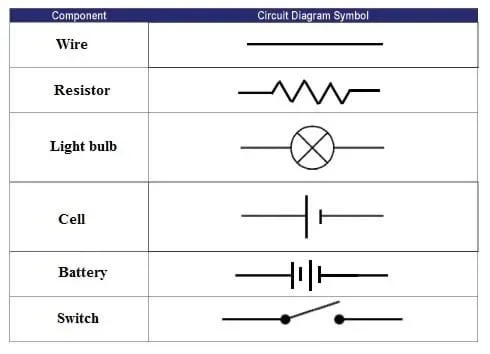 Figure 5. A selection of representational circuit diagram symbols.Copyright Daria Kotys-Schwartz, ITL Laboratory, University of Colorado at Boulder, 2004.
Class Presentation: Working in groups of two to four, have students give a class presentation in which they dynamically act out the concepts they learned in the unit. Encourage role-playing and creativity.
- Have the students act out the scenario of an electrical engineer who has just invented a new toy using series or parallel (or combination of both) circuits. Other players can be consumers, patent officials, neighbors, other engineers, etc. Each scenario must include a description of the circuit and how it works, as well as a drawing of the circuit on the board.
Have students investigate the history of the computer industry and the integrated circuit. They can prepare posters and presentations on key inventions and the engineers and researchers who played important roles in the development of microchips and microprocessors.
Microchips are being increasingly used in devices, for example, in clothing irons that automatically shut themselves off, and toasters that detect perfectly browned toast. Have the students all the home appliances that they can think of that have a microchip. Microchips are in dishwashers, washing machines and dryers, televisions, microwave ovens, automobiles, VCRs, DVD players, satellite dish receivers, remote controls, video games, cameras, camcorders, smoke detectors, garage-door openers, cordless phones, mobile phones, fax machines, telescopes, GPS receivers, radios, keyboards, MP3 players, tape decks, stereos, clocks, calculators, printers, scanners, PDAs and animal identity tags.
Expressions and Equations: Have students solve Ohm's law (I = V / R) in the lesson closure for various variables including voltage, current, and resistance instead of just current.
Hewitt, Paul G. Conceptual Physics. 8th Edition. New York, NY: Addison Publishing Company, 1998.
Kagan, Spencer. Cooperative Learning. Capistrano, CA: Kagan Cooperative Learning, 1994. (Source for Numbered Heads assessment activity.)
Reid, T.R. The Chip: How Two Americans Invented the Microchip and Launched a Revolution. New York, NY: Random House, 2001, pg. 309.
- Put a Spark in It! - Electricity
- Lights Out!
- Take Charge! All About Static Electricity
- Electrons on the Move
- Go with the Flow
- Circuits: One Path for Electricity
- Parallel Circuitry & Ohm’s Law: Many Paths for Electricity
Contributors
Xochitl Zamora Thompson; Sabre Duren; Daria Kotys-Schwartz; Malinda Schaefer Zarske; Denise Carlson; Janet Yowell
Supporting Program
Integrated Teaching and Learning Program, College of Engineering, University of Colorado Boulder
Acknowledgements
The contents of this digital library curriculum were developed under a grant from the Fund for the Improvement of Postsecondary Education (FIPSE), U.S. Department of Education and National Science Foundation GK-12 grant no. 0338326. However, these contents do not necessarily represent the policies of the Department of Education or National Science Foundation, and you should not assume endorsement by the federal government.
Copyright
2004 by Regents of the University of Colorado.