
Lights Out!
 Figure 1. Students use tablets in class, which require electricity.Copyright Microsoft Word
What would your life be like without electricity? In this lesson, students engage in the science and engineering practices of making observations and asking questions to make sense of the phenomenon of electricity. They learn about two main forms of electricity, static and current, and that electrons can move between atoms, leaving atoms in a charged state. Students discover the disciplinary core concepts of electric forces and current while applying the crosscutting concept of energy transfer.
Since Thomas Edison invented the light bulb in 1879, engineers have continued to develop new products that use electricity. For example, in our everyday life we regularly use inventions such as the television, radio, refrigerator, water heater, washing machine and computer. We now demand so much electricity that engineers are asked to invent new ways to make it. The work of engineers has resulted in a choice of renewable alternative energy sources, such as hydroelectric power, solar and wind energy.
After this lesson, students should be able to:
- Explain the difference between static and current electricity.
- Understand that electricity is a form of energy that can move.
- Recognize that energy in the form of electricity can affect common objects and is involved in everyday events.
- Describe and list energy alternatives for electricity that engineers are developing.
- Identify and describe the variety of energy sources
Grade 4
Do you agree with this alignment? - Show that electricity in circuits requires a complete loop through which current can pass
Grade 4
Do you agree with this alignment?
- STEL-3D Explain how various relationships can exist between technology and engineering and other content areas.
Grades 3-5
Do you agree with this alignment? - STEL-5B Explore how technologies are developed to meet individual and societal needs and wants.
Grades -1-2
Do you agree with this alignment?
- 4-PS3-2 Make observations to provide evidence that energy can be transferred from place to place by sound, light, heat, and electric currents.
Grade 4
This resource focuses on the following Three Dimensional Learning aspects of NGSS:
Science & Engineering Practices- Make observations to produce data to serve as the basis for evidence for an explanation of a phenomenon or test a design solution.Do you agree with this alignment?
Disciplinary Core Ideas- Energy can be moved from place to place by moving objects or through sound, light, or electric currents.Do you agree with this alignment?
- Energy is present whenever there are moving objects, sound, light, or heat. When objects collide, energy can be transferred from one object to another, thereby changing their motion. In such collisions, some energy is typically also transferred to the surrounding air; as a result, the air gets heated and sound is produced.Do you agree with this alignment?
- Light also transfers energy from place to place.Do you agree with this alignment?
- Energy can also be transferred from place to place by electric currents, which can then be used locally to produce motion, sound, heat, or light. The currents may have been produced to begin with by transforming the energy of motion into electrical energy.Do you agree with this alignment?
Crosscutting Concepts- Energy can be transferred in various ways and between objects.Do you agree with this alignment?
Do you agree with this alignment? - Make observations to produce data to serve as the basis for evidence for an explanation of a phenomenon or test a design solution.
The Atom
Everything we see around us — all ordinary matter — is made of atoms. Every atom consists of negatively-charged electrons and a positively-charged center called a nucleus. The nucleus is made of positively-charged protons and neutral-charged (neither positively- nor negatively-charged) neutrons. In a simple model of an atom, known as a Bohr model (see Figure 2), it is assumed that the electrons are spinning around the nucleus of the atom on paths called orbitals. One can visualize this by thinking of satellites orbiting the Earth, or the moon orbiting around the Earth. The positive charges of the protons in the nucleus attract the negative charges of the electrons orbiting around the nucleus (opposites attract), maintaining the electrons' orbit. Charge is a fundamental quantity in electricity. The smallest amount of charge known to exist is carried by an electron and is -1.602 x 10⁻¹⁹ coulomb [C]. The other charge-carrying portion of the atom is the proton, which has a charge of +1.602 x 10⁻¹⁹ coulomb [C]. The unit used to measure charge is known as the Coulomb, named after French engineer and physicist Charles Coulomb.
Static Electricity
In an atom, the protons and neutrons that make up the nucleus are held together very tightly and rarely does the nucleus experience a change. However, some of the electrons that are associated with the atom are loosely held to their orbital. These electrons, which typically reside in the outer orbitals, can move from one atom to another. When an atom loses electrons, it has more positive particles than negative particles, which results in a positive net charge for the atom. An atom that acquires electrons has more negative particles than positive particles and, thus, has a negative net charge.
If the atoms in a material hold the electrons in the outer orbits tightly, the electrons are less likely to move to another atom. Such materials are known as insulators. Alternatively, materials whose atoms willingly give up and accept electrons are known as conductors. Conductors allow electrons to move through the material easily.
It is possible to transfer (or move) electrons from one material to another. One way to do this is by rubbing two objects together. The longer that two objects are rubbed together, the larger the quantity of electron movement from one object to the other, which results in a charge build up on each object. Static electricity occurs when there is an imbalance of positive charges and negative charges.
Positive and negative charges behave similarly to the north and south poles of a magnet: Opposite poles attract and like poles repel. In the case of charges, a positive and negative charge pull towards each other. Positive charges repel other positive charges, and negative charges push away other negative charges. Therefore, an object that has a positive or negative charge build up (net charge) attracts an object that is neutral. For instance, when you rub a balloon on your hair or a piece of wool cloth, the balloon acquires additional electrons. If you hold the balloon against a wall, the balloon sticks. This is because the negatively-charged electrons on the balloon push away the negatively-charged electrons in the wall (like charges repel) and attract the positive charges in the wall (opposites attract), causing the balloon to stick to the wall. Additionally, when an object with charge build-up attracts a neutral object, the electrons tend to move to areas where the electrical charge is positive until the atoms in both objects are neutral or balanced. When a large number of electrons move in an effort to balance the atoms, there is a chance of seeing a spark. This spark is a result of static electricity.
Demonstrate the effects of static electricity using an inflated balloon. Rub the balloon on your head, or if you have enough balloons for half the students, have them form groups of 2. Each group can have a balloon which they need to inflate, and then rub on their partners head. Explain to the children that both air and rubber are good electrical insulators, and do not conduct electricity well. When you rub the balloon on your hair, electrons are transferred TO the balloon where they stay. Since your hair has less electrons, it is positively charged. Show the students the figure below and explain that OPPOSITES ATTRACT. Anything with more electrons than protons (negative charge, like the balloon in this example) will want to find something with a positive charge (more protons than electrons, like your hair in this example). When this happens, the charges on the objects can even out. This is what causes a shock when you open a car door, or walk across carpet and touch a conductor (metal). Lightning is like a huge shock in the sky!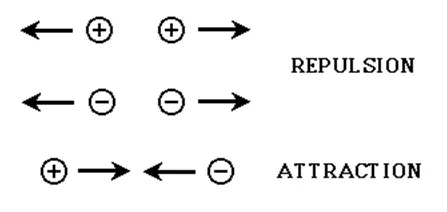 Attraction of Oppositely Charged ParticlesCopyright http://aether.lbl.gov/elements/stellar/strong/attract_repel.gif
Current Electricity
Current electricity is the flow of charge through a material. Electricity is when electrons are quickly passed from one atom to another atom within a material and 'flow' from one end of the material to the opposite end. This 'flow' is similar to the cascading you would see in a pipe filled with flowing water. Some materials, such as metals, allow electrons to flow more easily than other materials; they are called conductors. Computers, stereos, toasters, dryers and handheld computer games are examples of everyday electronics that utilize current electricity.
An electric current can be defined as the rate of change of charge passing through a pre-determined area during a period of time. The unit used for current is an ampere [A], where 1 ampere = 1 coulomb/second.
History of Electricity
The Greeks first discovered the concept of static electricity about 2,500 years ago by rubbing amber with fur cloth. They found that amber would attract certain objects, such as straw, after it was rubbed with the goatskin. Static electricity was not scientifically explored until 1600, when the English scientist William Gilbert performed several experiments in an effort to understand the static electricity phenomena. William Gilbert was also the first to record the word "electric" in his theory of magnetism report.
The fundamentals of current electricity were discovered in 1752 when Benjamin Franklin performed his famous kite experiment during an electrical storm in Philadelphia. Using an iron spike fastened on a kite and holding the end of the kite with an iron key, Franklin proved that lightning was a form of electricity. In 1879, Thomas Edison brought current electricity to our homes with the invention of the electric light bulb. Edison’s team kept improving his designs. For example, Lewis Howard Latimer patented a more efficient way to manufacture carbon filaments in 1882. Edison and his team designed a light bulb that made it possible for people to have indoor lighting, which was previously provided by kerosene lamps. In the late 1800s, George Westinghouse embarked on an effort to refine the design of the power transformer and also worked to build a practical alternating current (AC) power network. The AC power distribution network created by Westinghouse Electric and Manufacturing Co. made it possible to transmit current electricity over long distances. As a result, electric generating plants could be located significant distances from homes and businesses and still supply current electricity.
Explain to students that electricity is so common in our lives that we sometimes take it for granted. Ask the students to brainstorm how their lives would be different if they did not have electricity. (Possible answers: There would be no television, computer games, lights in the house, garage door openers, etc.). Tell students that without electricity we would have to wash our laundry by hand!
Ask students: Is electricity a form of energy? (Answer: Yes.). What is electricity? (Answer: It depends.) Explain to students that there are two types of electrical happenings: static electricity and current electricity. To answer the question "What is electricity?" depends on whether we are talking about static electricity or current electricity.
The Greeks first discovered static electricity about 2,500 years ago. However, we did not start to understand current electricity until 1752 when Benjamin Franklin conducted an experiment with a kite, iron spike and iron key during an electrical storm in Philadelphia, proving that lightning was a form of electricity. Also, it was just over 100 years ago in 1879 that Thomas Edison changed the world we live in by inventing the electric light bulb.
Draw a diagram of a Bohr model (see Figure 2) on the board and explain to the students that all matter (everything around them) is made of atoms. An atom has a positively-charged nucleus and negatively-charged electrons surrounding the nucleus. In the nucleus are protons, which have a positive charge, and neutrons, which have a neutral charge (neither positive nor negative).
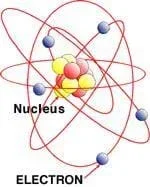 Figure 2. The Bohr Model: A basic (not to scale) model of an atom displaying the nucleus, electrons and orbiting paths of electrons.Copyright http://www.energy.ca.gov/education/story/story-html/chapter07.html
Tell students that static electricity and current electricity both depend on electrons. An electron can move from one atom to another trying to balance charge, and creating electricity. Let the students know that they will learn more about each type of electricity in the activity and future lessons in this unit. Following the lesson, conduct the associated activity Static Cling to have students explore static electricity using a comb (or balloon), O-shaped cereal and Styrofoam pellets.
Ask students to name objects that they use in their daily lives that utilize current electricity. (Possible answers: Toasters, blenders, electric toothbrush, light bulb, radio, printers, computers, televisions, washing machine, Blu-Ray and DVD players.) Ask students, from where does the current electricity in your home come? (Answer: Power plants.)
Explain that engineers are continuously developing new methods for efficiently creating electricity. Currently, the most common way to create electricity at a power plant is to convert fossil fuels (such as coal, gas or oil), a finite primary source of energy, into electricity. If we want to continue to conserve these resources for future use, it is necessary for engineers to find ways to use less of these primary resources to produce more electricity. Some primary energy sources that are alternatives to fossil fuels and are renewable include hydroelectric power, photovoltaic energy and wind energy.
Ask students to name some possible alternatives to using fossil fuels to create electricity? (Possible answers: Dams/water power, solar cells and windmills.)
- charge
- A fundamental quantity in electricity.
- current electricity
- The flow of electrons (negative charge) through a material.
- electric generator
- A device that changes mechanical energy into electricity.
- electricity
- The flow of electrons.
- electron
- The negatively-charged particle of an atom.
- neutron
- The neutral-charged particle of an atom.
- orbital
- The path of an electron in an atom or molecule, indicating the electron's probable location spinning around the nucleus of the atom.
- proton
- The positively-charged particles of an atom.
- static electricity
- The instantaneous movement of electrons due to the imbalance of states; the movement from negatively-charged atoms towards positively-charged atoms.
- transformer
- Changes the voltage of electricity so it can be transmitted over long distances.
Pre-Lesson Assessment
Brainstorming: In small groups, have the students engage in open discussion. Remind students that in brainstorming, no idea or suggestion is "silly." All ideas should be respectfully heard. Encourage wild ideas and discourage criticism of ideas. Ask the students:
- How would your life be different if you did not have electricity? (Possible answers: There would be no television, computer games, stereo, lights in the house, washing machines, garage door openers, etc.)
Post-Introduction Assessment
Discussion Question: Solicit, integrate and summarize student responses.
- What is electricity? (Answer: Electricity is a form of energy.)
- Where does electricity come from? (Answer: It comes from the transfer of electrons.)
Lesson Summary Assessment
Team Consensus Activity: Have students in teams number off within their team. Call a number, such as 3, and have all the 3s from each team come to the board. Ask a question and have them write the answer on the board. Each team gets a point for a correct answer. Continue until all questions are asked and all team members have come to the board. Possible questions include:
- Write down an example of static electricity. (Possible answers: Foot rubbing floor, hair standing on end, skirt sticking to leg, etc.)
- What is a source of current electricity? (Possible answers: Electrical wall outlet, dry cell battery.)
- Name one type of resource from which we generate electricity. (Possible answers: Coal, water, wind, natural gas, etc.)
- What is the negatively-charged particle in an atom called? (Answer: Electron.)
- What is the positively-charged particle in an atom called? (Answer: Proton.)
- What is the center part of an atom called? (Answer: Nucleus.)
- Who invented the light bulb? (Answer: Thomas Edison.)
- Who did an experiment with a kite to show that lightning is a form of electricity? (Answer: Ben Franklin.)
- What part of an atom can move from one atom to another? (Answer: Electron.)
- Ask students why their hair was attracted to the balloon. (Answer: Electrons had moved from their hair to the balloon, causing the balloon to have a negative charge, and the hair a positive charge. OPPOSITES ATTRACT so the balloon wants to move to the hair.)
- Ask the students what causes lightning. (Answer: That's right, the exact same principle! Basically different parts of a cloud will accumulate lots of electrons, or lots of protons, and there will be a difference between them.) Show the students the figure below. Point out that the ground may have an unequal charge also, and usually when a negatively charged part of the cloud gets near a positively charged part of the ground, A LIGHTNING STRIKE HAPPENS AND THE CHARGES EQUALIZE!
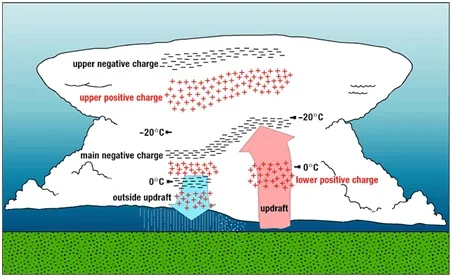 Schematic of Electrostatic Potential in a Storm Cloud (Makings of Lightning)Copyright http://www.nssl.noaa.gov/education/svrwx101/lightning/images/tstm-lightning-structure-800.png
Have students build a model of a Bohr atom. The model should include electrons, protons and neutrons.
Have students research Ben Franklin's kite experiment and electricity.
Have students investigate methods of producing electricity, for example, various types of power plants (coal, hydro), solar energy, wind energy.
Reuben, Gabriel. Electricity Experiments for Children. New York, NY: Dover, 1968.
Static Electricity. Electricity and Magnetism, ThinkQuest. Accessed November 7, 2005. Formerly available at: http://library.thinkquest.org/CR0211620/static.html
VanCleave, Janice. Physics for Every Kid. New York, NY: John Wiley & Sons, 1991.
What is Electricity?, Energy Information Administration, accessed February 2004. http://www.eia.doe.gov/kids/energyfacts/sources/electricity.html
Lewis H. Latimer, Lemelson-MIT Program. Accessed September 01, 2020. https://lemelson.mit.edu/resources/lewis-h-latimer
Contributors
Daria Kotys-Schwartz; Malinda Schaefer Zarske; Denise Carlson
Supporting Program
Integrated Teaching and Learning Program, College of Engineering, University of Colorado Boulder
Acknowledgements
The contents of this digital library curriculum were developed under a grant from the Fund for the Improvement of Postsecondary Education (FIPSE), U.S. Department of Education and National Science Foundation GK-12 grant no. 0338326. However, these contents do not necessarily represent the policies of the Department of Education or National Science Foundation, and you should not assume endorsement by the federal government.
Copyright
2004 by Regents of the University of Colorado.