
Go with the Flow
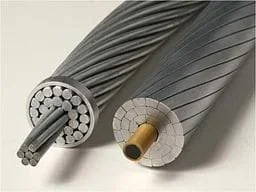 An example of electrical conductors.Copyright Wikimedia Commons http://commons.wikimedia.org/wiki/File:ACSR_%26_ACCC_Conductors.JPG
Students make sense of the phenomenon of electricity as they gain an understanding of the difference between electrical conductors and insulators. Using the science and engineering practices of generating and comparing solutions and making observations, students gain experience recognizing a conductor by its material properties. Students explore the disciplinary core ideas of energy and material properties and the crosscutting concepts of energy transfer and standard units in preparation for the associated hands-on activities. In one activity, students build a conductivity tester to determine whether different objects are conductors or insulators. In another activity, students use their understanding of electrical properties to choose appropriate materials to design and build their own basic circuit switch.
We know that electrical engineers design the circuits and batteries that run the appliances we use every day. But another aspect of designing electrical devices is deciding which materials make the best conductors and insulators for a given situation. Engineers consider a material's level of conductivity, ability to dissipate heat, ductility and resistance to corrosion at certain temperatures. Only through the smart selection of materials for parts, wiring, external housing and microchips are engineers able to design devices and appliances that operate correctly, dependably and safely.
After this lesson, students should be able to:
- Predict whether an object is likely to conduct electricity.
- Distinguish between electrical conductors and insulators.
- Understand that the electrical properties of a material determine how it can be used in an electrical circuit
- Understand why engineers must consider the materials for parts, wiring, external housing and microchips in order to design electronic devices and appliances.
- Show that electricity in circuits requires a complete loop through which current can pass
Grade 4
Do you agree with this alignment? - Describe the energy transformation that takes place in electrical circuits where light, heat, sound, and magnetic effects are produced
Grade 4
Do you agree with this alignment?
- Tools, machines, products, and systems use energy in order to do work.
Grades 3-5
Do you agree with this alignment? - STEL-3D Explain how various relationships can exist between technology and engineering and other content areas.
Grades 3-5
Do you agree with this alignment?
- 3-5-ETS1-2 Generate and compare multiple possible solutions to a problem based on how well each is likely to meet the criteria and constraints of the problem.
Grades 3-5
This resource focuses on the following Three Dimensional Learning aspects of NGSS:
Science & Engineering Practices- Generate and compare multiple solutions to a problem based on how well they meet the criteria and constraints of the design problem.Do you agree with this alignment?
Disciplinary Core Ideas- Research on a problem should be carried out before beginning to design a solution. Testing a solution involves investigating how well it performs under a range of likely conditions.Do you agree with this alignment?
- At whatever stage, communicating with peers about proposed solutions is an important part of the design process, and shared ideas can lead to improved designs.Do you agree with this alignment?
Crosscutting Concepts- Engineers improve existing technologies or develop new ones to increase their benefits, to decrease known risks, and to meet societal demands.Do you agree with this alignment?
Do you agree with this alignment? - Generate and compare multiple solutions to a problem based on how well they meet the criteria and constraints of the design problem.
- 4-PS3-2 Make observations to provide evidence that energy can be transferred from place to place by sound, light, heat, and electric currents.
Grade 4
This resource focuses on the following Three Dimensional Learning aspects of NGSS:
Science & Engineering Practices- Make observations to produce data to serve as the basis for evidence for an explanation of a phenomenon or test a design solution.Do you agree with this alignment?
Disciplinary Core Ideas- Energy can be moved from place to place by moving objects or through sound, light, or electric currents.Do you agree with this alignment?
- Energy is present whenever there are moving objects, sound, light, or heat. When objects collide, energy can be transferred from one object to another, thereby changing their motion. In such collisions, some energy is typically also transferred to the surrounding air; as a result, the air gets heated and sound is produced.Do you agree with this alignment?
- Light also transfers energy from place to place.Do you agree with this alignment?
- Energy can also be transferred from place to place by electric currents, which can then be used locally to produce motion, sound, heat, or light. The currents may have been produced to begin with by transforming the energy of motion into electrical energy.Do you agree with this alignment?
Crosscutting Concepts- Energy can be transferred in various ways and between objects.Do you agree with this alignment?
Do you agree with this alignment? - Make observations to produce data to serve as the basis for evidence for an explanation of a phenomenon or test a design solution.
- 5-PS1-3 Make observations and measurements to identify materials based on their properties.
Grade 5
This resource focuses on the following Three Dimensional Learning aspects of NGSS:
Science & Engineering Practices- Make observations and measurements to produce data to serve as the basis for evidence for an explanation of a phenomenon.Do you agree with this alignment?
Disciplinary Core Ideas- Measurements of a variety of properties can be used to identify materials. (Boundary: At this grade level, mass and weight are not distinguished, and no attempt is made to define the unseen particles or explain the atomic-scale mechanism of evaporation and condensation.)Do you agree with this alignment?
Crosscutting Concepts- Standard units are used to measure and describe physical quantities such as weight, time, temperature, and volume.Do you agree with this alignment?
Do you agree with this alignment? - Make observations and measurements to produce data to serve as the basis for evidence for an explanation of a phenomenon.
Why Do Some Solid Objects Conduct Electricity While Others Do Not?
Nearly all metals are good electrical conductors. Metals are good conductors due to the metallic bonds that hold metal atoms together in a solid form. The atoms in a solid metal are arranged regularly and surrounded by highly mobile electrons. Depending on the type of metal, there may be one to a few electrons that can move within the metal for every atom. The simplest model of the metallic bond is described as an array of metal cations (positive ions) surrounded by an electron sea. When there is a voltage across the metal, the free electrons move, producing an electric current. Refer to the Will It Conduct? activity to have students build a conductivity tester and use it to determine whether different objects and solutions can conduct electricity.
Most nonmetals are poor electrical conductors. The atoms in nonmetals — plastics, rubber and ceramics — are held together with covalent bonds. In covalent bonding, one or more electrons from one atom are shared with neighboring atoms. Covalent bonds are very strong. Because electrons are shared only within an individual molecule, they cannot be exchanged between molecules. Therefore, unlike metallic bonds, covalent bonds do not allow electrons to move freely within an object.
Why Do Some Liquids/Solutions Conduct Electricity While Others Do Not?
In contrast to electrical conduction in solids, current passing through a solution moves ions to the electrodes where they undergo chemical reactions. Therefore, a solution conducts electricity only if it contains ions. The conductivity of the solution depends on the concentration of ions — the more ions in a solution, the higher the conductivity. The concentration of ions in a solution depends on the amount of solute added to the solvent and the tendency of the solute to break apart to form ions.
Substances that dissolve in a liquid (generally water) to produce solutions that conduct electricity are called electrolytes. Ionic solids (salts), acids and bases are electrolytes. When an electrolyte dissolves in water, it dissociates, producing oppositely-charged ions. Electrolytes can be classified by their tendency to dissociate and form electrically-conducting solutions. Some electrolytes, such as ionic solids, acids and bases, are strong electrolytes and tend to dissociate completely. Weak electrolytes, the weak acids and weak bases, form weakly-conducting solutions because they dissociate to a much lesser extent than strong electrolytes. Non-electrolytes do not dissociate at all and, thus, produce solutions that do not conduct electricity.
Superconductors
As electric charge moves through a conductor, some energy is lost due to resistance. Under the right conditions, a few materials (usually metals) offer no resistance to an electric current and are known as superconductors. Nearly a quarter of the natural elements are superconductors and there are literally thousands of compounds and alloys with this property. However, for most of these materials, superconductivity only happens at temperatures far colder than those we ordinarily encounter. For example, a commonly-used low-temperature superconductor made from an alloy of niobium and titanium must be cooled to below –253°C in order to become superconducting! Commercial use of this material is limited by the expensive refrigeration required to cool the materials to such low temperatures.
Recently-discovered high-temperature superconductors function at temperatures as high as –133°C. In the 21st century, engineers use high-temperature superconductors to design better motors, magnets, generators, energy storage systems and power cables, which promise to change forever the way electricity is generated, delivered and used. For example, superconducting wires can carry as much as 100 times the amount of electricity of ordinary copper or aluminum wires of the same size. Electric generators made with superconducting wire are far more efficient than conventional generators wound with copper wire. In fact, their efficiency is greater than 99% and their size is about half that of conventional generators.
Superconductors are also used in medical instruments. Magnetic resonance imaging (MRI) machines enhance medical diagnostics by imaging internal organs, often eliminating the need for invasive surgeries. To achieve the high magnetic fields necessary in an MRI, superconductors are used to build the electromagnets. Mechanical and electrical engineers utilize another property of superconductors — superconductors can repel surrounding magnetic fields — to build high-speed trains. Maglev trains seem to float on air as a result of using superconducting magnets. A prototype in Japan exceeded 547 kilometers (340 miles) per hour!
How Do Engineers Use Material Properties in Designing Electrical Devices?
 Figure 3: Engineers design computer components by taking advantage of the different electrical properties of materials.Copyright Microsoft Corporation, 1983-2001.The following materials are listed in order of decreasing conductivity. Conductors: silver, copper, gold, aluminum, iron, mercury, carbon, water; Semiconductors: germanium, silicon; Insulators: dry air, wood, glass, rubber.
Engineers use these differences in the electrical properties of materials when they design parts for electrical devices. For example, wiring is typically copper because copper has a high conductivity without being prohibitively expensive. On the other hand, gold is sometimes used in electrical circuits to connect integrated circuits (microchips) to other parts of a larger circuit. In this case, the higher cost of gold is balanced by its high thermal conductivity (ability to dissipate heat), ductility and, most importantly, its resistance to tarnishing or corrosion at high and low temperatures. Students can use their knowledge of different materials to design and construct electrical switches in the Materials Switcheroo: Construct Simple Electrical Switches activity.
Actually, all materials conduct electricity, at least for a short time. If there is a high enough voltage across any material, from air to concrete, electrons are forced to move through it. Engineers use insulators in capacitors, a circuit component that stores a charge temporarily. A capacitor consists of two metal plates separated by an insulator, such as air or paper. When a circuit with a capacitor is first turned on, charge builds up on one metal plate because it cannot move through the insulator. However, at a point of high enough voltage across the plates, current is forced through the insulator.
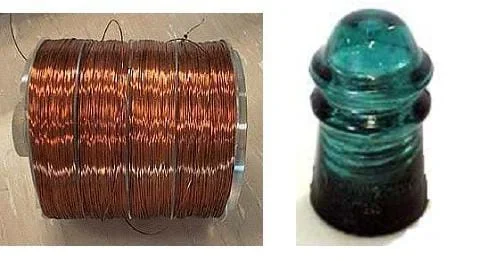 Figure 1. A conducting spool of copper wire (left) and a glass insulator used on telephone poles (right).Copyright http://www.ga.gov.au/education/minerals/images/copwire.gif and http://www.nps.gov/pisp/kids/graphics/insulatorlabels.jpg
Before starting the lesson, ask the students, what do you know about electricity? (Possible answers: It is the movement of electrical charge, it has to do with electrons, it can be dangerous.) Remind students that current electricity is the movement of electrons from atom to atom. You may also want to review that electrons carry a negative electric charge.
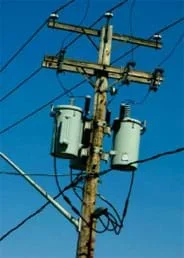 Figure 2: Metal wires carry electricity to our homes and schools.Copyright Microsoft Corporation, 1983-2001.
Next, ask students if they know how current electricity is able to move to the outlets in our walls and throughout our houses? (Answer: Wires.) Explain that the wires in our homes are made of copper, the same material as a penny. The reason that copper is used in electrical wires is because electricity can easily flow through copper. Electricity can flow more easily through some objects than others. The materials that electrons can move through are called conductors. The atoms in a conductor have loosely-attached electrons and a negative charge buildup pushes electrons through the material. Electrons in metals are loosely attached to the atom, so metals are conductors.
If the electrons are tightly attached to the atoms in a material and cannot be forced to move from one atom to another, no electricity flows; these materials are called insulators. Some examples of insulators include rock, wood, plastic, glass, cloth and air. For example, one purpose of the green glass insulators, once common on telephone poles, is to prevent current leakage from the wires (see Figures 1 and 2). Explain to students that they will learn more about conductors and insulators during the lesson.
Finally, explain to the students that there are also very special materials called semiconductors and superconductors. Ask students if they can guess what a semiconductor is? (Answer: A material with electrical conductivity between a conductor and an insulator.) In a superconductor, electrons move through the material with no resistance (nothing is stopping the electrons' movement). Wires made from a superconducting material can carry as much as 100 times the amount of electricity as a copper wire of the same size!
Ask the students to give examples of materials and objects that are conductors and insulators. As a class, list on the board at least five conductors and five insulators. (Possible answers: Conductors: iron, tap water, copper, silver, aluminum; Insulators: dry air, wood, ceramics, glass, plastics.) How are conductors and insulators used in electrical circuits? (Possible answers: Conductors are used in the wires, in filaments, in the connections, in the switch, etc. — wherever it is desirable to have current. Insulators are used around the wires and as parts of the bulb and battery holders — wherever it is desirable to prevent current leakage.) Why are engineers interested in the electrical properties of materials? (Possible answers: A material's electrical properties determine how it can be used. Engineers need to know the extent to which the material conducts electricity.)
- acid
- A substance that produces hydrogen ions (H+) when it is dissolved in water.
- alloy
- A homogeneous mixture of two or more metals, or of metallic and nonmetallic elements, usually fused together or dissolving into each other when molten, and producing a substance with metallic properties.
- base
- A substance that produces hydroxide ions (OH–) when it is dissolved in water; ammonia (NH3) forms ammonium ions (NH4+) when it is dissolved in water.
- capacitor
- An electric circuit element used to store charge temporarily.
- conductivity
- The relative ability of a material to conduct electricity.
- covalent bond
- A very strong bond in which one or more electrons from one atom are shared with neighboring atoms; usually occurs in non-metal materials such as plastics, rubber and ceramics.
- dissociate
- The separation of an electrolyte into ions of opposite charge.
- electrolyte
- A material that dissolves in water, producing a solution that conducts electricity.
- electrode
- A solid electrical conductor through which current enters or leaves a solution.
- electromagnet
- A magnet made of a current-carrying solenoid wrapped around an iron core.
- ionic solid
- A solid consisting of oppositely-charged ions; a salt.
- metal
- An element that gives up electrons easily, is shiny, malleable, ductile, and generally a good conductor of heat and electricity.
- semiconductor
- A typically crystalline substance whose electrical conductivity is between that of a metal and an insulator.
- solute
- A substance dissolved in another substance, forming a solution.
- solution
- A homogeneous mixture of two or more substances (solids, liquids, gases or a combination).
- solvent
- A substance in which another substance is dissolved, forming a solution.
- superconductor
- A metal, alloy or ceramic that has no resistance to electrical current at temperatures near absolute zero, and in some cases at temperatures hundreds of degrees above absolute zero.
Pre-Lesson Assessment
Discussion Question: Solicit, integrate, and summarize student responses:
- What do you know about electricity? (Possible answers: It is the movement of electrical charge, it has to do with electrons, it can be dangerous.)
Post-Introduction Assessment
Voting: Ask a true/false question and have students vote by holding thumbs up for true and thumbs down for false. Count the votes, and write the totals on the board. Give the right answer.
- True or False: The materials that electrons can move through are called conductors. (Answer: True.)
- True or False: A superconductor offers no resistance to an electric current. (Answer: True.)
- True or False: If no electricity flows through a material, that material is called an insulator. (Answer: True.)
- True or False: Metals are examples of insulators. (Answer: False. Metals are often used as conductors, but never as insulators.)
Lesson Summary Assessment
Quick Survey: Give students a piece of paper and ask them to write down the answers to the following three questions:
- What did you like best about the lesson?
- What could be done better?
- What did you learn that you didn't know before?
Homework/Independent Practice:
- Household Scavenger Hunt: Have the students look around their house for examples of conductors and insulators. Have them make a write down a list of 10 insulators and 10 conductors to turn in the next day.
Discussion Question: Lead a five-minute discussion during the next class period, asking students what they learned from the homework assignment.
Internet Search: Have students work on the Internet to further explore lesson concepts. Lead a small discussion of findings during the next class. For example, have students further investigate conductivity at: https://www.caryinstitute.org/sites/default/files/public/downloads/curriculum-project/conductivity_reading.pdf.
Have students investigate how conductivity in streams and lakes is related to their health and productivity.
Have students investigate superconductivity with the help of an adult.
Dull, Robert W. and Kerchner, H. Richard, Oak Ridge National Laboratory, A Teacher's Guide to Superconductivity for High School Students, accessed March 2004 at http://www.ornl.gov/reports/m/ornlm3063r1/contents.html . Currently available at https://ntrl.ntis.gov/NTRL/dashboard/searchResults/titleDetail/PB95141388.xhtml
Hewitt, Paul G. Conceptual Physics. 8th Edition. New York, NY: Addison Publishing Company, 1998.
Contributors
Xochitl Zamora Thompson; Sabre Duren; Joe Friedrichsen; Daria Kotys Schwartz; Malinda Schaefer Zarske; Denise Carlson
Supporting Program
Integrated Teaching and Learning Program, College of Engineering, University of Colorado Boulder
Acknowledgements
The contents of this digital library curriculum were developed under a grant from the Fund for the Improvement of Postsecondary Education (FIPSE), U.S. Department of Education and National Science Foundation GK-12 grant no. 0338326. However, these contents do not necessarily represent the policies of the Department of Education or National Science Foundation, and you should not assume endorsement by the federal government.
Copyright
2004 by Regents of the University of Colorado.