
Bulbs & Batteries Side by Side
We are surrounded everyday by circuits that utilize "in parallel" and "in series" circuitry. Complicated circuits designed by engineers are made of many simpler parallel and series circuits. In this hands-on activity, students build parallel circuits, exploring how they function and their unique features.
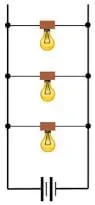 Students build parallel circuitsCopyright Svjo. Wikimedia Commons. http://commons.wikimedia.org/wiki/File:Parallellkoppling-3.svg
Engineers apply their understanding of circuitry to the design of practical, everyday products. They often choose to use parallel circuits so that if one circuit part breaks, the rest of the circuit continues to work. For example, when designing the electrical system for cars, trucks and SUVs, electrical engineers configure the wiring system so the brake lights and headlights are connected in parallel. That way, when one of the bulbs burns out, the other headlight or brake light remains illuminated.
After this activity, students should be able to:
- Define, recognize and assemble parallel circuits and parallel sections of more complex circuits
- Explain the path of electrical charge through a circuit
- Understand equations to calculate electrical power
- Understand that engineers apply their understanding of circuitry to the design of practical, everyday products
- 4.1.3.b.vi Assess the reasonableness of answers using mental computation and estimation strategies including rounding.
Grade 4
Do you agree with this alignment? - 4.2.1.a.iv Find the unknown in simple equations.
Grade 4
Do you agree with this alignment?
- Show that electricity in circuits requires a complete loop through which current can pass
Grade 4
Do you agree with this alignment? - Describe the energy transformation that takes place in electrical circuits where light, heat, sound, and magnetic effects are produced
Grade 4
Do you agree with this alignment?
- CCSS.Math.Content.5.NBT.B.7 Add, subtract, multiply, and divide decimals to hundredths, using concrete models or drawings and strategies based on place value, properties of operations, and/or the relationship between addition and subtraction; relate the strategy to a written method and explain the reasoning used.
Grade 5
Do you agree with this alignment? - CCSS.Math.Content.5.NF.B.3 Interpret a fraction as division of the numerator by the denominator (a/b = a ÷ b). Solve word problems involving division of whole numbers leading to answers in the form of fractions or mixed numbers, e.g., by using visual fraction models or equations to represent the problem.
Grade 5
Do you agree with this alignment?
- Tools, machines, products, and systems use energy in order to do work.
Grades 3-5
Do you agree with this alignment?
- 4-PS3-2 Make observations to provide evidence that energy can be transferred from place to place by sound, light, heat, and electric currents.
Grade 4
This resource focuses on the following Three Dimensional Learning aspects of NGSS:
Science & Engineering Practices- Make observations to produce data to serve as the basis for evidence for an explanation of a phenomenon or test a design solution.Do you agree with this alignment?
Disciplinary Core Ideas- Energy can be moved from place to place by moving objects or through sound, light, or electric currents.Do you agree with this alignment?
- Energy is present whenever there are moving objects, sound, light, or heat. When objects collide, energy can be transferred from one object to another, thereby changing their motion. In such collisions, some energy is typically also transferred to the surrounding air; as a result, the air gets heated and sound is produced.Do you agree with this alignment?
- Light also transfers energy from place to place.Do you agree with this alignment?
- Energy can also be transferred from place to place by electric currents, which can then be used locally to produce motion, sound, heat, or light. The currents may have been produced to begin with by transforming the energy of motion into electrical energy.Do you agree with this alignment?
Crosscutting Concepts- Energy can be transferred in various ways and between objects.Do you agree with this alignment?
Do you agree with this alignment? - Make observations to produce data to serve as the basis for evidence for an explanation of a phenomenon or test a design solution.
- 4-PS3-4 Apply scientific ideas to design, test, and refine a device that converts energy from one form to another.
Grade 4
This resource focuses on the following Three Dimensional Learning aspects of NGSS:
Science & Engineering Practices- Apply scientific ideas to solve design problems.Do you agree with this alignment?
Disciplinary Core Ideas- Possible solutions to a problem are limited by available materials and resources (constraints). The success of a designed solution is determined by considering the desired features of a solution (criteria). Different proposals for solutions can be compared on the basis of how well each one meets the specified criteria for success or how well each takes the constraints into account.Do you agree with this alignment?
- Energy can also be transferred from place to place by electric currents, which can then be used locally to produce motion, sound, heat, or light. The currents may have been produced to begin with by transforming the energy of motion into electrical energy.Do you agree with this alignment?
- The expression "produce energy" typically refers to the conversion of stored energy into a desired form for practical use.Do you agree with this alignment?
Crosscutting Concepts- Science affects everyday life.Do you agree with this alignment?
- Energy can be transferred in various ways and between objects.Do you agree with this alignment?
- Engineers improve existing technologies or develop new ones.Do you agree with this alignment?
- Most scientists and engineers work in teams.Do you agree with this alignment?
Do you agree with this alignment? - Apply scientific ideas to solve design problems.
Each group needs:
- 2 D-cell batteries
- 3 #40 bulbs (available at hardware stores)
- 3 bulb holders (available at hardware stores)
- 48 in (122 cm) of insulated wire (gauge AWG 22) (available at hardware stores)
- 1 store-bought light switch (available at hardware stores) or 1 paperclip and 2 thumbtacks
- 1 paper towel tube
- 4 Bulbs and Batteries Side by Side Worksheets (PDF)
- 4 Electric Power Math Worksheets (PDF) or Parallel Circuit Math Worksheets (PDF)
For the entire class to share:
- rubber bands
- wire strippers or sandpaper (to remove insulation at wire ends)
- wire cutters
- screwdriver
Note: Many of the materials required for this lab can be reused in numerous other electricity activities. When the batteries wear out, dispose of them at a hazardous waste disposal site.
Ask the students if any of them have ever been taking a shower when someone in another part of the house flushed a toilet — OUCH! The water in the shower becomes very hot because you were forced to share cold water with another device in the house. A parallel circuit works in a similar way. When two devices are connected in parallel, they are forced to share the current that is flowing through the circuit.
Ask the students if any of them have a lamp at home that uses a three-way light bulb? (Some will answer yes.) For those students who are not familiar with a three-way light bulb, explain that it has three bulb filaments, providing a low, medium and high brightness setting, for example, 60 watts / 75 watts / 100 watts. With each click of the lamp, the light bulb gets brighter. Ask the students who have a three-way light bulb at home if they have ever had the middle level of brightness not work, but the lowest level and highest level still work? (A student may answer yes.) Remind students that when they built circuits that were in series, when one light bulb was taken out of the series circuit, an open circuit was created and the electrons could not flow to light the other bulbs. Now ask the students, how is it possible that when the middle level of brightness does not work in a three-way light bulb, the lowest level and highest level still work? (Answer: The electrons can still flow to the other two filaments because the three filaments are connected in parallel.) Explain to students that the filaments in a three-way light bulb are connected as an "in parallel" circuit.
As another example, tell students that when designing the electrical system for cars, trucks or SUVs, electrical engineers design the wiring system so the brake lights and headlights are connected in parallel. That way, when one of the bulbs in a headlight or brake light burns out the other headlight or brake light remains illuminated. Headlights and brake lights are only a few examples of the many devices that engineers connect in parallel. Engineers use parallel circuits often to make sure that if one circuit part breaks, the rest of the circuit continues to work.
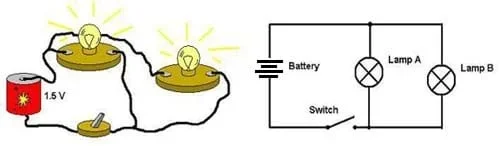 Figure 1. A parallel circuit (left) and its corresponding circuit diagram (right).Copyright 2003 Joe Friedrichsen, ITL Program, University of Colorado Boulder
Background — Parallel Circuits
- Since each device connects across the same two nodes (a point where two wires intersect), the voltage across each device is the same.
- The total resistance for a parallel circuit is less than the resistance of any one branch.
- From Ohm's law (I = V / R), the total current is equal to the voltage divided by the total resistance.
- The total current divides among parallel branches. Branches with lower resistances have higher current, while branches with higher resistances have lower current.
- The total current is equal to the sum of the currents in the branches.
- The total voltage for identical batteries connected in parallel is the same as the voltage across any one battery.
- Engineers connect things in parallel so that if one circuit part breaks the rest of the circuit still works.
Before the Activity
- Assemble all the materials. If you conducted the series circuit activity (Lesson 5, Bulbs and Batteries in a Row), reuse the wires, light bulbs, light bulb holders and batteries from that activity.
- Cut four 6 in (15 cm) pieces, two 10 in (25 cm) pieces, and one 4 in (10 cm) pieces for each team.
With the Students
- Ask students to predict how many batteries it will take to light the two light bulbs and record their prediction on the Side by Side Worksheet (PDF).
- Have the students use the wire strippers or sandpaper to remove about 1/2 in (1.3 cm) of the insulation from the ends of each wire piece.
- Have each team make a battery holder. Using masking tape, connect two D-cell batteries in series. The positive terminal of one battery should be touching the negative terminal of the second battery. Cut a paper towel holder to fit the length of the two batteries. Place the two batteries in the paper towel tube. Connect a 10-in wire to the positive terminal of one battery and another 10-in wire to the negative terminal of the second battery.
- Construct a circuit using the two batteries in series, a switch, and two light bulb holders and light bulbs in parallel (see Figure 2). Close the switch. What happens? (Answer: Both bulbs light up.)
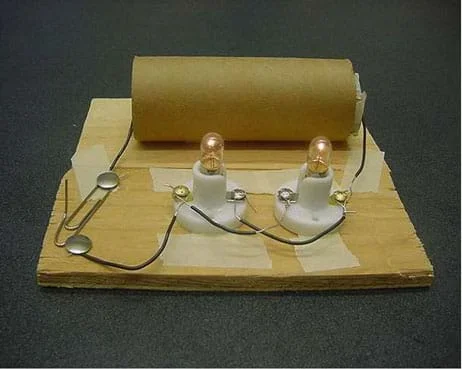 Figure 2. A parallel circuit with two light bulbs.Copyright 2003 Joe Friedrichsen, ITL Program, University of Colorado Boulder
- Open the switch and remove one of the light bulbs from its holder. Close the switch. What happens? (Answer: The bulb remaining in the circuit lights up. See Figure 3.)
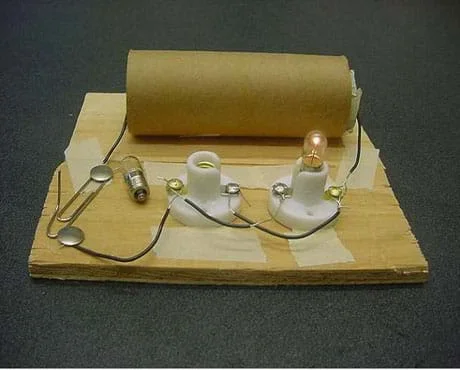 Figure 3. A parallel circuit with one light bulb removed, and one light bulb remaining in the circuit.Copyright 2003 Joe Friedrichsen, ITL Program, University of Colorado Boulder
- Open the switch and replace the light bulb you removed. Now remove the other light bulb. Close the switch. What happens? (Answer: The bulb now in the circuit lights up.)
- Open the switch. Replace the bulb you removed and add a third light bulb in parallel with the first two. Close the switch to test the circuit. What happens? (Answer: Each of the three bulbs is just as bright as when there were only two bulbs.)
- Use one team's circuit and demonstrate what happens to the brightness of the bulbs as you add a fourth bulb in parallel. What happens? (Answer: The fourth bulb is just as bright as the first three. Also, the first three bulbs are just as bright as they were before.)
- Use the knowledge you have gained about parallel circuits to complete the Electric Power Math Worksheet (PDF) and Parallel Circuit Math Worksheet (PDF). Or, if time is limited, assign for homework.
Pre-Activity Assessment
Human Diagram: Ask for three volunteers. Assign one volunteer to be the "battery" and two as 'light bulbs." (It may help to draw the appropriate symbols on pieces of paper and tape them to their shirts.) Have the students physically portray a series circuit by holding hands in a circle. Then have the students portray a parallel circuit by having the light bulbs and battery stand facing one direction with their arms touching the elbows of the person in front of them.
Prediction: Hand out the Side by Side Worksheets before the activity begins. Have students predict how many batteries they think it will take to light the two light bulbs, and record their prediction on the worksheet.
Activity Embedded Assessment
Worksheet: Hand out the Side by Side Worksheets before the activity begins and ask students to follow along, first diagramming the series circuit they construct, then filling in answers as they work through the activity.
Post-Activity Assessment
Roundtable: Have the class form into teams of 3-5 students each. Have the students on each team make a list of objects that might have parallel circuits in them by each person taking turns writing down ideas. Students pass the list around the group until all ideas are exhausted. Have teams read aloud the answers and write them on the board. (Possible items: Lights in a house, appliances, computers, toys, CD players, cell phones, etc.)
Make It Fun with Boggle!: Repeat the same activity as above, except when the teams read aloud their answers and write them on the board, ask if any other teams came up with the same idea. If any other teams have the same answer on their sheet, all teams have to cross that answer out on their list. The team that ends up with the most "unique" ideas, wins!
Problem Solving/Homework: Have students complete the Electric Power Math Worksheet and Parallel Circuit Math Worksheet.
- Ask students not to play with the light bulbs or holders. If either of these items break, they can cause injury.
- Ask students not to play with the insulated wire; they may cut or poke themselves or others.
To help students understand the equation on the Electric Power Math Worksheet, review it with them and ask them to find the "missing variable."
There must be good electrical contact between all the circuit components. If students have difficulty getting the circuit to work, check all the connections.
Use one team's circuit and insert a third battery in parallel. Use a multimeter to measure the voltage across the two batteries. How does it compare to the voltage of one D-cell battery? (Answer: The voltage across three identical batteries connected in parallel is the same as the voltage across two of the batteries.)
Use a multimeter to determine the voltage and current across a single light bulb, using a simple circuit with one light bulb. Use these values to find the resistance of the light bulb using Ohm's law R = V / I. Next, use the multimeter to determine the voltage across two bulbs in parallel and the current in the circuit. Find the resistance of this load using R = V / I. Compare the resistance of one bulb to the resistance of two bulbs in parallel. Compare the current in one bulb to the current in the circuit.
Note: A multimeter is an instrument that combines the measuring capabilities of an ammeter (measures current), voltmeter (measures potential difference, or voltage, between two points) and an ohmmeter (measures resistance) in one instrument to take measurements (current, voltage and resistance) from circuits. . Multimeters are available at Radio Shack (or other electronics store), ranging from $15-$100.
For lower grades, use the math worksheets as a challenge activity or complete them together, as a class.
Contributors
Xochitl Zamora Thompson; Sabre Duren; Joe Friedrichsen; Daria Kotys-Schwartz; Malinda Schaefer Zarske; Denise W. Carlson
Supporting Program
Integrated Teaching and Learning Program, College of Engineering, University of Colorado Boulder
Acknowledgements
The contents of this digital library curriculum were developed under grants from the Fund for the Improvement of Postsecondary Education (FIPSE), U.S. Department of Education and National Science Foundation (GK-12 grant no. 0338326). However, these contents do not necessarily represent the policies of the DOE or NSF, and you should not assume endorsement by the federal government.
Copyright
2004 by Regents of the University of Colorado