
Stack It Up!
Students analyze and begin to design a pyramid. Working in engineering teams, they perform calculations to determine the area of the pyramid base, stone block volumes, and the number of blocks required for their pyramid base. They make a scaled drawing of the pyramid using graph paper.
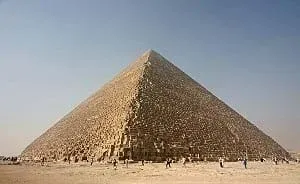 Students analyze and design a pyramidCopyright Nina Aldin Thune http://en.wikipedia.org/wiki/Great_Pyramid_of_Giza#/media/File:Kheops-Pyramid.jpg
Ancient engineers did not have the advanced machines we have today, but they still managed to build large structures that are still around. Before the first stone is moved, engineers design structures by exploring a variety of design solutions, making drawings, building models, using mathematics and estimating material requirements. To build any huge structure, an engineer asks and finds the answers to questions such as: What is the purpose of the structure? What will be its size and shape? How will the structure support itself? What type of material(s) should be used? How much material is needed? Where is a good location to build this structure?
After this activity, students should be able to:
- Understand that engineers always make a plan before building, and that plan is called a design.
- Understand that engineers analyze a project before attempting to construct anything.
- Understand that engineers must meet the constraints of a project, such as how far stones must be moved, how large stones can be and still be able to be moved to the pyramid construction site, etc.
- 5.1.2.a Fluently multiply multi-digit whole numbers using standard algorithms.
Grade 5
Do you agree with this alignment? - 5.1.4.e Interpret multiplication as scaling (resizing).
Grade 5
Do you agree with this alignment? - 5.4.1.b.ii Apply the formulas V = l × w × h and V = b × h for rectangular prisms to find volumes of right rectangular prisms with whole-number edge lengths.
Grade 5
Do you agree with this alignment? - 4.4.1.a.v Apply the area and perimeter formulas for rectangles in real world and mathematical problems.
Grade 4
Do you agree with this alignment?
- CCSS.Math.Content.4.MD.A.3 Apply the area and perimeter formulas for rectangles in real world and mathematical problems.
Grade 4
Do you agree with this alignment? - CCSS.Math.Content.5.MD.C.5b Apply the formulas V = l × w × h and V = b × h for rectangular prisms to find volumes of right rectangular prisms with whole-number edge lengths in the context of solving real world and mathematical problems.
Grade 5
Do you agree with this alignment? - CCSS.Math.Content.5.NBT.B.5 Fluently multiply multi-digit whole numbers using the standard algorithm.
Grade 5
Do you agree with this alignment? - CCSS.Math.Content.5.NF.B.5 Interpret multiplication as scaling (resizing), by:
Grade 5
Do you agree with this alignment?
- Models are used to communicate and test design ideas and processes.
Grades 3-5
Do you agree with this alignment?
- 3-5-ETS1-1 Define a simple design problem reflecting a need or a want that includes specified criteria for success and constraints on materials, time, or cost.
Grades 3-5
This resource focuses on the following Three Dimensional Learning aspects of NGSS:
Science & Engineering Practices- Define a simple design problem that can be solved through the development of an object, tool, process, or system and includes several criteria for success and constraints on materials, time, or cost.Do you agree with this alignment?
Disciplinary Core Ideas- Possible solutions to a problem are limited by available materials and resources (constraints). The success of a designed solution is determined by considering the desired features of a solution (criteria). Different proposals for solutions can be compared on the basis of how well each one meets the specified criteria for success or how well each takes the constraints into account.Do you agree with this alignment?
Crosscutting Concepts- People's needs and wants change over time, as do their demands for new and improved technologies.Do you agree with this alignment?
Do you agree with this alignment? - Define a simple design problem that can be solved through the development of an object, tool, process, or system and includes several criteria for success and constraints on materials, time, or cost.
Each group needs:
- A calculator
- Pencils and erasers
- A scaled ruler
- Graph paper
- Stack It Up! Math Worksheet (PDF)
Multiplication, division, using a ruler, graph paper, and the concept of proportional scaling. General knowledge of pyramids. Familiarity with the six simple machines introduced in Lesson 1 of this unit.
Imagine you are the chief engineers on a pyramid construction project in ancient times. You have been given specific dimension guidelines for the pyramid: its length and width (both 120 meters) and height (72 meters). All the other decisions involving the pyramid construction are left to you. As engineers, it is your task to ensure that the new pyramid is built solidly, efficiently, and completed on time, while also making sure that it is beautiful and lasts a long time. Developing a good plan — a design — helps you meet all of these goals.
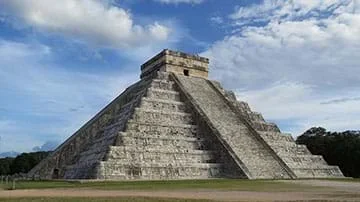 Copyright 2009 Daniel Schwen, CC BY-SA 4.0, Wikipedia, https://en.wikipedia.org/wiki/File:Chichen_Itza_3.jpg
Engineers need to make sure they develop a good design that is durable and takes environmental conditions into account, such as topography and weather. However, even if you succeed in these areas, your leader will be unhappy if the project costs more than expected. Additional time and money would be wasted if you cut more rock from the quarry than needed for the pyramid or if you do not cut enough and must go back to the quarry to get more stones to finish the job. So, as engineers, you must make accurate estimations. Either overestimating or underestimating the amount of materials is unacceptable.
Engineers must also be accurate in the timeline they give to the leader. If the project takes longer than estimated, your leader will be impatient and disappointed. On the other hand, if you finish ahead of schedule, instead of being pleased that you finished so quickly, your leader might be angry about not having enough time to plan a celebration for the unveiling of the pyramid. Given such an important job, you must draw on your engineering skills to build a pyramid that pleases your leader based on how magnificent it looks, sturdy it is, quickly it is built, and efficiently it is constructed.
Before the Activity
- Gather materials and make copies of the Stack It Up! Math Worksheet (PDF).
With the Students
- Divide the class into engineering project teams of two students each.
- Explain the concept of scaling.
- Hand out the worksheets and graph paper.
- Explain that each team's job is to use the worksheet to make detailed plans for their pyramid, and use the graph paper to make a scaled drawing of their pyramid design.
- Observe the students as they work through the worksheet calculations, helping as needed.
- Help students decide on a scale that fits the pyramid drawing optimally on the graph paper.
- Now that the students have been introduced to the design and analysis process that all engineers use to some extent, conclude the activity with a classroom brainstorming session (see the Assessment section for details). Ask the students to share with the class all the important design questions, constraints, or other topics to consider, investigate, analyze and test before building a pyramid — or any structure.
- approximation
- Simplifying a problem to get an answer that is close but not exact.
- area
- The amount of surface space (in two dimensions) that an object takes up.
- design
- (verb) To plan out in systematic, often graphic form. To create for a particular purpose or effect. Design a building. (noun) A well thought-out plan.
- estimate
- A rough or approximate calculation.
- plan
- (noun) A method worked out before hand for the accomplishment of an objective.
- scaling
- Drawing an item smaller or larger than actual size, but keeping the same relative proportions. For example, perhaps 1 cm represents 1 meter.
- topography
- The surface features of a place or region.
- volume
- The amount of space (in all three dimensions) that an object takes up.
Pre-Activity Assessment
Brainstorming: In small groups, have students engage in open discussion to generate a number of possible ideas about how the pyramids were built. Have them think about the physical processes involved (cutting and moving stone) and the mental processes (design and planning). Have one person record all proposed ideas on the classroom board. Encourage wild ideas and discourage criticism of ideas. Remind students that no idea or suggestion is "silly." All ideas should be respectfully heard.
Roundtable: Form teams of three to five students each. Ask the class how the pyramids might have been built. Have students on each team make a list, each one writing an answer and passing the paper on to the next person. Review the six types of simple machines (wedge, wheel and axle, lever, inclined plane, screw, and pulley) and ask if using any of these approaches might be helpful in the difficult work required to construct a pyramid. After students write down a few more ideas, have the teams share their responses with the class. Copyright 2004 Microsoft Corporation, One Microsoft Way, Redmond, WA 98052-6399 USA. All rights reserved.
Activity Embedded Assessment
Worksheet: Have the students provide answers and complete the calculations on the Stack It Up! Math Worksheet (PDF). Review students' worksheet progress to gauge their mastery of the subject.
Post-Activity Assessment
Closing Brainstorming: Now that students have been introduced to the design and analysis process that all engineers use to some extent, ask the students share with the class all the important design questions, constraints, or other topics to consider, investigate, analyze and test before building a pyramid — or any structure (houses, bridges, skyscrapers). Encourage wild ideas and discourage criticism of ideas. All ideas should be respectfully heard.
Before students begin to write on the graph paper, make sure they have decided on a scale that fits the pyramid drawing optimally on the graph paper.
Some students may need a reminder explanation about the units for area (m2) and volume (m3).
For an ELL focus, use multiple sensory associations, visuals, etc.
For a class project or individual assignment, have students examine more closely the geology of Egypt and how one builds on a desert of sand.
- To increase the difficulty, use block dimensions that are harder to calculate, such as a block sized 5.0m x 2.2m x 3.7m.
Dictionary.com. Lexico Publishing Group, LLC. (Source of some vocabulary definitions, with some adaptation) http://www.dictionary.com
Contributors
Gregory Ramsey; Glen Sirakavit; Lawrence E. Carlson; Jacquelyn Sullivan; Malinda Schaefer Zarske; Denise Carlson
Supporting Program
Integrated Teaching and Learning Program, College of Engineering, University of Colorado Boulder
Acknowledgements
The contents of this digital library curriculum were developed under a grant from the Fund for the Improvement of Postsecondary Education (FIPSE), U.S. Department of Education, and National Science Foundation GK-12 grant no 0338326. However, these contents do not necessarily represent the policies of the Department of Education or National Science Foundation, and you should not assume endorsement by the federal government.
Copyright
2005 by Regents of the University of Colorado.