
Powerful Pulleys
Students continue to explore the story of building a pyramid, learning about the simple machine called a pulley. They learn how a pulley can be used to change the direction of applied forces and move/lift extremely heavy objects, and the powerful mechanical advantages of using a multiple-pulley system. Students perform a simple demonstration to see the mechanical advantage of using a pulley, and they identify modern day engineering applications of pulleys. In a hands-on activity, they see how a pulley can change the direction of a force, the difference between fixed and movable pulleys, and the mechanical advantage gained with multiple / combined pulleys. They also learn the many ways engineers use pulleys for everyday purposes.
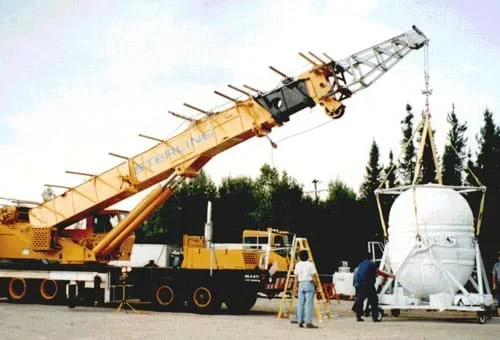 Figure 1. Notice the pulleys used by this by this crane — an example of how a modern device uses simple machines to perform complex tasks.Copyright NASA, <http://heawww.gsfc.nasa.gov>.
Engineers are experts at exploiting the advantages of simple machines in all sorts of real-world applications that benefit society. They incorporate the mechanical advantage of pulleys into their design of many modern-day structures, machines, products and tools, such as cranes, elevators, flagpoles, zip lines, motors, bicycle rings/chains, clothes lines, water well bucket/rope, rock climbing devices, window blinds and sail/fishing boats. Using multiple pulleys in conjunction with motors and electronics, engineers create complex modern devices that perform much work for very little power.
After this lesson, students should be able to:
- Demonstrate how pulleys are used.
- Explain how pulleys could have been used by engineers in ancient times to do work.
- Identify modern applications in which engineers use pulleys.
- 3.1.3.c Multiply and divide within 100.
Grade 3
Do you agree with this alignment?
- CCSS.Math.Content.3.OA.C Multiply and divide within 100.
Grade 3
Do you agree with this alignment?
- STEL-2J Demonstrate how tools and machines extend human capabilities, such as holding, lifting, carrying, fastening, separating, and computing.
Grades 3-5
Do you agree with this alignment?
- 3-PS2-1 Plan and conduct an investigation to provide evidence of the effects of balanced and unbalanced forces on the motion of an object.
Grade 3
This resource focuses on the following Three Dimensional Learning aspects of NGSS:
Science & Engineering Practices- Plan and conduct an investigation collaboratively to produce data to serve as the basis for evidence, using fair tests in which variables are controlled and the number of trials considered.Do you agree with this alignment?
- Science investigations use a variety of methods, tools, and techniques.Do you agree with this alignment?
Disciplinary Core Ideas- Each force acts on one particular object and has both strength and a direction. An object at rest typically has multiple forces acting on it, but they add to give zero net force on the object. Forces that do not sum to zero can cause changes in the object's speed or direction of motion. (Boundary: Qualitative and conceptual, but not quantitative addition of forces are used at this level.)Do you agree with this alignment?
- Objects in contact exert forces on each other.Do you agree with this alignment?
Crosscutting Concepts- Cause and effect relationships are routinely identified.Do you agree with this alignment?
Do you agree with this alignment? - Plan and conduct an investigation collaboratively to produce data to serve as the basis for evidence, using fair tests in which variables are controlled and the number of trials considered.
- 3-PS2-2 Make observations and/or measurements of an object's motion to provide evidence that a pattern can be used to predict future motion.
Grade 3
This resource focuses on the following Three Dimensional Learning aspects of NGSS:
Science & Engineering Practices- Make observations and/or measurements to produce data to serve as the basis for evidence for an explanation of a phenomenon or test a design solution.Do you agree with this alignment?
- Science findings are based on recognizing patterns.Do you agree with this alignment?
Disciplinary Core Ideas- The patterns of an object's motion in various situations can be observed and measured; when that past motion exhibits a regular pattern, future motion can be predicted from it. (Boundary: Technical terms, such as magnitude, velocity, momentum, and vector quantity, are not introduced at this level, but the concept that some quantities need both size and direction to be described is developed.)Do you agree with this alignment?
Crosscutting Concepts- Patterns of change can be used to make predictions.Do you agree with this alignment?
Do you agree with this alignment? - Make observations and/or measurements to produce data to serve as the basis for evidence for an explanation of a phenomenon or test a design solution.
General knowledge of pyramids. Familiarity with the six simple machines introduced in Lesson 1 of this unit.
Use the Pulleys and the Pyramids PowerPoint presentation (PPTX) as a helpful classroom tool. (Show the PowerPoint presentation, or print out the slides to use with an overhead projector. The presentation is animated to promote an inquiry-based style; each click reveals a new point about each machine; have students suggest characteristics and examples before you reveal them.)
The pulley, a simple machine, helps to perform work by changing the direction of forces and making easier the moving of large objects. When thinking of pulleys, most people think of the type of pulley that allows a person to redirect the direction of a force. With this type of pulley — called a fixed pulley — pulling down on a rope makes an object rise off the ground. There are also movable pulleys and pulley systems. Thousands of years ago, early engineers used pulleys to help with construction and many useful everyday tasks. Many obelisks were erected using pulleys and wells have pulleys to help retrieve water.
Fixed Pulleys
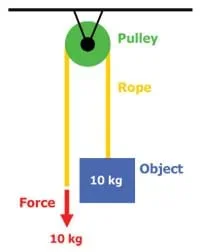 Figure 5. A fixed pulley with no mechanical advantage.Copyright Denise W. Carlson, ITL Program, College of Engineering, University of Colorado at Boulder, 2007.
The most commonly understood concept of a pulley is that it is a simple machine that redirects force. This means that by looping rope around a pulley and attaching the rope to an object, one pulls down on the rope to raise the object, instead of having to lift the object (see Figure 5; imagine raising a flag). Although this is a helpful and convenient use for pulleys, it has a major limitation: the force you must apply to lift the object is the same amount as if you were just lifting the object without the pulley (which is acceptable for raising a flag, but not helpful enough if trying to raise a pyramid stone). This means that a fixed pulley does not give any mechanical advantage.
A fixed pulley configuration is useful for raising an object to a level above your head. Using this type of pulley also enables you to take advantage of gravity. And, by attaching weights to the end of the rope that you pull, you can lessen the amount of force you must apply. This type of pulley can also be used to balance an object, by attaching objects of equal weight to both sides of the rope, neither object moves. Once a force is applied to either side, the system continues moving in that direction. This kind of pulley system is used in some elevators. The elevator has cable attached to it that goes up, around a pulley, then comes down and attaches to a counterweight. The motor that moves the elevator car uses much less power since the counterweight keeps the elevator balanced.
Movable Pulleys
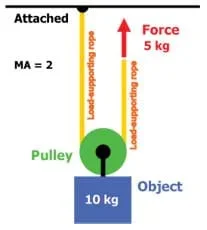 Figure 6. A movable pulley with a mechanical advantage of two.Copyright Denise W. Carlson, ITL Program, College of Engineering, University of Colorado at Boulder, 2007.
Another type of pulley is a movable pulley. In a movable pulley system, the rope is attached to a fixed (non-moving) point, the pulley is attached to the object that you want to move and the other end of the rope is left free (see Figure 6). By pulling on the rope, the pulley moves and the object raises. This type of system is good if you are trying to raise an object located below you to your level. In a variation, if both sides of a movable pulley system are fixed and the rope is taut between the fixed points, the system becomes like a wheel and axle because the object can ride along the rope if a force is applied to it (for example, a zip line).
Pulley Systems
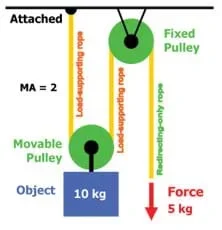 Figure 7. A pulley system with a mechanical advantage of two.Copyright Denise Carlson, ITL Program, College of Engineering, University of Colorado at Boulder, 2007.
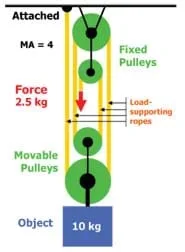 Figure 8. A pulley system with a mechanical advantage of four because it has four load-supporting rope segments.Copyright Denise W. Carlson, ITL Program, College of Engineering, University of Colorado at Boulder, 2007.
Using a system of pulleys can be much more complex and provide a powerful mechanical advantage — greatly reducing the amount of force required to move an object. If one movable pulley is used (Figure 6), the amount of force required to raise the object attached to the movable pulley is cut in half. The pulley system seen in Figure 7 does not change the mechanical advantage from Figure 6, however, it does change the direction of the necessary force. The trade-off is that the amount of rope required increases and the amount of rope that you must pull to raise the object is also increased. If two fixed pulleys are added to the system and a second movable pulley is attached to the object, the amount of force needed to raise the object becomes one-fourth of the object's weight, and four times as much rope is required (see Figure 8 and Pulleys and the Pyramids PowerPoint presentation (PPTX)).
Mechanical Advantage
The powerful mechanical advantage of a pulley is in using many pulleys at once. Combining multiple pulleys decreases the amount of force necessary to move an object by increasing the amount of rope used to raise the object. The amount of rope can be found by rope = original amount of rope x the number of pulleys. The mechanical advantage (MA) of a pulley system is equal to the number of ropes supporting the movable load. (That means, do not count ropes that are only used for redirecting, see Figures 6, 7 and 8.)
We are well underway in learning about simple machines and building the ancient Egyptian pyramids that we have been hired as engineers to design and construct. Now, we are going to go deeper into our understanding of pulleys to see if we can use this knowledge to help make our work easier.
No one knows for sure if pulleys were one of the simple machines that ancient cultures used to build pyramids. A few people believe that the beautiful and massive pyramids could not possibly have been built using something as simple as simple machines. Some people have wild theories about how the pyramids came to be — that perhaps aliens from another planet came to Earth and built them. Well, we do not know about that, but we do know that human beings are very creative and resourceful when they want to be. As long as we limit ourselves to materials and technologies that would have been available to the ancient Egyptians, it is acceptable for us to use our knowledge to construct pulley systems to build our pyramid.
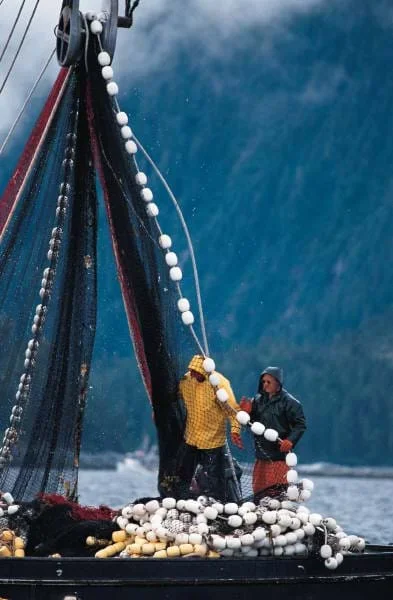 Figure 2. A pulley on a fishing boat.Copyright 2004 Microsoft Corporation, One Microsoft Way, Redmond, WA 98052-6399 USA. All rights reserved.
A pulley is a simple machine consisting of a string (or rope) wrapped around a wheel (sometimes with a groove) with one end of the string attached to an object and the other end attached to a person or a motor. Pulleys may seem simple, but they can provide a powerful mechanical advantage so lifting tasks may be done easily.
Pulleys are used in many ways, everyday. What kind of pulleys can you think of? Some common examples are large construction cranes that use pulleys to lift heavy objects with what would normally be a very underpowered motor (see Figure 1), weight machines at a gym, some elevators, flagpoles, window blinds, bicycle rings/chains, clotheslines, water well bucket/rope, zip lines, motors, rock climbing devices, and sailing and fishing boats (see Figure 2).
An elevator is a modern engineering use of a pulley system that performs much like the raising of a large stone for pyramid building. Without the use of pulleys, an elevator would require a large motor to pull the cable straight up. Instead of using a large motor, some elevators use a large weight that takes advantage of gravity to help raise the elevator car (see Figure 3). In this situation, the powering motor can be much smaller and only be used to determine the direction the elevator should go.
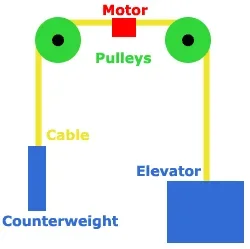 Figure 3. Adding a counterweight and two pulleys with a motor in the middle makes an elevator easier to move.Copyright Justin Fritts, ITL Program, College of Engineering, University of Colorado at Boulder, 2005.
But how can a wheel with string over it help us move the huge stones required to build a pyramid? Well, pulleys help us by changing the direction of the force we use to lift an object. Is it easier for you to pull up on a rope or pull down on a rope? By using a pulley, we do not have to pull up on a rope to lift a heavy object attached to it, but instead we can pull down on it. Think of a flagpole as an example. When you pull down on the rope of a flagpole, the flag goes up the pole to wave in the air. That's because a flagpole has a pulley on it. By using pulleys to redirect force, a stone could be lifted off the ground, allowing more people to grab on to the rope, and adding weight so workers have to pull less. To simplify this effort even more, workers using a pulley could move a large stone up a ramp by pulling on a rope while walking down the ramp, using gravity to their advantage.
The real mechanical advantage of a pulley is in using many pulleys at once. Using multiple pulleys decreases the amount of force necessary to move an object by increasing the amount of rope used to raise the object. The mechanical advantage (MA) of a pulley system is equal to the number of ropes supporting the movable load. (That means, do not count ropes that are only used for redirecting, see Figures 6 and 7.) We know from other lessons on simple machines that to gain a greater mechanical advantage, there is a trade-off. With a pulley, the trade-off is distance. So, if two pulleys are used together, the amount of force required is cut in half, but twice the amount of rope is needed to be pulled to raise the object to the same desired height. (Illustrate this concept to students by conducting the following classroom demonstration; see Figure 4.)
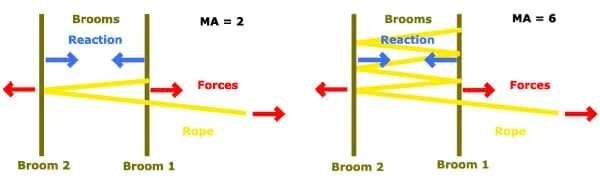 Figure 4. (left) Using one wrap of the rope, it is difficult to pull the brooms together. (right) Using several wraps makes it easier to pull the brooms together.Copyright Justin Fritts, ITL Program, College of Engineering, University of Colorado at Boulder, 2005.
Classroom Broom and Rope Demonstration:
This demo requires three students, two brooms and ~6 meters of rope. Tie the rope to one of the brooms (broom 1) and wrap the rope around the other broom (broom 2). Have two students stand about a meter apart each holding one broom, and try to keep the brooms separated while the third student pulls on the free end of the rope; it should be a difficult task to pull the broom sticks together. Next, wrap the rope around each of the brooms again. Try again to pull the students/brooms together; the more times you wrap the rope around the brooms, the easier it is for the third student to pull the others together! This is an example showing the power of mechanical advantage. Refer to the associated activity Pulley'ing Your Own Weight to further students involvement in understanding pulley systems by illustrating how a pulley can be used to easily change the direction of a force, making the moving of large objects easier.
Pulleys can be much more complicated. Engineers combine many pulleys into a pulley system that significantly reduces the amount of force required to lift an object. They often use pulley systems to move extremely heavy objects. A block and tackle is an example of a pulley system that can be attached to anything. It may take a lot of cable or rope, but a human using enough pulleys could lift several tons. Engineers use the block and tackle along with motors and electronics to create modern devices that operate with very low power requirements, such as cranes and elevators. At Disneyland, engineers even use a pulley system to move Tinkerbell across the sky.
We are unsure if the Egyptians used pulleys, and have yet to find any evidence that they did, but we do know, that if they had used them, life would have been easier than if they did not. Now, since we understand pulleys and have modern materials, we can build the pyramids much easier. Today we are going to look at engineering a pulley system and see if we can design a way to get our heaviest stones to the top of our pyramid with the help of this simple machine.
How can pulleys make our lives easier? Pulleys are powerful simple machines. They can change the direction of a force, which can make it much easier for us to move something. If we want to lift an object that weighs 10 kilograms one meter high, we can lift it straight up or we can use a pulley, so we can pull down on one end to lift the object up. It is much easier to use the pulley because, as long as we weigh more than 10 kilograms, we can just hang onto the end of the rope and take advantage of gravity so our weight provides all the necessary force to lift the object.
Pulleys can also provide us with a mechanical advantage when we use several together and more rope. This process lessens the amount of force required to lift something.
While we do not know if pulleys were used by ancient pyramid builders, we know pulleys are an ideal simple machine for many of the tasks required to build a pyramid. In today's highly-technical world, engineers still use pulleys to make difficult tasks easier. Without them, our lives would be much more difficult.
Conduct summary assessment activities as described in the Assessment section. Conclude by finishing the KWL Chart and assigning Word Problems in which students calculate the mechanical advantage of an inclined plane (see the Assessment section).
In other lessons of this unit, students study each simple machine in more detail and see how each could be used as a tool to build a pyramid or a modern building.
- fixed pulley
- A pulley system in which the pulley is attached to a fixed point and the rope is attached to the object.
- force
- A push or a pull on an object; the capacity to do work.
- gravity
- The natural force of attraction exerted by Earth upon objects at or near its surface, tending to draw them toward the center of the body.
- mechanical advantage
- An advantage gained by using simple machines to accomplish work with less effort. Making the task easier (which means it requires less force), but may require more time or room to work (more distance, rope, etc.). For example, applying a smaller force over a longer distance to achieve the same effect as applying a large force over a small distance. The ratio of the output force exerted by a machine to the input force applied to it.
- movable pulley
- A pulley system in which the pulley is attached to the object; one end of the rope is attached to a fixed point and the other end of the rope is free.
- pulley
- A simple machine that changes the direction of a force, often to lift a load. Usually consists of a grooved wheel in which a pulled rope or chain runs.
- redirect force
- To change the direction of your push or pull to gain advantage over a task.
- simple machine
- A machine with few or no moving parts that is used to make work easier (provides a mechanical advantage). For example, a wedge, wheel and axle, lever, inclined plane, screw, or pulley.
- work
- Force on an object multiplied by the distance it moves. W = F x d (force multiplied by distance).
Pre-Lesson Assessment
Brainstorming: As a class, have the students engage in open discussion. Remind students that in brainstorming, no idea or suggestion is "silly." All ideas should be respectfully heard. Take an uncritical position, encourage wild ideas and discourage criticism of ideas. Have them raise their hands to respond. Write their ideas on the board. Ask the students:
- What are simple machines? What is the advantage of simple machines? (Possible answers: A machine with few or no moving parts that is used to make work easier. Simple machines make work easier by creating a mechanical advantage, such as trading more distance for less force.)
- Why do engineers care about simple machines? (Answer: Modern equipment, structures and tools use the simple machine principles to perform simple and complex tasks. Although you may never see a pulley in action on the job site pulleys are hidden inside motors, inside cranes, and are working behind the scenes all the time.)
Know / Want to Know / Learn (KWL) Chart: Create a classroom KWL chart to help organize learning about a new topic. On a large sheet of paper or on the classroom board, draw a chart with the title "Simple Machines: Pulleys." Draw three columns titled, K, W and L, representing what students know about pulleys, what they want to know about pulleys and what they learned about pulleys and their mechanical advantages. Fill out the K and W sections during the lesson introduction as facts and questions emerge. Fill out the L section at the end of the lesson.
Post-Introduction Assessment
Discussion Questions: Solicit, integrate and summarize student responses.
- What did we observe during the broom and rope demo? What was the effect of adding more pulleys? (Possible answers: Pulleys in action, using mechanical advantage to make work easier, adding more pulleys (wraps of rope) made pulling the two brooms together easier.)
- Explain how to find the mechanical advantage of a pulley system. (Answer: The mechanical advantage of a pulley is system is equal to the number of ropes supporting a movable pulley.)
- What is the trade-off of mechanical advantage in a pulley system? (Answer: Distance or length of rope.)
- What are some examples of modern items that engineers have designed with pulleys? (Possible answers: Cranes, elevators, block and tackle on boats, flagpoles, zip lines, motors, bicycle rings/chains, rock climbing devices, window blinds and sail boats.)
Lesson Summary Assessment
KWL Chart (Conclusion): As a class, finish column L of the KWL Chart as described in the Pre-Lesson Assessment section. List all of the things students learned about pulleys and their mechanical advantages. Were all of the W questions answered? What new things did they learn? Based off of their observations of an object's motion can a pattern be used to predict future motion?
Word Problems: Assess students' understanding of the lesson concepts by assigning the following word problems. Write on the board: Mechanical advantage of a pulley system = number of number of rope segments supporting the load.
- If we used one fixed pulley and wanted to raise a rock 100 meters, how much force and rope would it take to raise a 500-kilogram rock? (Answer: Force is equal to the mass of the rock times the acceleration due to gravity (9.8 m/s2), so 4900 Newtons. Since we are using only one pulley, the rope would need to likely be around 200 meters [one length up to the pulley from the rock and one length from the pulley to you].)
- If we used 10 pulleys in a system and wanted to raise a rock 100 meters, how much force and rope would we need to raise that same 500-kilogram rock? (Answer: The force could be lowered to 1/10th the weight of the rock [490 Newtons] since we would have 10 ropes with the pulleys. However, we would easily need 1,000 meters of rope [10 times the length of one rope] or 2,000 meters if we were at the same level as the rock.)
Try making a human pulley. You need board, a strong rope and a spot with an overhead support, such as a soccer goal or playground equipment. Wrap one end of the rope around a 2 x 4 (or something strong such as a seat from a swing) and wrap the other end of the rope around the goal, letting the trailing end hang to the ground. Allow one child to sit on the 2 x 4 while two other children try to lift them by pulling down on the free end of the rope. Keep wrapping the rope around the goal or support bar until two children can easily lift the sitting child up and down. It may be helpful to start the sitting child from a standing position (both feet on the ground).
If the students are unfamiliar with a zip line, have them research this on the internet. A zip line is a fun example of a movable pulley.
Challenge more advanced students to calculate the mechanical advantage of using multiple pulleys, requiring division with remainders or fractions.
Dictionary.com. Lexico Publishing Group, LLC. Accessed January 25, 2006. (Source of some vocabulary definitions, with some adaptation) http://www.dictionary.com
Contributors
Justin Fritts; Lawrence E. Carlson; Jacquelyn Sullivan; Malinda Schaefer Zarske; Denise Carlson
Supporting Program
Integrated Teaching and Learning Program, College of Engineering, University of Colorado Boulder
Acknowledgements
The contents of these digital library curricula were developed by the Integrated Teaching and Learning Program under National Science Foundation GK-12 grant no. 0338326. However, these contents do not necessarily represent the policies of the National Science Foundation, and you should not assume endorsement by the federal government.
Copyright
2005 by Regents of the University of Colorado.