
Pyramid Building: How to Use a Wedge
Students learn how simple machines, including wedges, were used in building both ancient pyramids and present-day skyscrapers. In a hands-on activity, students test a variety of wedges on different materials (wax, soap, clay, foam). Students gain an understanding of how simple machines are used in engineering applications to make our lives and work easier.
 How were pyramids built?Copyright 2015 Sam Valadi, CC BY 2.0, flickr.com, https://www.flickr.com/photos/132084522@N05/16344178454
Wedges perform work on materials and enable engineers to build or cut materials into desired shapes. One of the most common uses of a wedge is as a construction or manufacturing tool. Technological advances have modified the way we use the wedge as a tool. For example, the jackhammer — an automated chiseling device — is a modern-day wedge. When designing a wedge for a specific task, engineers design the wedge angle (or sharpness) and determine the wedge material appropriate for the task. Engineers use a wedge to gain a mechanical advantage — a trade-off that results in the amount of cutting one must do being increased, but the cutting being much easier to perform.
After this lesson, students should be able to:
- Understand what a wedge is and how it has been used in the past and present to help do work.
- Hypothesize how wedges might have been used in pyramid building.
- Describe how engineers use their understanding of material properties to choose the correct tool material.
- CCSS.Math.Content.4.MD.C.5 Recognize angles as geometric shapes that are formed wherever two rays share a common endpoint, and understand concepts of angle measurement:
Grade 4
Do you agree with this alignment?
- STEL-1H Design solutions by safely using tools, materials, and skills.
Grades 3-5
Do you agree with this alignment?
General knowledge of pyramids and geometric angles. Familiarity with the six simple machines introduced in Lesson 1 of this unit.
It is beneficial to the students to have already completed Simple Machines: Lesson 1, in which they began learning about pyramids and how we believe they were built. The quarry site chosen by student teams in the Lesson 1 activity gives them a better idea of the early steps involved in pyramid building, and the Stack It Up! activity introduces math concepts required to determine stone size for creation of a pyramid.
To aid in student learning about how a wedge is most effectively designed and used as a cutting tool, it is beneficial for students to understand the basics about geometric angles (for example, knowing that a small angle makes a sharper point or wedge, while a larger angle creates a duller wedge).
If students have completed Simple Machines: Lesson 1 and activities, they have already chosen a pyramid building site and rock quarry location. The next step of the pyramid construction process is to determine the best way to extract the large rock pieces using a wedge.
Consider showing students an excellent Polish video about transportation methods that do not use a wheel and axle: https://www.youtube.com/watch?v=R_mGXrHQs9M. The animation shows how heavy stone blocks might have been systematically moved up an inclined plane (ramp) using many human-powered wedges.
Simple machines have few or no working parts; their main objective is to make work easier. The wedge is just one of many simple machines that are used to make our lives easier. A wedge is a device that forces a substance apart. For example, an axe is a commonly-used wedge for splitting wood. As the axe sinks into the wood, the wedge shape moves forward, and forces the wood apart (see Figures 1 and 2).
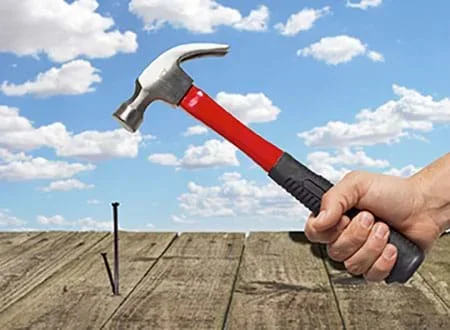 Figure 1. A nail is an example of a wedge.Copyright 2020 Tumisu, Public Domain, pixabay.com, https://pixabay.com/photos/hammer-nail-construction-carpenter-5318123/
The wedge can be used in a variety of ways, but its goal is to perform work on another object, allowing for work to be done more easily. When using the wedge in an engineering application, the choice of wedge material is critical. When performing the desired work, the tool or wedge must be strong enough to successfully complete the task without breaking. For example, if the wedge is used as a chiseling device to cut through another material, it is necessary to choose an appropriate wedge material based on the material being cut. If rock is being cut, the wedge must be made from a strong material. The wedge also gives us a mechanical advantage because it allows us to do more work over a desired distance. This means that while we may have to make more cuts to extract the work, we are gaining an advantage in the fact that we have to do less work overall than we would have to do if we tried to remove the rock by hand.
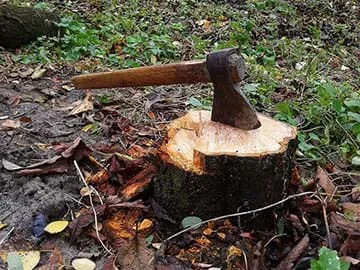 Figure 2. An axe is an example of a wedge.
When discussing the different types of wedge sharpness, or angle, it is important to understand the mechanical benefits of each type. Large wedge angles are good for cutting soft objects like splitting wood, but require a greater cutting force. Small wedge angles are good for cutting hard materials like rock and require a lower force.
There are also different types of wedges — both a single- and double-sided wedge. A single wedge is flat on one side with an angle on the other, like an inclined plane. A double wedge is angled on both sides, like an arrow point.
Wedges have many applications. They can be used to simply split a material, like an axe splitting firewood. Or, wedges can be used as fasteners and stoppers, such a zipper or door stop. Another use for the wedge is as a knife, for example, cutting through bread. Everyday wedge examples include an axe, nail, chisel, knife, fork, jackhammer, bulldozer, snow plow, zipper and the bow of a boat or ship.
We are chief engineers for the leader of ancient Egypt who has hired us to build a pyramid. We have already chosen the pyramid building site and we have made a final pyramid design. We have figured out what the dimensions of our stone blocks will be, calculated exactly how many stone blocks we will need, and estimated the timeline for the completion of our project. Since we have finished the planning stage, the next step for us is to begin the construction process.
We need to go to the quarry (the rock pit where we are going to get our stone), cut out the rock from the ground, shape the rock into the correct-sized stones, transport the stones to the site, and lift the stones into place. But how are we going to do all of these things?
Let's divide the entire job into smaller tasks and focus on the first two: cutting and shaping the rocks. Which of the simple machines do you think would be the best for cutting rocks? Would it be a lever, pulley, screw, wheel and axle, wedge or an inclined plane? (Review or refer to the different types of simple machines and lead the class to decide on a wedge to split things apart.) A variety of wedges made of different materials can be used as tools to break away the stones. The size of a wedge determines how big a rock you can remove from the quarry.
The rock is removed due to the forces applied onto it. A force causes an object, with mass, to move. Another word for this is acceleration. By focusing the force on a small area of the rock, and not all around it or equally from both sides, these unbalanced forces cause some of the rock's particles to move and shear, or slide apart.
No matter what location you chose for your building site, your quarry is likely to have a variety of different rock types within it. That is why it is necessary to have wedges made from different materials to effectively cut each rock type. It helps to understand the material properties of both the wedge and the material to be cut. Some large rocks are very hard and require a sharp and metallic wedge, while softer, clay-like rocks can be cut using wedges created from softer materials.
Pyramid stones were quite large, which means that the wedges would also have been large to be able to complete the task of removing rocks from the quarry. As a class, let's create a list of the different materials, or rocks, that you might come across in your quarry. For example, if your site is in the desert you will probably be working with sand, marble and clay, and you would not find the large boulders that would be present in a mountain quarry.
Now that you have thought through what types of rocks you expect to encounter, think about the size of the rock pieces you want to extract. The rock size determines the type of wedge to use. Can anyone give a description of the type of wedge tool they would want to use in their quarry? (This is a quick assessment to see how many students already know what a wedge is and how it works.)
The wedge can be used as a rock cutting tool; its sharpness determines how much work you will be able to complete using the tool. The sharper the tool, or wedge (for example, the smaller the angle), the less force a person must exert on the rock material being cut. A wedge enables you to split the rock material. Without a tool such as the wedge, it would be nearly impossible to extract large rocks from the quarry because you would not be able to do it by hand.
The wedge must be not only the correct sharpness, but it must be made from an appropriate material. If the wrong material is used the wedge may not work, or it may wear out too quickly.
The final important design decision that must be made when choosing a wedge is its width. A large width enables you to make larger cuts, creating larger building blocks, and possibly resulting in fewer total cuts. However, if you want to create smooth or perfect-shaped rocks, you will not be able to do your cutting with a large, bulky, heavy wedge. Cutting clean and accurate blocks requires using a smaller, sharper wedge, and means that you will have to make many more cuts to remove your rock.
These are all important considerations before you decide on your final block size and your wedge shape and material. These types of design decisions — and trade-offs — are always an important part of any engineering design.
Now that you know something about what a wedge is and how it works, can anyone think of a way that wedges are used in modern-day construction of skyscrapers? (Possible answers: Jackhammer, chisel, fork, nail, axe, saw, bulldozer, snow plow, etc.) Simple machines like wedges are still used today because we have designed ways to combine multiple simple machines together to make work even easier. Engineers still use wedges as a tool to cut material apart because it does its job well; however, we have come up with much stronger materials from which to make wedges. Today, wedge tools are made of metal that lets us cut much harder materials, allowing us to cut a lot more material before our wedge wears out or breaks. So, wedges have come a long way since pyramid building, but the reasons for which we use them are still the same.
Now that we have learned about wedges and how they were used in pyramid building we are going to complete a group activity to gain a better understanding of what it is like to design the best wedge to help construct your pyramid. (Refer to the associated activity Solid Rock to Building Block for more instructions.)
Wedges served an important purpose in pyramid building, and they are effective enough to still be used today. The modern version of the wedge tool used in pyramid rock quarries is the jackhammer, which is essentially a powered wedge. Have you ever heard a jackhammer being used? They are used sometimes to break up sidewalks or pavement. The rock or material is still removed in the same manner as with a manual wedge, just at a faster pace.
Engineers continue to use all of the simple machines because they help complete tasks that would never be able to be completed by hand. Imagine trying to build a pyramid without a wedge with which to cut the rock! Wow!
Conduct summary assessment activities as described in the Assessment section.
In other lessons of this unit, students study each simple machine in more detail and see how each could be used as a tool to build a pyramid or a modern building.
- angle
- The "sharpness" of a wedge.
- design
- (verb) To plan out in systematic, often graphic form. To create for a particular purpose or effect. Design a building. (noun) A well thought-out plan.
- engineering
- Applying scientific and mathematical principles to practical ends such as the design, manufacture and operation of efficient and economical structures, machines, processes and systems.
- force
- A push or pull on an object.
- inclined plane
- A simple machine that raises an object to greater height. Usually a straight slanted surface and no moving parts, such as a ramp, sloping road or stairs.
- material properties
- Characteristics of a material, such as texture, toughness, hardness, etc.
- mechanical advantage
- An advantage gained by using simple machines to accomplish work with less effort. Making the task easier (which means it requires less force), but may require more time or room to work (more distance, rope, etc.). For example, applying a smaller force over a longer distance to achieve the same effect as applying a large force over a small distance. The ratio of the output force exerted by a machine to the input force applied to it.
- quarry
- A pit from which rock or stone is removed from the ground.
- simple machine
- A machine with few or no moving parts that is used to make work easier (provides a mechanical advantage). For example, a wedge, wheel and axle, lever, inclined plane, screw, or pulley.
- split
- When material is pushed out of the way using a wedge.
- tool
- A device used to do work.
- wedge
- A simple machine that forces materials apart. Used for splitting, tightening, securing or levering. It is thick at one end and tapered to a thin edge at the other.
- work
- Force on an object multiplied by the distance it moves. W = F x d (force multiplied by distance).
Pre-Lesson Assessment
Open Discussion: To determine how much the students already know about wedges, conduct a class discussion about simple machines. Have the students suggest different examples of wedges (if they can) and list them on the board.
Post-Introduction Assessment
Design: Have the students design a wedge based on the type of rock that is in the quarry they chose from Simple Machines: Lesson 1. They should determine how large their wedge needs to be, how sharp it should be, and the material from which it will be made. They should be able to list or present to the class the reasons why they designed their wedge they way they did.
Note: When determining how large their wedge needs to be, students could sketch their wedge and measure their wedge angles in degrees using a protractor.
Lesson Summary Assessment
Numbered Heads: Have students on each team pick numbers (or number off) so each member has a different number. Ask the students a question (give them a time frame for solving it, if desired). The members of each team should work together to answer the question. Everyone on the team must know the answer. Call a number at random. Students with that number should raise their hands to give the answer. If not all the students with that number raise their hands, allow the teams to work a little longer. Ask the students:
- A wedge is ________. (Answer: A simple machine.)
- Write down an example of a wedge. (Possible answers: Chisels, nails, axes, saws, knife, screwdriver, zipper, etc.)
- What does a wedge do? (Answer: Pushes things apart.)
- What do you find in a quarry? (Answer: Rocks)
- A hard rock may need a (sharp and metal, soft and plastic) wedge to split in two. (Answer: Sharp and metal.)
- The sharper the wedge the (more, less) force you need to use on an object? (Answer: Less)
Discuss the use of a wedge as a blocker or stopper by introducing the concept of friction. For example, if you are pushing something heavy uphill and you need to stop and rest before you reach the top, a wedge can be slid under the edge of your load to keep it from slipping back down the hill. The friction between the ramp and the wedge is greater than the amount of force that is trying to pull the load back down the ramp. This is another example of how wedges do work. The wedge is exerting a force on the load and the ramp, and it is making the job much easier. As a student activity, have the students try wedging different-sized loads on different-angled hills and determine if one wedge works for all loads, or if engineers would need to create a variety of wedges appropriate to each situation.
Bochnacki, Andrzeh. 2005. O Piramidach Inaczeh. Andrzej Bochnacki (Polish engineer). Accessed January 18, 2006. (An excellent animation shows how heavy stone blocks might have been systematically moved up an incline plane using many human-powered wedges. Click on Site Map, then click on Transport on the Ramp.) http://www.swbochnacki.com/
Chephren's pyramid at Giza experimental results (image). LBNL Image Library Collection, Berkeley-Lab/Research, 1930-1990 Particle Physics, Magnet Vol. 13, No. 5, May 1969, p. 1. Accessed January 18, 2006. http://imglib.lbl.gov/ImgLib/COLLECTIONS/BERKELEY-LAB/RESEARCH-1930-1990/PARTICLE-PHYSICS/OTHER/index/96A04898.html
Construction of the Great Pyramid, Construction Theories. World-Mysteries.com. Accessed January 18, 2006. (Includes translated quotations from the ancient Greek historian Herodotus, and an excellent animation of the method of raising pyramid stone blocks, as described by Herodotus.) http://www.world-mysteries.com/mpl_2_1.htm#Machines
Kagan, Spencer. Cooperative Learning. Capistrano, CA: Kagan Cooperative Learning, 1994. (Source for Numbered Heads assessment)
Simple Machines. MIKIDS.com. Accessed January 18, 2006. http://www.mikids.com/Smachines.htm
Simple Machines Activities. Updated 2005. Edheads. Accessed January 18, 2006. http://edheads.org/activities/simple-machines/
Contributors
Lindsey Wright; Lawrence E. Carlson; Jacquelyn Sullivan; Malinda Schaefer Zarske; Denise Carlson
Supporting Program
Integrated Teaching and Learning Program, College of Engineering, University of Colorado Boulder
Acknowledgements
The contents of these digital library curricula were developed by the Integrated Teaching and Learning Program under National Science Foundation GK-12 grant no. 0338326. However, these contents do not necessarily represent the policies of the National Science Foundation, and you should not assume endorsement by the federal government.
Copyright
2005 by Regents of the University of Colorado.