
What is a Nanometer?
Students are introduced to the nano-size length scale as they make measurements and calculate unit conversions. They measure common objects and convert their units to nanometers, giving them a simple reference frame for understanding the very small size of nanometers. Then, they compare provided length data from objects too small to measure, such as a human hair and a flea, giving them a comparative insight to the nanotechnology scale. Using familiar and common objects for comparison helps students understand more complex scientific concepts.
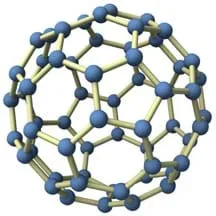 Bucky balls (or a C60 molecule) are extremely small. These strong, rigid molecules that form structures that resemble soccer balls are a major subject of nanotechnology research.Copyright 2010 James Hedberg. Free science images.
http://www.jameshedberg.com/scienceGraphics.php?sort=all&id=c60-buckyball-atoms-blue
Bucky balls (or a C60 molecule) are extremely small. These strong, rigid molecules that form structures that resemble soccer balls are a major subject of nanotechnology research.Copyright 2010 James Hedberg. Free science images.
http://www.jameshedberg.com/scienceGraphics.php?sort=all&id=c60-buckyball-atoms-blue
Engineers need to have a good sense in the scale of measurements. That is, be able to identify measurement, roughly, in conditions in which a measuring tape, ruler or other device is not available. Engineers must always pay close attention to units and correct conversions to ensure their mathematical and scientific relationships are equivalent from one measuring system to another. Making correct unit conversions are extremely important to the scientific and engineering community and are a fundamental type of calculation often overlooked by secondary school students.
After this activity, students should be able to:
- Make measurements using multiple measuring techniques.
- Perform unit conversions.
- Explain the nano-sized length scale as it compares to multiple references.
- CCSS.Math.Content.HSN-Q.A.1 Use units as a way to understand problems and to guide the solution of multi-step problems; choose and interpret units consistently in formulas; choose and interpret the scale and the origin in graphs and data displays.
Grades 9-12
Do you agree with this alignment?
- STEL-3F Apply a product, system, or process developed for one setting to another setting.
Grades 6-8
Do you agree with this alignment?
- collect data and make measurements with accuracy and precision;
Grades 10-12
Do you agree with this alignment? - express and manipulate chemical quantities using scientific conventions and mathematical procedures, including dimensional analysis, scientific notation, and significant figures;
Grades 10-12
Do you agree with this alignment?
Each group needs:
- two 12-inch rulers (alternatively, provide measuring tapes or meter sticks)
- two 12-in (30 cm) pieces of string
- 1 tennis ball or other round object (orange, apple, etc.)
- 1 pencil
- one 2-in x 2-in (5-cm x 5-cm) square of cardboard or paper
- 1-3 scientific calculators
- Measurement & Conversion Worksheet (PDF), one per student
Nanotechnology is the engineering of functional systems at the molecular scale. While these materials have been around for decades, only recently—because of our improved capability to see at that scale—have they received so much attention. However, traditional material science and physics cannot explain, nor see, phenomena that occur at their tiny length scale. With the birth of quantum mechanics, scientists and engineers are able to model and predict material behaviors at those length scales, yet it is all relatively new.
Nano materials are unique because of the relative size compared to the atomic scale. How small? At 100 nm, this is only 10 angstroms, which is ~5 times that of atom interatomic spacing in crystalline solids. This is extremely small and because of this relative size comparison, new interactions start occurring.
Before jumping into an investigation of the applications and improvements using nanotechnology, let's consider how small a nanometer is. The size description of a nanometer just given is not meaningful to someone who is not a material scientist or engineer. How small is the nano scale compared to tangible, familiar objects? A nanometer is expressed as 1 x 10⁻⁹m, which means 1 meter contains 1,000,000,000 nanometers. This number is one BILLION nanometers in one meter. To put this in perspective, 1 nanometer is to 1 meter as 1 km is to the distance between the Earth and Saturn. Or, 1 nanometer is 1 millionth the size of a SkittlesTM candy. Or, the thickness of one sheet of loose-leaf notebook paper is equivalent to ~100,000 nm.
To grasp and understand these distances, we will use practical, everyday references to understand the nanometer. Today, you will measure a series of objects and provide answer in nanometers. You will also compare nanometers to small known objects or living things. By the end of today's activity, you should have a firm grasp on this unique and important length scale.
Before the Activity
- Set out all supplies, except the worksheet, on a table.
- Make copies of the Measurement & Conversion Worksheet (PDF), one per student.
With the Students
- Divide the class into groups of three or four students each.
- Instruct students to double check that they have all supplies.
- Have student groups read the worksheet and proceed to take measurements, make unit conversions and answer the questions.
- Have students turn in their worksheets for grading.
- Conclude with a class discussion to compare results and realizations about the extreme smallness of the nano length scale.
- engineering
- Creating new things for the benefit of humanity and our world.
- nanometer
- Length measurement that is equal to 1 x 10^-9m.
Activity Embedded Assessment
Activity Worksheet: Have student teams use the attached Measurement & Conversion Worksheet (PDF) as they collect data and make conversion calculations. The worksheet guides students to record measurements and calibration steps, and it tests their knowledge of fractional comparisons and scaling factors. Expect students to complete the worksheet in class (showing their work) and turn it in for grading. Review their answers to gauge their mastery of the concepts.
Post-Activity Assessment
Closing Class Discussion: Lead a post-activity discussion to compare results and realizations about the extreme smallness of the nano length scale.
FDA Continues Dialogue on "Nano" Regulation. Last updated July 18, 2012. For Consumers, US Food and Drug Administration. Accessed September 26, 2012. (caption information on Bucky balls) http://www.fda.gov/ForConsumers/ConsumerUpdates/ucm258462.htm
Contributors
Marc Bird
Supporting Program
National Science Foundation GK-12 and Research Experience for Teachers (RET) Programs, University of Houston
Acknowledgements
This curriculum was created by the University of Houston's College of Engineering with the support of National Science Foundation GK-12 grant no. DGE 0840889. However, these contents do not necessarily represent the policies of the National Science Foundation, and you should not assume endorsement by the federal government.
Copyright
2013 by Regents of the University of Colorado; original © 2011 University of Houston