
Magnetic Fluids
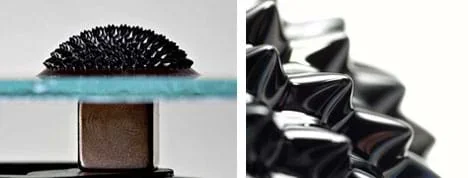 A ferrofluid on a reflective glass plate under the influence of a strong magnet underneath.Copyright 2006 Gregory F. Maxwell (left) and 2008 Opoterser (right) http://commons.wikimedia.org/wiki/File:Ferrofluid_Magnet_under_glass_edit.jpg http://commons.wikimedia.org/wiki/File:Ferrofluid_close.jpg
In this fun, engaging activity, students are introduced to a unique type of fluid—ferrofluids—whose shape can be influenced by magnetic fields! Students act as materials engineers and create their own ferrofluids. They are challenged to make magnetic ink out of ferrofluids and test their creations to see if they work. Concurrently, they learn more about magnetism, surfactants and nanotechnology. As they observe fluid properties as a standalone-fluid and under an imposed magnetic field, they come to understand the components of ferrofluids and their functionality.
Around since the 1960s, ferrofluids have been used as audio speaker coolants and high-end engineering seals. Dynamic rotary shaft seals are an example of high-end sealing technologies that are typically implemented by mechanical engineers in an industrial plant setting. Recently, this technology has been a topic of research involving nanoparticle suspensions and engineering design so they have greater magnetic properties under moderate magnetic fields. Materials engineers have developed new nanomaterials for medical applications targeted towards localized drug delivery systems by induced magnetic fields. Materials engineers use basic chemistry and physics fundamentals as well as newly acquired nanoscience concepts to introduce particles small enough to transport through capillary systems and organs and have sufficient magnetization. Additionally, materials and biochemical engineers design biocompatible and biodegradable organic coatings that reduce toxicity levels and biochemical reactions that may occur with magnetic nanomaterials inside human or animal bodies. Most importantly, the fluid must behave like a fluid until a magnetic field is applied.
After this activity, students should be able to:
- Explain magnetism theory.
- Describe the role of each ferrofluid ingredient.
- Describe the unique behavior of ferrofluids under the influence of magnetic fields.
- Describe applications and uses for ferrofluids.
- STEL-1Q Conduct research to inform intentional inventions and innovations that address specific needs and wants.
Grades 9-12
Do you agree with this alignment?
- HS-PS2-6 Communicate scientific and technical information about why the molecular-level structure is important in the functioning of designed materials.
Grades 9-12
This resource focuses on the following Three Dimensional Learning aspects of NGSS:
Science & Engineering Practices- Communicate scientific and technical information (e.g. about the process of development and the design and performance of a proposed process or system) in multiple formats (including orally, graphically, textually, and mathematically).Do you agree with this alignment?
Disciplinary Core Ideas- Attraction and repulsion between electric charges at the atomic scale explain the structure, properties, and transformations of matter, as well as the contact forces between material objects.Do you agree with this alignment?
Crosscutting Concepts- Investigating or designing new systems or structures requires a detailed examination of the properties of different materials, the structures of different components, and connections of components to reveal its function and/or solve a problem.Do you agree with this alignment?
Do you agree with this alignment? - Communicate scientific and technical information (e.g. about the process of development and the design and performance of a proposed process or system) in multiple formats (including orally, graphically, textually, and mathematically).
- describe the nature of metallic bonding and apply the theory to explain metallic properties such as thermal and electrical conductivity, malleability, and ductility; and
Grades 10-12
Do you agree with this alignment?
Each group needs:
- 25 ml test tube with a stopper or threaded lid
- 1, 0.5-inch diameter x 0.250-inch thick rare earth neodymium disc magnet (such as part number NSN0641, quantity 8 for $13 at: https://www.magcraft.com/disc-magnets)
- glass stir rod, or Popsicle® stick
- duct or electrical tape (if using a stopper)
- 1 empty fountain pen/ink applicator
- blank sheet of paper
- apron and goggles (for each student)
- (optional) latex gloves (for each student; toner may stain skin and clothes)
- lab glass wear, such as a 200 ml beaker
- Magnetic Fluids Worksheet (PDF), one per student
To share with the entire class:
- 250 ml beaker
- 1 bottle MICR toner powder refill (such as HP C4127 #27, 500 g bottle, $36 at: https://www.inkowl.com/laser/micr-refill-kits/hp/1-micr-toner-refill-for-use-in-hp-c4127-27-c4129-29-c8061-61/P3305/) NOTE: Refill bottle lasts for multiple liquid magnet activities.
- 1 bottle vegetable oil (available at grocery stores)
- graduated cylinders, for measuring oil and toner
Students should have had an introduction to nanotechnology, its scale, characteristics and applications, as presented in the two lessons of this unit, Nanotechnology as a Whole and Fun with Nanotechnology, including their PowerPoint presentation and worksheet.
Materials can react quite differently to the presence of an external magnetic field. Most materials fall into three categories by their response to externally applied magnetic fields: paramagnetic, diamagnetic and ferromagnetic. What might be the differences between these three categories of magnetic materials? (Listen to student ideas.) Well, their magnetic responses differ greatly in strength. Diamagnetic materials create a magnetic field, a very weak one, in opposition to an externally applied magnetic field. This is a property of most materials in the periodic table, including copper, silver and gold. Paramagnetism is stronger than diamagnetism and produces magnetization in the direction of the applied field, and proportional to the applied field. Examples are magnesium, molybdenum, lithium and tantalum. Ferromagnetic materials exhibit the largest magnetic permeability—very large—producing magnetizations often orders of magnitude greater than the applied field, thus much larger than either diamagnetic or paramagnetic effects. Examples of ferromagnetic materials are cobalt, iron and nickel.
As the name suggests, ferrofluids are composed of ferromagnetic particles, a surfactant and a carrier fluid. Ferromagnetic particles are used because of their large magnetic permeability, as compared to other classifications of magnets. Essentially, the resultant magnetic field is orders of magnitude larger than the induced magnetic field, which becomes important when manipulating ferrofluids under moderate and controlled magnetic fields.
What ingredients are found in ferrofluids? (Listen to see if students heard you mention this earlier.) Typical ferromagnetic materials consist of iron-, nickel- and cobalt-based metals and occasional rare earth materials. Ferromagnetism is caused by a long-range atomic scale ordering that causes unpaired electrons to align parallel with each other in a domain. These domains, or regions of magnetic alignment, are randomly oriented and confined within the bulk material, leading to a net magnetic field of zero. However, under an external magnetic field, these domains align, causing an amplification of the applied magnetic field. These domains created under atomic scale long-range ordering may span over large numbers of atoms. However, to make a ferromagnetic material fluid, for our purposes, would require melting the metal. Under such conditions, typical ferromagnetic alloys have melting points in excess of the point when ferromagnetic properties transition to paramagnetic. This transition is denoted as the Curie temperature.
As a material scientist, these principles become important when developing a magnetic fluid. The challenge is making a fluid magnetic without exceeding the materials' Curie point. Scientists have developed paramagnetic salt solutions for magnetic fluids. These fluids exhibit less-than-adequate magnetic permeability, which would be expected, considering paramagnetic materials have a magnetic permeability far less than a ferromagnetic material. This is where nanomaterials become increasingly important.
To meet such a challenge, scientists and engineers have developed ferromagnetic nanoparticles, which are approximately 10 nm in diameter, but small enough to be suspended in various carrier fluids. Such suspension could be considered colloidal. Additionally, the size of each nanoparticle is on the order of a few atoms in diameter, which creates a single magnetic domain particle. That means that each nanoparticle is its own permanent magnet suspended in the carrier fluid. With a suitable surfactant to prevent particle agglomeration, the suspension can be manipulated under a controlled moderate magnetic field.
Do you have any ideas for useful applications of these materials? These magnetic fluids have received considerable attention over the last few decades with applications geared towards rotary shaft sealing and audible speaker cooling systems. More recently, ferrofluids have been applied to cancer treatments and drug delivery systems. Cancer treatment methods use the heating effect of alternating magnetic fields and the energy lost from such cycling. For drug delivery systems, magnetic drugs with a suitable surfactant are injected into the blood stream and manipulated with external magnetic fields to localize treatment to a particular human system. The medical treatment advancements are only limited by the ability to create non-toxic, biologically compatible, magnetic particles.
In this activity, you are acting as a materials engineer, creating your own ferrofluid. Your challenge: To make a magnetic ink that you can write with and test to see if it works. Use your observation skills and newly found knowledge of ferrofluids to complete the worksheet. Good luck!
Before the Activity
- Place all lab supplies out and available to students.
- Separate and measure the MICR toner and oil for each group: 50 ml toner, 30 ml vegetable oil. Alternatively, allow time for students to do this as part of the activity:
- Make copies of the Magnetic Fluids Worksheet (PDF), one per student.
With the Students—Overall Procedure
- Divide the class into groups of three or four students each. Hand out the worksheets.
- Instruct students to obtain and review the activity supplies.
- Have students read the worksheet, follow its instructions and answer its questions.
- Have students turn in their worksheets for grading.
- Conclude with a class discussion to compare results and conclusions.
Ferrofluid Fabrication Procedure (Parts 1 and 2)
- Pour 50 ml of MICR toner into a 200 ml beaker.
- Pour 30 ml of vegetable oil into the 200 ml beaker.
- Stir the mixture until it has a light, smooth texture.
- Carefully, pour the fluid into an empty test tube and seal with a lid or stopper.
- Answer the Part 2 worksheet questions.
Magnetic Ink Procedure (Part 3)
- Remove the stopper from the test tube. Make sure not to spill any fluid.
- Dip the fountain pen (ink applicator) into the test tube and allow the fluid to seep onto its tip.
- Remove the fountain pen and begin writing on a blank piece of paper.
- Allow the paper to dry for 10 minutes.
- While it is drying, complete Part 4 on the worksheet.
- Once dry, test your ink using the permanent magnet, and then complete Part 3 questions.
Alternative Magnetic Ink Procedure
- Place the permanent magnet under the paper and pour a small amount of fluid over the magnet.
- Using your hands, manipulate the magnet and fluid, making symbols, pictures, etc.
Fun with Ferrofluids Procedure (Part 4)
- Place the stopper back on the test tube top, if not already on it.
- Using tape, securely fasten the stopper to the test tube.
- Feel free to move the liquid around and play with the permanent magnet.
- Answer the worksheet questions for this section.
- colloidal
- A chemical system in which a continuous liquid phase exists with a solid phase suspended in the liquid.
- curie point
- The temperature at which ferromagnetism is lost due to excessive thermal agitation.
- diamagnetic
- A material with no unpaired electrons. Electron alignment within a domain causes counter currents opposing an external applied magnetic field.
- domain
- A region where unpaired electrons are aligned parallel, creating a magnetic field.
- ferrofluid
- Ferromagnetic particles suspended in a carrier fluid with the aid of a surfactant.
- ferromagnetic
- Long-range ordering phenomenon at the atomic level that causes unpaired electron spins to line up parallel with each other in a domain.
- magnetic permeability
- A measure of a material's ability to sustain a magnetic field.
- paramagnetic
- Magnetism by an externally applied magnetic field.
- surface tension
- An increased attraction of molecules at the surface of a liquid resulting from forces of attraction on fewer sides of the molecules.
- surfactant
- A chemical that acts as a wetting agent to lower the surface tension of a liquid and improve spreadability.
Activity Embedded Assessment
Worksheet: Use the attached Magnetic Fluids Worksheet (PDF) as a teaching aid for students to record all observations during the activity. The worksheet questions are designed to stimulate students' critical thinking of this topic; they are asked to answer questions related to both magnetism and chemistry, with a main focus on the importance of scientific observations. Expect students to finish the worksheet in class.
Post-Activity Assessment
Presentation: Have students prepare posters containing scientific and technical information about the molecular-level structure of the magnetic particles in the solution and how this structure relates to the magnetic properties of the engineered ferrofluid.
Worksheet: Have students turn in their completed worksheets for grading. Review their answers to gauge their mastery of the concepts.
Closing Class Discussion: Lead a post-activity discussion to compare results and conclusions, including answers to the worksheet questions and real-life examples.
- Ingredients used in this activity are harmless when exposed to skin in standard form. However, as with all laboratory practices, read the material safety data sheets prior to conducting the activity.
- All students should wear aprons and goggles when conducting this activity.
- Caution: Toner may stain skin and clothes; consider wearing latex gloves.
- Dispose of toner/oil mixtures into a trash can.
Show students the many short and amazing "ferrofluid sculptures" videos on YouTube
Benson, Harris. University Physics - Revised Edition. New York, NY: John Wiley & Sons, Inc., 1995, pp. 662-667.
Diamagnetic, Paramagnetic and Ferromagnetic Materials. NDT Education Resource Center, Iowa State University. Last accessed September 27, 2012. http://www.ndt-ed.org/EducationResources/CommunityCollege/MagParticle/Physics/MagneticMatls.htm
Magnetic Properties of Solids. Last updated February 19, 2006. Department of Physics & Astronomy, Georgia State University. Last accessed September 27, 2012. http://hyperphysics.phy-astr.gsu.edu/hbase/solids/magpr.html
Odenbach, Stefan. Ferrofluids: magnetically controllable liquids. Published March 18, 2002. Proceedings in Applied Mathematics and Mechanics. Vol. 1, Issue 1, pp. 28-32. Accessed September 27, 2012. http://onlinelibrary.wiley.com/doi/10.1002/1617-7061(200203)1:1%3C28::AID-PAMM28%3E3.0.CO;2-8/abstract
Ruuge, E.K. and A.N. Rusetski, Magnetic fluids as drug carriers: Targeted transport of drugs by a magnetic field. Published 1993. Journal of Magnetism and Magnetic Materials. Vol. 122, Issue 1-3, pp. 335-339. Accessed September 27, 2012. http://adsabs.harvard.edu/abs/1993JMMM..122..335R
Contributors
Marc Bird
Supporting Program
National Science Foundation GK-12 and Research Experience for Teachers (RET) Programs, University of Houston
Acknowledgements
This curriculum was created by the University of Houston's College of Engineering with the support of National Science Foundation GK-12 grant no. DGE 0840889. However, these contents do not necessarily represent the policies of the National Science Foundation, and you should not assume endorsement by the federal government.
Copyright
2013 by Regents of the University of Colorado; original © 2011 University of Houston