
NanoTech: Insights into a Nano-Sized World
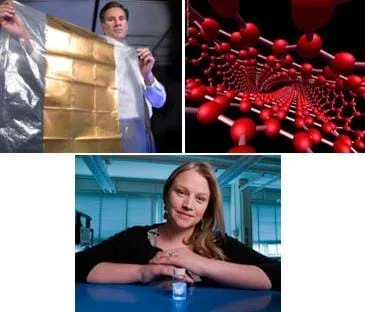 Nanotechnology is a rapidly growing branch of material science with many applications in a range of disciplines. (left to right) A man holds a sheet of nanoantenna arrays designed to harvest solar energy, a drawing shows the path of molecular flow through a nanotube, and a researcher with quantum dots—ultra-small light beacons with specialized optical properties.Copyright Idaho National Laboratory; Vin Crespi, Pennsylvania State Physics [PD} via National Science Foundation; Research.gov
https://inlportal.inl.gov/portal/server.pt?open=514&objID=1269&mode=2&featurestory=DA_101047
http://www.nsf.gov/news/news_images.jsp?cntn_id=117862&org=NSF
http://www.research.gov/research-portal/appmanager/base/desktop?_nfpb=true&_windowLabel=researchAreas_11&_urlType=action&researchAreas_11_action=selectAwardDetail&researchAreas_11_id=%2FresearchGov%2FAwardHighlight%2FPublicAffairs%2F23578_Ultra-smallLightBeaconsDetectUltra-lightParticles.html
Nanotechnology is a rapidly growing branch of material science with many applications in a range of disciplines. (left to right) A man holds a sheet of nanoantenna arrays designed to harvest solar energy, a drawing shows the path of molecular flow through a nanotube, and a researcher with quantum dots—ultra-small light beacons with specialized optical properties.Copyright Idaho National Laboratory; Vin Crespi, Pennsylvania State Physics [PD} via National Science Foundation; Research.gov
https://inlportal.inl.gov/portal/server.pt?open=514&objID=1269&mode=2&featurestory=DA_101047
http://www.nsf.gov/news/news_images.jsp?cntn_id=117862&org=NSF
http://www.research.gov/research-portal/appmanager/base/desktop?_nfpb=true&_windowLabel=researchAreas_11&_urlType=action&researchAreas_11_action=selectAwardDetail&researchAreas_11_id=%2FresearchGov%2FAwardHighlight%2FPublicAffairs%2F23578_Ultra-smallLightBeaconsDetectUltra-lightParticles.html
Lesson 1 provides an overview of nanotechnology as a new frontier in material science and engineering and how it has become important to technological advances in our society. Topics covered include an introduction to nanotechnology and its history, the nano-size length scale, types of nano phenomena and properties, real-world applications, research technologies and consumer goods that use nanotechnology and misconceptions about nanotechnology. A PowerPoint presentation is included to introduce the topics. In the associated activity, students make measurements of common objects and convert their units into nanometers, cultivating an understanding of the very small size of the nano world.
Lesson 2 introduces students to specific fields and applications in nanoscience through the use of three mini laboratory exercises. A teacher demo piques their interest in the odd and intriguing nano-material behaviors they witness with ferrofluids, quantum dots, and gold nanoparticles, before conducting three hands-on activities on those topics. Each activity includes a student worksheet.
Working in the field of nanosciences involves the use of advanced techniques and a thorough understanding of material science and engineering. In addition, material scientists specializing in nanotechnology are posed with challenging problems that require a different thinking from conventional, "micro-scaled," materials thinking. This unit introduces and reduces these "advanced techniques" to a level appropriate for teenagers using the approach of teaching the basic principles of materials and colloids, including their magnetic, photoelectric and chemical properties. Current research on the examples investigated—ferrofluids, quantum dots and gold nanoparticles—shows that they have significant impacts in biomedical applications (biosensors), consumer products (electronic devices) and industrial applications (solar energy).
- Research and development is a specific problem-solving approach that is used intensively in business and industry to prepare devices and systems for the marketplace.
Grades 9-12
Do you agree with this alignment?
- HS-PS2-6 Communicate scientific and technical information about why the molecular-level structure is important in the functioning of designed materials.
Grades 9-12
This resource focuses on the following Three Dimensional Learning aspects of NGSS:
Science & Engineering Practices- Communicate scientific and technical information (e.g. about the process of development and the design and performance of a proposed process or system) in multiple formats (including orally, graphically, textually, and mathematically).Do you agree with this alignment?
Disciplinary Core Ideas- Attraction and repulsion between electric charges at the atomic scale explain the structure, properties, and transformations of matter, as well as the contact forces between material objects.Do you agree with this alignment?
Crosscutting Concepts- Investigating or designing new systems or structures requires a detailed examination of the properties of different materials, the structures of different components, and connections of components to reveal its function and/or solve a problem.Do you agree with this alignment?
Do you agree with this alignment? - Communicate scientific and technical information (e.g. about the process of development and the design and performance of a proposed process or system) in multiple formats (including orally, graphically, textually, and mathematically).
- Day 1: Nanotechnology as a Whole lesson
- Day 2: What is a Nanometer? activity
- Day 3: Fun with Nanotechnology lesson
- Day 4: Magnetic Fluids activity and Nanoparticles & Light Energy Experiment: Quantum Dots and Colors activity
- Day 5-6: Thirsty for Gold activity
- NanoTech: Insights into a Nano-Sized World
See a concise, introductory 22-slide presentation by the National Cancer Institute called, "What is Nanotechnology?' that covers the nanoscale and its unique characteristics, potential benefits, various nanodevices including nanopores, quantum dots, and gold nanoshells, and designing nanodevices for the body and medical applications: http://www.cancer.gov/cancertopics/understandingcancer/nanodevices/AllPages
Supporting Program
National Science Foundation GK-12 and Research Experience for Teachers (RET) Programs, University of Houston
Acknowledgements
This curriculum was created by the University of Houston's College of Engineering with the support of National Science Foundation GK-12 grant no. 0840889. However, these contents do not necessarily represent the policies of the National Science Foundation, and you should not assume endorsement by the federal government.
Copyright
2013 by Regents of the University of Colorado; original © 2011 University of Houston