
Nanotechnology as a Whole
 A 3D axial view down the center of a carbon nanotube.Copyright 2010 James Hedberg. Used with permission.
http://www.jameshedberg.com/scienceGraphics.php?sort=all&id=carbon-nanotube-3D-model-axial
A 3D axial view down the center of a carbon nanotube.Copyright 2010 James Hedberg. Used with permission.
http://www.jameshedberg.com/scienceGraphics.php?sort=all&id=carbon-nanotube-3D-model-axial
Students are given a general overview of nanotechnology principles and applications, as well as nanomaterials engineering. Beginning with an introductory presentation, they learn about the nano-scale concept and a framework for the length scales involved in nanotechnology. Engineering applications are introduced and discussed. This prepares students to conduct the associated activity in which they relate the nano-length scale to everyday objects. At completion, students are able to identify nanotechnology applications and have a frame of reference for the second lesson of the unit.
Working in the fields of nanotechnology and engineering requires an understanding of many classical materials engineering principles and fundamentals. However, due to the very small length scale, some classical fundamentals break down and new physics is necessary to fully understand nanotechnology. It is important for students to learn that to produce such technological applications, existing science has been modified to describe and replicate unique behaviors found at the extremely small scale. In addition, because of their small size, nanoscale devices can readily interact with human cells. With access to so many areas of the body and their unique behaviors, they have the potential to detect disease and deliver treatment in ways never unimagined.
After this lesson, students should be able to:
- Describe ways nanotechnology is expected to influence society.
- List key areas of research in the nanotechnology field and real-world applications.
- Explain the length scale of nanotechnology relative to traditional length scales.
- Convert measurements to different units.
- Students will develop an understanding of the role of society in the development and use of technology.
Grades K-12
Do you agree with this alignment? - Students will develop an understanding of the relationships among technologies and the connections between technology and other fields of study.
Grades K-12
Do you agree with this alignment? - STEL-3F Apply a product, system, or process developed for one setting to another setting.
Grades 6-8
Do you agree with this alignment?
- HS-PS2-6 Communicate scientific and technical information about why the molecular-level structure is important in the functioning of designed materials.
Grades 9-12
This resource focuses on the following Three Dimensional Learning aspects of NGSS:
Science & Engineering Practices- Communicate scientific and technical information (e.g. about the process of development and the design and performance of a proposed process or system) in multiple formats (including orally, graphically, textually, and mathematically).Do you agree with this alignment?
Disciplinary Core Ideas- Attraction and repulsion between electric charges at the atomic scale explain the structure, properties, and transformations of matter, as well as the contact forces between material objects.Do you agree with this alignment?
Crosscutting Concepts- Investigating or designing new systems or structures requires a detailed examination of the properties of different materials, the structures of different components, and connections of components to reveal its function and/or solve a problem.Do you agree with this alignment?
Do you agree with this alignment? - Communicate scientific and technical information (e.g. about the process of development and the design and performance of a proposed process or system) in multiple formats (including orally, graphically, textually, and mathematically).
- Science concepts. The student knows that relationships exist between the structure and properties of matter. The student is expected to:
Grades 9-10
Do you agree with this alignment? - explore technology applications of atomic, nuclear, and quantum phenomena such as nanotechnology, radiation therapy, diagnostic imaging, and nuclear power.
Grades 9-12
Do you agree with this alignment?
Students must be able to operate a basic scientific calculator, take measurements using measuring tapes, sticks or string, and complete unit and place value conversions.
Nanotechnology is a rapidly growing market that is impacting all facets of society through consumer products, energy solutions, and biochemical and medical solutions. Market research indicates that by 2015, nanotechnology goods are expected to gross $2.5 trillion. This substantial amount of growth over a short period of time is expected to stimulate demand for more material science experts. Since 2006, the number of products that include nanotechnologies, or at least some form (nanoparticles), have nearly quadrupled and continues to increase. This includes breakthroughs in medical treatments and renewable energy technologies. Most notable are cancer treatment methods with an emphasis on gold nanoshells; clinical trials have already begun. Nanoscience, nanotechnology and the future are here.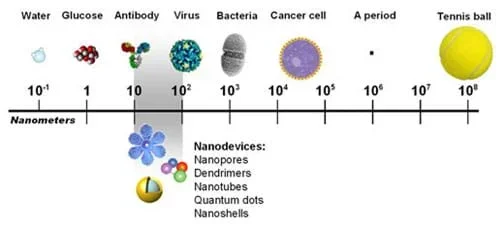 Nanoscale devices are 100 to 10,000 times smaller than human cells. That means that nanoscale devices smaller than 50 nanometers can easily enter most cells, while those smaller than 20 nm can move out of blood vessels as they circulate through the body.Copyright National Cancer Institute http://nano.cancer.gov/learn/understanding/
Nanotechnology is the engineering of functional systems at the molecular scale. While these materials have been around for decades, only recently—because of our improved capability to see at that scale—have they received so much attention. However, traditional material science and physics cannot explain, nor see, phenomena that occur at their tiny scale. With the birth of quantum mechanics and electron microscopes, engineers are able to model, predict and visually design specific material behaviors at those length scales. Nano materials are unique because of the relative size compared to the atomic scale. How small? The thickness of one sheet of loose-leaf notebook paper is equivalent to ~100,000 nm. This is extremely small and because of this relative size comparison, new interactions start occurring. All this is meaningless if one cannot visualize or comprehend how small the nano scale is in comparison to tangible, familiar objects. To start envisioning this scale, one nanometer is 1 millionth the size of a SkittleTM candy. Refer to the associated activity What is a Nanometer? so students obtain a simple reference framework to the nano-size length scale by measuring everyday objects and converting their length units to nanometers.
Note: The attached PowerPoint presentation provides information on topics such as: What is nanotechnology? What does nano really mean? and How old is nanotechnology? Other topics in the presentation include: types of nano phenomena, single-walled carbon nanotubes, SWNT properties and applications, the world's smallest radio, quantum dots and applications; ferrofluids (magnetic fluids) and applications, nano shells, gold nanoshell synthesis, nanoshell applications, misconceptions about nanotechnology, and consumer uses and projections.
(Be ready to show students the attached 21-slide Introduction to Nanotechnology Presentation (PPTX) PowerPoint file. In advance of class, make sure to download some of the PowerPoint images into the slides; see notes in the PowerPoint file. Ask students the following questions to stimulate their thinking about the topic of nanotechnology. Survey students' knowledge prior to giving the attached presentation. Expect the introduction and presentation to not exceed 25 minutes.)
What is nanotechnology? (Listen to student ideas and definitions.) Nanotechnology' is the engineering of functional systems at the molecular scale. How small is that!? Nanotechnology refers to the projected ability to construct items from "the bottom up," using techniques and tools being developed today to make complete, highly advanced products.
What types of technologies and goods (products, services) do you think nanotechnology is a part of? (Listen to student suggestions. Make a list on the board.) Examples: Car bumpers (nanocomposites), sporting goods (golf clubs, tennis rackets), quantum dots (optical beacons), cancer treatment, antibacterial dressings, photovoltaic devices (solar cells), sunscreens (similar to solar cells; want to absorb UV light), protein tracking, stain-repellant fabrics, rocket propellants, synthetic bone, organic light-emitting diodes (telephone and radio screens), nanostructured materials for engineering applications, nanocatalysts, filters.
(Proceed to show students the attached PowerPoint presentation.)
- crystalline
- A solid with a periodic arrangement of atoms that make-up crystals.
- engineer
- A person who applies her/his understanding of science and math to creating things for the benefit of humanity and our world.
- nanometer
- Length measurement that is equal to 1 x 10^-9m.
Opening Questions: Survey students' knowledge about nanotechnology by asking them the following questions before showing the attached presentation. Listen to student ideas, definitions and suggestions. See the Introduction/Motivation section for discussion points and answers.
- What is nanotechnology?
- What types of technologies and goods (products, services) do you think nanotechnology is a part of?
Closing Questions: At lesson conclusion, ask students to take five minutes and write out and hand in their own answers to the following questions. Review their answers to gauge their comprehension of the material presented.
- What is nanotechnology?
- What are some example products and technologies that take advantage of nanotechnology?
Research: Have students research online articles on nanotechnology and write a summary to share with the class.
Sanders, Robert. "Single Nanotube Makes World's Smallest Radio." October 31, 2007. University of California-Berkeley. Accessed October 10, 2012. http://berkeley.edu/news/media/releases/2007/10/31_NanoRadio.shtml
Contributors
Marc Bird
Supporting Program
University of Houston, NSF GK-12 and Research Experience for Teachers (RET) Programs
Acknowledgements
This curriculum was created with the support of National Science Foundation GK-12 grant no. 0840889. However, these contents do not necessarily represent the policies of the National Science Foundation, and you should not assume endorsement by the federal government.
Copyright
2013 by Regents of the University of Colorado; original © 2012 University of Houston