
Thirsty for Gold
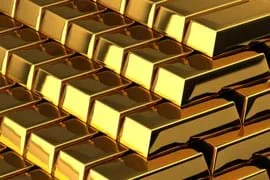 The phenomenon called surface plasmon resonance explains the brilliant, shiny "gold" color of bulk gold.Copyright 2004 Microsoft Corporation, One Microsoft Way, Redmond, WA 98052-6399 USA. All rights reserved.
Student teams conduct an experiment that uses gold nanoparticles as sensors of chemical agents to determine which of four sports drinks has the most electrolytes. In this way, students are introduced to gold nanoparticles and their influence on particle or cluster size and fluorescence. They also learn about surface plasmon resonance phenomena and how it applies to gold nanoparticle technologies, which touches on the basics of the electromagnetic radiation spectrum, electrolyte chemistry and nanoscience. Using some basic chemistry and physics principles, students develop a conceptual understanding of how gold nanoparticles function. They also learn of important practical applications in biosensing.
Gold nanoparticles have been used for centuries to make vibrant stained-glass colors. More recently, engineers have developed applications in the field of biosensing. Because of their inherently small size, nanoparticles exhibit superior surface controlled electronic and optical properties. They also allow for easy surface manipulation to engineer surfaces for particular applications. Engineers have developed many methods for attracting particular DNA base, controlling surface charge for cation/anion attraction and created biological coatings to bind to particular hormones.
After this activity, students should be able to:
- Describe how nanoscale gold interacts with light differently than bulk gold.
- Explain how the color of gold nanoparticle solutions is dependent on particle or cluster size.
- Explain how nanoscale gold can be used for sensing chemical and biological agents.
- STEL-1Q Conduct research to inform intentional inventions and innovations that address specific needs and wants.
Grades 9-12
Do you agree with this alignment?
- HS-PS2-6 Communicate scientific and technical information about why the molecular-level structure is important in the functioning of designed materials.
Grades 9-12
This resource focuses on the following Three Dimensional Learning aspects of NGSS:
Science & Engineering Practices- Communicate scientific and technical information (e.g. about the process of development and the design and performance of a proposed process or system) in multiple formats (including orally, graphically, textually, and mathematically).Do you agree with this alignment?
Disciplinary Core Ideas- Attraction and repulsion between electric charges at the atomic scale explain the structure, properties, and transformations of matter, as well as the contact forces between material objects.Do you agree with this alignment?
Crosscutting Concepts- Investigating or designing new systems or structures requires a detailed examination of the properties of different materials, the structures of different components, and connections of components to reveal its function and/or solve a problem.Do you agree with this alignment?
Do you agree with this alignment? - Communicate scientific and technical information (e.g. about the process of development and the design and performance of a proposed process or system) in multiple formats (including orally, graphically, textually, and mathematically).
- investigate and analyze characteristics of waves, including velocity, frequency, amplitude, and wavelength, and calculate using the relationship between wavespeed, frequency, and wavelength;
Grades 9-12
Do you agree with this alignment? - understand the electromagnetic spectrum and the mathematical relationships between energy, frequency, and wavelength of light;
Grades 10-12
Do you agree with this alignment? - describe the nature of metallic bonding and apply the theory to explain metallic properties such as thermal and electrical conductivity, malleability, and ductility; and
Grades 10-12
Do you agree with this alignment? - distinguish between types of solutions such as electrolytes and nonelectrolytes and unsaturated, saturated, and supersaturated solutions;
Grades 10-12
Do you agree with this alignment?
Each group needs:
- 20 ml gold colloid (have students synthesize these gold nanoparticles using supplies listed below and instructions in the Procedure section; alternatively: purchase the gold nanoparticles—see suggested source below, or ask for a small supply from your local university)
- Gatorade IceTM (colorless flavor), 2 drops
- pickle juice with little color, 2 drops
- Pedialyte® (flavorless), 2 drops
- PowerAdeTM (any colorless flavor), 2 drops
- 4 1-dram glass vials (at https://www.sks-bottle.com/340c/fin11a.html or https://www.amazon.com/Glass-Vials-Dram-Pack-12/dp/B002JV6976)
- 4 disposable plastic pipets
- glass waste container with screw-top lid
- gloves and goggles for each student
- Thirsty for Gold Worksheet (PDF), one per student
Supplies for gold nanoparticle fabrication by teacher for the entire class:
- 20 ml of 1.0 mM HAuCl4, gold (III) chloride hydrate; for example, part #244169-500 mg for $98 at www.sigmaaldrich.com. NOTE: To make 20 ml solution of 1.0 mM HAuCl4, dissolve 7 mg of solid gold (III) chloride hydrate in distilled water.
- 2 ml of 38.8 mM Na3C6H5O7, sodium citrate anhydrous; for example, part #W302600-Sample K for $40 at www.sigmaaldrich.com. NOTE: to make 2 ml of 38.8 mM sodium citrate anhydrous, dissolve 14.86 mg of solid Na3C6H5O7 in 2 ml of distilled water.
- stirring hot plate
- magnetic stir bar
- distilled water, 50 ml (this is water for the above solution preparation and additions as solutions boil)
- (optional) refrigerator, for cooling solution, and fume hood
To purchase gold nanoparticles (or ask for a small supply from your local university biochemistry or chemistry programs):
- Get enough for 20 ml gold colloid per group
- Example source of gold colloid: part #752568 for $298 at www.sigmaaldrich.com. NOTE: It is much less expensive to source raw chemicals and make solutions, and raw materials last for multiple activities.
Students must be able to perform simple algebra. It is also helpful if students have been introduced to basic physics involving wavelengths and frequencies.
Since ancient times, gold and silver nanoparticles have been used for staining glass with intense colors. In fact, it is recorded that ancient Romans used gold colloid for this very purpose. This is just one example in which nanomaterials have been around of for hundreds of years, but only recently have we been able to see and control this technology at its very small length scale. Why is gold so special?
Gold, in its bulk form is a very intense yellow appearance and similarly silver is very reflective or white color. This is explained as a phenomenon called surface plasmon resonance (SPR). Although it sounds complicated, it is easy to understand if you visualize electron interactions resulting from metallic bonding. Because metallic bonding does not require sharing of valence electrons and that sub-shell energy levels are filled, free electrons become present in the atomic structure. This is why metals are superior electrical conductors. Free electrons are present, in the form of a cloud, facilitating easy transport of such electrons when perturbed by a potential. This electron cloud also influences the optical properties of metallic metals. Imagine a cloud of moving electrons surrounding the atoms in a metallic material. According to quantum mechanics, these electrons exhibit two behaviors, depending on the experimental technique, particles or waves; this is known as particle-wave duality. If we imagine electrons as waves, they have some sort of associated energy level, which is inversely proportional to their wavelengths. What if this characteristic wavelength was equal to a particular incident light wavelength? Only that portion of light energy with equal wavelengths can be absorbed by the electron cloud. When this occurs, a resonance or electron cloud vibration commences dissipating energy. The remaining wavelengths of light are reflected off of the electron cloud. This process occurs only at the surface and illustrates how some light is reflected or absorbed. But this still does not explain why gold and silver are so special. How are nanoparticles affected by this phenomenon?
Gold has electron absorption cloud wavelengths in the infrared wavelength range (>750 nm) and therefore all visible light is reflected and a yellow shiny luster is seen. Silver appears white because the metal absorbs slightly smaller wavelengths than gold, reflecting only combinations of shorter wavelength colors to create a silvery appearance. But this only explains bulk metallic materials. When we consider nanoparticles, a very fundamental property change comes into play: surface area-to-volume ratio. Because nanoparticles are so small, the number of atoms is drastically decreased per crystal, however, the surface area remains large with respect to the number of atoms per volume. This large surface area enables an increased SPR effect. One effect of this is that gold nanoparticles exhibit SPR in certain portions of visible wavelengths, thus rendering the various reflected colors that gold can have at this size scale. Like quantum dots, particle or cluster size has an influence on the reflected color. Smaller particles absorb blue-green spectrums (~400-500 nm) and larger particles absorb the red light spectrum (>700 nm). If the light is absorbed, the opposite is reflected and thus defines the object color.
These unique physical and optical characteristics lend gold nanoparticles to a variety of biosensing applications, such as home pregnancy devices, DNA testing and (for the purpose of this activity) electrolyte detecting. These applications require knowledge of SPR, particle size, shape, ionic interactions between particles and biochemistry. How do color changes occur during a biosensing experiment?
We know that increasing gold nanoparticle size yields a blue-green color shift from yellow-red color. When synthesizing gold nanoparticles, a chemist or material scientist does not rely on physically growing larger-diameter gold spheres as with quantum dots. S/he relies on cluster forming or particle agglomeration during experimentation to increase the net nanoparticle size. Consider a 5 nm gold nanoparticle that has a corresponding negative charge on the surface (electron cloud) that repels neighboring gold nanoparticles. When an electrolyte (salt) is dissolved in water, cations (positive) and anions (negative) are formed and free floating. Chemistry and physics tell us that the positive cations will bind to the negatively charged gold nanoparticle surface because of charge attraction, creating a neutral cation-gold nanoparticle. As more and more cations bind to gold nanoparticle surfaces, the particles begin to agglomerate into clusters. These clusters are much larger than the original gold nanoparticle and are accompanied by a change in solution color. Thus, by forming clusters, the net size of gold nanoparticles have increased, changing their surface plasmon resonance susceptibility and changing the wavelength of absorption. What you end up seeing is a different color, consistent with the size-color effect.
Today, we want to understand this phenomenon first-hand by experimenting with gold nanoparticles and sports drinks of varying electrolyte content. By using our gold nanoparticle biosensor, we will determine which sport drink has more electrolytes. While doing this, we will explore the electromagnetic radiation spectrum, nanoparticle size-color effect and other questions that relate chemistry and physics to nanotechnology. When we are finished you will at least know what sports drink to consume after breaking a mental sweat.
Before the Activity
- Decide to either purchase gold nanoparticles or have students synthesized their own as part of the experiment. Have students follow the steps below to fabricate the gold nanoparticles.
- Gather materials and make copies of the Thirsty for Gold Worksheet (PDF), one per student.
- For each group, use pipets to fill four vials with each electrolyte.
- Place all other supplies (pipets, glassware) at each lab station.
Gold Nanoparticle Fabrication (Student Instructions)
- Pour 20 ml of 1.0 mM HAuCl4 into a 50 ml beaker. Add a magnetic stir bar. Heat the solution to boiling on a stir/hot plate while stirring with the magnetic stir bar.
- After the solution begins to boil, add 2 ml of 38.8 mM Na3C6H5O7. Continue to boil and stir the solution until it is a deep red color (about 10 minutes). As the solution boils, add distilled water as needed to keep the total solution volume near 22 ml. How does the solution visibly change? The sodium citrate reduces the Au ions to nanoparticles of Au metal. Excess citrate anions in solution stick to the Au metal surface, giving an overall negative charge to each Au nanoparticle.
- When the solution is a deep red color, turn off the hot plate and stirrer. Cool the solution to room temperature.
- Place vials in a fume hood or on table as a central access location.
With the Students—Overall Procedure
- Divide the class into groups of three or four students each. Hand out the worksheets.
- Have students review the materials list on their worksheets to make sure they have all items.
- Have students answer the pre-activity questions on the worksheet.
- Have students read the worksheet, follow its instructions and answer its questions.
- Have students turn in their worksheets for grading.
- Conclude with a class discussion to compare results and conclusions, as described in the Assessment section.
Student Lab Procedure (also on the worksheet)
- Take four glass vials and add 3-4 drops of the gold nanoparticles to each.
- To each vial, add 2 drops of a different electrolyte and observe what happens to the color of the nanoparticles. Carefully keep track of which liquid was added to which vial.
- Record your observations in the worksheet data table.
- After recording your observations, answer the remaining worksheet questions.
- Clean up your lab station.
- electromagnetic radiation
- A means of energy travel through a vacuum. Has characteristic wavelengths and frequencies.
- electron cloud
- The region of negative charge surrounding an atomic nucleus that is associated with an atomic orbital.
- plasmon
- Oscillations of electron cloud against the fixed positive ions in a metal.
- resonance
- The selective response of an object or system that vibrates in step with an externally applied vibration.
- surface plasmon resonance
- The excitation of surface plasmons by light for planar or nanoparticle surfaces.
Pre-Activity Assessment
Worksheet: Have students answer the pre-activity questions about sports drinks. Review and discuss their predictions at activity end to gauge their understanding of the concepts.
Activity Embedded Assessment
Worksheet: The attached Thirsty for Gold Worksheet (PDF) is designed to guide students in recording observations, analyzing their observations and drawing conclusions based on observations. Through this worksheet, they explore more general physics and chemistry concepts on light energy, wavelength, frequency, electrolytes, ionic bonding and chemical bonding. Students need to read questions thoroughly to identify pertinent information to solve each problem. Expect students to finish the worksheet in class.
Post-Activity Assessment
Worksheet: Have students turn in their completed worksheets for grading. Review their answers to gauge their mastery of the concepts.
Closing Class Discussion: Lead a post-activity discussion to compare results and conclusions, including answers to the worksheet questions. Gauge students' understanding of how they used nanotechnology for electrolyte detection and the relationship of cluster/particle size to the electromagnetic radiation spectrum. How can gold nanoparticles be used to sense chemical agents for the benefit of humans? What sensing applications might they invent?
Team Poster Project: After students have completed the two lessons and four activities of the unit, assign student pairs to each create posters that summarize what was learned during the unit. This summary assessment is fully described in the NanoTech: Insights into a Nano-Sized World unit document, and includes a grading rubric for the teacher.
- All supplies used in this activity are safe.
- Handle gold nanoparticle solution vials with care and abide by laboratory safety and handling procedures, as necessary.
- Have students wear gloves and goggles.
- Dispose of the solutions in a glass waste container with screw-top lid.
To minimize waste, label the plastic pipets to denote which is used with each sports drink.
Greenberg, Andrews. Gold Nanoparticles as Sensors for Electrolytes in Sports Drinks. Nanoscale Science and Engineering Center, University of Wisconsin-Madison. Accessed September 27, 2012. (source of the lab experiment portion of this activity; based on work supported by the National Science Foundation under DMR grant no. 0425880) http://mrsec.wisc.edu/Edetc/EExpo/sensors/NanogoldSensors_ProgramGuide.pdf
McFarland, Adam D. et al., plus Andrew Greenburg. Nanogold Sensors Activity. 2004. Exploring the Nanoworld, Activities and Programs, Materials Research Science and Engineering Center, University of Wisconsin-Madison. Accessed October 10, 2012. (source of the lab experiment portion of this activity; based on work supported by the National Science Foundation under DMR grant no. 0520527) http://mrsec.wisc.edu/Edetc/EExpo/sensors/
McFarland, Adam D., Christy L. Haynes, Chad A. Mirkin, Richard P. Van Duyne andHilary A. Godwin. "Color My Nanoworld." Department of Chemistry, Northwestern University, Evanston, IL 60208-3113. Journal of Chemical Education, 2004, 81 (4), p 544A. Accessed Octobr 10, 2012. http://pubs.acs.org/doi/abs/10.1021/ed081p544A
Winter, Jessica. Gold Nanoparticle Biosensors. Revision 3 published May 23, 2007. Center for Affordable Nanoengineering of Polymeric Biomedical Devices, The Ohio State University (a National Science Foundation Nanoscale Science and Engineering Center [NSEC]). Accessed September 27, 2012. http://www.nsec.ohio-state.edu/teacher_workshop/Gold_Nanoparticles.pdf
Contributors
Marc Bird; Sarah Castillo
Supporting Program
National Science Foundation GK-12 and Research Experience for Teachers (RET) Programs, University of Houston
Acknowledgements
This curriculum was created by the University of Houston's College of Engineering with the support of National Science Foundation GK-12 grant no. DGE 0840889. However, these contents do not necessarily represent the policies of the National Science Foundation, and you should not assume endorsement by the federal government.
Copyright
2013 by Regents of the University of Colorado; original © 2011 University of Houston