
Fun with Nanotechnology
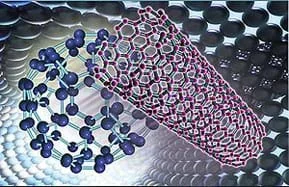 It's a whole new world at the nano scale.Copyright The National Institutes of Environmental Health Sciences, National Institutes of Health; Nanotechnology Consortiums http://www.niehs.nih.gov/research/supported/dert/cospb/programs/nanotech/index.cfm
Through three teacher-led demonstrations, students are shown samplers of real-world nanotechnology applications involving ferrofluids, quantum dots and gold nanoparticles. This nanomaterials engineering lesson introduces practical applications for nanotechnology and some scientific principles related to such applications. It provides students with a first-hand understanding of how nanotechnology and nanomaterials really work. Through the interactive demos, their interest is piqued about the odd and intriguing nano-materials behaviors they witness, which engages them to next conduct the three fun associated nanoscale technologies activities. The demos use materials readily available if supplies are handy for the three associated activities.
Work in the emerging field of nanotechnology depends upon many classical materials engineering principles and fundamentals that stem from chemistry and physics. While engineers have been using ferrofluids for many decades, recent research has enabled new medical applications for them to become reality. Quantum dots are slated to drastically improve cancer cell targeting and other focused medical treatments because of their optical properties. Unique nano materials properties are also being applied to renewable energy solutions. Scientists and engineers have developed very efficient, size-dependent, optical beacons, and are designing biocompatible compounds. Gold nanoparticles are also suitable for numerous biosensing applications. Engineers are challenged to develop inexpensive fabrication processes for creating industrial amounts of such materials efficiently.
After this lesson, students should be able to:
- Explain how nanoscience works as it pertains to real-world applications.
- Describe how ferrofluids work, including a conceptual knowledge of magnetic requirements.
- Describe how quantum dots work, including a conceptual knowledge of optical property effects due to quantum confinement.
- Explain how gold nanoparticles interact with light and the effect of particle clustering on optical properties. Additionally, describe the surface charge and its effect on particle clustering.
- Identify key applications and potential applications for specific nanotechnologies.
- STEL-1Q Conduct research to inform intentional inventions and innovations that address specific needs and wants.
Grades 9-12
Do you agree with this alignment?
- HS-PS2-6 Communicate scientific and technical information about why the molecular-level structure is important in the functioning of designed materials.
Grades 9-12
This resource focuses on the following Three Dimensional Learning aspects of NGSS:
Science & Engineering Practices- Communicate scientific and technical information (e.g. about the process of development and the design and performance of a proposed process or system) in multiple formats (including orally, graphically, textually, and mathematically).Do you agree with this alignment?
Disciplinary Core Ideas- Attraction and repulsion between electric charges at the atomic scale explain the structure, properties, and transformations of matter, as well as the contact forces between material objects.Do you agree with this alignment?
Crosscutting Concepts- Investigating or designing new systems or structures requires a detailed examination of the properties of different materials, the structures of different components, and connections of components to reveal its function and/or solve a problem.Do you agree with this alignment?
Do you agree with this alignment? - Communicate scientific and technical information (e.g. about the process of development and the design and performance of a proposed process or system) in multiple formats (including orally, graphically, textually, and mathematically).
- collect data and make measurements with accuracy and precision;
Grades 10-12
Do you agree with this alignment? - express and manipulate chemical quantities using scientific conventions and mathematical procedures, including dimensional analysis, scientific notation, and significant figures;
Grades 10-12
Do you agree with this alignment? - in all fields of science, analyze, evaluate, and critique scientific explanations by using empirical evidence, logical reasoning, and experimental and observational testing, including examining all sides of scientific evidence of those scientific explanations, so as to encourage critical thinking by the student;
Grades 10-12
Do you agree with this alignment? - communicate and apply scientific information extracted from various sources such as current events, news reports, published journal articles, and marketing materials;
Grades 10-12
Do you agree with this alignment? - draw inferences based on data related to promotional materials for products and services;
Grades 10-12
Do you agree with this alignment? - evaluate the impact of research on scientific thought, society, and the environment;
Grades 10-12
Do you agree with this alignment? - describe the connection between chemistry and future careers; and
Grades 10-12
Do you agree with this alignment? - research and describe the history of chemistry and contributions of scientists.
Grades 10-12
Do you agree with this alignment?
Students must be familiar with nanotechnology and some of its applications. For a good overview, conduct the related lesson, Nanotechnology as a Whole, to impart an introduction to nanotechnology and a conceptual understanding of the nanometer scale. In addition, students must be proficient in algebra. And, having an introduction to physics and chemistry concepts is helpful.
Nanotechnology has existed in our society for centuries, yet only recently have we been able to see, control and produce such small materials for specific consumer, medical and engineering applications. The incredible phenomena unique to the small length scale are being exploited to create technologies that make the engineering and technology of nanoscience so exciting.
The three associated activities enable students to further explore ferrofluids, quantum dots and gold nanoparticles. Embedded within each activity is comprehensive background touching on fundamental topics related to chemistry and physics. Students also practice using scientific method and becoming exceptional observers. The activity questions provided on worksheets are designed to test students' understanding of the topic and critical thinking skills.
Ferrofluids
As a material scientist, the small scale characteristics become important when developing magnetic fluids. The challenge is to make a fluid magnetic without exceeding its Curie point. Scientists have developed paramagnetic salt solutions for magnetic fluids that exhibit less-than-adequate magnetic permeability, which would be expected, considering paramagnetic materials have a magnetic permeability far less than a ferromagnetic material. This is the point at which nanomaterials become increasingly important.
To meet such a challenge, scientists have developed ferromagnetic nanoparticles that are approximately 10 nm in diameter, but small enough to be suspended in various carrier fluids. Such suspension could be considered colloidal. Additionally, the size of each nanoparticle is a few atoms in diameter, which creates a single magnetic domain particle. That means that each nanoparticle is its own permanent magnet suspended in the carrier fluid. With a suitable surfactant to prevent particle agglomeration, the suspension can be manipulated under a controlled moderate magnetic field.
These magnetic fluids have received considerable attention over the last few decades, with applications geared towards rotary shaft sealing and audible speaker cooling systems. However, recent interest is in the application of ferrofluids to cancer treatments and drug delivery systems. Cancer treatment has been proposed through methods utilizing the heating effect of alternating magnetic fields and the energy lost from such cycling. For drug delivery systems, magnetic drugs with a suitable surfactant can be injected into the blood stream and manipulated with external magnetic fields to localize treatment to a particular human system. In the case of medical treatments, these advancements are only limited by the ability to create non-toxic, biologically compatible, magnetic particles.
Quantum Dots
Quantum dots offer a highly efficient process that mimics that of a bulk semiconductor but is quantized because of the length scales involved. "Quantum confinement" allows for quantum dots to be tailored to specific incident energy levels based on particle size. Additionally, nanoparticles offer superior surface area increases that also enhance absorption properties per unit volume and/or conductive properties. Material scientists have found that by varying quantum dot size energy, band gap size may increase or decrease. Larger-size quantum dots create a decrease in energy band gap and emit large wavelength photons (red-shift). Small quantum dot sizes generate an increase in energy band gap and emit short wavelength light (blue shift). This effect is demonstrated by quantum dot solutions of different particle sizes emitting different colors when exposed to UV light sources. Surface area affects enhance the efficiency of energy transfer properties, hence, quantum dots are known to have "high quantum yield." This also pertains to quantum dots emitting light long after exposure to a UV energy source.
Because of the unique quantum confinement effect, quantum dots may be used for a variety of applications, most notably for medical and energy applications. Tumor or cancer detection is a primary application for quantum dots. Scientists attach different antibodies to specific proteins and release them. Once quantum dots have permeated cell walls, they can tag their locations through fluorescence imaging. Additionally, because of the high quantum yield and sustaining light emittance, quantum dots remain fluorescent over time for imaging purposes. Solar energy is another targeted application for use of such dots. Specifically, quantum dots are of interest for their exceptional and tailored light optical properties. Additionally, a robust solar cell may be easily manufactured consisting of optical layers of differing quantum dot sizes to absorb specific incident photons. This allows solar cells to utilize all wavelengths of light provided by the Sun and boost solar cell efficiencies.
Gold Nanoparticles
In ancient times, gold and silver nanoparticles were used for staining glass with intense colors. In fact, it is recorded that ancient Romans used gold colloid for this very purpose. This is one example in which nanoscience and technology have been around hundreds of years, but only recently are we able to see and control this technology at its length scale.
In its bulk form, gold is a very intense yellow appearance. Similarly, silver is a very reflective or white color. A simple explanation is a phenomenon called surface plasmon resonance (SPR). Because metallic bonding does not require the sharing of valence electrons and that sub-shell energy levels be filled, free electrons become present in the atomic structure. These free electrons are present in cloud form and create a barrier to specific electromagnetic radiation (light) energy. Any light that is not absorbed is reflected. Because bulk gold absorbs infrared light, all visible light is reflected and elucidates the shiny-yellow appearance. However, at the nanometer scale, gold interacts differently with light where most visible wavelengths are absorbed while only a narrow portion of the light spectra is reflected. In fact, depending upon the specific size and shape of gold nanoparticles, they can appear red, purple, blue or other colors.
These unique optical characteristics lend gold nanoparticles to a variety of biosensing applications. Most notably are home pregnancy detection devices, DNA testing, and electrolyte detecting (as in this lesson and associated activity). However, these applications require knowledge of SPR, particle size, shape, ionic interactions between particles, and biochemistry.
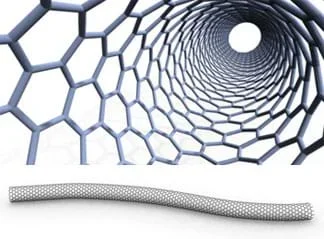 A 3D axial view looking down the center of a carbon nanotube model.Copyright 2010 James Hedberg. Free science images. http://www.jameshedberg.com/scienceGraphics.php?sort=nano
(To engage and motivate students, open with a few short demonstrations that relate to the three associated activities. See the materials lists and instructions for three example demonstrations below; modify them as needed. Allow approximately 15 minutes for the demonstrations.)
Ferrofluids Demonstration Materials List
- ferrofluid (follow instructions in the Procedure section of the Magnetic Fluids activity)
- clear test tube, beaker or flask of suitable size, such as a 250 ml beaker
- rare-earth magnet
- paper or wax paper
- paper towel
Ferrofluids Demo Procedure
- In advance, make the ferrofluid 2. Show students the liquid in the clear container.
- Ask students: "If I pour out this liquid, will it spill?" Wait to hear student responses, and then proceed.
- Place the magnet under a piece of paper or wax paper.
- Pour a small amount of ferrofluid onto the magnet and show the class.
- Ask students: "How is this possible?" Wait to hear student responses, and then continue.
- Move the liquid around while showing it to students.
- Tilt the paper with the magnet and fluid still in contact, remove the magnet and watch the fluid drip into the container.
Ferrofluids Discussion
- How was I able to magnetize the fluid? (Give students the opportunity to consider the fluid constituents.)
- How big are these magnetic nanoparticles? (Give students a chance to participate and suggest how large these particles might be, using what they learned in the related lesson and activity on nano scale.)
- How might I utilize this technology? (Give students the opportunity to contribute their ideas and think outside the box.)
Quantum Dots Demonstration Materials List
- black light and/or room lighting
- quantum dots of various sizes (see the Nanoparticles & Light Energy Experiment: Quantum Dots and Colors activity for source information)
- vial or test tube holder for quantum dots
Quantum Dots Demo Procedure
- Hold up the quantum dots solutions and ask students: "Describe what is special about these solutions." Wait to hear student responses, and then proceed.
- Show students the liquid and have them look for any floating solid particles and remind them that "each vial is essentially a semiconductor with exceptional optical and electrical properties."
- Turn off the classroom lights and ask students: "Is anything different about each solution?"
- Wait to hear student responses, and then continue. NOTE: Depending on the room lighting, you may need to turn on a black light to really illustrate the fluorescence.
- Turn on the classroom light.
Quantum Dots Discussion
- "How did this solution emit different colors?" (Give students the opportunity participate and think about how this seemingly clear liquid was able to give off visible light.)
- Tell students: "This liquid is comprised of many nanoparticle semiconductors and the incoming light interactions with the semiconductors cause the color emission." NOTE: At this point, DO NOT give away the associated activity by discussing size and fluorescence dependence.
Gold Nanoparticles Demonstration Materials List
- 20 ml gold colloid (see the Procedure section of the Thirsty for Gold activity for fabrication instructions) in 1-dram glass vial with top
- disposable plastic pipet filled with pickle juice
- waste container
- vial or test tube holder
Gold Nanoparticles Procedure
- Hold up the gold nanoparticle solution and ask students: "Describe what is special about these solutions?" Wait to hear student responses, and then proceed.
- Tell students: "The solution contains gold nanoparticles." Ask them: "Do you know why my gold is red?" Then ask: "How much do you think my gold solution is worth?" Listen to student responses. Tell the students: "The solution's gold quantity is worth a fraction of a cent." and "The light is interacting differently with gold nanoparticles then it does with bulk gold."
- Add one drop of pickle juice. Ask students "Do you see a color change?"
- Continue to add drops until the solution changes from red to clear-blue.
Gold Nanoparticles Discussion
- "How did this solution change colors?" (Give students the opportunity participate and think about how this seemingly clear liquid was able to change colors as electrolytes were added.)
- Tell students: "The liquid is comprised of many gold nanoparticles (10-15nm diameter in size). Electrons surround each gold nanoparticle, creating a net negative surface charge. Adding electrolytes causes cations to bond to gold nanoparticles causing gold nanoparticle agglomeration. " NOTE: At this point, DO NOT give away the particle size effect on color change!
- band gap
- Energy gap between conductive and valence bands. The size is characteristic of the material. For conductive materials, the band gap is nonexistent and both conductive and valence bands overlap. In semiconductor materials, both valence and conductive bands are separated. The band gap is the energy required to excite and electron into the conductive band.
- colloidal
- A chemical system in which a continuous liquid phase exists with a solid phase suspended in the liquid.
- conductive band
- The semiconductor energy band where electrons are transferred when excited from the valence band.
- curie point
- The temperature at which ferromagnetism is lost due to excessive thermal agitation.
- domain
- A region where unpaired electrons are aligned parallel, creating a magnetic field.
- electromagnetic radiation
- Means of energy travel through a vacuum. Have characteristic wavelengths and frequencies.
- electron cloud
- The region of negative charge surrounding an atomic nucleus that is associated with an atomic orbital.
- ferrofluid
- Ferromagnetic particles suspended in a carrier fluid with the aid of a surfactant.
- ferromagnetic
- Long-range ordering phenomenon at the atomic level that causes unpaired electron spins to line up parallel with each other in a domain.
- fluorescence
- The emission of light by a substance that absorbs light by electromagnetic radiation of a different wavelength.
- holes
- Positive-charged space that is created when an electron is excited and moving. Holes can move free about the crystal. Typically, they are separated and form in p-type semiconductors.
- plasmon
- Oscillations of electron cloud against the fixed positive ions in a metal.
- quantum confinement
- An effect created by decreasing particles to the same magnitude as the particle wave function. Cause for change in electrical and optical properties.
- quantum dots
- Semiconducting nanoparticles that are able to confine electrons in small, discrete spaces.
- quantum yield
- The number of times an event occurs per photon absorbed by the system.
- resonance
- The selective response of an object or system that vibrates in step with an externally applied vibration.
- surface plasmon resonance
- The excitation of surface plasmons by light for planar or nanoparticle surfaces.
- surface tension
- An increased attraction of molecules at the surface of a liquid resulting from forces of attraction on fewer sides of the molecules.
- surfactant
- A chemical that acts as a wetting agent to lower the surface tension of a liquid and improve spreadability.
- valence band
- A semiconductor energy band where holes are transferred when electrons are excited and transferred to the conductive band.
Embedded Lesson Assessment
Demo Discussions: After each demonstration, ask students questions about what they just observed to elicit their understanding and draw out any questions, as described in the Introduction/Motivation section.
Post-Introduction Assessment
Vocabulary Dive: After the lesson, but before conducting the associated three activities, divide the class into teams of two students each. Give each pair one vocabulary word and its definition. Have each team spend 5-10 minutes researching the term on the Internet so they are prepared to share the word and definition with the class, with enough background information to explain it more fully if the definition is not enough for other students to understand. As students share their terms and definitions, make connections among the various vocabulary words.
Lesson Summary Assessment
Team Poster Project: After students have completed the two lessons and four activities of the unit, assign student pairs to each create posters that summarize what was learned during the unit. This summary assessment is fully described in the NanoTech: Insights into a Nano-Sized World unit document, and includes a grading rubric for the teacher.
Benson, Harris. University Physics - Revised Edition. New York, NY: John Wiley & Sons, Inc., 1995, pp. 662-667.
Greenberg, Andrews. Gold Nanoparticles as Sensors for Electrolytes in Sports Drinks. Nanoscale Science and Engineering Center, University of Wisconsin-Madison. NSF Grant No. DMR0425880. Accessed September 27, 2012. http://mrsec.wisc.edu/Edetc/EExpo/sensors/NanogoldSensors_ProgramGuide.pdf
Lindsay, Stuart .M. Introduction to Nanoscience. New York, NY: Oxford University Press, Inc., 2010, pp. 318-335.
Odenbach, Stefan. Ferrofluids: magnetically controllable liquids. Published March 18, 2002. Proceedings in Applied Mathematics and Mechanics. Vol. 1, Issue 1, pp. 28-32. Accessed September 27, 2012. http://onlinelibrary.wiley.com/doi/10.1002/1617-7061(200203)1:1%3C28::AID-PAMM28%3E3.0.CO;2-8/abstract
Ruuge, E.K. and A.N. Rusetski, Magnetic fluids as drug carriers: Targeted transport of drugs by a magnetic field. Published 1993. Journal of Magnetism and Magnetic Materials. Vol. 122, Issue 1-3, pp. 335-339. Accessed September 27, 2012. http://adsabs.harvard.edu/abs/1993JMMM..122..335R
Sanderson, Katharine. "Quantum dots go large: A small industry could be on the verge of a boom," Special Report, Nature. Macmillan Publishers Ltd. Vol. 459, No. 11, pp. 760-761; June 2009. Accessed September 20, 2012. http://unanotech.com/wp-content/uploads/2011/06/Nature_Quantum_dots_go_large.pdf
Williams, Linda and Wade Adams. Nanotechnology Demystified. New York, NY: McGraw-Hill, 2007, pp. 146-149.
Winter, Jessica. Gold Nanoparticle Biosensors. Revision 3 published May 23, 2007. Center for Affordable Nanoengineering of Polymeric Biomedical Devices, The Ohio State University (a National Science Foundation Nanoscale Science and Engineering Center [NSEC]). Accessed September 27, 2012. http://www.nsec.ohio-state.edu/teacher_workshop/Gold_Nanoparticles.pdf
Contributors
Marc Bird; Sarah Castillo
Supporting Program
National Science Foundation GK-12 and Research Experience for Teachers (RET) Programs, University of Houston
Acknowledgements
This curriculum was created by the University of Houston's College of Engineering with the support of National Science Foundation GK-12 grant no. 0840889. However, these contents do not necessarily represent the policies of the National Science Foundation, and you should not assume endorsement by the federal government.
Copyright
2013 by Regents of the University of Colorado; original © 2011 University of Houston