
Natural and Urban "Stormwater" Water Cycle Models
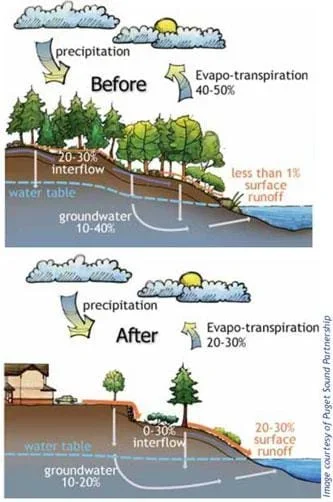 What is the affect that humans and urban development have on the natural water cycle?Copyright Puget Sound Partnership (a Washington state agency) https://fortress.wa.gov/ecy/publications/publications/0710058.pdf
Students apply their understanding of the natural water cycle and the urban "stormwater" water cycle, as well as the processes involved in both cycles to hypothesize how the flow of water is affected by altering precipitation. Student groups consider different precipitation scenarios based on both intensity and duration. Once hypotheses and specific experimental steps are developed, students use both a natural water cycle model and an urban water cycle model to test their hypotheses. To conclude, students explain their results, tapping their knowledge of both cycles and the importance of using models to predict water flow in civil and environmental engineering designs. The natural water cycle model is made in advance by the teacher, using simple supplies; a minor adjustment to the model easily turns it into the urban water cycle model.
Civil and environmental engineers design and construct critical infrastructure for human communities—everything from roads and buildings to sewers and drainage ditches to dams and water and wastewater treatment facilities. Varying rates and occurrences of precipitation events affects both groundwater flow and surface runoff, which in turn, affects the volume of water that these designed infrastructures experience. Modeling the natural and urban "stormwater" water cycles is critical in predicting future surface and groundwater flow rates, as well as surface runoff rates. These predictions enable engineers to design infrastructure to survive and handle anticipated extremes. In this activity, students gain experience in developing and testing hypotheses to acquire a deeper understanding of the relationship between precipitation and resulting groundwater and surface runoff flows.
After this activity, students should be able to:
- Develop hypotheses about how the intensity and duration of precipitation affects the runoff and groundwater flow in the natural water cycle model.
- Develop hypotheses about how the intensity and duration of precipitation affects the runoff and groundwater flow in an urban "stormwater" water cycle and how it compares with the natural water cycle model.
- Explain how humans have affected the natural water cycle and thus created an urban "stormwater" water cycle.
- Test hypothesis using water cycle models and analyze results, using knowledge of the water cycle and its associated processes to explain the results.
- SC.6.E.7.In.b Identify components in the water cycle, including evaporation, condensation, precipitation, ground water, and runoff.
Grade 6
Do you agree with this alignment? - SC.6.E.7.Su.b Recognize parts of the water cycle such as clouds (condensation), rain (precipitation), and evaporation.
Grade 6
Do you agree with this alignment?
- STEL-3G Explain how knowledge gained from other content areas affects the development of technological products and systems.
Grades 6-8
Do you agree with this alignment?
- describe the water cycle, the composition and structure of the atmosphere and the impact of oceans on large-scale weather patterns
Grades 5-8
Do you agree with this alignment?
- MS-ESS2-4 Develop a model to describe the cycling of water through Earth's systems driven by energy from the sun and the force of gravity.
Grades 6-8
This resource focuses on the following Three Dimensional Learning aspects of NGSS:
Science & Engineering Practices- Develop a model to describe unobservable mechanisms.Do you agree with this alignment?
- Conduct an investigation to produce data to serve as the basis for evidence that meet the goals of an investigation.Do you agree with this alignment?
Disciplinary Core Ideas- Water continually cycles among land, ocean, and atmosphere via transpiration, evaporation, condensation and crystallization, and precipitation, as well as downhill flows on land.Do you agree with this alignment?
- Global movements of water and its changes in form are propelled by sunlight and gravity.Do you agree with this alignment?
Crosscutting Concepts- Within a natural or designed system, the transfer of energy drives the motion and/or cycling of matter.Do you agree with this alignment?
Do you agree with this alignment? - Develop a model to describe unobservable mechanisms.
To share with the entire class:
- seven 2-liter plastic bottles; ask students to bring from home or rinse bottles from recycling bins; one bottle must have its screw-on cap; have a few spares in case they are needed for any experiments
- portable drill with 1/16-in and 3/16-in drill bits (preferred), or hammer with nails, to put holes in the bottle cap
- scissors, to cut the plastic bottles
- 1 liter of one type of pervious material, such as tire crumbs, course-grain sand, 3/8-in granite or small pebbles; use what can be recycled or scavenged for free
- impervious surface material, such as a piece of aluminum foil, a foil pan, a plastic lid, a paver stone with a model-size house and car, or a concrete cast you have created; use what can be recycled or scavenged for free
- ¼-in clear acrylic tubing, 3 feet; estimated cost of $10
- construction paper, one sheet per student
- drawing implements, such as pencils, colored pencils or markers
- 2 measuring cups, each able to measure up to 2 liters
- access to water and a sink
Students should have a strong understanding of both the natural water cycle and the urban "stormwater" water cycle from completing the associated lesson prior to beginning this activity.
In our previous lesson, we learned about both the natural water cycle and the urban "stormwater" water cycle. These cycles are important for civil and environment engineers to understand in order to make predictions and design infrastructure, such as roads, sewers, drainage ditches, water and wastewater treatment facilities and much more.
How do engineers gain their understanding of these water cycles? How do they know what to expect if very intense precipitation occurs? Or very little precipitation? Engineers develop models to help them understand the flow of water through these water cycles. Today, we will use models to gain a better understanding of the flow of water through both cycles.
Background
Refer to the associated lesson for an extensive background on both the natural water cycle and the urban "stormwater" water cycle. Conduct this activity just after presenting the lesson to students.
Before the Activity
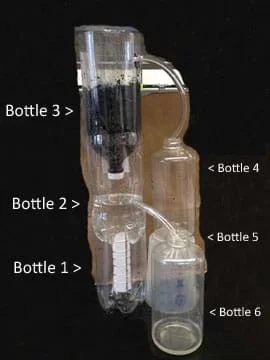 Figure 1. The natural water cycle model. What part of the water cycle do you think the tubes represent?Copyright 2013 WARE raingardens.us (used with permission)
- Gather materials, including asking a few students to bring in empty 2-liter plastic soda bottles.
- Prepare one natural water cycle model for use by the entire class, as shown in Figure 1, following the steps provided below. This model is used to elicit student response, engage student participation, address student misconceptions, and run experimental tests.
- Prepare the urban "stormwater" water cycle model, which is the natural water cycle model with the addition of an impervious surface placed on top of the pervious material in the top bottle. Decide and/or prepare this impervious surface material, perhaps a piece of aluminum foil (see other suggestions in the Materials List) such that it can be easily added and removed.
Before the Activity—Steps for Building the Natural Water Cycle Model
Gather the following materials: seven 2-liter bottles, drill with bits (or hammer and nails), 1 liter of one type of pervious material, 3 feet of clear acrylic tubing, and refer to Figure 1 to assemble the model.
- Remove the labels from all the plastic bottles.
- Cut the length of tubing in half, so you have two pieces.
- Bottle #1: Cut the top off the bottle where the neck begins to reduce in diameter. This bottle is used as a base; set it aside.
- Bottle #2: Cut the top off the bottle where the neck begins to reduce in diameter. Cut a hole in the wall of this bottle about one-third of the way up the bottle from the bottom. Make the hole slightly smaller than the diameter of the tubing so the tubing fits snugly. Insert the tubing. Nest bottle #2 into bottle #1. This bottle serves as the groundwater table.
- Bottle #3 with cap: Remove the cap and drill (or hammer) several holes in it; this creates a way for water to percolate through. Cut the bottom off where the diameter begins to remain constant. Cut a hole in the wall of this bottle about one-third of the way up from the bottom. Make the hole slightly smaller than the tubing diameter. Insert the tubing. Screw on the cap, invert the bottle and insert it into bottle #2. Fill this bottle with your pervious material of choice. This bottle serves as the soil or ground that permits infiltration of water into the deeper groundwater table.
- Bottle #4: Insert the end of the tubing from bottle #3 into its neck. So that it can be seen better, elevate it higher than bottle #6 by using bottle #5. This bottle collects the groundwater flow.
- Bottle #5: Cut and/or invert the bottle, as necessary, to make it work as a stand under bottle #5 to raise it higher so bottle #4 can be seen more easily.
- Bottle #6: Insert the end of the tubing from bottle #2 into its neck. This bottle collects the runoff flow.
- Bottle #7: Not part of the model; use it to pour 2 liters of water at a time into the model during the experimental tests.
With the Students—Natural Water Cycle Model Experimentation
- Elicit: As a class, tell the students: Imagine you are standing in this exact location and you are one of the first humans to ever see this area. Imagine this region before any influences occurred from humans. What do you see? (Expect responses to include any combination of natural elements such as trees, grasses, bushes, plants, animals, river, lake, soil and rocks. Write students' answers on the board under a "What do you see?" heading.)
- Tell students: Now, imagine you are standing in this exact location as one of the first persons to ever see this area and it begins to rain. From where did the rain come? And where will it all go? (Elicit student responses around the terms having to do with the water cycle.)
- As students begin to describe parts of the water cycle, write them on the board in two columns, one for parts of the water cycle that are more associated with the production of rain and the other for parts of the water cycle that have to do with where the rain goes after it hits the ground. Expect student responses to include the following: the rain comes from precipitation, evaporation, transpiration, condensation; the rain goes to infiltration, plant uptake, runoff, lakes, rivers, ocean, estuaries, groundwater, aquifer, and specific examples such as Tampa Bay or Gulf of Mexico.
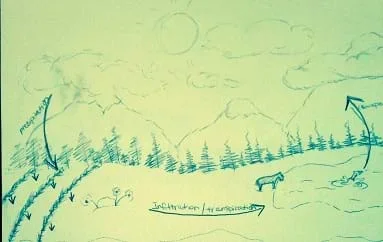 Figure 2. An example student drawing of the natural water cycle to answer the question: What would this region look like if you were the first person to discover it?Copyright 2013 WARE raingardens.us (used with permission)
 - Think-Pair-Share: Hand out to each student a sheet of construction paper and direct students to each sketch a picture of what they think this area may have looked like when the first humans saw it, and label their natural water cycle drawings using the words generated by the class. See an example in Figure 2.
- Divide the class into student pairs. Have students discuss their drawings and the natural water cycle within their groups.
- Go around to each pair and ask: How does the water get from rainfall to the river/lake/groundwater? How does the water get from the river/lake to the atmosphere/clouds? (The intent of the teacher-student interaction is to assess students' existing knowledge and any misconceptions that they may have coming into the activity, and to address any misconceptions at this point so that students attain an accurate understanding of the natural water cycle.)
- Engage: Tell the students: Now, let's use the drawings we just created and our previous knowledge of the water cycle to describe the flow of water within the natural water cycle model.
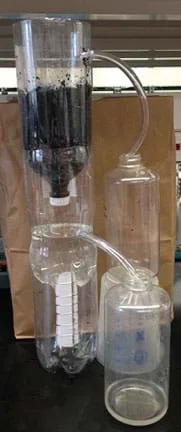 Figure 3. The assembled natural water cycle model ready for experimentation.Copyright 2013 WARE raingardens.us (used with permission)
 - Have the class gather around the fully assembled natural water cycle model (Figure 3) in the center of the classroom. Use the seventh plastic bottle to slowly pour 2 liters of water into the top of the natural water cycle model and ask questions, such as:
- What part of the water cycle does the water I am pouring into the top of the model represent? (Answer: Precipitation)
- What part of the water cycle does the water passing through the soil layer represent? (Answer: Infiltration)
- What part of the water cycle would you use to describe the water that is collecting in the bottom bottle? (Answer: This is the groundwater table or aquifer.)
- The model has two tubes, one near the surface and the other below the soil. What part of the water cycle do you think these tubes represent? (Answer: The top tube represents surface runoff, and the bottom tube represents groundwater flow. Note: Groundwater is a part of the water cycle and was covered in the associated lesson, however it is somewhat of an abstract concept. Use this exploration activity to compare the flow of groundwater to that of streams and rivers happening above ground, and explain infiltration to reinforce the concept of flow through the ground.)
- After emptying out the two collection bottles, and setting up the natural water cycle model for use again, quickly pour 2 liters of water into the top of the model again so that students can see the different interactions. This time, focus students' attention to the amount of water that is leaving each tube (that is, runoff flow and groundwater flow).
- Explore: Tell the class: As you know, it does not rain at the same time every day, it does not rain the same amount every day, it does not rain for the same amount of time every day, and it does not rain every day! Rainfall is variable, and that makes it very hard to predict! However, the impacts of rainfall can be evaluated in order to understand what happens to rain after it falls. Scientists and engineers create models and experiment with them to see what happens under various situations.
- Divide the class into groups of three or four students each. Direct groups to each develop several hypotheses and create a set of steps to test their predictions on where the majority of water goes once it enters the natural water cycle model (that is, runoff or groundwater flow). Instruct students to develop a set of steps to vary the rainfall intensity entering the natural water cycle model and make predictions on whether runoff or groundwater flow will be greater. Do not specify the number of hypotheses or steps required to test their predictions; instead, direct students to come up with as many as they can think of in a five-minute time period (extend the time, based on student interactions).
- Before releasing students into the group work, ask them how they are going to conduct themselves and what is expected from them. Expect students to know how to work in groups and the objective: To develop a set of steps to vary the intensity of rainfall entering into the natural water cycle model and make predictions on where the majority of water goes once it enters the natural water cycle.
- While students work in their groups, visit each to ask questions in support of the development of their hypotheses and the steps they designed to test their predictions. Example questions:
- What do you think will happen to runoff flow if it rains really hard?
- Why do you think the groundwater flow is greater than the runoff flow?
- Then ask groups to rank their hypotheses and share their best ones with the class. As they do this, write each group's hypothesis on the classroom board. Then ask groups to share another hypothesis, skipping to the next one if the same one has already been provided by another group. Have each group also provide the list of steps for testing their hypotheses; write these steps on the board also. As a class, go through each hypothesis and steps to obtain a consensus on the best approach for testing its hypothesis. See below for an example hypothesis and testing steps:
Example hypothesis: Groundwater flow will be greater than runoff for all types of rainfall.
Example steps:
A. Fill the 2-liter bottle with water.
B. Pour water into the natural water cycle model at a 45-degree angle.
C. Record the amount (volume) of runoff and groundwater flow.
D. Cut the top off a 2-liter bottle.
E. Fill the 2-liter bottle with water.
F. Pour water into the natural water cycle model at a 45-degree angle.
G. Record the amount (volume) of runoff and groundwater flow.
H. Compare the volume of water from runoff and groundwater flow for the two rainfall scenarios.
- Next, as a class, test each hypothesis using the natural water cycle model.
- As a class, discuss the results of all the experiments and come to a consensus on a conclusion that can be drawn from the experimental results. Expect the conclusion to be some variation of: The experiment showed that under natural water cycle conditions, a high groundwater flow and no runoff are generated from light-intensity rainfall, and a high groundwater flow and low runoff are generated from high-intensity rainfall.
With the Students—Urban "StormWater" Water Cycle Model Experimentation
- Elicit: Ask students: Now imagine that you are standing in this exact location, except it is in the present time. What do you see? How have humans changed the natural environment? (Write students' answers on the board under a "What do you see?" heading. Expect responses to include any type of urban infrastructure, such as roads, buildings with roofs, cars, parking lots, light poles, steps, school, storm sewer drains, driveways, sidewalks, storm sewer drains, playground, basketball court, soccer field, airplane in the sky, telephone poles, cable boxes, etc. These are all parts of the urban infrastructure.)
- Engage: Ask students: Now what happens to the natural water cycle when humans introduce buildings and roads or any type of surface that water does not go through?" (Place an impervious surface material, such as a piece of aluminum foil, into the top of the fully assembled natural water cycle model to create the urban "stormwater" water cycle model. The foil represents the very common impervious surfaces in the human-built world, such as buildings, roadways and driveways. Make sure the two collection bottles have been emptied and the model is ready for use again.)
- Slowly pour 2 liters of water into the top of the urban "stormwater" water cycle model and ask students some questions, such as:
- What part of the water cycle does the water I am pouring into the top of the model represent? (Answer: Precipitation)
- What part of the water cycle does the water collecting on the surface represent? (Answer: Runoff)
- What part of the water cycle does the water passing through the soil layer represent? (Answer: Infiltration)
- What part of the water cycle would you use to describe the water that is collecting in the bottom bottle? (Answer: This is the groundwater table or aquifer.)
- What part of the water cycle would you use to describe the water that is leaving from the top and bottom tubes? (Answer: The top tube represents runoff and the bottom tube represents groundwater flow.)
- How have people impacted the natural water cycle? (Answer: Humans have created surfaces that water does not go through—impervious surfaces.)
- Empty out the two collection bottles, and set up the model for use again. Remove the foil barrier and quickly pour 2 liters of water into the top of the natural water cycle model again so that students can see the different interactions. Focus their attention on the amount of water that is leaving each tube (that is, runoff and groundwater flow)
- Explore: Tell the students: Similar to our previous experiment, in your groups, predict whether runoff or groundwater flow will be greater for the urban "stormwater" water cycle. Develop several hypotheses and create sets of steps to test your predictions of how the flow of water within the urban "stormwater" water cycle differs from the natural water cycle (that is, runoff and groundwater flow).
- Direct students to build on their previous experience with the natural water cycle model to develop a set of steps to vary the intensity of rainfall entering into the urban "stormwater" water cycle model, and make predictions on how the flow of water will be different between the two models. Do not specify the number of hypotheses or steps required to test their predictions; instead, direct students to come up with as many as they can think of in the next five minutes (extend the time if needed).
- Before releasing students into the group work, ask them how they are going to conduct themselves and what is expected from them. Expect students to know how to work in groups and the objective: To develop a set of steps to vary the intensity of rainfall entering into the urban "stormwater" water cycle model and make predictions on how the flow of water will differ from the natural water cycle model. Make sure they know they only have five minutes to brainstorm their ideas and design their experimental plans.
- While students work in their groups, visit each to ask questions in support of the development of their hypotheses and the steps they designed to test their predictions. Example questions:
- What do you think will happen to runoff flow if it rains really hard? (Expected student responses might include: Even more runoff, more flooding, less infiltration. Follow-up by asking: What are you thinking when you say "even more runoff"? Why do you think there will be less infiltration?)
- Why do you think the runoff flow is greater than groundwater flow?" (Possible answer: Because of the existence of buildings, roads and parking lots.)
- Then ask groups to rank their hypotheses and share their best ones with the class. As they do this, write each group's hypothesis on the classroom board. Then ask groups to share another hypothesis, skipping to the next one if the same one has already been provided by another group. Have each group also provide the list of steps for testing their hypotheses; write these steps on the board also. As a class, go through each hypothesis and its steps to obtain a consensus on the best approach for testing each hypothesis. See below for an example hypothesis and testing steps:
Example hypothesis: Runoff will be greater than groundwater flow for intense rainfall when compared to the natural water cycle.
Example steps:
A. Fill the 2-liter bottle with water.
B. Pour water into urban "stormwater" water cycle model at a 45-degree angle.
C. Record the amount (volume) of runoff and groundwater flow.
D. Cut the top off a 2-liter bottle.
E. Fill the 2-liter bottle with water.
F. Pour water into the urban "stormwater" water cycle model at 45-degree angle.
G. Record the amount (volume) of runoff and groundwater flow.
H. Compare the volume of water from runoff flow and groundwater flow for the two rainfall scenarios.
- Next, as a class, test each hypothesis using the two models. Between tests, empty out the two collection bottles (measuring and recording the volumes), and set up the model for use again.
- As a class, discuss the results of all the experiments and come to a consensus on a conclusion that can be drawn from the experimental results. Expect the conclusion to be some variation of: The experiment showed that the urban "stormwater" water cycle model generated runoff from light-intensity rainfall and an increase in the amount (volume) of runoff under high-intensity rainfall compared with the natural water cycle model.
- Conclude by asking students the summary questions provided in the Assessment section.
- combined sewer
- A series of pipes that collects and transports stormwater and wastewater.
- condensation
- The process in which water vapor changes from a gaseous state (vapor) to the liquid phase.
- directly connected impervious areas
- Impervious surfaces that are connected to each other without any pervious separation. Examples: Driveway to road, gutter to storm sewer. Abbreviated as DCIA.
- evaporation
- The process in which water changes from liquid to a gas or vapor.
- groundwater flow
- A lateral or horizontal flow of water beneath the ground surface.
- impervious surface
- A surface that water can NOT pass through.
- infiltration
- The movement of water into the media layer.
- media layer
- A mix of inorganic and/or organic earth materials, such as sand, soil, mulch, compost, gravel.
- model
- (noun) A representation of something for imitation, comparison or analysis, sometimes on a different scale. (verb) To simulate, make or construct something to help visualize or learn about something else (as a product, process or system) that is difficult to directly observe or experiment upon.
- percolation
- The movement of water within a media layer.
- pervious surface
- A surface that water can pass through.
- plant uptake
- The process of plants absorbing water and nutrients in order to grow.
- precipitation
- Condensed water vapor that falls to Earth as rain, snow or hail.
- reaction rates
- The speed of a reaction; how fast or slow a reaction takes place.
- sanitary sewer
- A series of pipes that collects and transports only wastewater and does not include stormwater.
- stochastic
- Unpredictable nature of storm events; random.
- storm duration
- The length of a storm (in hours).
- storm intensity
- The rate of rainfall (in inches per hour).
- storm sewer
- A series of pipes that collects and transports only stormwater.
- surface water
- Water that is contained by stormwater ponds, rivers, lakes, estuaries, bays, dams, wetlands, oceans or Gulf Coast areas.
- transpiration
- A process by which plants release water into the air.
- urban infrastructure
- A structure or system that supports the urban environment. Examples: Roads, bridges, buildings, water distribution, sanitary and storm sewers, stormwater pond, electricity transmission lines, cable and internet.
- wastewater
- Water that exits your home through a drain.
Pre-Activity Assessment
Lesson Review: Ask students questions to review the natural water cycle and the urban "stormwater" water cycle that were taught in the associated lesson, specifically asking them to explain how the water cycles differ from each other. The review helps students begin thinking about concepts central to this hands-on activity.
Activity Embedded Assessment
Developing and Testing Hypotheses: Have students work in groups and then as a class to develop appropriate hypotheses to test in the two models, as described in the Procedure section. Ask students to explain their experimental test results based on their understanding of the natural water cycle and the urban "stormwater" water cycle and their associated processes. Assess students based on their group participation and the understanding they demonstrate through the development of suitable hypotheses and experimental designs.
Post-Activity Assessment
Summary Questions: Conclude the activity by asking students the following questions:
- Where does stormwater go within the urban environment and how does the urban water cycle differ from the natural water cycle? (Example answer: The urban water cycle contains all of the same phase components of the natural water cycle, such as precipitation, evaporation, condensation etc., in addition to being transported through the human-made urban infrastructure. Within the urban environment, stormwater travels along impervious surfaces into storm sewer systems that discharge into surface water systems. This stormwater makes its way into water treatment facilities that provides drinking water for our homes, schools and communities. The wastewater generated from the use of drinking water is transported through sanitary sewer systems to wastewater treatment facilities where it is cleaned before being discharged back into the surface water system.)
- Why is it important for engineers to understand phase transformation and can we calculate reaction rates within the natural and urban "stormwater" water cycles? (Example answer: By understanding phase transformation, engineers are able to predict, model and design systems based on reaction rates. We can calculate water cycle reaction rates by conducting experiments, observing results and calculating data.)
- Urban Stormwater Management
- Natural and Urban "Stormwater" Water Cycles
- Natural and Urban "Stormwater" Water Cycle Models
- Green Infrastructure and Low-Impact Development Technologies
- Natural and Urban "Stormwater" Water Cycles
Contributors
Ryan Locicero; Maya Trotz; Austin Childress; Andrew O'Brien; Carleigh Samson
Supporting Program
Water Awareness Research and Education (WARE) Research Experience for Teachers (RET), University of South Florida, Tampa
Acknowledgements
This curriculum was developed by Water Awareness Research and Education (WARE) Research Experience for Teachers (RET) at the University of South Florida, funded by National Science Foundation grant number EEC 1200682. However, the contents do not necessarily represent the policies of the NSF, and should not be assumed an endorsement by the federal government.
Copyright
2014 by Regents of the University of Colorado; original © 2013 University of South Florida