
Urban Stormwater Management
 Examples of technologies to manage urban stormwater include this rain garden designed and constructed by students in Florida, and this pervious pavement in South Dakota.Copyright (left) Ryan Locicero, WARE raingardens.us (author); (right) U.S. EPA http://www2.epa.gov/region8/green-infrastructure#4
Students are introduced to the sub-units of the hydrologic cycle and urban stormwater management through two lessons: Natural and Urban "Stormwater" Water Cycles and Green Infrastructure and Low-Impact Development Technologies. The lessons maybe be conducted in any order, however students should complete both lessons' PowerPoint® presentations and associated tasks (handout, design scenario sketching) prior to conducting each lesson's associated activities. One activity directly follows the water cycle lesson and three activities follow the GI/LID technologies lesson. The final rain garden activity builds on all the activities—both concepts and materials—as teams construct personal rain gardens that can be incorporated into school grounds or home yards.
In terms of cost, many materials are introduced and then reused in later activities (both expendable and non-expendable items), with most items being pulled together for the culminating rain garden activity.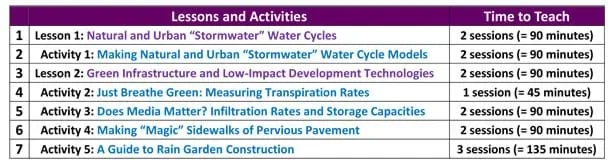 Table 1. The suggested order to conduct the unit's lessons and activities.
Watch a video about the National Science Foundation-sponsored program that generated this unit (7:17 minutes), USF-Green Space Based Learning at https://www.youtube.com/watch?v=8UWeJ8ky43w. Starting at about minute 4, the personal rain garden unit project is discussed, and then images are provided of students involved in the surveying, project management, site assessment, project sizing, excavation, underdrain sample port installation, media layer and planter selection and installation, and final elevation grading to install a bioretention rain garden on a Florida school campus.
Examples of human-made infrastructure that rely on engineers fully understanding the hydrologic cycle include stormwater ponds, earthen dams, levees, treatment facility influent and effluent; sheet, overland and channelized flows; stream flow and base flow. Practical applications of hydrology are found in such tasks as the design and operation of hydraulic structures, drinking water supply, wastewater treatment and disposal, recreational water use, and fish and wildlife protection.
Engineers are involved in analyzing the problems involved in these urban infrastructure tasks and then designing solutions and providing guidance for planning and management of water resources. Civil and geotechnical engineers must have a comprehensive understanding of in situ soil mechanics, groundwater flow and influent runoff in order to properly design systems to manage stormwater. In order to design technologies that address water quality and treatment of stormwater, groundwater and remediation projects, environmental engineers must understand the movement of water as it percolates through different soil layers.
Rain gardens are a promising green infrastructure (as opposed to "gray infrastructure") and low-impact development technology for managing stormwater at its sources using natural means to restore the water quality of developed sites to near pre-development conditions. Rain gardens are typically constructed with high-permeability media, consisting of soil, sand and organic matter, designed to maximize infiltration, improve water quality and promote vegetative growth. (Roy-Poirier, 2010)
Today's engineering graduates and global citizens are charged with the responsibility of creating sustainable solutions to 21st century "grand engineering challenges." (NAE, 2008) From an environmental perspective, rain gardens recharge groundwater, provide natural stormwater management, reduce energy usage, improve water quality, reduce heat-island effects, and increase habitat. Social aspects to consider are the beautification and increase in recreational opportunities, improved health through cleaner air and water, and improved psychological well-being. Economic concerns that are met range from reducing the future costs of stormwater management to increasing property values and tourism.
- CCSS.Math.Content.6.RP.A.1 Understand the concept of a ratio and use ratio language to describe a ratio relationship between two quantities.
Grade 6
Do you agree with this alignment? - CCSS.Math.Content.6.RP.A.3 Use ratio and rate reasoning to solve real-world and mathematical problems, e.g., by reasoning about tables of equivalent ratios, tape diagrams, double number line diagrams, or equations.
Grade 6
Do you agree with this alignment? - CCSS.Math.Content.7.RP.A.2 Recognize and represent proportional relationships between quantities.
Grade 7
Do you agree with this alignment?
- SC.7.E.6.6 Identify the impact that humans have had on Earth, such as deforestation, urbanization, desertification, erosion, air and water quality, changing the flow of water.
Grade 7
Do you agree with this alignment? - SC.7.L.17.3 Describe and investigate various limiting factors in the local ecosystem and their impact on native populations, including food, shelter, water, space, disease, parasitism, predation, and nesting sites.
Grade 7
Do you agree with this alignment? - SC.8.L.18.1 Describe and investigate the process of photosynthesis, such as the roles of light, carbon dioxide, water and chlorophyll; production of food; release of oxygen.
Grade 8
Do you agree with this alignment? - SC.8.P.8.4 Classify and compare substances on the basis of characteristic physical properties that can be demonstrated or measured; for example, density, thermal or electrical conductivity, solubility, magnetic properties, melting and boiling points, and know that these properties are independent of the amount of the sample.
Grade 8
Do you agree with this alignment?
- Knowledge gained from other fields of study has a direct effect on the development of technological products and systems.
Grades 6-8
Do you agree with this alignment? - Systems, which are the building blocks of technology, are embedded within larger technological, social, and environmental systems.
Grades 9-12
Do you agree with this alignment? - Humans devise technologies to reduce the negative consequences of other technologies.
Grades 9-12
Do you agree with this alignment?
- describe the water cycle, the composition and structure of the atmosphere and the impact of oceans on large-scale weather patterns
Grades 5-8
Do you agree with this alignment?
- MS-ESS2-4 Develop a model to describe the cycling of water through Earth's systems driven by energy from the sun and the force of gravity.
Grades 6-8
This resource focuses on the following Three Dimensional Learning aspects of NGSS:
Science & Engineering Practices- Develop a model to describe unobservable mechanisms.Do you agree with this alignment?
Disciplinary Core Ideas- Water continually cycles among land, ocean, and atmosphere via transpiration, evaporation, condensation and crystallization, and precipitation, as well as downhill flows on land.Do you agree with this alignment?
- Global movements of water and its changes in form are propelled by sunlight and gravity.Do you agree with this alignment?
Crosscutting Concepts- Within a natural or designed system, the transfer of energy drives the motion and/or cycling of matter.Do you agree with this alignment?
Do you agree with this alignment? - Develop a model to describe unobservable mechanisms.
- MS-ESS3-3 Apply scientific principles to design a method for monitoring and minimizing a human impact on the environment.
Grades 6-8
This resource focuses on the following Three Dimensional Learning aspects of NGSS:
Science & Engineering Practices- Apply scientific principles to design an object, tool, process or system.Do you agree with this alignment?
Disciplinary Core Ideas- Human activities have significantly altered the biosphere, sometimes damaging or destroying natural habitats and causing the extinction of other species. But changes to Earth's environments can have different impacts (negative and positive) for different living things.Do you agree with this alignment?
Crosscutting Concepts- The uses of technologies and any limitations on their use are driven by individual or societal needs, desires, and values; by the findings of scientific research; and by differences in such factors as climate, natural resources, and economic conditions. Thus technology use varies from region to region and over time.Do you agree with this alignment?
- Relationships can be classified as causal or correlational, and correlation does not necessarily imply causation.Do you agree with this alignment?
Do you agree with this alignment? - Apply scientific principles to design an object, tool, process or system.
- MS-ETS1-1 Define the criteria and constraints of a design problem with sufficient precision to ensure a successful solution, taking into account relevant scientific principles and potential impacts on people and the natural environment that may limit possible solutions.
Grades 6-8
This resource focuses on the following Three Dimensional Learning aspects of NGSS:
Science & Engineering Practices- Define a design problem that can be solved through the development of an object, tool, process or system and includes multiple criteria and constraints, including scientific knowledge that may limit possible solutions.Do you agree with this alignment?
Disciplinary Core Ideas- The more precisely a design task's criteria and constraints can be defined, the more likely it is that the designed solution will be successful. Specification of constraints includes consideration of scientific principles and other relevant knowledge that is likely to limit possible solutions.Do you agree with this alignment?
Crosscutting Concepts- The uses of technologies and any limitations on their use are driven by individual or societal needs, desires, and values; by the findings of scientific research; and by differences in such factors as climate, natural resources, and economic conditions.Do you agree with this alignment?
- All human activity draws on natural resources and has both short and long-term consequences, positive as well as negative, for the health of people and the natural environment.Do you agree with this alignment?
Do you agree with this alignment? - Define a design problem that can be solved through the development of an object, tool, process or system and includes multiple criteria and constraints, including scientific knowledge that may limit possible solutions.
- MS-ETS1-3 Analyze data from tests to determine similarities and differences among several design solutions to identify the best characteristics of each that can be combined into a new solution to better meet the criteria for success.
Grades 6-8
This resource focuses on the following Three Dimensional Learning aspects of NGSS:
Science & Engineering Practices- Analyze and interpret data to determine similarities and differences in findings.Do you agree with this alignment?
Disciplinary Core Ideas- There are systematic processes for evaluating solutions with respect to how well they meet the criteria and constraints of a problem.Do you agree with this alignment?
- Sometimes parts of different solutions can be combined to create a solution that is better than any of its predecessors.Do you agree with this alignment?
- Although one design may not perform the best across all tests, identifying the characteristics of the design that performed the best in each test can provide useful information for the redesign process—that is, some of the characteristics may be incorporated into the new design.Do you agree with this alignment?
Do you agree with this alignment? - Analyze and interpret data to determine similarities and differences in findings.
- Urban Stormwater Management
References
Davis, A. P., Shokouhian, M., Sharma, H., and Minami, C. (2006). Water quality improvement through bioretention media: Nitrogen and phosphorus removal. Water Environment Research , 78(3), 284-293. doi: 10.2175/106143005x94376
Kadlec, R. H., and Wallace, S. D. Treatment Wetlands. Boca Raton, FL: CRC Press, 2009.
NAE. (2008). National Academy of Engineering Summit Series – Face the Challenge http://www.grandchallengesummitorg. Retrieved November 2010.
Roy-Poirier, A., Champagne, P., and Filion, Y. (2010). Review of Bioretention System Research and Design: Past, Present, and Future. Journal of Environmental Engineering-Asce , 136(9), 878-889. doi: 10.1061/(asce)ee.1943-7870.0000227
Contributors
Ryan Locicero; Maya Trotz; Krysta Porteus; Jennifer Butler; William Zeman; Brigith Soto
Supporting Program
Water Awareness Research and Education (WARE) Research Experience for Teachers (RET), University of South Florida, Tampa
Acknowledgements
This curriculum was developed by Water Awareness Research and Education (WARE) Research Experience for Teachers (RET) at the University of South Florida, funded by National Science Foundation grant no. EEC 1200682. However, the contents do not necessarily represent the policies of the NSF, and should not be assumed an endorsement by the federal government.
Copyright
2014 by Regents of the University of Colorado; original © 2013 University of South Florida